

Protecting your parent's legacy in North Carolina begins not with a court filing, but with a deep breath and a clear understanding of your legal responsibilities. Losing a loved one is an emotional weight that few are prepared to carry, yet the state requires you to act quickly to secure their estate. Knowing exactly what to do when a parent dies in north carolina is the difference between a smooth transition and a year of legal frustration.
It's natural to feel overwhelmed by the pressure to manage financial accounts and real estate while still processing your grief. You might worry that Medicaid recovery could claim the family home or that a technical error could leave you personally liable for estate debts. This guide provides a clear, compassionate roadmap to help you navigate North Carolina's specific probate requirements with confidence. We'll walk through the 2026 filing deadlines, asset protection strategies, and the exact steps needed to safeguard your family's future and honor your parent's final wishes.
Key Takeaways
- Identify the essential logistical steps required within the first 48 hours, from obtaining a legal pronouncement of death to coordinating with a funeral home.
- Learn exactly what to do when a parent dies in north carolina to locate original legal documents and order the correct number of certified death certificates.
- Understand the unique role of the North Carolina Clerk of Superior Court in supervising the probate process and settling your parent's affairs.
- Discover how to manage critical deadlines and creditor notices to protect the estate's assets from personal liability and Medicaid recovery claims.
- Recognize the specific scenarios, such as out-of-state real estate or family conflict, where professional probate administration services become a vital safeguard for your legacy.
Immediate Actions: The First 48 Hours After a Parent Passes in North Carolina
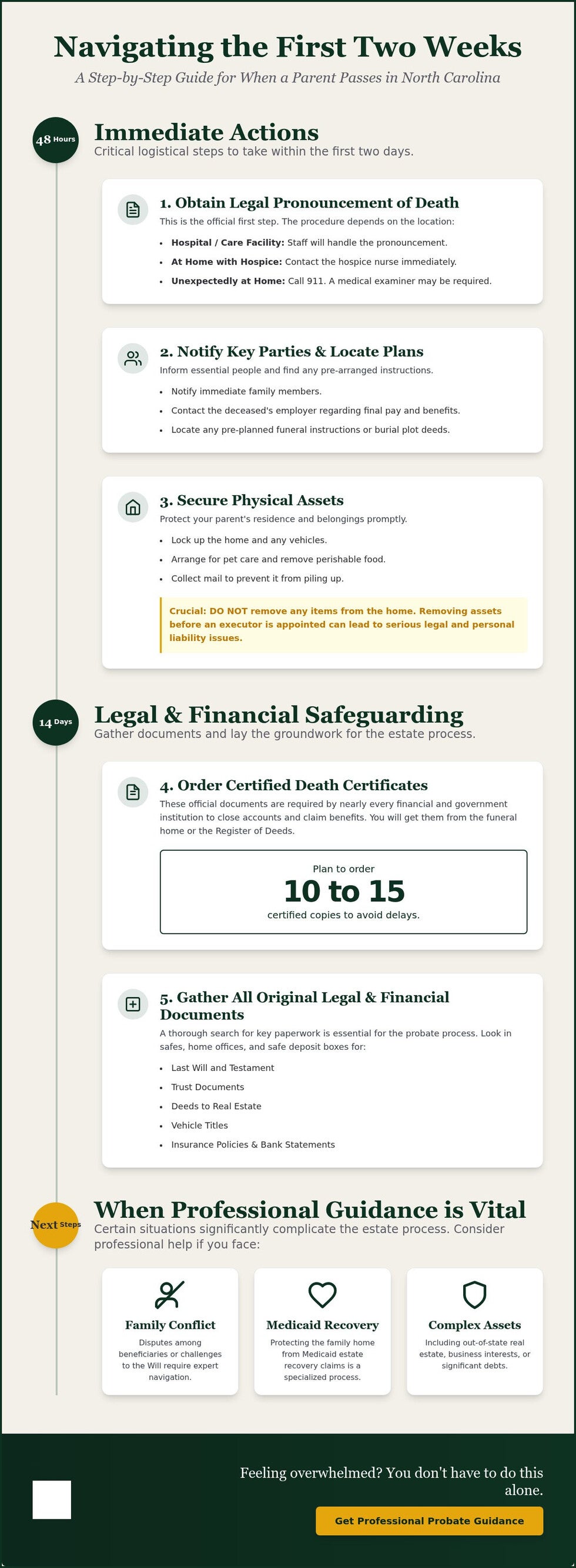
The first two days after a loss are often a blur of phone calls and heavy decisions. While your heart needs space to grieve, the state of North Carolina requires specific logistical steps to begin the legal transition of your parent's estate. Taking these actions promptly ensures that your parent's dignity is preserved and that the upcoming administrative process remains manageable. It's a difficult time, but following a structured path can provide a sense of order amid the emotional weight.
Understanding what to do when a parent dies in north carolina begins with the official declaration of death. This is a foundational step because no other legal or financial arrangements can proceed without a formal pronouncement. This document serves as the key that unlocks the next stages of the probate process.
To better understand the immediate steps involved, watch this helpful video:
Legal Pronouncement and Authorities
The setting of your parent's passing determines your first call. If they were in a hospital or a licensed care facility, the staff will handle the legal pronouncement. However, if your parent passed away at home while under hospice care, you should contact the hospice nurse immediately. They are authorized to make the pronouncement and will help coordinate with the funeral home you've chosen. This helps avoid unnecessary involvement from emergency services during a sensitive time.
If the death was sudden or occurred at home without hospice involvement, you must call 911. In many North Carolina counties, a medical examiner may need to investigate unattended deaths to determine the cause before the body can be moved. This usually happens within a 24 to 48 hour window. Once the authorities provide clearance, you can arrange for a funeral home to transport your parent. During this time, notify immediate family members and your parent's employer to discuss any immediate benefits or final paycheck procedures. Locating pre-planned funeral instructions or burial plot deeds early can also save your family from making difficult, high-cost decisions while in the depths of acute grief.
Immediate Property Safeguarding
While it may feel premature, protecting your parent's physical legacy is a critical part of Navigating the North Carolina Probate Process. You should secure their residence and vehicles as soon as possible. This isn't about distrust; it's about fulfilling your potential role as a protector of the estate. Ensuring the home is locked and the mail is collected prevents external risks and keeps the property's value intact for the beneficiaries.
Start by arranging care for pets and removing perishable food from the home. It's vital that you don't remove any jewelry, furniture, or high-value items from the home yet. Removing property before the court formally appoints an executor can create significant legal complications and personal liability. By keeping the estate's assets exactly where they are, you demonstrate a commitment to a fair and legal transition. This simple act of restraint protects you from future claims by creditors or other family members, ensuring that what to do when a parent dies in north carolina remains a process of honor rather than conflict.
Legal and Financial Safeguarding: Tasks for the First 14 Days
Once the initial shock begins to settle and the funeral arrangements are in motion, your focus must shift toward the administrative framework of your parent's estate. The first two weeks represent a critical window for gathering documentation and preventing financial leakage. During this time, you transition from an immediate responder to a guardian of their legacy. This period requires a methodical approach to ensure that no assets are lost and no legal requirements are overlooked.
One of your first practical tasks is ordering certified copies of the death certificate. Most families find they need between 10 and 15 copies. While this might seem excessive, nearly every institution requires an original for their permanent records. You'll need these for life insurance claims, real estate transfers, and closing financial accounts. Having these on hand early prevents administrative delays that can stretch into months. You should also notify the Social Security Administration and stop any recurring digital payments or subscriptions to preserve the estate's cash flow.
Finding and Validating the Will
Searching for the original Last Will and Testament is often the most stressful aspect of what to do when a parent dies in north carolina. You should look in safe deposit boxes, home filing cabinets, or contact the attorney who drafted the document. If you cannot find a Will, check with the local courthouse, as some individuals file their Wills for safekeeping during their lifetime.
A "self-proving" Will, which includes a notarized affidavit from the witnesses, is the ideal scenario because it allows the Clerk of Court to validate the document without tracking down the original witnesses. If your parent died intestate, or without a Will, North Carolina's intestacy laws will dictate how the property is divided. This legal default often differs from what the family expects, which makes locating any existing estate planning documents your top priority.
Initial Financial Triage
Protecting the estate's liquidity is your next priority. You must notify banks to freeze individual accounts, which prevents unauthorized access and protects the funds for future distribution. During this process, you may discover non-probate assets. These are accounts with "Payable on Death" (POD) or "Transfer on Death" (TOD) designations that bypass the court process entirely.
Identifying these assets early provides your family with much-needed peace of mind, as these funds are typically available to beneficiaries much faster than probate assets. Compiling a preliminary list of all real estate holdings and bank balances will give you a clear picture of the estate's total value. If you find the sheer volume of financial records and legal requirements overwhelming, professional probate administration services can provide the structured guidance needed to manage these tasks without personal liability.
Navigating the North Carolina Probate Process and the Clerk of Court
After you have secured the immediate physical and financial records, the transition into the formal legal arena begins. Understanding what to do when a parent dies in north carolinainvolves recognizing that probate is not just a series of forms, but a court-supervised protective measure. This process ensures that your parent's debts are satisfied and their remaining assets are distributed according to their exact wishes or state law. While the word "probate" often carries a reputation for being slow or difficult, it provides a structured environment that shields you from many potential disputes.
The first formal step is filing the original Will with the Clerk of Superior Court in the county where your parent resided. This filing officially opens the estate and begins the public record of the transition. While a North Carolina Probate Administration Attorney can provide specific guidance on the nuances of these filings, the process generally moves from validation to the formal appointment of a representative. You will apply for "Letters Testamentary" if there is a Will, or "Letters of Administration" if there is not. These documents are the legal keys that allow you to act on behalf of the estate.
The Role of the Clerk of Superior Court
In North Carolina, the Clerk of Superior Court holds a unique position known as the "Judge of Probate." Unlike many other states where a traditional judge handles these matters, the Clerk has the authority to oversee the entire administration process. You should prepare for your first appointment at the county courthouse by bringing the original Will, a certified death certificate, and a preliminary list of assets. During this meeting, the Clerk will assess the value of the estate's personal property. North Carolina charges a probate fee of 0.4% of the estate's personal property value, which is capped at a maximum of $6,000. This fee is essential for maintaining the court's supervision and ensuring the estate is handled with total transparency.
Empowering the Personal Representative
Once you receive your Letters Testamentary, you possess the legal authority to manage bank accounts, sell real estate, and negotiate with creditors. However, this power comes with a significant weight of responsibility. The fiduciary duty of a North Carolina executor represents the highest legal standard of care, requiring the representative to manage estate assets with undivided loyalty and scrupulous honesty. You are legally responsible for every penny that enters or leaves the estate accounts.
A common pitfall for many executors is the urge to distribute funds or property to family members too quickly. If you distribute assets to heirs before all creditors and taxes are paid, you may be held personally liable for those debts. To prevent this, you must file a mandatory 90-day inventory with the court. This document provides a detailed snapshot of the estate's value at the time of death, serving as the baseline for all future accounting. By adhering to these strict court deadlines, you protect yourself from liability and ensure your parent's legacy is settled with the integrity it deserves.
Critical Deadlines and Preventing Medicaid Estate Recovery in NC
Managing an estate involves more than just distributing heirlooms. It requires satisfying the state's rigid timeline for debts and taxes. Understanding what to do when a parent dies in north carolina includes mastering the process of creditor notification. Within a few weeks of being appointed, you must publish a "Notice to Creditors" in a local newspaper once a week for four consecutive weeks. This legal notice starts a clock. Creditors generally have 90 days from the first publication to present their claims. If you fail to follow this procedure, you might remain personally liable for the estate's debts long after the assets are gone.
Handling the financial finish line also means addressing taxes for the 2026 calendar year. You are responsible for filing your parent's final state and federal income tax returns. While North Carolina does not impose a state-level inheritance or estate tax, the federal landscape in 2026 features a $15 million estate tax exemption. Most families won't owe federal estate tax, but the administrative filing remains a necessary step to close the estate officially and protect the executor from future IRS inquiries.
Managing Debts and Creditors
North Carolina law establishes a strict priority for who gets paid first. Funeral expenses and the "Year's Allowance" take precedence over almost everything else. In 2026, a surviving spouse is entitled to an allowance of up to $60,000 from the decedent's personal property. This allowance stays protected from most creditors. You should never use your personal bank account to pay estate debts. If the estate is insolvent, meaning the debts exceed the total assets, the law dictates a specific order of payment. If you pay a low-priority credit card bill before a high-priority medical bill, the court could hold you legally responsible for the error.
Protecting the Family Home from Medicaid
One of the most significant risks to a family's legacy is the Medicaid Estate Recovery program. If your parent received Medicaid benefits for nursing home care or home health services, the state of North Carolina may seek to recover those costs from the estate. However, the state won't pursue recovery if the total benefits paid were less than $10,000. There are also critical exemptions that provide peace of mind. Recovery is prohibited if your parent is survived by a spouse, a child under 21, or a child of any age who is blind or disabled.
If these exemptions don't apply, the family home could be at risk of being sold to reimburse the state. You may be able to apply for a hardship waiver if the property is the sole income-producing asset for surviving heirs. Because these rules are complex and the stakes involve the family home, engaging in Medicaid crisis planning is often the most effective way to protect the property during the probate process. Acting quickly can prevent the state from becoming the primary beneficiary of your parent's hard-earned assets.
When to Engage a North Carolina Probate Administration Attorney
Determining exactly what to do when a parent dies in north carolina often involves an honest assessment of the estate's complexity and your own comfort with legal liability. While some small estates can be settled through a simple affidavit, most standard administrations benefit from professional oversight. If your parent owned real estate in multiple states, held interests in a closely held business, or left behind a significant amount of medical debt, the procedural requirements multiply quickly. These scenarios create a higher risk for technical errors that can stall the process for years.
You should prioritize professional help if you suspect family members might contest the Will. Conflict among heirs is not just emotionally draining; it creates a legal minefield that can lead to expensive litigation. Similarly, if your parent was receiving Medicaid benefits, the recovery process described in previous sections requires precise communication with the state. An attorney ensures that you meet every court deadline and fulfill your fiduciary duties without exposing yourself to personal financial risk. If you distribute assets to heirs before the 2026 tax obligations or creditor claims are fully satisfied, you may be held personally responsible for those shortfalls.
The Mentorship of Legal Counsel
A probate lawyer acts as a steady guide through a landscape that often feels overwhelming during a time of loss. Rather than viewing legal fees as an added expense, many executors see them as a protective investment that prevents court-ordered penalties and costly administrative mistakes. Our Probate Administration Services provide the structural support you need to manage the estate with total transparency. We help you balance the emotional weight of your parent's passing with the serious responsibility of preserving their hard-earned legacy for the next generation.
Getting Started with Your Consultation
Preparing for your first meeting with a North Carolina probate attorney doesn't have to be a source of anxiety. To make the most of your time, you should bring the original Last Will and Testament, a certified copy of the death certificate, and a preliminary list of known assets and debts. If you have received any letters from creditors or the North Carolina Department of Health and Human Services regarding Medicaid, include those as well. We help you navigate the NC Clerk of Court requirements with confidence, ensuring that every filing is accurate and every asset is protected. Schedule a consultation with our experienced North Carolina probate team today to secure the partnership you need for this transition.
Securing Your Family's Future with Confidence
Taking the first steps after a loss is never easy, but you've now established a foundation for managing your parent's estate with integrity. By securing the property early, respecting the Clerk of Court's strict filing deadlines, and identifying potential Medicaid recovery risks, you're fulfilling a vital role as the guardian of their legacy. Understanding exactly what to do when a parent dies in north carolina allows you to replace administrative anxiety with a methodical, protective roadmap.
Our practice serves as a steady guide for families across North Carolina, South Carolina, Maryland, and Tennessee. We specialize in Medicaid crisis planning and asset protection, offering the professional authority needed to navigate complex probate laws while prioritizing your emotional well-being. You don't have to face these legal transitions alone. Whether you're dealing with medical debt or complex multi-state assets, our mentor-led approach provides the peace of mind you deserve.
Protect your family legacy. Contact our North Carolina probate attorneys today.
You have the strength to navigate this process. With the right partnership, you can ensure your parent's final wishes are honored with the scrupulous care they deserve.
Frequently Asked Questions
How long do I have to file for probate after a parent dies in North Carolina?
North Carolina law doesn't set a rigid deadline to open an estate, but you should aim to file the Will with the Clerk of Court within 30 days of the passing. Once you are formally appointed as the executor, specific clocks begin to tick, such as the mandatory 90 day window for filing the estate inventory. Delaying the process can lead to complications with property insurance, taxes, and potential claims from creditors.
Can I sell my parent's house before probate is finished in NC?
You generally cannot sell the residence until you receive Letters Testamentary, which grant you the legal authority to act on behalf of the estate. While real estate in North Carolina technically "vests" in the heirs at the moment of death, the property remains subject to the estate's debts. If the estate needs cash to pay creditors, the executor may need to pull the property back into the estate to sell it under court supervision.
What happens if my parent died in North Carolina but lived in another state?
The primary probate process must occur in the state where your parent was a legal resident at the time of their death. If they owned real estate in North Carolina but lived elsewhere, you will likely need to open a secondary process known as "ancillary probate" in the North Carolina county where the property is located. This ensures the land is transferred according to local statutes while the rest of the assets are handled in the home state.
Do I have to pay my parent's debts out of my own pocket?
You are not personally liable for your parent's debts unless you co-signed a specific loan or credit agreement. The estate's assets are used to satisfy creditors in a strict order of priority established by state law. If the estate is insolvent, meaning the debts are greater than the assets, the remaining creditors typically lose their right to collect once the estate's funds are exhausted.
How much does a probate lawyer cost in North Carolina?
The cost of legal representation depends on the complexity of the assets and the level of support you need to navigate the court's requirements. Some attorneys charge a flat fee for specific filings, while others work on an hourly basis. North Carolina law limits the combined commission for executors and attorneys to 5% of the estate's value, ensuring that the costs remain reasonable and proportional to the work performed.
Is probate required if my parent had a Revocable Living Trust?
Assets properly titled in a Revocable Living Trust usually bypass the probate process and pass directly to beneficiaries. However, probate is often still necessary if your parent owned assets in their individual name that were never transferred into the trust. In these cases, a "pour-over" Will acts as a safety net to move those remaining items into the trust through the court system.
What is a "Small Estate" in North Carolina and can I use a simplified process?
A small estate is defined as one where the decedent's personal property is valued at $20,000 or less, excluding real estate. This threshold increases to $30,000 if the surviving spouse is the only heir. If the estate qualifies, you can use a simplified process called "collection by affidavit," which allows you to settle affairs without the length and expense of a full probate administration.
How do I get a copy of my parent's Will if I cannot find the original?
The Clerk of Superior Court rarely accepts copies, so finding the original document is a priority. If it isn't in a safe deposit box or home file, contact the attorney who drafted the document or check with the Clerk's office in the county of residence. Many individuals file their original Wills for safekeeping with the court. Knowing what to do when a parent dies in north carolinaincludes these early searches to ensure the most recent legal instructions are followed.
Comments
There are no comments for this post. Be the first and Add your Comment below.
Leave a Comment