

If you haven't written a will, the state of North Carolina has already written one for you. Most people assume their spouse automatically inherits everything; however, the reality of what happens if you die without a will in nc is far more complex and often creates unintended financial burdens for those you love most. Under the North Carolina Intestate Succession Act, your assets are divided based on rigid legal formulas that don't account for your personal wishes or unique family dynamics.
It is natural to feel overwhelmed by the thought of probate court; in 2024 alone, 86,390 estate cases were filed in North Carolina superior courts. You want to ensure your partner is protected and your children are provided for without the state interfering. This guide explains how current 2026 laws distribute your property, from the $60,000 spousal year's allowance to the 0.4% gross estate fee that can drain your family's inheritance. You'll discover which assets bypass probate entirely and how to secure a plan that works when it matters most, moving your family from uncertainty toward lasting peace of mind.
Key Takeaways
- Understand how North Carolina General Statute Chapter 29 acts as your "default will" and why these rigid laws rarely align with a modern family's actual needs.
- Learn exactly what happens if you die without a will in nc, including the surprising reality that your spouse may be legally forced to share assets with your parents or children.
- Discover the court's "Priority of Appointment" process and how it determines who will be authorized to lead your estate when no executor is named.
- Identify the hidden financial risks of "Heirs' Property" and how a lack of planning can make it difficult or impossible for your family to sell the family home.
- Explore how tools like a Revocable Living Trust can help your loved ones bypass the probate court entirely, preserving both your legacy and family harmony.
Understanding Intestacy: North Carolina's "Default Plan" for Your Estate
Many people feel a sense of dread when considering what happens if you die without a will in nc. There is a persistent myth that the state of North Carolina simply seizes your bank accounts and property if you haven't signed a legal document. This is not true. Instead, the state applies a rigid, impersonal set of rules called "intestate succession." Think of this as the government's "default plan" for your life's work. It doesn't care about your specific family dynamics, your verbal promises, or who "deserves" what; it simply follows a mathematical formula designed for the "average" citizen.
The Clerk of Superior Court in your county oversees this process. Their role is to ensure that your debts are paid and that whatever remains is distributed according to the letter of the law. While this provides a structured path, it lacks the empathy and nuance your family deserves during a time of grief. Without a plan of your own, you're leaving your loved ones to manage a process that prioritizes legal checklists over personal relationships.
The Legal Framework: NC General Statutes Chapter 29
The Intestate Succession Act, found in Chapter 29 of the North Carolina General Statutes, serves as the final authority for estates without a valid will. Understanding Intestacy is the first step in realizing that without your own instructions, the law creates a hierarchy for your assets. Intestate succession is the legal hierarchy for asset distribution when no will exists. These laws apply regardless of your intentions or the needs of your heirs. Even if you told your children for decades that one would receive the house and the other the savings, those words carry no weight in probate court. The court only recognizes what is written in a valid Last Will and Testament or established through specific account titling.
Probate vs. Non-Probate Assets in NC
When analyzing what happens if you die without a will in nc, it's vital to distinguish between probate and non-probate assets. Probate assets are items owned solely in your name, such as an individual bank account, a vehicle, or personal belongings. These are the assets trapped by the state's default plan. However, several types of property bypass the probate process entirely:
- Joint Tenancy with Rights of Survivorship: Assets owned with another person that automatically transfer to the survivor.
- Tenancy by the Entirety: A critical exception for married couples in North Carolina where real estate automatically passes to the surviving spouse.
- Beneficiary Designations: Life insurance policies, IRAs, and 401ks that name a specific person to receive the funds.
- Payable on Death (POD) Accounts: Bank accounts that transfer directly to a named individual upon your passing.
If your assets don't fall into these categories, they must go through the formal probate process. This involves paying the $120 initial filing fee and the 0.4% gross estate fee. By identifying which of your assets are currently "probate-bound," you can take steps to simplify the process for your heirs through proper estate planning.
Who Inherits? The Surprising Reality of NC Intestate Succession Rules
The most common assumption people make is that a surviving spouse inherits everything by default. Unfortunately, this misunderstanding often leads to significant financial distress. In reality, what happens if you die without a will in nc depends on a specific hierarchy that may force your spouse to share assets with your parents or your children. This rigid structure even applies to wrongful death proceeds from personal injury legal representation claims; if a family member passes due to negligence, any settlement reached must be distributed according to these same NC Intestate Succession Rules, rather than where the need is greatest.
North Carolina also uses the concept of "per stirpes" to manage distributions. This means if one of your children passes away before you, their share of your estate flows directly down to their own children. While this ensures a legacy remains within a specific branch of the family, it can create logistical hurdles if those grandchildren are still minors. Without a will to name a trustee, the court must step in to manage these funds, often at a high cost to the estate's total value.
Scenario 1: Surviving Spouse and Children
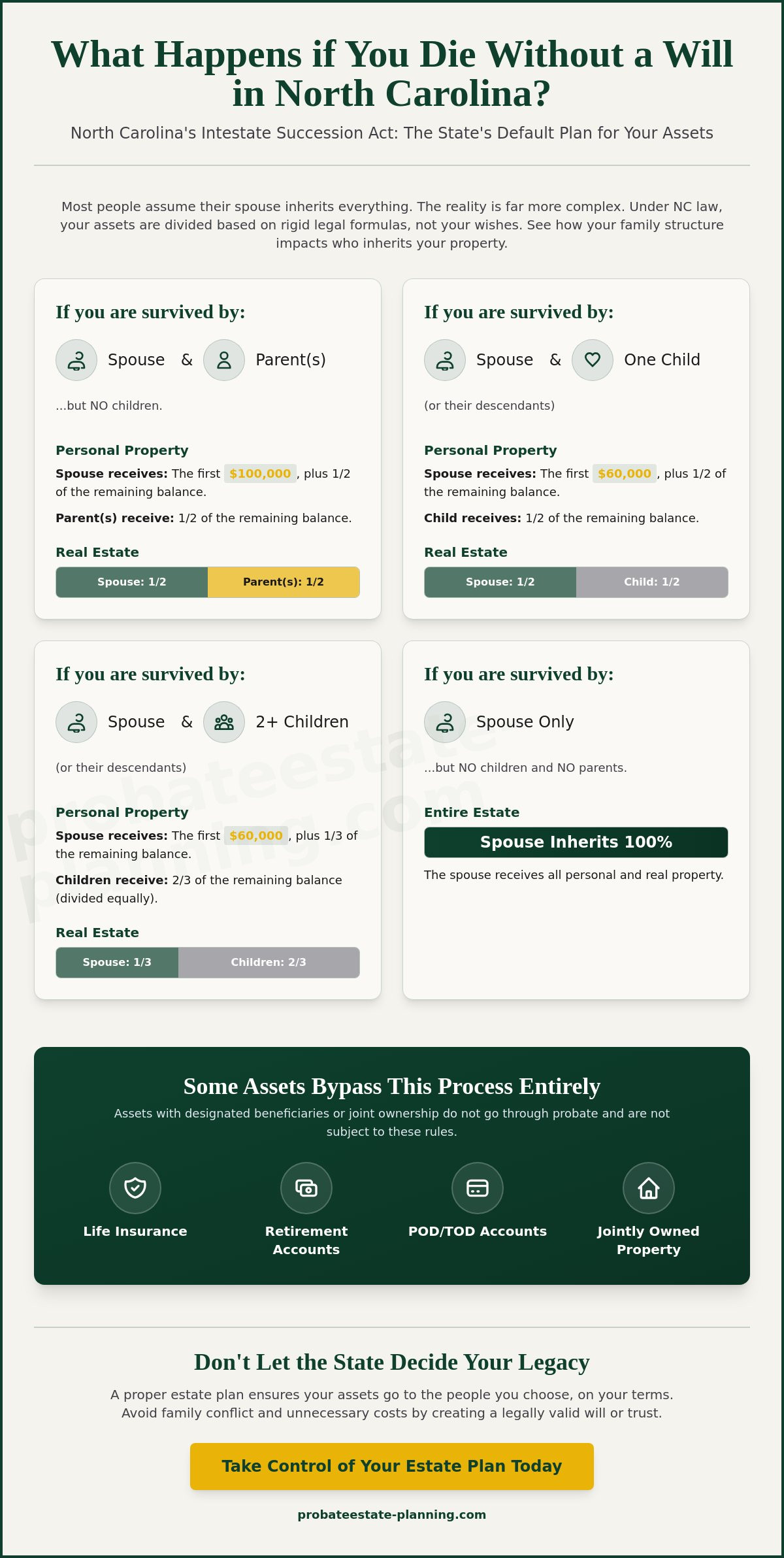
When you pass away leaving both a spouse and children, the distribution becomes a multi-step calculation. Your spouse is entitled to a $60,000 year's allowance from your personal property. For deaths occurring on or after March 1, 2024, each eligible child is also entitled to a $10,000 allowance. Beyond these allowances, the remaining assets are split. If you have one child, the spouse and child usually share the personal property and real estate interests 50/50. If you have two or more children, the spouse's share of personal property typically drops to one-third. Because minor children cannot legally own property, the court must appoint a guardian to manage their inheritance, which adds layers of oversight and expense.
Scenario 2: Surviving Spouse and Parents (No Children)
This is perhaps the most startling scenario for many couples. If you die without children but your parents are still living, your spouse does not receive the entire estate. Instead, after a $100,000 allowance and a portion of the personal property, your spouse must split the remaining assets 50/50 with your parents. This often creates an unexpected financial strain, especially if the surviving spouse relied on those assets for daily living expenses. It's a situation that can lead to unintended tension between a grieving spouse and their in-laws during an already difficult time.
Scenario 3: No Spouse, No Children
If you leave no spouse or descendants, the law looks to your parents first. If they're no longer living, your siblings are next in line. This continues until the court finds "laughing heirs," which are distant relatives who may not have known you at all. It's also vital to remember that step-children have no legal right to inherit under these rules unless you've legally adopted them. To ensure your family remains in harmony, you might consider starting your estate planning journey now to override these default state formulas.
The Probate Process Without a Will: Costs, Delays, and Legal Hurdles
When you die with a valid will, you've already chosen a trusted individual to handle your affairs. However, what happens if you die without a will in nc is that the court must step in to appoint an "Administrator" instead of an Executor. This person is tasked with the heavy burden of settling your debts and distributing your property according to the North Carolina Intestate Succession Act. Because the court doesn't know your family dynamics, it follows a strict "Priority of Appointment" to decide who leads the estate. Generally, the surviving spouse has the first right to serve, followed by anyone entitled to receive property under the law, and finally, any next of kin or even a creditor.
One of the most significant hurdles for an intestate administrator is the mandatory probate bond. This is essentially an insurance policy that protects the heirs and creditors from potential mismanagement or theft. Unlike a drafted will, which almost always waives this requirement, the court requires administrators to pay for this bond out of the estate's funds. This creates an immediate financial drain before a single cent reaches your family. The entire process is rarely fast; most intestate estates in North Carolina take a minimum of 9 to 12 months to close, leaving your loved ones in a state of legal limbo while they grieve.
The Administrator's Burden
Serving as an administrator is a serious fiduciary responsibility that carries personal legal liability. The administrator must identify and locate every legal heir, which can be an exhausting task if family members are estranged or live out of state. They are also required to publish a formal notice to creditors in a local newspaper for four consecutive weeks. This starts a mandatory three-month waiting period for creditors to file claims. If an administrator distributes assets too early or misses a legal heir, they can be held personally responsible for those financial errors.
The Hidden Costs of Intestacy
Doing nothing is often the most expensive choice a person can make. Intestate estates frequently face higher costs than those with a clear plan. Beyond the initial $120 filing fee, the Clerk of Superior Court charges a fee of 0.4% of the gross estate value, capped at $6,000. Because these cases require more frequent court supervision and detailed accountings, legal fees often climb higher as attorneys spend more billable hours guiding the administrator through complex filings. These expenses, combined with bond premiums and newspaper notice fees, can significantly reduce the legacy you intended to leave behind.
Why "Doing Nothing" Is the Most Expensive Estate Planning Mistake
A common misconception is that a Last Will and Testament is a luxury reserved for the wealthy. In reality, the cost of "doing nothing" is almost always higher than the cost of a professional plan. When you consider what happens if you die without a will in nc, you must look beyond the immediate court fees. You're choosing a path that exposes your family to public scrutiny and potential financial loss. Every document filed in an intestate case becomes a public record at your local North Carolina county courthouse, meaning anyone can view the exact value of your assets and the names of those receiving them.
One of the most draining expenses in an intestate estate involves minor heirs. If your children are under 18, they cannot legally receive their inheritance directly. The court must appoint a "Guardian ad Litem," which is an attorney tasked with representing the child's interests. This attorney's fees are paid directly out of the estate assets, effectively reducing the money meant for your child's future. This is a purely administrative expense that could have been avoided with a simple trust or a named guardian in a will.
Real estate also becomes a major hurdle. When a home passes through intestacy, it often becomes "Heirs' Property." This means multiple family members own fractional, undivided interests in the house. Selling the property later requires the signature of every single heir. If one relative refuses to sign or cannot be located, the home stays in legal limbo, making it impossible to sell or refinance without expensive litigation.
Family Conflict and the "Default Will"
The state's rigid formula doesn't account for the nuances of your relationships. It treats an estranged relative the same as a devoted caregiver. This lack of flexibility often leads to "Partition Sales." If multiple heirs inherit a family home and cannot agree on whether to sell or keep it, any single heir can petition the court to force a sale. These sales often occur on the courthouse steps, frequently resulting in a lower price than a traditional market sale, while legal fees further erode the family's equity.
The Impact on Blended Families
Blended families face the highest risk under North Carolina's intestacy laws. Step-children have zero legal rights to inherit from a step-parent who dies without a will. If you intended to provide for a child you raised but never legally adopted, the state will ignore that bond entirely. There is also the risk of "accidental disinheritance." If your spouse inherits the bulk of your estate and later remarries, those assets could eventually pass to their new spouse or children, leaving your own children with nothing. You can take control of your family's future today by starting your estate planning process to ensure your legacy reaches the right people.
Taking Control: Moving From Intestacy to a Protected Legacy
Understanding what happens if you die without a will in nc is the first step toward preventing a legal crisis for your family. While the state's default plan is rigid and impersonal, you have the power to replace it with a strategy that reflects your actual values and unique family dynamics. A Last Will and Testament acts as your voice when you can no longer speak, specifically overriding the Chapter 29 statutes that would otherwise dictate your legacy. It's the primary tool used to ensure that your spouse is fully protected and that your children receive their inheritance without unnecessary court-ordered guardianships.
For those seeking to avoid the 9 to 12 month probate delay mentioned earlier, a Revocable Living Trust offers a more robust solution. This tool allows your assets to pass to your heirs privately and immediately, bypassing the NC probate court entirely. This isn't just about avoiding the 0.4% gross estate fee; it's about providing your family with a seamless transition during their most difficult moments. By moving assets into a trust, you ensure that your financial affairs remain private and that your loved ones aren't forced to wait for a clerk's approval to access the resources they need.
We serve as your steady guide through these complexities. Our process begins with a comprehensive estate planning audit where we examine your current asset titling and beneficiary designations. This audit shows you exactly what the state's plan currently looks like for your specific situation. From there, we help you transition from the uncertainty of intestacy to the security of a tailored plan. We focus on stewardship and protection, ensuring your life's work is preserved for the people you love.
Customizing Your Plan with The Probate & Estate Planning Co.
Our approach to estate planning is grounded in the belief that a plan must work when it is needed most. We don't just prepare documents; we build a framework for family harmony. This includes drafting a Durable Power of Attorney and Healthcare Directives alongside your Will. These documents protect you during your lifetime by ensuring your medical and financial decisions remain in the hands of someone you trust if you're ever unable to speak for yourself. We invite you to a consultation to secure your family's future and move away from the "default" legal landscape toward a predictable, protected outcome.
Next Steps for Surviving Families
If you're currently dealing with the loss of a loved one who died without a will, the path forward requires a methodical, patient approach. The probate process is thorough, but it can feel overwhelming without a clear map. We provide Probate Administration Services to handle the heavy lifting of Clerk of Court filings and creditor notices. If you find yourself in this position, follow this 3-step immediate action plan:
- Secure the Assets: Take immediate steps to protect the decedent's home, vehicles, and personal belongings from unauthorized access.
- Gather Records: Collect recent bank statements, real estate deeds, and life insurance policies to identify which assets must go through the probate process.
- Consult a Guide: Reach out for professional support to determine who has the priority of appointment to lead the estate and to begin the necessary court filings.
Protect your family from NC intestacy—schedule your consultation today.
Securing Your Family's Future Beyond the Default Plan
Leaving your legacy to the rigid formulas of the North Carolina Intestate Succession Act creates a burden your family doesn't deserve. You've now seen how what happens if you die without a will in nc involves mandatory court fees, public records, and potential financial strain for your surviving spouse and children. These 2026 laws prioritize legal checklists over the interpersonal harmony you've worked a lifetime to build. Choosing to act now prevents the 9 to 12 month probate delays and ensures that your assets reach the people you love exactly as you intended.
You don't have to navigate these complexities alone. With over a decade of experience in North Carolina probate law and multi-state expertise across NC, SC, TN, and MD, we offer personalized, stewardship-focused planning to protect your life's work. Secure your legacy and avoid the chaos of probate; contact The Probate & Estate Planning Co. today. We're here to provide the steady guidance you need to replace uncertainty with a plan that actually works when it matters most. Your family's peace of mind is within reach.
Common Questions About North Carolina Intestacy
Does a spouse get everything in NC if there is no will?
No; your spouse does not automatically inherit your entire estate if you have living parents or children. Under the NC Intestate Succession Act, the spouse receives a $60,000 year's allowance but must often share the remaining personal property and real estate interests with other relatives. This is a common point of confusion for those wondering what happens if you die without a will in nc, as the law divides assets based on a rigid hierarchy rather than marital status alone.
How is a house handled in NC when someone dies without a will?
Real estate distribution depends entirely on how the deed is titled at the time of death. If you own the home as "Tenancy by the Entirety" with a spouse, it passes automatically to them outside of probate. However, if you are the sole owner, the property becomes "Heirs' Property," meaning ownership is split among your spouse and children. This often leads to "Partition Sales" if the heirs cannot agree on whether to keep or sell the home, which can result in a forced sale on the courthouse steps.
Who can be an administrator of an estate in North Carolina?
The Clerk of Superior Court follows a strict priority list to appoint an administrator. The surviving spouse has the first right to serve, followed by any individual entitled to receive property from the estate. If no family member steps forward, a next of kin or even a creditor can petition for the role. The administrator must be at least 18 years old and typically must reside in North Carolina or appoint a resident agent to handle legal service.
Are step-children considered legal heirs under NC intestacy law?
No; step-children have no legal right to inherit from a step-parent under North Carolina's default rules. Unless you have legally adopted the child, the law treats them as a legal stranger to your estate. This is why a Last Will and Testament is vital for blended families; it's the only way to ensure your step-children are included in your legacy and protected from being accidentally disinherited.
What happens if a minor inherits property in North Carolina?
Minors cannot legally own property or manage large sums of money in their own names. When a child under 18 inherits, the court appoints a Guardian ad Litem to protect their interests, and the funds are often held by the Clerk of Court until the child reaches adulthood. This process is expensive and drains estate assets through court-ordered attorney fees and administrative costs that could have been avoided with a trust.
How much does it cost to probate an estate without a will in NC?
Probate costs include a $120 initial filing fee and a gross estate fee of 0.4% of the estate's value, capped at $6,000. Additionally, administrators must pay for a mandatory probate bond and public notices in local newspapers. For a $250,000 estate, total probate costs can range from $10,000 to $20,000 when factoring in these fees, bond premiums, and the professional support needed to navigate the Clerk of Court's requirements.
What happens to a bank account if the owner dies without a will in NC?
If a bank account does not have a joint owner or a "Payable on Death" (POD) beneficiary, it becomes a probate asset. The funds are frozen until the court appoints an administrator who can access the account to pay debts and eventually distribute the remainder. This is a primary reason why families face liquidity issues immediately following a death, as the legal process to access these funds can take several months.
Can a girlfriend or boyfriend inherit under NC intestacy rules?
No; unmarried partners have zero inheritance rights in North Carolina, regardless of the length of the relationship or if you live together. The law only recognizes legal marriages and blood relatives for the purposes of asset distribution. To protect a partner, you must use specific tools like a Revocable Living Trust or a Will, as they are otherwise entirely excluded from what happens if you die without a will in nc.
Comments
There are no comments for this post. Be the first and Add your Comment below.
Leave a Comment