

Most families in Richland or Greenville worry that the legal system will consume their loved one's legacy before a single dollar reaches the heirs. Determining the actual cost of probate in South Carolina shouldn't feel like solving a mystery while you're still grieving. You likely feel that the process is intentionally opaque, with tiered court fees and ticking clocks that seem designed to create stress rather than harmony. We understand that you want to be a good steward of your family's future while avoiding the chaos of hidden legal expenses.
This guide provides a predictable budget for your family's protection. You'll learn how the May 8, 2025, increase of the small estate threshold to $45,000 might simplify your path. We also examine the 5 percent executor commission limits and the typical $150 to $400 hourly attorney rates you may encounter. This preview of the legal landscape will show you how to navigate the mandatory 8 month creditor period and protect your inheritance from unnecessary depletion.
Key Takeaways
- Learn how to calculate the total cost of probate in South Carolina by understanding the tiered court fee schedule and the valuation of your gross estate.
- Discover if your family qualifies for the simplified small estate process, which now applies to estates valued up to $45,000 as of May 2025.
- Identify the standard rates for legal and professional support, including the 5 percent statutory cap on executor commissions and typical attorney hourly fees.
- Prepare for mandatory administrative expenses like creditor notices and professional appraisals that impact the final distribution of assets.
- Explore proactive strategies such as revocable living trusts to help your heirs bypass the court system and preserve their inheritance.
Understanding the Components of South Carolina Probate Costs
Probate is the court-supervised process of identifying a deceased person's assets, paying their valid debts, and distributing the remaining property to heirs. It's a necessary bridge between a legacy left behind and the future of your family. The cost of probate in south carolina isn't a single, flat price. Instead, it's a calculation based on the total value of what the court calls the "Gross Estate." When a person dies without a will, a situation known as intestacy, the financial and emotional toll often increases. Without a clear plan, the court must appoint an administrator, which frequently leads to family disputes and higher legal fees that could have been avoided with simple stewardship.
The primary cost categories you'll face include filing fees paid to the county, professional fees for attorneys or accountants, and administrative overhead. These costs aren't just numbers on a ledger; they represent the resources required to ensure your loved one's final wishes are honored with precision and care. By understanding these components, you can create a predictable budget and focus on preserving the harmony of your family during a difficult transition.
What Counts Toward the 'Gross Estate' Value?
The "Inventory and Appraisement" form is the most critical document for determining your initial expenses. You must file this with the court within 90 days of your appointment as personal representative. This form tallies your probate assets, which typically include real estate, bank accounts held solely in the deceased's name, and personal belongings. Non-probate assets like 401ks, life insurance policies with named beneficiaries, or property held in a revocable living trust generally bypass this calculation. If your family owns a home in a high-growth area like Charleston or Spartanburg, the market value of that property will likely push the estate into a higher fee tier, even if the liquid cash available is low.
The Hidden Impact of Location: County-Specific Nuances
While the South Carolina Code of Laws provides a consistent framework for all 46 counties, your experience may vary based on your location. Filing an estate in a busy metro area like Greenville or Richland might involve longer wait times than in a smaller county like Edgefield. These local court backlogs don't change the mandatory filing fees, but they can indirectly increase costs. Longer timelines mean more months of paying property taxes, insurance premiums, and utilities on estate property before it can be sold or distributed. A steady guide can help you navigate these timing nuances to ensure the process remains manageable rather than overwhelming.
Decoding the South Carolina Probate Court Fee Schedule
Understanding the cost of probate in south carolina begins with the state-mandated fee schedule. These fees aren't arbitrary; they're defined by the value of the assets you're tasked with protecting. You don't have to pay these costs out of your own pocket. Instead, they're considered administrative expenses of the estate, paid to the County Treasurer once the inventory is filed. This structured system ensures that the court has the resources to oversee the transfer of property while keeping costs predictable for the family. By referencing the South Carolina Probate Court Fee Schedule, you can determine exactly what your initial financial commitment will be based on the gross value of the assets.
Beyond the primary filing fee, you'll encounter mandatory miscellaneous costs that ensure the legal validity of your actions. These include fees for certified copies of "Letters Testamentary," which you'll need to prove your authority to banks and insurance companies. If you need to sell a family home to settle debts or distribute funds, you'll likely file a "Petition for Sale of Real Estate," which carries its own specific recording fee. These steps are part of the meticulous attention to detail required to shield the estate from future claims. If you're feeling uncertain about these calculations, consulting an estate professional can provide the clarity you need to move forward with confidence.
The Fee Tiers: From $0 to $600,000+
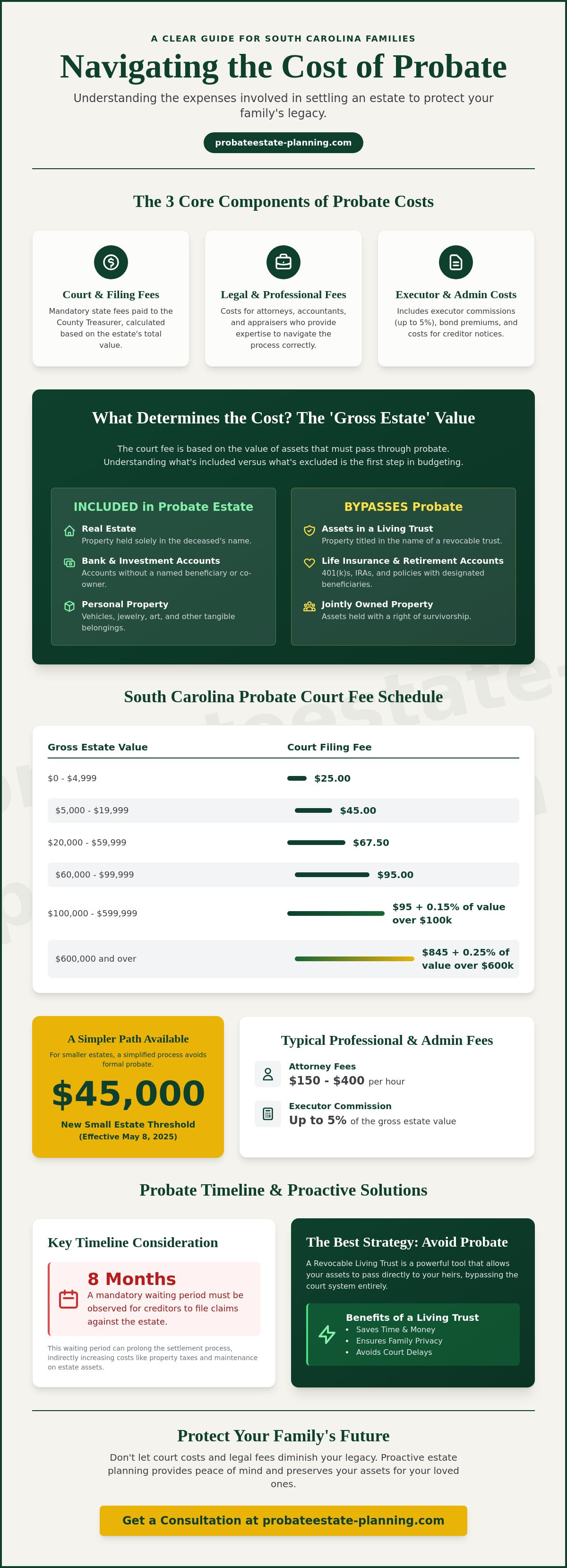
South Carolina's tiered system starts as low as $25 for estates valued under $5,000. As the estate grows, the fees increase to reflect the complexity of the oversight. For estates in the $20,000 to $60,000 range, costs are moderate, but it's important to remember that as of May 8, 2025, estates under $45,000 may qualify for a simplified process. For high-value estates exceeding $600,000, the fee is typically $845 plus 0.25 percent of the value exceeding that threshold. This transparency allows you to budget accurately and maintain family harmony by setting clear expectations for the heirs.
Additional Court-Related Expenses
Court costs also include formal proceedings and recording fees. While the vast majority of estates use informal administration, any disputes between beneficiaries may require a formal hearing, which involves higher filing fees. You should also account for the cost of recording the Deed of Distribution. This is the final, essential step in transferring real estate from the deceased to the heirs. These small but mandatory expenses ensure the title to your family's property remains clear and secure for the next generation, preventing the chaos of future ownership disputes.
Professional Fees: Attorneys, Appraisers, and Accountants
While court filing fees are fixed by state law, professional fees often constitute a larger portion of the total cost of probate in South Carolina. These expenses are investments in the security of your family's future. Hiring a skilled probate attorney often results in long-term savings by preventing costly tax errors or administrative delays that can drain an estate's value. In South Carolina, legal fees typically follow an hourly structure ranging from $150 to $400, though some firms offer flat-fee arrangements for standard estate administration. These professionals ensure that your actions as a personal representative align with the Executor Commissions and Administrative Expenses guidelines set by the state legislature.
Beyond legal counsel, you may need to hire an accountant to handle the decedent's final income tax returns or a CPA to prepare the estate's fiduciary tax filings. These experts help you fulfill your fiduciary duty with precision, protecting you from personal liability if the IRS or the South Carolina Department of Revenue conducts an audit. Using professional support moves the burden of paperwork away from your family, allowing you to focus on the human side of your loss while we handle the technical complexities of the law.
Evaluating Legal Costs: Is an Attorney Necessary?
You might consider a "do-it-yourself" approach if the estate is very simple and falls below the $45,000 small estate threshold. However, even minor clerical errors can lead to court-ordered formal proceedings, which significantly increase the cost of probate in south carolina. The financial risk escalates if a family member contests the will. Litigation expenses can quickly erode an inheritance, turning a peaceful transition into a period of conflict. We structure our professional fees to provide the predictability you need, ensuring you don't face unexpected bills while you're focused on your family's emotional well-being.
Appraisals and Expert Valuations
Accurate valuations are the foundation of a successful probate process. If the estate includes South Carolina land, whether it's a coastal home or Upstate acreage, a professional appraisal is required for the court inventory. These experts provide the "Date of Death" valuation, which is critical for determining the new tax basis for heirs and ensuring court accuracy. If the deceased owned a closely-held family business, a specialized business appraiser may be necessary to determine its fair market value. While these experts charge their own fees, their reports protect you from accusations of mismanagement and ensure that the distribution of assets is handled with absolute fairness and transparency.
Executor Commissions and Administrative Expenses
The cost of probate in south carolina includes more than just the fees paid to the court clerk; it encompasses the compensation for the person managing the estate and the operational costs of keeping assets secure. An executor, known in our state as a personal representative, serves as a fiduciary steward of your family's assets. This role is demanding. It requires significant time and meticulous record-keeping, which is why South Carolina law provides a framework for compensation. Understanding these administrative expenses is the first step in protecting the final distribution to your heirs.
Beyond commissions, you'll encounter carry costs. These are the expenses of maintaining a home or business while the legal process unfolds. Since an estate cannot be fully closed until the 8-month creditor period ends, you'll need to budget for ongoing maintenance. These costs often include:
- Homeowners insurance premiums and property taxes.
- Utility payments to prevent property damage.
- Surety bonds, which the court may require to protect heirs from potential mismanagement.
- Professional storage for valuable personal property or collections.
The 5% Rule: Understanding Executor Pay
South Carolina Code Section 62-3-719 limits an executor's commission to 5 percent of the appraised value of personal property plus the proceeds of any real property sold under court order. They can also receive 5 percent of the income earned by the estate. It's vital to remember that these fees are considered taxable income for the recipient. If a family member is serving as the executor, they may choose to waive this fee. Doing so allows the funds to pass as an inheritance, which is generally not taxed as income in South Carolina. This simple choice can preserve a larger portion of the family legacy for everyone involved.
Creditor Notices and Mandatory Publications
You must legally inform potential creditors that the estate is open. Traditionally, this required publishing a notice in a newspaper of general circulation in the county where the probate is filed once a week for three consecutive weeks. In major metros like Columbia or Charleston, these publication fees can add several hundred dollars to the total cost of probate in south carolina. While Bill 4511, updated in February 2026, now allows for centralized online publication as an alternative, many counties still utilize the traditional newspaper route. These notices trigger the mandatory 8-month window for claims, a period that dictates the overall rhythm of the administration. If you want to ensure your administration is as efficient as possible, contact us for a personalized probate consultation.
Strategies to Minimize Probate Costs in South Carolina
Stewardship isn't just about managing what remains; it's about ensuring that your family's inheritance remains intact. You can significantly reduce the cost of probate in south carolinaby using legal tools that bypass the court's oversight entirely. By using 'Pay on Death' (POD) or 'Transfer on Death' (TOD) designations, you ensure that bank accounts and securities move directly to your loved ones the moment they're needed. This simple step keeps those assets off the court's inventory and out of the tiered fee calculation. Additionally, proactive Medicaid planning is essential for those concerned about long-term care. It protects your home and savings from estate recovery efforts, ensuring your property stays within the family rather than being liquidated to settle state claims.
Planning ahead allows you to move from a reactive stance to a protective one. While the court system provides a necessary framework for those without a plan, it's a framework that comes with built-in delays and expenses. By taking the time to organize your affairs now, you're not just saving money. You're giving your family the gift of a clear path forward, free from the stress of legal ambiguity and the drain of administrative overhead.
The Small Estate Shortcut
As of May 8, 2025, South Carolina has made the path easier for many families by increasing the small estate threshold to $45,000. This change, enacted by Act No. 26, allows for a simplified affidavit process under SC Code § 62-3-1201. If the total value of the assets, excluding real estate, stays below this limit, you can avoid the full 8 month creditor period and formal administration. This shortcut involves a 30-day waiting period and carries much lower filing fees. It also typically eliminates the requirement for newspaper publication, saving your family hundreds in administrative costs. However, it's a tool with specific limits. If the decedent owned a home in their name alone, the small estate path is usually unavailable, making early planning even more critical.
Long-Term Solutions: Avoiding Probate Altogether
A Revocable Living Trust serves as a private, low-cost alternative to the public court system. When you transfer assets into a trust, you're safeguarding your family's business from the public record and eliminating the court fees we've previously detailed. For real estate, using joint tenancy with right of survivorship allows the property to transfer automatically to a spouse or partner without a court order. These methods provide peace of mind by creating a seamless transition that doesn't rely on a judge's schedule or a clerk's backlog. To ensure your assets are protected and your heirs are spared from the burden of court oversight, schedule a consultation to build a plan that avoids probate costs.
Protecting Your Family's Financial Future
Managing the cost of probate in south carolina requires a balance of legal precision and proactive stewardship. You've seen how the May 8, 2025, small estate threshold increase provides a faster path for estates under $45,000, and how the 5 percent commission cap for personal representatives shapes the financial landscape. While court fees and the 8-month creditor window are mandatory for most, they don't have to lead to family chaos or financial uncertainty. By utilizing revocable living trusts and clear beneficiary designations, you can preserve the harmony of your home and the integrity of your loved one's legacy.
Our firm provides the specialized expertise in South Carolina probate law you need to navigate these complexities with confidence. We offer empathetic guidance through Medicaid crisis planning and asset protection, ensuring your family's most valuable resources remain secure. With our predictable fee structures, you can focus on your emotional well-being instead of worrying about hidden legal expenses. Secure your family's legacy and minimize probate costs by contacting The Probate & Estate Planning Co. today. You don't have to walk this path alone; we're here to serve as your steady guide toward a secure and predictable outcome.
Frequently Asked Questions
What is the minimum cost to probate a will in South Carolina?
The minimum filing fee to probate a will is $25 for estates valued under $5,000. This base cost covers the court's initial processing of your application. However, this figure is only the starting point for the total cost of probate in South Carolina. Most families will also pay for certified copies of the personal representative's appointment and recording fees for the final deed of distribution to ensure the property title is clear.
How long does probate take in South Carolina before heirs get paid?
Most heirs receive their inheritance within 8 to 12 months after the case is opened. This timeline is strictly influenced by the mandatory 8-month creditor claim period required by state law. The personal representative cannot safely distribute all assets until this window closes and all valid debts are settled. While small estates may move faster, larger estates with real property usually require the full year to conclude.
Are attorney fees in SC probate cases based on a percentage of the estate?
No, South Carolina does not use a state-mandated percentage schedule for legal fees. Attorneys typically charge an hourly rate between $150 and $400 or a flat fee based on the estate's complexity. This structure ensures you only pay for the specific stewardship and legal protection your family requires. It's a more transparent approach that allows for a predictable budget regardless of the gross value of the assets involved.
Who is responsible for paying the probate court fees in South Carolina?
The estate is responsible for all court fees and administrative expenses. The personal representative typically uses the decedent's liquid cash or sells specific assets to cover these costs. You shouldn't have to use your personal savings to pay these fees. Because these are considered priority administrative expenses, they are paid before any debts are settled or distributions are made to the beneficiaries listed in the will.
Can I avoid probate in South Carolina if I have a will?
No, a will does not bypass the court; it actually serves as the map for the probate process. To avoid the court system, you must use tools like a revocable living trust or joint tenancy with right of survivorship. While a will is essential for naming guardians and expressing your final wishes, it must still be validated by a judge before any assets can be legally transferred to your heirs.
Does South Carolina have an inheritance tax or estate tax in 2026?
South Carolina does not have a state inheritance tax or a state estate tax in 2026. This is a significant benefit for local families looking to preserve their financial legacy. While federal estate taxes might apply to very high-value estates, most residents only need to budget for court filing fees and professional services. This lack of state-level death taxes helps maintain family harmony during the asset distribution process.
What happens if the estate doesn't have enough cash to pay the court fees?
If the estate lacks liquid cash, the personal representative may need to sell personal property or real estate to cover the costs. The probate court must approve the sale of real property to ensure the heirs' interests are protected. This situation can be stressful for families, which is why we emphasize the importance of liquidity in estate planning to prevent the forced sale of sentimental family homes or acreage.
How much does a Small Estate Affidavit cost in SC?
The cost of probate in South Carolina for a small estate is significantly lower than formal proceedings, with filing fees starting around $12.50. These fees are tiered based on the value of the assets. Since the small estate threshold increased to $45,000 on May 8, 2025, more families can use this affordable path. It eliminates the need for expensive newspaper publications, making it a protective and cost-effective option for smaller legacies.
Comments
There are no comments for this post. Be the first and Add your Comment below.
Leave a Comment