

The small amount you save today on a digital template could cost your children tens of thousands in legal fees and years of probate delays tomorrow. It's understandable why you'd want to avoid high legal fees while trying to protect your family. Planning for the future feels daunting; a quick online kit seems like a sensible way to check a box off your list. However, the risks of do-it-yourself will kits often outweigh the convenience. These generic forms frequently fail to account for specific state laws, potentially leaving your loved ones with an invalid document and a mountain of stress.
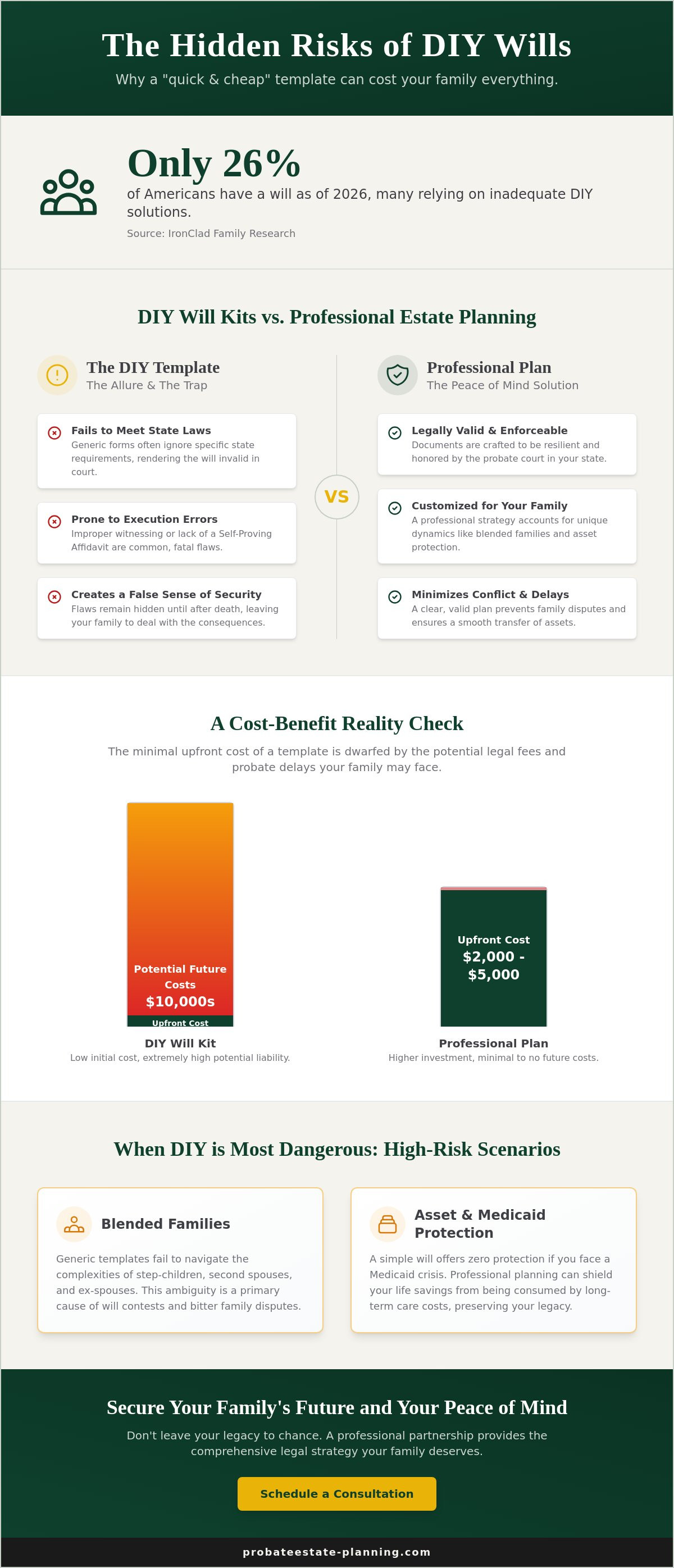
In 2026, research from IronClad Family shows that only 26% of Americans have a will. This low number often stems from an anxiety about the process being too complex or clinical. You deserve a plan that prioritizes your emotional well-being alongside your formal security. This article explores why DIY templates fall short and explains how professional planning protects your family from costly legal battles. You'll learn how to ensure your documents are legally valid, minimize family conflict, and navigate the nuances of modern probate court with confidence.
Key Takeaways
- Understand why the immediate gratification of a low-cost template often masks long-term liabilities and legal vulnerabilities for your heirs.
- Identify the specific execution errors and strict witnessing requirements that constitute the primary risks of do-it-yourself will kits in 2026.
- Evaluate the true financial impact of your plan by comparing minimal upfront savings against the substantial costs of future will contests and probate delays.
- Learn why generic documents are particularly dangerous for blended families or those who need to protect assets during a Medicaid crisis.
- Discover how a professional partnership provides a comprehensive legal strategy that safeguards your family's emotional well-being and long-term financial continuity.
The Allure and the Hidden Trap of Do-It-Yourself Will Kits
Many people start their estate planning journey looking for the most efficient path forward. A DIY will kit is essentially a pre-formatted template, often sold as a downloadable file or a physical box at a retail store. It promises immediate gratification and low costs. It's easy to see why these are popular. You want to protect your family without spending a fortune on legal fees. However, the risks of do-it-yourself will kits lie in the gap between a signed piece of paper and a document that actually functions in a courtroom. This compliance gap is the difference between a document that looks like a will and one that a judge will actually honor. In 2026, the rise in probate disputes highlights how often these gaps occur when families use generic forms.
Creating a last will and testament is more than a clerical task. It's a protective legal safeguard. In 2026, as laws regarding digital assets and electronic signatures become more complex, using a generic template is a high-stakes gamble. A document might look professional, but if it doesn't meet the specific statutory requirements of your state, it's nothing more than a piece of paper. This is especially true as states like North Carolina now allow electronic wills, but only under very specific conditions that a standard kit might miss.
To better understand the complexities involved in this process, watch this helpful video:
The Psychology of the "False Sense of Security"
There's a psychological relief that comes with checking a difficult task off your to-do list. When you finish a DIY kit, you feel "covered." This is a dangerous illusion. The tragedy of these templates is that their flaws are invisible until they're needed most. Families often discover critical errors only after a death has occurred, when it's too late to fix them. For example, a will that's legal in one state might be completely invalid in another due to different witnessing rules. You don't want your legacy to be a legal puzzle for your children to solve during their time of grief.
Why Generic Software Can't Replace Legal Counsel
Algorithms are excellent for data entry, but they lack professional wisdom. A software program can't spot the red flags in your family dynamics or understand the nuances of a blended family. It follows a rigid path. If your situation doesn't fit the "standard" model, the software won't warn you about the potential risks of do-it-yourself will kits in your specific case. A mentor provides a partnership in long-term management that no algorithm can replicate. This steady, measured approach ensures that every detail is addressed, from asset protection to the emotional well-being of your beneficiaries. Software companies sell forms, while an attorney sells results and continuity for your loved ones.
Technical Failures: Why "Legal" Does Not Mean "Effective"
A document that looks official is not necessarily enforceable. Execution errors are the primary reason probate courts reject documents, making them one of the most significant risks of do-it-yourself will kits. You might sign the paper in your kitchen, thinking the task is complete, but without following strict statutory formalities, you haven't created a valid legal instrument. Many retail kits overlook the necessity of a Self-Proving Affidavit. This specific document, signed by witnesses and a notary, allows the court to accept the will without tracking down witnesses years later. Without it, your family faces a procedural hurdle that can delay the transfer of assets for months during an already difficult time.
You don't want your legacy to be a source of confusion for those you leave behind. When you choose a generic form, you often inherit the technical risks of do-it-yourself will kits that an experienced guide would easily avoid. A steady guide ensures your final wishes aren't just written, but are legally resilient.
Strict Execution Rules in the Southeast and Mid-Atlantic
Each state maintains its own gatekeeping rules for what constitutes a valid signature. In Maryland, for example, witnesses must be "disinterested," meaning they cannot inherit from you, and they must be physically present during the signing. Tennessee law allows for holographic, or handwritten, wills, but these often become a trap for the unwary because they require specific proof of handwriting that is easily challenged in court. South Carolina's probate code is equally precise; if witness signatures and notarization don't follow the exact sequence required, the entire document may be deemed void by a judge.
The Ambiguity Crisis in DIY Drafting
Generic templates often rely on "common sense" phrasing that doesn't translate well to legal settings. A statement like "I leave everything to my kids" seems clear, but it fails to address what happens if one child passes away before you do. The Problems With Do-It-Yourself Online Wills often stem from this lack of specific contingency planning. In North Carolina and South Carolina, "anti-lapse" statutes may automatically redirect an inheritance to a deceased beneficiary's own heirs, which might not be your intention. Without a professional estate planning strategy, these unintended consequences can spark bitter family disputes that cost far more than the kit you purchased.
Attorney-Drafted vs. DIY: A Cost-Benefit Reality Check
The financial logic behind choosing a retail template often falls apart when you look at the long-term math. While the upfront savings of a digital download are clear, they pale in comparison to the potential back-end liabilities. One of the most significant risks of do-it-yourself will kits is that they trade immediate affordability for future catastrophic costs. For example, a simple error in a $50 kit can easily lead to $20,000 in legal fees if your heirs are forced into a will contest. You aren't just paying for a document; you're paying to prevent a legal battle that could consume a large portion of your estate's value.
Beyond the direct legal costs, an invalid DIY will can freeze your assets for months or even years. During this time, your family may be unable to access bank accounts to pay for funeral expenses or sell property to cover immediate needs. Generic kits also rarely optimize for state-level nuances. In 2026, the federal estate tax exemption is $15 million, but many families still face tax inefficiencies because their DIY documents don't account for specific state-level deductions or support increases, such as the North Carolina Year's Allowance rising to $60,000. Without a professional strategy, you're leaving your family's financial continuity to chance.
The Price of "Fixing" an Invalid Will
If a will lacks a self-proving affidavit, your family must track down the original witnesses and bring them before a clerk of court. If those witnesses have moved or passed away, the legal fees to "prove" the will's validity rise quickly. This creates a massive emotional toll on your children, who may find themselves in adversarial court positions against other relatives just to honor your wishes. The Probate & Estate Planning Co. focuses on preventing these specific conflicts by ensuring every document is executed with meticulous attention to state-specific formalities. We believe in providing a partnership that safeguards your legacy before a crisis occurs.
Intestacy: The Default Plan You Didn't Choose
When a court declares your DIY will invalid, your estate enters a process called Intestate Succession. This is the state's default plan for your assets, and it rarely matches a person's actual intentions. In Maryland and Tennessee, these laws distribute property in ways that might surprise you. Many people don't realize that under default state laws, a surviving spouse might not inherit everything. Instead, they may be forced to share the estate with your children or even your parents. This lack of control is one of the most distressing risks of do-it-yourself will kits, as it can leave your primary partner financially vulnerable at the worst possible time.
When DIY is Most Dangerous: High-Risk Scenarios
Standardized templates are designed for a "perfect" scenario that rarely exists in modern life. While a simple document might seem sufficient for a straightforward estate, the risks of do-it-yourself will kits become magnified when your family structure or financial needs are complex. For the entrepreneur, the parent of a child with special needs, or those in blended families, these kits often act as a ticking time bomb. The inability of a generic form to account for multi-state property or specific family obligations can lead to the very legal battles you hoped to avoid. You aren't just filling out a form; you're attempting to predict and prevent future complications for the people you love most.
The Medicaid Trap: Protecting the Surviving Spouse
One of the most overlooked risks of do-it-yourself will kits is their interaction with long-term care planning. If you leave assets directly to a surviving spouse who later requires nursing home care, those assets may have to be "spent down" to nearly nothing before they can qualify for Medicaid. In Maryland and North Carolina, a standard DIY distribution can inadvertently disqualify a spouse from receiving essential benefits. Professional planning preserves Medicaid eligibility by utilizing structures like testamentary trusts, which allow a spouse to benefit from assets without those assets counting against their eligibility limits. This human-centric approach prioritizes your partner's long-term security over mere administrative preparation.
Blended Families and "Accidental Disinheritance"
Blended families face a unique set of legal hurdles that generic software simply cannot navigate. A common tragedy occurs when a parent leaves everything to a second spouse, assuming that spouse will eventually provide for the children from a prior marriage. Without a "Contract to Will" or specific trust protections, that second spouse is under no legal obligation to do so. They could later change their own will to leave everything to their own biological children, effectively disinheriting yours. In South Carolina, probate laws regarding elective shares add another layer of complexity that a one-size-fits-all kit will miss. A steady guide ensures that both your current spouse and your children from all chapters of your life remain protected. If you're managing a complex family dynamic, it's vital to seek Medicaid crisis planning or comprehensive estate strategy to ensure your legacy reaches the right hands.
For parents of children with special needs, the stakes are even higher. A direct inheritance from a DIY will can disqualify a loved one from vital government benefits like SSI or Medicaid. Similarly, business owners often find that generic kits fail to address the operational continuity and succession planning required to keep a company running after their passing. These scenarios require a partnership in long-term management that only a reliable mentor can provide; this moves away from cold technicalities toward a plan that honors your unique life story.
The Peace of Mind Alternative: Professional Estate Planning
Transitioning from a generic template to a professional strategy is about more than just legal compliance. It's about securing a sense of quiet confidence that your legacy is protected. While we've explored the technical and financial risks of do-it-yourself will kits, the real alternative isn't just a better document. It's a partnership with a steady guide who understands the gravity of your personal transitions. Professional planning moves away from cold, clinical forms and toward a human-centric approach that prioritizes your emotional well-being alongside your formal security. This ensures that your plan doesn't just look right on paper, but actually works when your family needs it most.
A reliable mentor helps you navigate the complexities of long-term management with patience and clarity. This methodical process identifies potential procedural obstacles before they become crises. By choosing a guided path, you're not just managing administrative tasks. You're safeguarding your future and preserving your most important interpersonal connections through a plan built on functional reliability.
A Holistic Approach to Your Legacy
A Last Will and Testament is often just one piece of a much larger puzzle. To truly protect your family, your strategy should integrate various tools that work in harmony. For instance, a Revocable Living Trust can help your estate avoid the temporal delays of probate court entirely. Additionally, incapacity planning is just as vital as death planning. A Durable Power of Attorneyand a Healthcare Power of Attorney ensure that your wishes are honored if you're ever unable to speak for yourself. The Probate & Estate Planning Co. focuses on this comprehensive view, ensuring that your plan addresses every stage of life's journey while avoiding the common risks of do-it-yourself will kits.
Your Next Steps Toward Security
The journey toward a predictable outcome begins with a measured, deliberate consultation. You don't have to feel overwhelmed by state-specific probate laws or the nuances of multi-state assets in Tennessee, Maryland, and the Carolinas. During our initial meeting, we'll walk through your unique circumstances to identify which tools, such as an Irrevocable Trust or specific Asset Protection Planning, are right for you. We handle the technicalities so you can focus on your family. Stop the guesswork and move toward a future defined by continuity and safety. Secure your family's future with a professional estate planning review today.
Securing Your Legacy with Confidence
Your legacy is too important to leave to the limitations of a generic algorithm. We've explored how technical execution errors and the lack of state-specific nuance can turn a simple document into a legal hurdle for your grieving heirs. Choosing to avoid the risks of do-it-yourself will kits isn't just about avoiding probate delays; it's about providing your family with a clear, stress-free path forward. By integrating professional oversight with specialized strategies like Medicaid Crisis Planning, you ensure your assets are protected and your loved ones are cared for.
Our practice offers a partnership built on wisdom and empathy. With multi-state expertise across North Carolina, South Carolina, Maryland, and Tennessee, we act as a steady guide through the complexities of estate law. You deserve the peace of mind that comes from knowing your plan is functionally reliable and legally resilient. Take the first step toward a predictable and secure future today.
Schedule Your Peace of Mind Consultation Today. Your family's security is our highest priority.
Common Questions About Estate Planning and DIY Templates
Are DIY will kits legally binding in North Carolina and South Carolina?
Yes, these kits can be legally binding, but they must strictly adhere to each state's specific statutory requirements. In North Carolina, as of January 1, 2026, electronic wills are recognized only if they are recorded by a licensed attorney while the testator is still alive. South Carolina maintains precise rules regarding witness signatures and notarization that generic templates often fail to explain clearly.
If you miss a single procedural detail, the court may deem the entire document void. This leaves your family without the protection you intended. Relying on a one-size-fits-all form is a gamble with your legacy.
What is the most common reason a DIY will is rejected by a probate court?
Improper execution is the primary reason courts toss out these documents. This usually involves a failure to meet witnessing requirements, such as using "interested" witnesses who stand to inherit or failing to sign the document in the physical presence of all parties. Courts prioritize the letter of the law over your intended meaning.
Can a DIY will be contested more easily than one drafted by an attorney?
Yes, these documents are much more vulnerable to legal challenges. Without a professional's attestation of your mental capacity and the absence of undue influence, it's easier for disgruntled relatives to claim the document is invalid. This vulnerability is one of the most significant risks of do-it-yourself will kits, as it often leads to expensive and adversarial court battles.
Does a DIY will kit address what happens if I become incapacitated?
No, a will only takes effect upon your death and provides no guidance for life transitions. It doesn't empower anyone to manage your finances or make medical decisions if you become ill or injured. To protect yourself during your lifetime, you'll need a Durable Power of Attorney and a Healthcare Power of Attorney.
How much does it cost to have a lawyer review my existing DIY will?
Review costs depend on the complexity of your assets and the specific family dynamics you need to address. It's best to consult with a professional to discuss their specific review process. This step is a methodical way to identify the hidden risks of do-it-yourself will kits before they create a crisis for your heirs.
What happens if my DIY will doesn't meet Maryland witnessing requirements?
If the document fails Maryland's requirement for two disinterested witnesses, the court will treat your estate as if you died without a will. Your assets will be distributed according to the state's intestacy laws. This default plan often divides property in ways that don't prioritize a surviving spouse or specific children as you would have chosen.
Do online will kits account for state-specific estate taxes in 2026?
Most online kits use generic language that fails to optimize for 2026 tax nuances. While the federal estate tax exemption is $15 million, state-level changes, such as North Carolina's increase in the Year's Allowance to $60,000, are frequently overlooked. These omissions can result in unnecessary tax burdens or the loss of financial support for your spouse.
Can a DIY will help me avoid the probate process entirely?
No, a will is a document that must go through probate to be validated and executed. It serves as the court's instruction manual rather than a bypass. If your goal is to avoid the public probate process and its associated delays, a Revocable Living Trust is a much more effective tool for your estate planning strategy.
Comments
There are no comments for this post. Be the first and Add your Comment below.
Leave a Comment