

What if the inheritance you have worked a lifetime to build actually puts your loved one's healthcare at risk? For many families, this isn't just a hypothetical worry; it's a looming reality. You likely know that the strict $2,000 asset limit for SSI and the $2,500 limit for Maryland Medicaid mean that even a modest gift can trigger a loss of vital services. Establishing a special needs trust maryland is the most effective way to ensure your child or sibling is cared for without compromising the government support they rely on every day.
We understand the weight of these decisions and the desire for a plan that prioritizes your family member's emotional well-being alongside their formal security. This guide will show you how to safeguard benefits while providing for lifelong financial needs. We will explore the differences between various trust types, compare them to Maryland ABLE accounts, and outline the specific legal steps required for 2026. By following this methodical approach, you'll gain the peace of mind that comes from knowing your loved one's future is protected by a reliable, professional framework.
Key Takeaways
- Discover how a special needs trust maryland allows your loved one to receive an inheritance without losing essential SSI or Medicaid coverage.
- Learn why the appropriate trust structure is determined by the source of the funding, ensuring the legal framework matches your family's specific financial situation.
- Evaluate the differences between ABLE accounts and trusts to determine the right balance of accessibility and long-term asset protection.
- Identify the essential qualities of a trustee and the importance of a Letter of Intent in guiding the future management of your loved one's care.
- Understand how to weave these protections into a broader estate plan to safeguard your entire family's legacy and financial continuity.
Understanding the Maryland Special Needs Trust: Why It Is Essential
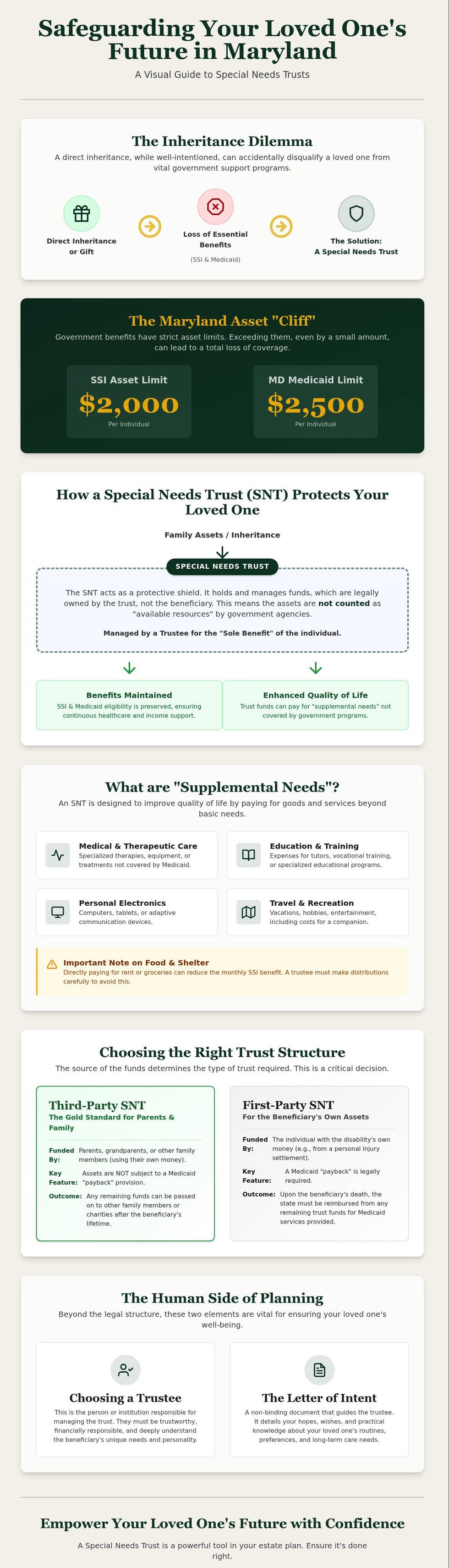
A Special Needs Trust (SNT) is a specialized legal arrangement designed to hold and manage assets for a person with a disability. Its primary function is to ensure that these funds are not counted as "available resources" by government agencies. By establishing a special needs trust maryland families can provide for a loved one's long-term comfort without accidentally disqualifying them from essential means-tested benefits. It acts as a protective shield, allowing your family member to benefit from your legacy while keeping their safety net intact.
Many well-meaning parents or relatives consider leaving an inheritance through a standard will or a direct gift. This approach often leads to what we call "accidental disinheritance." If a person with a disability receives assets directly, those funds can trigger an immediate loss of healthcare and income support. Instead of providing security, the gift creates a bureaucratic crisis. A properly structured trust avoids this outcome by ensuring the beneficiary never legally "owns" the assets, even though the money is used exclusively for their care.
To better understand how these legal tools function within the state's framework, watch this helpful video:
The $2,000 Cliff: Why Maryland Families Must Plan Early
In 2026, the financial requirements for government programs remain incredibly tight. The resource limit for Supplemental Security Income (SSI) is just $2,000 for an individual. For Maryland Medicaid, the limit is slightly higher at $2,500. Crossing this "cliff" by even a single dollar can result in a total loss of benefits. The Maryland Department of Health closely monitors beneficiary assets, and any sudden increase in a bank balance will be flagged. While Maryland allows for a "spend-down" process where excess funds are used on medical bills, this is a sub-optimal strategy. It forces the beneficiary to exhaust their resources rather than saving them for future needs.
What "Supplemental Needs" Actually Means
The goal of a special needs trust maryland is to pay for things that improve the beneficiary's quality of life but aren't covered by basic government checks. These are known as "supplemental needs." A trustee can use the funds for a variety of purposes, including:
- Specialized therapies or medical equipment not covered by Medicaid.
- Educational expenses, including tutors or vocational training.
- Personal electronics, such as computers or adaptive communication devices.
- Travel and recreation, including the costs for a companion to join them.
It's vital to remember that these trusts typically shouldn't pay for food or shelter directly, as doing so can reduce the monthly SSI benefit, which is $967 for an individual in 2026. Every distribution must adhere to the "sole benefit" rule, which dictates that the trust's assets can only be used for the specific individual with the disability. Integrating this tool into your broader Asset Protection Planning ensures that your entire family's financial future remains stable and predictable.
The Three Types of Special Needs Trusts in Maryland
Choosing the right special needs trust maryland structure is the most critical step in your planning journey. It isn't just about paperwork; it's about matching the legal framework to the source of the assets. Maryland law recognizes three primary types of trusts, and selecting the wrong one can lead to unnecessary costs or the loss of family wealth. While some trusts require a "payback" to the state after the beneficiary passes away, others allow you to keep the remaining funds within the family. You should also be aware that Maryland courts or the Attorney General's office may have oversight roles depending on the trust's origin.
Third-Party Special Needs Trusts: The Gold Standard for Parents
If you're a parent or grandparent looking to leave a legacy, a Third-Party SNT is almost always the preferred choice. This trust is funded entirely by someone other than the beneficiary. Because the disabled individual never owned the assets, there is no requirement to pay back Maryland Medicaid for services provided during their lifetime. You can establish this through a Last Will and Testament or as part of a broader estate plan. This flexibility ensures that any remaining funds can eventually pass to other children or grandchildren rather than being claimed by the state.
First-Party SNTs (d4A) and Pooled Trusts (d4C)
Circumstances change when the assets belong to the person with the disability. This often happens after a personal injury settlement, an inheritance received directly, or retroactive Social Security payments. In these cases, a First-Party SNT is required. Federal and Maryland law mandate a "Medicaid Payback" provision for these accounts. This means that when the beneficiary passes away, the state must be reimbursed for the cost of medical care provided. In our state, any special needs trust maryland funded with the beneficiary's own money must be approved in writing by the Maryland Attorney General's office before it's finalized.
For families managing smaller amounts of money, a Pooled Trust offers a practical, cost-effective alternative. These trusts are managed by non-profit organizations that aggregate the resources of many beneficiaries for investment purposes while maintaining separate accounts for spending. The Maryland Department of Disabilities provides resources that can help families understand these community-based options. If you're feeling overwhelmed by these choices, exploring Asset Protection Planning can provide the clarity you need to move forward with confidence.
Maryland ABLE Accounts vs. Special Needs Trusts: A Comparative Analysis
While a special needs trust maryland offers robust long-term protection, it isn't the only tool available to your family. The Maryland ABLE (Achieving a Better Life Experience) program serves as a flexible companion to a formal trust. These accounts allow individuals with disabilities to save money in a tax-advantaged environment without losing their state or federal benefits. In 2026, the annual contribution limit for an ABLE account is $20,000. While these accounts are simpler to open, they shouldn't be viewed as a replacement for the comprehensive security a trust provides.
Key Differences in Control and Costs
ABLE accounts are designed for accessibility and daily use. They're often "do-it-yourself" platforms with minimal setup fees, and the beneficiary can frequently manage the account themselves. This includes using a linked debit card for routine expenses. Up to $100,000 in a Maryland ABLE account is excluded from the SSI asset limit. By contrast, a special needs trust maryland requires professional legal drafting to ensure it survives state scrutiny. A trustee manages these funds, which provides a vital layer of protection against financial exploitation or impulsive spending. This oversight is a cornerstone of long-term stability.
When to Use an SNT Instead of an ABLE Account
Certain scenarios demand the higher capacity and tighter controls of a trust. If your loved one is set to inherit a family home or a life insurance payout of $200,000, an ABLE account's $20,000 annual contribution cap makes it an impractical solution. You can't simply deposit a large windfall into an ABLE account all at once. An SNT can hold unlimited assets and provides superior protection against creditors. It ensures that a family home remains a stable residence for decades rather than a liability that must be sold to maintain Medicaid eligibility.
We find that the most effective plans often utilize both tools in tandem. The trust holds the bulk of the family legacy for "lifetime security," while the ABLE account provides the beneficiary with "daily flexibility" for small, routine purchases. This combination balances personal autonomy with the rigorous protection required for significant assets. Maryland also offers state income tax advantages for those contributing to an ABLE account, making it a tax-efficient way for multiple family members to support a loved one's immediate needs.
The Human Side of Planning: Choosing a Trustee and the Letter of Intent
"Who will watch over my child when I'm gone?" This single question often drives the entire process of creating a special needs trust maryland. While the previous sections of this guide focused on the legal structures and financial limits, the success of your plan ultimately rests on the human element. You're building a partnership that will likely span decades. This requires a blend of professional competence and genuine empathy to ensure your loved one's needs are met long after you're no longer there to advocate for them.
The trustee you select carries a heavy burden of responsibility. They aren't just a bookkeeper; they are the gatekeeper of your loved one's eligibility for government support. Their daily duties include managing trust investments, filing specialized tax returns, and ensuring every single distribution complies with the "sole benefit" rule. In Maryland, where the Attorney General's office may review first-party trust actions, the trustee's attention to detail is paramount. They must understand how to provide for your family member without triggering a benefit reduction or a total loss of coverage.
Selecting the Right Trustee for Your Maryland Trust
The choice between a family member and a professional trustee is deeply personal. Many parents instinctively look toward a sibling. While a sibling offers a deep emotional bond, the administrative requirements of a special needs trust maryland can be overwhelming for a layperson. They must navigate complex fiduciary duties and stay current with evolving state laws. A professional or corporate trustee offers technical expertise and continuity, but they may lack a personal connection to the beneficiary. One effective solution is to appoint a "Trust Protector." This is an independent third party who doesn't manage the money but has the legal authority to remove and replace a trustee who isn't performing their duties effectively.
When evaluating potential trustees, look for these specific qualities:
- A thorough understanding of Maryland's specific Medicaid and SSI resource limits.
- Financial literacy and a proven track record of prudent investment management.
- Longevity, ensuring the individual or organization will be available for the beneficiary's entire life.
- The ability to communicate clearly and empathetically with the beneficiary and their care team.
Drafting Your Letter of Intent: A Roadmap for Care
While the trust document is a legal mandate, the Letter of Intent is the heart of your care plan. It's the most important non-legal document you'll ever write. It serves as an instruction manual for future trustees and caregivers, bridging the gap between financial stability and personal happiness. Without this roadmap, a future trustee might know how much money is in the bank, but they won't know what makes your loved one's life meaningful. You should update this document annually to reflect changing needs and preferences.
Your Letter of Intent should include specific, granular details that only a family member would know. Consider documenting the following:
- Daily routines that provide the beneficiary with a sense of comfort and security.
- Favorite social activities, hobbies, or community organizations they enjoy.
- Specific dietary needs, strong food preferences, or sensory sensitivities.
- A comprehensive medical history, including a list of trusted providers and successful therapy approaches.
To ensure your instructions are both legally sound and emotionally comprehensive, it's vital to integrate these documents into your broader Estate Planning strategy. This creates a seamless transition of care that protects your loved one's future from every angle.
A special needs trust maryland is a powerful tool, but it cannot function effectively in a vacuum. It must be viewed as one component of a comprehensive strategy that protects the entire family's future. True security comes from Asset Protection Planning that accounts for the needs of every generation. If you focus only on the trust while ignoring your own long-term care needs or your other children's inheritance, you leave your legacy vulnerable to unforeseen risks.Reviewing your beneficiary designations is a vital part of this integration. Many families painstakingly draft a trust but forget to update their life insurance policies, retirement accounts, or bank "payable on death" instructions. If these assets name the disabled individual directly, the funds will bypass the trust entirely. This simple oversight can lead to the very benefit disqualification you worked so hard to avoid. Similarly, parents should consider how their own potential need for Medicaid Crisis Planning could impact their ability to fund a child's trust. Planning for your own long-term care ensures that your resources aren't exhausted by nursing home costs before they can reach your loved one.
Avoiding Common Mistakes in Maryland SNT Planning
One of the most dangerous errors we see is the "informal trust." This occurs when a parent leaves money to a non-disabled sibling with a "handshake" agreement that they will use the funds for their disabled brother or sister. While the intent is noble, this strategy offers no legal protection. The money is legally owned by the sibling; this means it's subject to their creditors, a potential divorce settlement, or their own estate issues. It's a risk that can jeopardize your child's entire financial future.
Another outdated strategy is "disinheriting" the disabled child entirely to keep them under the asset limit. This leaves your loved one completely dependent on the state's minimum level of care. A special needs trust maryland allows you to provide a higher quality of life without the risks associated with disinheritance. Because Maryland and federal laws regarding disability benefits and trust administration evolve, regular legal reviews are a necessity to ensure your plan remains compliant with current regulations.
Taking the First Step Toward Peace of Mind
Securing your family's future requires a methodical approach. Working with a Maryland probate and estate attorney allows you to identify potential complications before they become crises. We recommend gathering your current financial statements, existing wills, and insurance policies as you prepare for this transition. This preparation ensures that every detail is captured and every risk is mitigated.
It's never too early to begin this process. Proactive planning is the only way to ensure a predictable and secure outcome for your loved one. Waiting until a health crisis or an unexpected inheritance occurs often limits your options and increases emotional stress. By taking action now, you're not just preparing documents; you're fulfilling a profound responsibility to protect your family member's continuity and financial security for the rest of their life.
Empowering Your Loved One's Future with Confidence
Establishing a special needs trust maryland is more than a legal requirement; it's a profound act of love and foresight. You now understand how to navigate the strict asset limits that often threaten essential benefits. By selecting the appropriate trust structure and drafting a detailed Letter of Intent, you provide the specific roadmap your family member needs for a life of comfort and dignity. These tools work together to ensure that your legacy provides for supplemental needs without compromising the state's safety net.
Our practice brings decades of experience in Maryland Medicaid and Estate Planning to every client partnership. we provide the empathetic, mentor-led guidance necessary to navigate these sensitive transitions with clarity and poise. As a multi-state practice focused on comprehensive asset protection, we ensure your plan is built on a foundation of functional reliability and practical outcomes. We prioritize your family's emotional well-being alongside your formal legal security.
Taking these steps today ensures that your loved one is never left without the resources or the advocacy they deserve. You have the power to create a predictable, protected future, and we are here to guide you through every step of that journey with wisdom and care.
Frequently Asked Questions
Can a Special Needs Trust pay for a house or rent in Maryland?
Yes, a trust can pay for housing costs, but it requires careful coordination with Social Security rules. If the trust pays for rent or mortgage directly, it's considered In-kind Support and Maintenance, which can reduce a beneficiary's monthly SSI payment by up to one-third. Many families choose to have the trust own the home itself to provide a stable residence while minimizing the impact on monthly cash benefits.
How much money can you put into a Maryland Special Needs Trust?
There is no legal limit on the total amount of assets you can place into a special needs trust maryland. Unlike ABLE accounts, which have a $20,000 annual contribution limit in 2026 and a $500,000 maximum balance, a trust can hold millions of dollars. This makes it the essential tool for protecting large inheritances, life insurance payouts, or significant personal injury settlements.
Does a Special Needs Trust protect assets from Medicaid estate recovery?
Protection from estate recovery depends entirely on the source of the funds. A third-party trust funded by parents or grandparents is not subject to Medicaid payback, meaning you can leave the remaining funds to other family members. However, first-party trusts funded with the beneficiary's own money must include a provision to reimburse the state for medical costs after the beneficiary passes away.
Who can serve as a trustee for an SNT in Maryland?
You can appoint any competent adult, such as a sibling or trusted friend, or a professional corporate trustee like a bank. The trustee is held to a high fiduciary standard and must follow the Maryland Trust Act. Recent updates to the Act now allow a trustee to resign by providing 30 days' notice to relevant parties without needing a court's permission, which simplifies administration.
What happens to the money in an SNT when the beneficiary dies?
In a third-party trust, the assets are distributed to the successor beneficiaries you've named in the document, such as other children or charities. For a first-party special needs trust maryland, the state must first be reimbursed for the total cost of Medicaid services provided during the beneficiary's life. Any funds remaining after this mandatory payback can then be distributed to your named heirs.
Can I change a Special Needs Trust once it is created?
Most special needs trusts are irrevocable to ensure the assets aren't counted toward the $2,000 SSI resource limit. While you cannot simply "take back" the money, you can build flexibility into the document. By appointing a Trust Protector, you allow an independent party to make administrative changes or replace a trustee if state laws or the beneficiary's needs change over time.
Is an SNT the same as a Maryland ABLE account?
They are different tools that often work best when used together. An ABLE account allows for more "daily flexibility" and can be managed by the beneficiary, but it has strict contribution caps. A trust provides "lifetime security" for much larger sums and offers stronger protection against financial exploitation. Using both allows you to maximize tax advantages while ensuring long-term asset preservation.
How do I fund a Special Needs Trust if I don't have a lot of cash right now?
You don't need a large sum of liquid cash to start. Many families establish a "standby" trust that remains empty until it's funded through a life insurance policy or a specific designation in a Last Will and Testament. This approach allows you to secure your loved one's future using your existing assets and death benefits without impacting your current household budget.
Comments
There are no comments for this post. Be the first and Add your Comment below.
Leave a Comment