

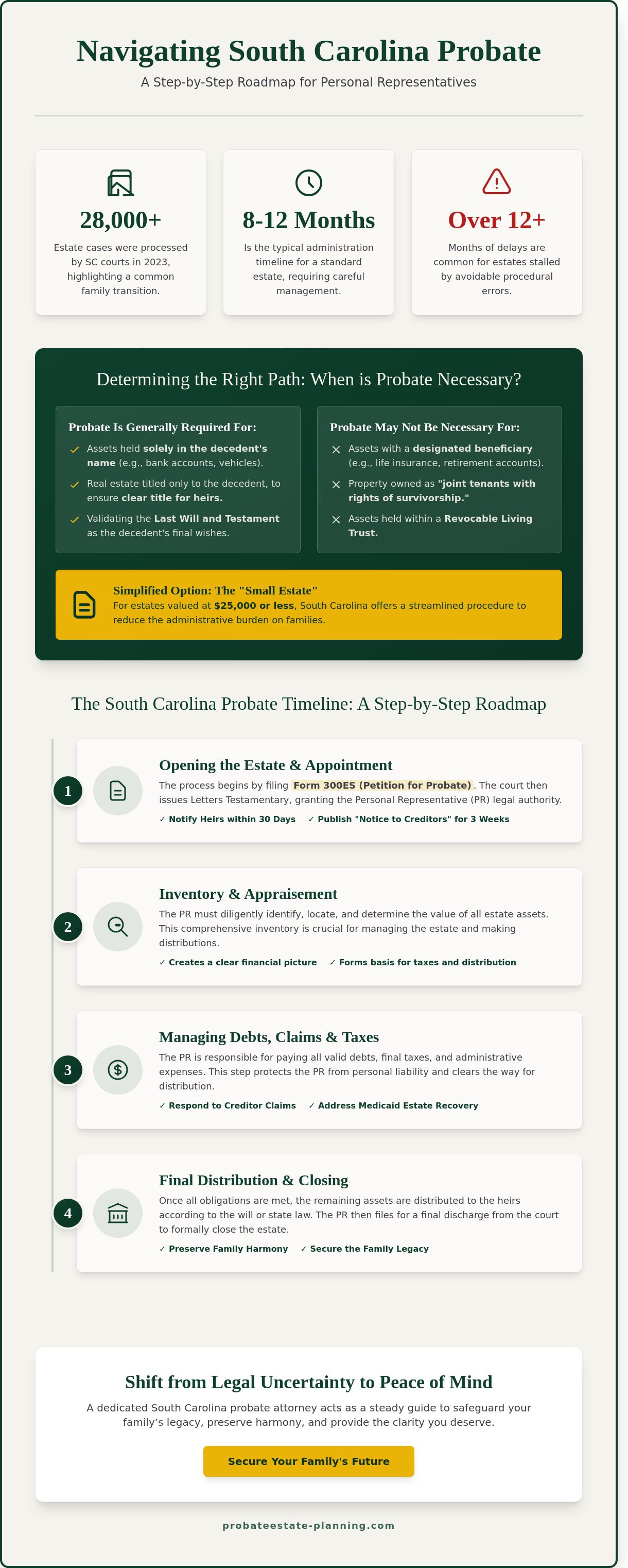
According to the South Carolina Judicial Department's 2023 annual report, probate courts across the state processed more than 28,000 estate cases, yet many of these remain stalled for over 12 months due to avoidable procedural errors. It's a heavy burden to carry when you're already grieving, and the fear of making a mistake that leads to personal liability for estate debts can feel overwhelming. You likely believe that settling an estate should be a time for reflection and family unity, not a source of anxiety over South Carolina-specific court forms or potential disputes among heirs.
This article serves as your comprehensive guide to the legal landscape, showing how a dedicated south carolina probate attorney protects your family legacy from creditors and Medicaid recovery. You'll gain a clear roadmap of the state's probate timeline and learn how to maintain harmony during asset distribution. We will walk through the exact steps required to move from the initial filing to a secure final distribution, providing the peace of mind you deserve during this difficult transition.
Key Takeaways
- Understand the South Carolina probate process and learn if an estate qualifies for the simplified "Small Estate" threshold of $25,000.
- Navigate the typical 8-to-12-month administration timeline with confidence by understanding the critical responsibilities of the Personal Representative.
- Protect the family home from the South Carolina Medicaid Estate Recovery Program and learn how to effectively manage complex creditor claims.
- Discover how a dedicated south carolina probate attorney acts as a steady guide to preserve family harmony during the distribution of sentimental assets.
- Shift from legal uncertainty to peace of mind by following a methodical roadmap designed to safeguard your family's legacy and financial future.
Understanding South Carolina Probate: More Than Just a Legal Filing
Probate often feels like a heavy burden during a season of grief. In South Carolina, this court-supervised probate process serves a vital role beyond mere paperwork. It's the formal mechanism for authenticating a decedent's will and ensuring their final wishes are honored with precision. While many view the South Carolina Probate Court as a rigid judicial body, it's better understood as a guidance system designed to foster harmony among heirs and protect the family legacy.
The court's involvement provides a structured path for the personal representative to follow. For smaller estates valued at $25,000 or less as of 2026, South Carolina law offers a simplified "Small Estate" procedure. This streamlined option reduces the administrative weight for families while still providing the legal closure necessary to move forward with confidence.
To better understand how this system functions, watch this helpful video:
The Purpose of Probate in the Palmetto State
The primary goal of probate is to validate the Last Will and Testament. This step confirms that the document is the final, authentic expression of the decedent's intent. Beyond validation, the process creates a specific legal forum where creditors must present their claims within a defined window. This structure is protective; it shields the Personal Representative from future personal liability once the estate is closed. In South Carolina's 46 counties, probate is also the essential mechanism for ensuring clear title for real estate. Without this court-monitored transfer, heirs may find themselves unable to sell or refinance family property years later.
When Is Probate Necessary in South Carolina?
Not every asset passes through the probate court. Probate is generally required for assets held in a decedent's sole name. This differs from non-probate assets like joint tenancy property with rights of survivorship or accounts with designated beneficiaries, which transfer by operation of law. South Carolina law requires any person in possession of a will to deliver it to the judge of probate within 30 days of the decedent's death.
A common misconception is that property transfers automatically to a surviving spouse without court intervention. This isn't usually the case for assets without specific beneficiary designations. Working with a skilled south carolina probate attorney ensures you don't miss these critical deadlines. Your south carolina probate attorney can help you distinguish between these asset classes, preventing the chaos that often arises from unmanaged estates. This proactive stewardship preserves family relationships and provides the peace of mind you deserve during a difficult transition.
The South Carolina Probate Timeline: A Step-by-Step Roadmap
The probate process in South Carolina isn't an overnight event. It's a structured journey that typically spans between 8 and 12 months for a standard estate. This duration ensures that all legal obligations are met and that your family's legacy is protected from future disputes. South Carolina Code of Laws Title 62 governs this entire procedure, providing a clear framework for how assets move from the deceased to their rightful heirs. At the center of this process is the Personal Representative (PR), a person who acts as the steady guide and legal steward for the estate. Working with a south carolina probate attorney helps ensure the PR meets every deadline and fulfills their fiduciary duties without unnecessary stress.
Phase 1: Opening the Estate and Appointment
The journey begins with filing Form 300ES, the Petition for Probate, with the county court. Once the court accepts the filing, it issues Letters Testamentary or Letters of Administration. These documents grant the PR the legal authority to act. Within 30 days of this appointment, the PR must notify all heirs and devisees to ensure transparency. Another critical requirement is publishing a "Notice to Creditors" in a local county newspaper once a week for three consecutive weeks. This public announcement starts the clock for potential claimants. If you're feeling overwhelmed by these initial filings, securing professional guidance can provide the clarity you need to move forward confidently.
Phase 2: Inventory, Appraisement, and Management
The PR's next major milestone is filing the Inventory and Appraisement, known as Form 350ES, within 90 days of their appointment. This document lists all probate assets and their fair market values. The PR is responsible for safeguarding everything from physical real estate and vehicles to digital accounts and investment portfolios. According to resources provided by the South Carolina Bar, precision is vital during this stage. South Carolina law requires formal appraisals for non-cash assets, such as land or unique collectibles, to ensure the estate's value is recorded accurately for tax and distribution purposes. This step prevents friction among family members by establishing an objective baseline for the estate's worth.
Phase 3: Creditor Claims and Final Distribution
South Carolina mandates an 8-month creditor claim period that begins upon the first publication of the notice in the newspaper. The PR must manage any claims that arise, paying valid debts and contesting those that lack merit. Once this window closes and all taxes are settled, the PR prepares a Proposal for Distribution and a Final Accounting. These documents show exactly how the remaining assets will be divided. The estate can be closed through either formal or informal procedures, depending on the level of court oversight required. After the court approves the final filings, the PR receives a discharge, successfully completing their role as the protector of the family's harmony. A south carolina probate attorney can help streamline these final steps to avoid common administrative delays.
Navigating Complexities: Medicaid Recovery and Creditor Claims
One of the most frequent concerns family members share with us is the fear that the state will take their loved one's home to pay for nursing home care. This anxiety is understandable. When a family member has received long term care benefits through Medicaid, the state of South Carolina has a legal obligation to seek reimbursement from the probate estate. However, this doesn't mean the family home is automatically lost. By understanding the rules and partnering with a south carolina probate attorney, you can provide the clarity and protection your family needs during this transition.
The Medicaid Estate Recovery Program (MERP) in South Carolina
The South Carolina Department of Health and Human Services (SCDHHS) manages the Medicaid Estate Recovery Program. When a Medicaid recipient over the age of 55 passes away, the state files a claim against the probate estate to recover the costs paid for nursing facility services or home based care. It's important to realize that Medicaid is technically a creditor, not a lien holder that seizes property instantly. There are significant protections in place. Recovery is typically deferred or waived if the deceased is survived by a spouse, a child under the age of 21, or a child of any age who is blind or permanently disabled. Even if these exceptions don't apply, crisis planning after a death can sometimes identify other exemptions or hardships that protect the family legacy.
Strategic Debt Management for Executors
Personal Representatives often feel pressured by aggressive debt collectors calling shortly after a death. You shouldn't pay these bills out of your own pocket, nor should you pay them from estate funds without a plan. South Carolina law establishes a strict hierarchy for payments under SC Code § 62-3-805. If an estate is "insolvent," meaning the debts are higher than the value of the assets, some creditors will simply not get paid. Paying a low priority debt, like a credit card, before a high priority debt can make the Personal Representative personally liable to other creditors. Consulting a south carolina probate attorney ensures you follow the strict order of operations required by law:
- Costs of Administration: This includes court filing fees and legal fees necessary to handle the estate.
- Funeral Expenses: Reasonable costs for the service and burial or cremation.
- Medical Expenses: Debts related to the decedent's last illness.
- State and Federal Taxes: Any outstanding tax obligations owed to the government.
- General Creditors: Unsecured debts like credit cards or personal loans.
By treating the probate process as a methodical stewardship of assets, you protect yourself from liability and ensure that every dollar is distributed according to the law's protective structure. This approach brings harmony to a process that might otherwise feel chaotic.
Avoiding Conflict: Why Family Harmony is Part of the Legal Process
Probate is often more about people than it is about paper. While the court focuses on the technical transfer of assets, families are frequently navigating the heavy emotional weight of losing a loved one. Sentimental items, such as a grandmother's wedding ring or a father's collection of tools, can trigger intense friction among heirs. An experienced south carolina probate attorney serves as a steady guide during these moments, providing a neutral perspective that helps de-escalate rising tensions before they turn into permanent family rifts.
When disagreements escalate, they may lead to a formal "Will Contest." In South Carolina, these challenges typically center on claims that the deceased lacked the mental capacity to sign the document or was under "undue influence" from another person. Under SC Code Section 62-3-407, the person contesting the will bears the burden of proof. Litigation is expensive and can drain the estate's value by 10% or more in legal fees and court costs. Transparency in accounting is the best defense against these disputes. When the Personal Representative (PR) provides clear, documented reports of every penny spent or moved, it removes the suspicion that often fuels legal battles.
Resolving Disputes Without Litigation
You don't have to go to trial to settle a disagreement. South Carolina law allows for Family Settlement Agreements under SC Code Section 62-3-912, which let heirs collectively agree to alter the distribution of the estate without a judge's intervention. Mediation is another powerful tool; many South Carolina probate courts now require parties to meet with a neutral third party to find common ground. A fiduciary duty is the legal obligation of the PR to act in the best interests of the estate and its beneficiaries, serving as a protective shield for everyone involved.
The Role of Clear Communication
Silence often breeds anxiety. South Carolina requires a minimum 8-month creditor period before an estate can be closed, which can feel like an eternity to heirs waiting for news. It's vital that the PR sends regular updates to prevent the "Black Box" effect, where beneficiaries feel ignored and become litigious out of frustration. Using a "personal property memorandum" as permitted under SC Code Section 62-2-512 helps clarify who receives specific items not listed in the main will. This simple document can prevent hours of arguments over household goods.
- Provide heirs with a copy of the Inventory and Appraisement within 90 days of appointment.
- Keep a detailed log of all communication with creditors and tax authorities.
- Distribute copies of the final accounting before filing it with the court.
Finding the Right South Carolina Probate Attorney for Your Family
Navigating the legal aftermath of a loss shouldn't consume your life or your family's emotional bandwidth. A skilled south carolina probate attorney provides more than just technical filing; they offer a clear path from confusion to resolution. By securing professional counsel, you ensure the estate moves through the court system with speed and precision. This accuracy prevents costly mistakes that often stretch probate from a standard one-year process into a multi-year ordeal. At The Probate & Estate Planning Co., we serve families throughout South Carolina, transforming a daunting legal requirement into a structured act of stewardship that honors your loved one's wishes.
Criteria for Choosing a Steady Guide
Effective legal representation requires a broad lens. You should seek a firm experienced in both routine administration and complex "crisis" Medicaid planning. It's common for families to realize too late that an estate's value is being depleted by long-term care costs that could've been managed with the right strategy. Additionally, look for a firm that understands multi-state jurisdictional nuances. If your loved one owned a vacation home in North Carolina while residing in South Carolina, you'll need an attorney who can manage the ancillary probate process across state lines without missing a beat.
Beyond technical skill, evaluate the human element. You deserve a guide who offers steady reassurance rather than cold, clinical paperwork. A true advisor listens to your concerns about family dynamics and long-term security. They should be able to explain why certain steps are necessary, helping you feel empowered rather than overwhelmed by the South Carolina Probate Code.
How We Protect Your Legacy
Our firm focuses on creating plans that actually work when they're needed most. We've seen how poorly managed estates can lead to permanent family disharmony, often over preventable misunderstandings. To prevent this, we prioritize meticulous administration and clear communication with all beneficiaries. Our holistic approach combines probate expertise with asset protection and Medicaid strategy, ensuring that the legacy passed down isn't just a collection of assets, but a foundation for the next generation.
We don't just settle accounts; we safeguard the relationships and resources you've spent a lifetime building. If you're ready to move from the chaos of an unplanned estate to the peace of a structured legal strategy, our team is here to help. We provide the professional authority needed to handle the courts and the empathetic reassurance your family needs during a difficult transition.
Take the next step toward certain outcomes:
Schedule a consultation with our South Carolina probate team to protect your family's future.
Protecting Your Legacy Through the Probate Process
Navigating the South Carolina probate system requires more than just filling out forms; it demands a strategic approach to protect everything you've built. Under South Carolina Code Section 62-3-801, creditors have 8 months to file claims against an estate, making the timeline a critical factor for every executor to manage. You don't have to face these strict deadlines or the complexities of Medicaid recovery alone. Our team provides multi-state expertise across South Carolina, North Carolina, Maryland, and Tennessee to ensure your legacy remains intact regardless of state lines. We integrate specialized Medicaid Crisis Planning into the probate process to shield assets from unexpected recovery claims that often catch families off guard. Working with a dedicated south carolina probate attorney ensures that legal technicalities won't overshadow your family's emotional well-being during a difficult transition. We focus on maintaining harmony among heirs while fulfilling every fiduciary duty with precision. You've worked hard for your assets; let's make sure they're distributed according to your exact wishes.
Secure your family's legacy with a South Carolina probate consultation
Take the first step toward clarity today. Your family deserves the peace of mind that comes from a plan designed to work when it matters most.
Frequently Asked Questions
How long does probate typically take in South Carolina?
Probate in South Carolina typically takes between 8 and 12 months to complete. State law requires a mandatory 8 month period for creditors to file claims after you publish the first legal notice in a local newspaper. Complex estates involving the sale of real estate or complicated family dynamics can extend this timeline beyond 1 year. This structured process ensures the orderly stewardship of assets for your family's future security.
Can I avoid probate in South Carolina if there is a Will?
No, a Will does not allow your estate to avoid the probate process in South Carolina. A Will acts as a set of instructions for the probate judge to follow during the 8 month creditor period. To truly bypass the court, you must use specific legal tools like a revocable living trust. These strategies provide privacy and harmony by transferring assets directly to your loved ones without court intervention.
What happens if someone dies without a Will (Intestate) in SC?
South Carolina Code Section 62-2-101 dictates how your assets are distributed if you die without a Will. If you leave a spouse and children, the spouse typically receives 50% and the children share the remaining 50%. This rigid legal formula ignores specific family needs or verbal promises. Engaging a south carolina probate attorney helps navigate these strict intestacy laws to ensure your family's protection and prevent unnecessary conflict.
How much does a probate attorney cost in South Carolina?
Fees vary based on the estate's complexity and the specific services required for your family's protection. South Carolina law requires that attorney fees must be reasonable under Rule 1.5 of the SC Rules of Professional Conduct. Some firms charge hourly rates while others use a flat fee for specific documents. A south carolina probate attorney will provide a clear fee agreement before starting the stewardship of your loved one's estate.
Is the Personal Representative personally liable for the deceased's debts?
No, you aren't personally responsible for the deceased person's debts unless you were a co-signer or joint owner of that specific debt. The estate's assets are used to pay valid claims during the 8 month creditor window. However, a Personal Representative can become liable if they distribute funds to heirs before paying legitimate creditors. This risk makes careful legal guidance essential for your peace of mind and financial safety.
Does South Carolina have an inheritance tax or estate tax in 2026?
South Carolina does not impose a state-level inheritance tax or estate tax as of the current 2024 legislation. For 2026, the federal estate tax exemption is scheduled to sunset to approximately $7 million per person under the Tax Cuts and Jobs Act of 2017. Most South Carolina families won't owe these taxes. We focus on protecting your legacy from administrative costs and delays rather than state tax burdens.
Can I handle South Carolina probate without an attorney?
You can technically file probate documents yourself, but the court staff isn't allowed to give you legal advice. Small estates under $25,000 may qualify for a simplified Summary Administration process. For larger estates, the 8 month creditor period and complex filing deadlines often create stress for grieving families. Professional guidance ensures you fulfill your fiduciary duty without making costly procedural errors that could disrupt your family's harmony.
What is the difference between formal and informal probate in SC?
Informal probate is a streamlined process handled by the court's application specialist without a formal hearing. Formal probate requires a summons and petition, leading to a hearing before a judge to resolve disputes or clarify a Will's validity. About 90% of South Carolina estates proceed through informal probate because it's faster. Choosing the right path prevents chaos and maintains family relationships during a difficult emotional transition.
Comments
There are no comments for this post. Be the first and Add your Comment below.
Leave a Comment