

If your estate plan was put to the test in a crisis tomorrow, would it actually work, or is it just a stack of expensive paper? Many families realize too late that a generic document often fails to account for the specific tax laws in Maryland or the new electronic will statutes in North Carolina. This realization leads many to wonder, 2. What Questions Should I Ask Before Hiring an Estate Planner? to ensure their legacy is truly protected. You want to know that your assets won't be tied up in probate for years or depleted by nursing home costs before they reach your children.
It's natural to feel overwhelmed by legal jargon and the fear of making a mistake that impacts your loved ones. You deserve a plan that offers more than just a signature on a page; you need a strategy that functions when your family needs it most. This article will empower you with the exact questions required to distinguish a strategic legal partner from a simple document preparer. We will walk through how to find an advisor who offers predictable pricing and a customized approach, giving you the relief and security that comes from knowing your future is handled with meticulous care.
Key Takeaways
- Discover the answer to 2. What Questions Should I Ask Before Hiring an Estate Planner? to ensure you're hiring a strategic partner rather than just a document preparer.
- Learn why vetting an attorney's multi-state experience is vital for families with assets or beneficiaries across North Carolina, South Carolina, Maryland, or Tennessee.
- Gain clarity on fee structures and office processes so you can ensure predictable pricing and avoid unexpected costs during the design of your plan.
- Identify a legal mentor who translates complex jargon into plain English and provides a steady hand for your family during sensitive transitions.
- Focus on functional reliability to ensure your legacy remains secure and your heirs aren't burdened by avoidable probate delays or nursing home costs.
Why the Right Questions Matter: Moving Beyond Basic Document Preparation
Estate planning is a deeply personal journey that involves much more than just signing papers. It's about safeguarding your family's future and ensuring your most important interpersonal connections remain intact during sensitive transitions. It is completely normal to feel a sense of unease or anxiety when you are faced with complex legal decisions. You aren't just looking for a set of documents; you're looking for peace of mind and the assurance that your loved ones will be protected when you can no longer guide them yourself.
The distinction between a simple document preparer and a strategic legal partner is the difference between a plan that works and one that fails during a crisis. When you begin your search for a professional, you must ask yourself: 2. What Questions Should I Ask Before Hiring an Estate Planner? This inquiry is the first step in moving away from cold, clinical technicalities and toward a human-centric approach that prioritizes your emotional well-being alongside your formal security. Finding a mentor who offers wisdom and functional reliability is essential for long-term success.
To better understand this concept, watch this helpful video:
The Risk of the "Cookie-Cutter" Estate Plan
Many people believe that having a basic Last Will and Testament is sufficient protection. However, a "failure of planning" often occurs when documents exist but assets remain unprotected or misaligned with the law. For example, a generic form might not account for Maryland's specific 10% inheritance tax on collateral heirs or the $5 million state estate tax exemption. In North Carolina, failing to understand the 2026 rules regarding the storage of electronic wills can lead to significant procedural obstacles for your executors. A "cheap" plan often becomes the most expensive mistake your family will ever face when errors surface during a probate administration or a Medicaid crisis. These generic solutions lack the meticulous attention to detail required to navigate state-specific nuances in NC, SC, MD, and TN.
What a Comprehensive Planning Partnership Looks Like
A true strategic partner doesn't just deliver a folder and end the relationship. They act as a reliable mentor, guiding you through a step-by-step solution to preserve your legacy. This partnership involves dynamic asset protection planning that evolves as your life and the laws change. For instance, families in Tennessee or South Carolina might benefit from long-term dynasty trusts that can now last up to 360 years. Your attorney should be a steady guide who focuses on practical outcomes rather than mere administrative preparation. By vetting your potential partner with the right questions, you ensure that your plan is a living strategy designed to work when it's needed most. This approach transforms a daunting professional landscape into a manageable path toward security.
Questions About Expertise: Vetting Technical Knowledge and Specialization
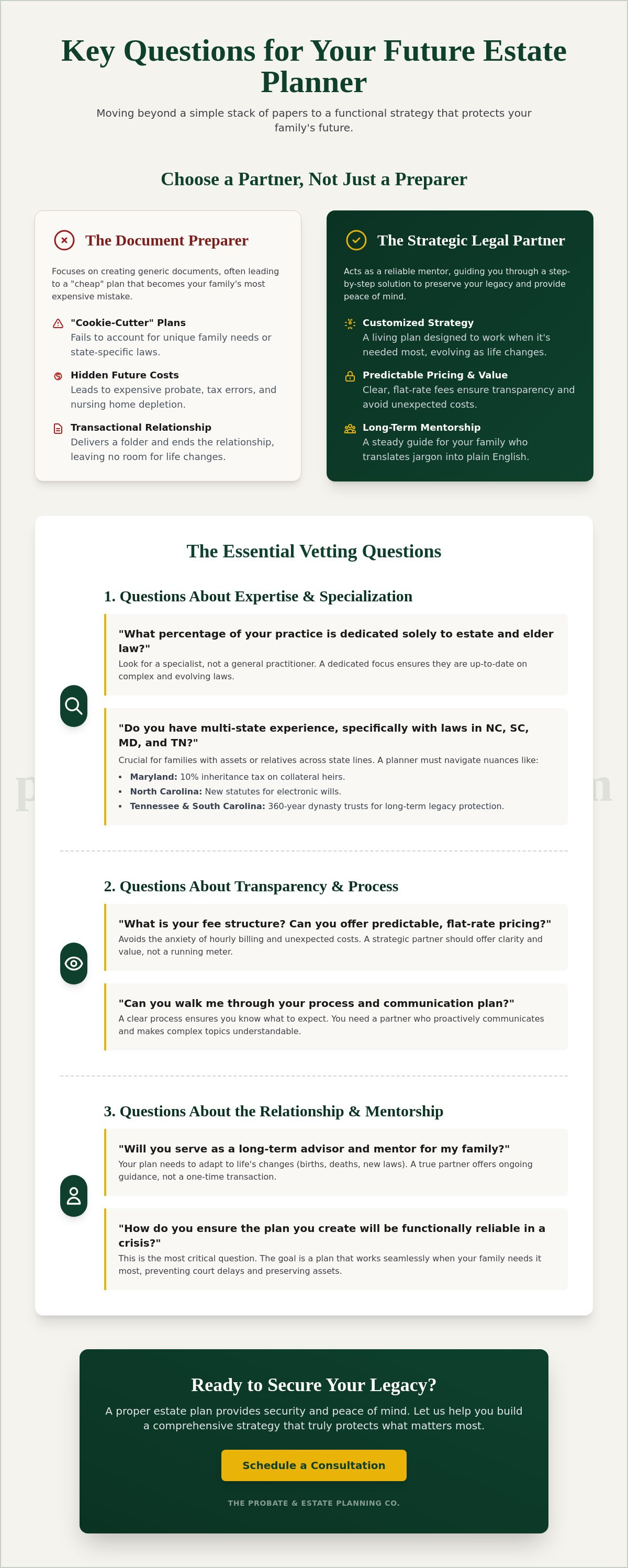
Choosing a legal partner is a significant decision. You aren't just buying documents; you're securing a future for those you love. When you ask, 2. What Questions Should I Ask Before Hiring an Estate Planner? you must look for depth. A general practitioner who handles traffic tickets or divorces might not understand the specific nuances of a 360-year dynasty trust in Tennessee or the 2026 spousal allowance increase in North Carolina. You need a specialist who lives in this complex legal world every day. Start by asking what percentage of their practice is dedicated solely to estate and elder law. If it's a small fraction, they may not be prepared for the intricacies of your situation.
Multi-state expertise is equally vital for residents in our region. Many families own property in both North Carolina and South Carolina, or they may move between Maryland and Tennessee. If your planner isn't comfortable navigating different state statutes, your plan might fail when it's needed most. For instance, Maryland imposes a 10% inheritance tax on certain beneficiaries that other states do not. A steady guide will understand these discrepancies and help you avoid unnecessary tax traps. A comprehensive Estate Planning strategy should always account for where you live now and where your assets are located.
The Critical Importance of Trust Funding
Trust funding is the process of retitling your assets, such as bank accounts and real estate, so they are owned by your trust. This is a step where many plans fail. Ask your planner: "What specific steps do you take to ensure my trust is actually funded?" If an attorney creates a Revocable Living Trust but leaves you to move the assets yourself without guidance, the trust remains empty. An unfunded trust is essentially a worthless stack of paper that will not avoid probate. You need to know if your legal partner provides a methodical, step-by-step solution to ensure your assets are properly aligned with your instructions.
Specialization in Elder Law and Medicaid
Long-term care costs can quickly deplete a lifetime of savings. You must ask how your planner handles Medicaid crisis planning and asset protection. Generalists often miss the traps within the five-year "look-back" period, which can result in significant penalties and delayed care eligibility. Ask specifically: "How do you protect a home from Medicaid estate recovery?" If you are managing a personal injury settlement, the stakes are even higher. You need a partner who knows how to structure these funds so they don't disqualify you from essential benefits. This level of specialization ensures your inheritance is preserved for the next generation rather than being consumed by nursing home costs.
Questions About Transparency: Understanding Fees, Process, and Communication
Transparency is the cornerstone of a healthy legal partnership. When you are planning for sensitive transitions, the last thing you need is the stress of unpredictable costs or a confusing process. As you interview potential advisors, you must feel empowered to ask, 2. What Questions Should I Ask Before Hiring an Estate Planner? specifically regarding their business practices. A reliable mentor will be open about how they manage your case, ensuring you feel like a priority rather than just another file on a desk. This clarity serves to empower you, making the daunting professional landscape feel manageable rather than overwhelming.
Flat Fees vs. Hourly Billing: What is Best for Families?
Many traditional law firms bill by the hour, which often leads to "clock-watching" anxiety for the client. You shouldn't have to worry that a quick phone call to clarify your Revocable Living Trust will result in an unexpected invoice. We believe flat fees are generally better for families because they encourage open communication. When pricing is predictable, you are more likely to share the vital details of your family dynamics that lead to a better legal outcome. Always ask for a written fee agreement that explicitly includes any potential "hidden" costs, such as court filing fees for probate administration or deed recording fees for asset protection planning. This openness allows you to focus on the gravity of your decisions rather than the ticking of a clock.
The process itself should be a methodical, step-by-step solution. Ask your planner to walk you through their specific lifecycle, from the initial consultation to the final signing ceremony. You deserve to know exactly what to expect at each stage. This includes understanding who your primary point of contact will be. Will you speak directly with an attorney for strategic decisions, or will a paralegal handle most of the day-to-day communication? A steady guide will have a clear system for keeping you informed throughout the drafting and execution phases of your plan.
The Lifecycle of Your Estate Plan
Estate planning is not a one-time event; it's a lifelong strategy of asset alignment. Laws change frequently, such as the 2026 update allowing electronic wills in North Carolina or the federal estate tax exemption reaching $15 million per individual in 2026. Because of this, you must ask how often your plan should be reviewed and what the cost will be for future updates. A proactive firm may offer maintenance services or membership programs to ensure your documents stay current with state-specific regulations in SC, MD, or TN. Finally, inquire about the firm's long-term continuity. You need to know that your records are safe and accessible even if the lead attorney retires or leaves the practice. A professional organization will have a secure system for document storage and retrieval that protects your legacy for decades to come.
Assessing the Relationship: Finding a Mentor, Not Just a Lawyer
Beyond the technicalities of tax exemptions and trust funding, the success of your plan depends on the relationship you build with your legal counsel. You're entrusting this person with your family's most sensitive transitions. When considering 2. What Questions Should I Ask Before Hiring an Estate Planner? you must evaluate the attorney's ability to act as a mentor. A true guide listens more than they talk. They should seek to understand your specific family dynamics and fears before offering a solution. This human-centric approach ensures your plan reflects your values, providing a sense of relief that mere procedural compliance cannot offer.
The "Plain English" Test
An attorney who hides behind dense legal jargon may not be the best guide for your family. During your consultation, ask the attorney to explain a Revocable Living Trust in under two minutes. If they can't describe it in accessible language, your family will likely struggle to understand their roles during a crisis. A mentor-style personality prioritizes your emotional well-being by making the complex feel manageable. You need a partner who values clarity over clinical technicalities, ensuring you feel confident in every decision you make for your future security.
Empowering Your Heirs and Executors
A common oversight in planning is neglecting the people who will carry out your wishes. Your documents are only as effective as the people prepared to use them. Ask the planner: "Do you offer educational resources or meetings for my chosen executors?" The first 30 days after a loss are often the most overwhelming for a family. Having a steady hand to navigate the initial steps of Probate Administration Services can prevent countless future complications. A planner who prepares your people, not just your papers, offers the highest level of functional reliability. This proactive stance protects your heirs from unnecessary stress and preserves your most important interpersonal connections.
If you are looking for a legal partner who prioritizes your peace of mind and provides a steady hand through life's most serious transitions, The Probate & Estate Planning Co. is here to guide you toward a secure and predictable outcome.
Securing Your Legacy with The Probate & Estate Planning Co.
Your legacy is much more than a collection of financial accounts and property titles. It represents the culmination of your life's work and the foundation for the next generation's security. When you consider, 2. What Questions Should I Ask Before Hiring an Estate Planner?you're looking for more than just technical answers. You're seeking a legal partner who understands the gravity of your situation and treats your family's future with the seriousness it deserves. At The Probate & Estate Planning Co., we answer these critical questions by offering a partnership rooted in professional authority and empathetic reassurance. We move away from cold, clinical technicalities to focus on the human impact of every decision you make.
Our firm provides a steady hand for families navigating complex legal landscapes. Whether you require a Revocable Living Trust to avoid probate or urgent Medicaid Crisis Planning to protect a family home, we offer a methodical, step-by-step solution. We don't just draft papers; we craft strategies. Our commitment to functional reliability means your plan is designed to work when it's put to the test, providing a sense of relief that generic documents simply cannot offer. We prioritize your emotional well-being by ensuring every step of the process is clear, logical, and patient.
A Steady Guide Through Sensitive Transitions
Our human-centric approach to Asset Protection Planning and continuity is built on the belief that your plan should safeguard your most important interpersonal connections. We understand that procedural obstacles and temporal delays can cause significant anxiety during a crisis. By focusing on meticulous attention to detail, we eliminate the risks of inaction and guide you toward a secure and predictable outcome. You deserve the peace of mind that comes from knowing your legacy is in the hands of a reliable mentor. We invite you to Schedule your consultation with The Probate & Estate Planning Co. to experience a private partnership designed specifically for your unique circumstances.
Protecting What Matters Most Across State Lines
Managing a legacy across state lines requires a deep understanding of varying state statutes. With a presence in Charlotte, Nashville, Towson, and beyond, our firm is uniquely positioned to handle the nuances of multi-state planning for families in North Carolina, South Carolina, Maryland, and Tennessee. We understand how the 2026 changes to the Maryland estate tax exemption or the North Carolina spousal allowance laws impact your specific strategy. Taking the first step toward securing your future is often the most difficult part of the process. However, the sense of security you gain once a customized strategy is in place is invaluable. Your legacy deserves a proactive guardian who views your long-term management as a shared responsibility. We are ready to steer you toward a future that is both protected and predictable.
Take the Next Step Toward Lasting Security
Choosing the right legal partner is a profound decision that impacts your family's continuity and peace of mind. You now understand that a successful strategy requires moving beyond basic document preparation to find a mentor who understands the nuances of Medicaid Crisis Planning and Asset Protection. By answering the fundamental question, 2. What Questions Should I Ask Before Hiring an Estate Planner? you've already begun the process of distinguishing a simple administrative service from a protective partnership. Our team brings specialized expertise across North Carolina, South Carolina, Maryland, and Tennessee, ensuring your plan remains resilient regardless of state lines.
We invite you to experience a human-centric approach to legal guidance that prioritizes your emotional well-being. It's time to replace the anxiety of the unknown with a methodical, step-by-step solution designed for your unique circumstances. Your legacy represents your life's most important work; it deserves a guardian who's as committed to its preservation as you are. Taking this first step is a powerful act of responsibility for those you love.
Secure Your Legacy: Book a Consultation with Our Multi-State Experts
Frequently Asked Questions
Do I really need an attorney, or can I use an online estate planning tool?
Online tools often provide generic templates that fail to account for specific state laws, such as Maryland's inheritance tax or North Carolina's 2026 electronic will storage rules. An attorney provides a customized strategy and functional reliability that software cannot replicate. You're paying for legal wisdom and the assurance that your plan will actually work when your family faces a sensitive transition.
How much does a typical estate planning consultation cost in 2026?
Consultation fees vary depending on the complexity of your assets and the specific experience of the legal professional. Some firms may apply the consultation fee toward the total cost of your plan if you choose to move forward with their services. You should check with individual practices to understand their specific billing structure before you schedule your initial meeting.
What is the difference between an estate planner and a financial advisor?
An estate planner is a legal professional who drafts binding documents like an Irrevocable Trust or a Durable Power of Attorney to manage your legacy. A financial advisor focuses on wealth accumulation and investment strategies. While they often collaborate, only an attorney can provide legal advice and ensure your documents meet the rigorous state-specific requirements in NC, SC, MD, or TN.
Can an estate planner help me if I already have a will from another state?
Yes, an estate planner can review your existing documents to ensure they comply with the laws of your current state. This is a vital part of the vetting process when people ask, 2. What Questions Should I Ask Before Hiring an Estate Planner? Laws regarding spousal allowances and trust duration vary greatly between states, and a local expert ensures your documents won't lead to procedural obstacles.
What happens if I hire an estate planner and then want to change my mind?
You generally have the right to terminate your relationship with a legal professional at any time. You may be responsible for fees associated with work already performed according to your engagement agreement. Clear communication is essential. Most reputable firms provide a written agreement at the start of the partnership that outlines the steps for ending or modifying the scope of your legal work.
Should I ask about their experience with probate court specifically?
You should absolutely inquire about their experience with Probate Administration Services. A planner who understands the practical realities of the courtroom is better equipped to draft documents that prevent future complications for your heirs. This perspective ensures your plan is grounded in functional reliability rather than just administrative theory, protecting your family from unnecessary delays and emotional stress.
How long does the entire estate planning process usually take from start to finish?
The timeline for creating a comprehensive plan typically ranges from a few weeks to a few months depending on the complexity of your estate. A methodical, step-by-step solution involves an initial consultation, a design phase, and a final signing ceremony. While some documents can be prepared quickly in a crisis, a thorough strategy for asset protection requires a deliberate and patient pace.
Comments
There are no comments for this post. Be the first and Add your Comment below.
Leave a Comment