

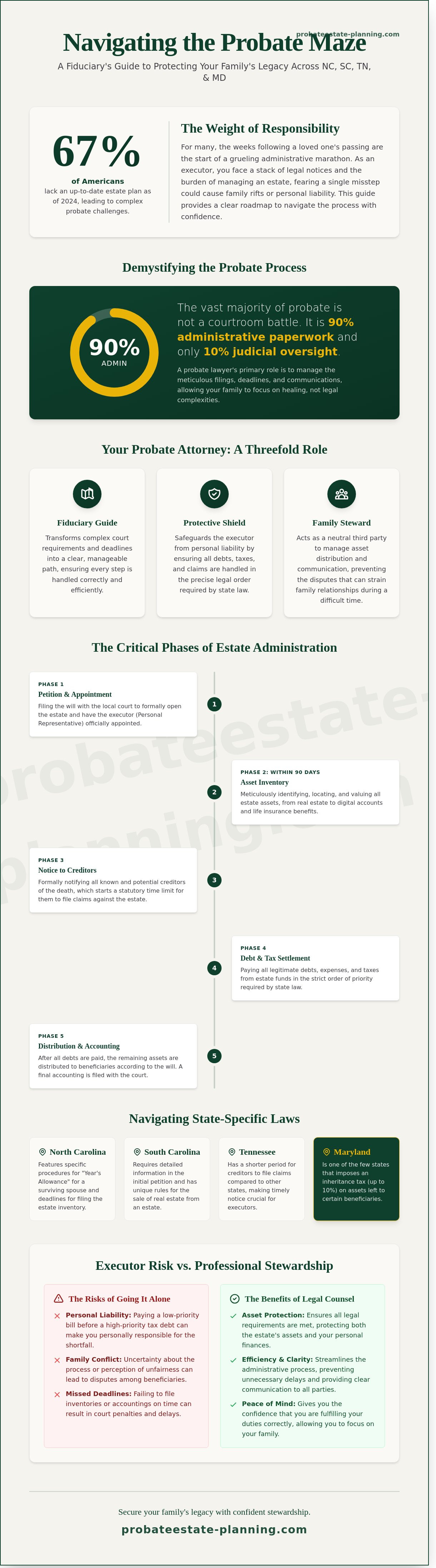
Imagine sitting at a kitchen table in Raleigh or Baltimore, staring at a stack of legal notices that arrived just fourteen days after a funeral. For the 67% of Americans who do not have an up-to-date estate plan as of 2024, this moment often marks the start of a grueling administrative marathon where probate court lawyers become essential partners in stewardship. You likely feel the weight of this responsibility, fearing that one missed deadline or a single mismanaged asset could spark a rift in your family or lead to personal liability. It's a heavy burden to carry while you're still grieving.
You aren't alone in this struggle, and your desire to protect your family's harmony is both valid and achievable. This guide shows you how to protect assets and fulfill your fiduciary duties with confidence across North Carolina, South Carolina, Tennessee, and Maryland. We'll walk through the specific court requirements for each state to provide a clear roadmap that closes the estate legally, fairly, and with your peace of mind intact. By understanding the process, you can move from a place of uncertainty to a position of steady, capable leadership for your family.
Key Takeaways
- Understand the essential role of a fiduciary guide in transforming complex court paperwork into a manageable path forward for executors and beneficiaries.
- Discover how probate court lawyers safeguard your family's legacy by meticulously marshaling assets and navigating the specific inheritance laws of NC, SC, TN, and MD.
- Evaluate your unique situation to decide if a full estate administration is necessary or if simplified legal tools can help you avoid unnecessary delays.
- Master the critical phases of the probate timeline, ensuring you meet strict deadlines for filing petitions, inventorying assets, and settling creditor claims.
- Learn how professional stewardship can prevent family conflict and provide the emotional reassurance needed to transition through the estate process smoothly.
Understanding the Role of Probate Court Lawyers in the Estate Process
Losing a loved one brings an immediate, heavy burden of responsibility. You aren't just grieving; you're suddenly tasked with managing a complex legal transition. Probate court lawyers serve as the steady hand for executors and beneficiaries, acting as fiduciary guides through the local court systems of North Carolina, South Carolina, Tennessee, and Maryland. While the word "court" often suggests a judge's gavel and heated arguments, the reality is far more methodical. In the majority of cases, the process involves 90 percent administrative paperwork and 10 percent judicial oversight.
There's a distinct difference between estate planning and probate administration. Planning is the act of creating the map years in advance. Administration is the actual journey taken after that map is opened. Without a professional to lead the way, the transition from a written will to the actual distribution of assets can stall. Probate court lawyers ensure that the deceased's wishes don't remain just words on a page but become a reality for the surviving family. This professional oversight prevents the chaos that typically follows unmanaged estate distribution, where assets might be frozen or family relationships strained by uncertainty.
The Administrative vs. Adversarial Role
Most probate cases focus on routine filings like the initial petition, the inventory of assets, and final accountings. A lawyer manages these strict deadlines so the family can focus on healing. However, if a distant relative challenges a 2025 amendment or a creditor makes an unsubstantiated claim, the role shifts. The lawyer becomes a protective buffer, resolving disputes before they escalate into full-scale litigation. This stewardship preserves family harmony during a period when emotional tensions naturally run high.
Why Legal Counsel is Essential for Executors
Personal representatives face significant risks that many don't realize until it's too late. If you accidentally pay a low-priority medical bill before a high-priority tax debt and the estate runs out of funds, state laws in NC or MD may hold you personally liable for the shortfall. A probate lawyer serves as a protective shield against procedural errors that could jeopardize an executor's personal assets or the family's inheritance. By ensuring all creditors are paid in the exact legal order required by 2026 statutes, the lawyer provides a secure path forward.
- Verification of all life insurance and retirement death benefits.
- Management of digital assets and cryptocurrency accounts, which became a standard requirement for inventories by 2024.
- Formal notification of all known creditors to start the statutory claim period.
- Preparation of the final inheritance tax returns to ensure the estate is closed properly.
By partnering with a professional, you're not just hiring a document preparer. You're securing a partnership in stewardship that prioritizes your family's future over cold, clinical legalism.
Key Responsibilities: How a Probate Attorney Safeguards Your Family's Legacy
Probate court lawyers act as the primary stewards of a decedent's final wishes, transforming a complex legal requirement into a structured path toward resolution. Their first task involves identifying and marshaling assets. This requires cataloging everything from real estate holdings to digital investment accounts within the first 90 days of the court appointment. This inventory ensures the court has a transparent view of the estate's total value before any debts are paid or assets are moved. Without this meticulous accounting, executors risk personal liability for missing or undervalued property.
Beyond physical assets, these attorneys manage state-specific tax filings and inheritance requirements that vary significantly across the Mid-Atlantic and Southeast. While federal estate tax thresholds are high, states like Maryland continue to impose an inheritance tax of up to 10% on certain beneficiaries as of 2024. Your attorney ensures these taxes are calculated correctly and paid from the estate's funds, preventing the state from placing liens on the family home or other inherited property.
Managing the "Notice to Creditors" is a critical shield for the family's future financial security. This process typically involves:
- Publishing a legal notice in a local newspaper for a duration specified by state law, such as four consecutive weeks in North Carolina.
- Identifying known creditors and sending direct notices to ensure all valid debts are settled.
- Establishing a clear "bar date" after which most unknown claims are legally void.
- Drafting a final accounting and distribution plan that requires court approval before the final check is written.
Experienced probate court lawyers ensure that every creditor is accounted for so the family's inheritance remains protected from future lawsuits. Once the debts are cleared, the lawyer prepares a final accounting. This document provides a line-by-line justification of every cent spent, ensuring the court can confidently close the estate.
State-Specific Nuances: NC, SC, TN, and MD
In North Carolina, the Clerk of Superior Court acts as the probate judge, overseeing filings with strict procedural oversight. Maryland utilizes the Register of Wills for administrative tasks, though the Orphans' Court intervenes if a dispute arises. Tennessee and South Carolina rely on dedicated Probate Judges who often exercise broader discretion over estate settlements. Understanding these local hierarchies is why many families choose to consult with experienced counsel early in the process to avoid procedural delays.
Protecting Beneficiary Rights
A lawyer's duty includes ensuring the "Last Will and Testament" remains the absolute roadmap for distribution. If a probate case drags on past the 12-month mark, probate court lawyers can often facilitate partial distributions. This provides grieving family members with immediate financial relief while the remaining legal details settle. Clear communication remains the priority; translating complex court orders into plain language maintains family harmony during a period of high emotional stress.
Do You Need a Probate Lawyer? Evaluating Your Situation
Deciding whether to hire probate court lawyers depends on three specific factors: the total value of the estate, the types of assets involved, and the level of cooperation among heirs. You're likely feeling the weight of your fiduciary duties, and it's vital to determine if the estate qualifies for simplified procedures. In North Carolina, for instance, a "Collection by Affidavit" is available if the deceased's personal property is valued under $20,000. Maryland offers a similar "Small Estate" process for assets worth $50,000 or less, or $100,000 if the surviving spouse is the sole heir. If the estate exceeds these specific thresholds, the law generally requires a more formal, supervised process.
Attempting a DIY probate to save money often results in "hidden" costs that far exceed legal fees. The IRS can impose a 20% penalty for substantial estate tax underpayments under Section 6662. Additionally, if an executor distributes funds to beneficiaries before satisfying a priority creditor, like a state Medicaid recovery claim, that executor is often held personally liable for the debt. These financial traps, combined with potential interest on unpaid inheritance taxes in states like Maryland, make professional oversight a protective necessity rather than a luxury.
Signs You Definitely Need Legal Representation
If your loved one owned a business or held real estate in multiple states, such as a primary home in Tennessee and a rental property in South Carolina, the process becomes exponentially more difficult. You'll likely face "ancillary probate," which requires filing in two different court systems simultaneously. Legal counsel is also mandatory if the deceased died "intestate," meaning they left no valid will. In these cases, state laws dictate exactly who receives which asset. Without a lawyer to interpret these rigid statutes, you risk a lawsuit from a disgruntled relative who feels slighted by the state's default distribution plan.
The Value of Peace of Mind
Professional guidance significantly reduces the timeline for asset distribution. While a standard probate can drag on for 12 to 18 months, probate court lawyers ensure filings are accurate the first time, preventing the court from rejecting your petitions and resetting your timeline. Delegating the technical work allows you to focus on your family's emotional recovery rather than missing court deadlines or deciphering tax codes. A lawyer's fee is often an investment in family harmony because it provides a neutral, third-party framework that ensures every heir is treated fairly and according to the law.
Navigating the Probate Court Timeline in the Southeast and Mid-Atlantic
Understanding the legal clock is the first step toward peace of mind. While every family's situation is unique, most estates in North Carolina, South Carolina, Tennessee, and Maryland follow a predictable rhythm that spans 9 to 12 months. This duration isn't arbitrary. It's a structured period designed to protect the rights of heirs and ensure all financial obligations are met before assets change hands. Knowing what to expect each month can transform a daunting task into a manageable series of steps.
The first 30 days are often the most intense. During this window, you must file the petition for probate and the original will with the clerk of court. Once the court approves the filing, it issues "Letters of Testamentary" or "Letters of Administration." These documents are vital. They grant the executor the legal authority to access bank accounts, speak with insurance companies, and manage property. Without these letters, the estate remains frozen.
The middle phase focuses on transparency and debt resolution. You'll spend this time identifying assets and notifying creditors. In many jurisdictions, this includes a mandatory 3 to 4 month waiting period for creditors to file claims. This phase ensures that the legacy you're passing on is clear of unexpected liens or debts. Finally, the process moves into the closing phase, where you submit a final accounting to the court and distribute the remaining assets to the beneficiaries.
Step-by-Step: From Petition to Discharge
The journey begins with a formal filing in the county where the deceased resided. In states like North Carolina and Maryland, the law mandates a strict 90-day deadline for filing an initial inventory of the estate's assets. This inventory must list the fair market value of all property at the time of death. Precision here is critical. After debts and taxes are paid, you'll file a final petition for discharge. This legal step is your shield. It officially closes the estate and releases you from your fiduciary liabilities, ensuring the process is finished correctly.
Common Delays and How to Avoid Them
Administrative errors are the most frequent cause of probate stagnation. A single missing signature or an incorrectly formatted document can stall a case for 30 to 60 days. Out-of-state property also complicates the timeline, often requiring a secondary process known as ancillary probate. Probate court lawyers help you avoid these traps by conducting thorough document reviews before anything reaches the clerk's desk. They act as a steady guide, managing the logistical hurdles of out-of-state executors and ensuring that every deadline is met with professional accuracy.
Choosing the Right Probate Partner: The Probate & Estate Planning Co.
Losing a loved one brings enough emotional weight; the legal aftermath shouldn't add to your burden. At The Probate & Estate Planning Co., our team of probate court lawyers acts as your professional stewards during this transition. We don't just process paperwork. We protect your family's legacy and ensure the preservation of interpersonal relationships. Our "Plan That Works" promise is built on the foundation of functional outcomes. Many firms focus solely on document preparation, but we prioritize the actual execution of those plans so that assets move efficiently to the rightful heirs without unnecessary friction.
Our commitment to empathetic stewardship means we recognize the gravity of your situation. We move away from cold, clinical legalism to provide a human-centric experience. By handling the complex fiduciary duties and court filings, we allow you the space needed for personal healing. We've seen how lack of preparation leads to family discord, and our goal is to maintain harmony through clear, decisive legal action.
A Multi-State Approach with Local Expertise
Estate laws shift the moment you cross state lines, making a multi-state perspective essential for modern families. Whether your family is managing assets in Charlotte, Nashville, Rock Hill, or Towson, we provide the local depth required to navigate specific state statutes. Our team understands the nuances of North Carolina's General Statutes Chapter 28A and Maryland's specific probate codes with equal precision. This regional experience is vital when dealing with diverse property laws, such as Tennessee's unique real estate transfer rules or South Carolina's specific creditor claim periods.
We maintain active working relationships with local court clerks in Mecklenburg, Davidson, York, and Baltimore counties. These connections help us anticipate local court preferences that can often stall a case for months. Our presence in these four states allows us to handle "ancillary probate" seamlessly. If a decedent lived in Nashville but owned a vacation home in Rock Hill, we manage both processes under one roof, reducing the 12 to 18-month delays commonly associated with multi-state estates.
Your Next Steps Toward Peace of Mind
Taking the first step often feels like the hardest part of the process. When you meet with our probate court lawyers, we handle the heavy lifting so you can focus on your family's emotional well-being. To make your initial probate consultation most effective, please bring the following items:
- The original last will and testament, if one exists
- A certified copy of the death certificate
- A preliminary list of known assets, including bank statements and real estate deeds
- A list of known creditors or outstanding debts
We'll review these documents to identify potential hurdles early, such as tax liens or contested clauses. Our steady, measured pace ensures that every detail is addressed, from filing the initial petition to the final distribution of assets. You don't have to carry this weight alone. Schedule your consultation with our probate team today to begin securing your family's future and finding the path toward a predictable, secure outcome.
Protect Your Family Legacy with Confidence
The probate process doesn't have to be a source of chaos or confusion for your loved ones. By understanding the specific court timelines in North Carolina, South Carolina, Tennessee, and Maryland, you can transform a complex legal requirement into a structured path toward resolution. Experienced probate court lawyers serve as more than just legal representatives; they act as stewards of your family harmony and protectors of your hard-earned assets. This stewardship ensures that your final wishes are honored without unnecessary delays or interpersonal friction.
At The Probate & Estate Planning Co., we bring decades of experience to every case, ensuring every fiduciary duty is met with meticulous precision. Our team provides specialized Medicaid and asset protection expertise to prevent the erosion of your estate during the transition. We've spent years guiding families through these transitions with a focus on empathy rather than clinical legalism. You don't have to navigate these state-specific hurdles alone when a steady guide is ready to help you manage the details. Secure your family's future with a probate consultation today. You've worked hard to build your life; we're here to make sure your legacy remains exactly as you intended.
Frequently Asked Questions
What exactly does a probate court lawyer do for an executor?
A probate lawyer guides you through the legal filing of the will and the formal identification of all estate assets. They ensure you meet strict court deadlines to avoid personal liability for any administrative errors. This role includes notifying creditors, filing inventory reports, and managing the distribution of property according to the law. You gain a steady guide who handles the complex paperwork so you can focus on your family's emotional healing.
How much does a probate lawyer cost in North Carolina or Tennessee?
Costs vary based on the estate's complexity, but legal fees are typically paid directly from the estate's assets. In North Carolina, the Clerk of Court also collects a probate fee of $0.40 per $100 of asset value, which is capped at $6,000 as of 2024. Most attorneys offer a clear fee structure during the initial consultation. This transparency helps you manage the estate's resources without unexpected financial strain on your own household.
Can I handle the probate process without a lawyer?
You can technically represent yourself, but it's a risky path because executors carry 100 percent personal liability for any mistakes. If you miss a mandatory creditor notice or miscalculate a tax payment, you're legally responsible for the loss. Experienced probate court lawyers provide a shield of protection. They ensure every step follows the specific statutes of your state, which prevents the chaos of legal disputes or financial penalties later.
How long does it take for a probate court to close an estate?
A typical estate takes 9 to 12 months to settle in states like Maryland and South Carolina. This timeline is largely dictated by mandatory creditor notice periods, which usually last 90 to 120 days depending on the jurisdiction. If the estate involves complex real estate holdings or federal tax filings, the process often extends beyond the 18 month mark. Your attorney works to keep the timeline as short as possible through meticulous organization.
What happens if a family member contests the will in court?
The probate court moves the case into a litigation phase, which often halts the distribution of assets to all beneficiaries. In North Carolina, this is known as a caveat proceeding where a judge or jury determines if the will is valid. You'll need a steady guide to manage the evidence and protect the deceased's legacy. Legal intervention helps resolve these 100 percent emotionally charged conflicts while maintaining as much family harmony as possible.
Do I have to go to court in person if I hire a probate lawyer?
You'll rarely need to step into a courtroom when you have professional representation. Your attorney handles the vast majority of filings and communications with the Clerk of Court on your behalf. Since 2024, many jurisdictions have expanded electronic filing systems, allowing your legal team to manage the process remotely. This convenience saves you time and reduces the stress of navigating a formal courthouse environment during a difficult time of grief.
What is the difference between a probate lawyer and an estate lawyer?
An estate lawyer focuses on drafting your legacy documents before they're needed, while probate court lawyers manage the administration after someone passes away. Think of the estate lawyer as the architect who designs the plan and the probate lawyer as the navigator who follows it. Both roles are essential for the protection of your family. They work together to ensure that 100 percent of your final wishes are honored and legally enforced.
Will the probate lawyer handle the sale of the deceased's house?
Your lawyer manages the legal requirements of the sale, such as drafting the deed or obtaining a court order to sell. While they don't act as real estate agents, they ensure the title is clear and the sale proceeds are distributed correctly to the heirs. This oversight prevents 100 percent of the common title defects that can stall a closing. It provides a layer of security that protects the estate's most valuable financial asset.
Comments
There are no comments for this post. Be the first and Add your Comment below.
Leave a Comment