

What if the most expensive part of settling your loved one's estate isn't the taxes, but the administrative costs you didn't see coming? It's natural to feel a heavy sense of unease when you're handed the responsibility of being an executor. You want to honor your family's legacy, yet the fear of personal liability and confusing court fee calculations can make the process feel like a burden instead of a service. We understand that you're looking for clarity during a sensitive time of transition.
This guide helps you understand exactly how probate attorney fees in north carolina work; we cover everything from the 5% executor commission cap to the specific filing taxes mandated by the state. You'll gain a clear perspective on the "reasonable compensation" standard and learn how to protect your family's inheritance from unnecessary depletion. We'll walk you through the different billing structures available in 2026, show you how to minimize court interaction, and provide the confidence you need to lead your family through this complex legal landscape with grace and precision.
Key Takeaways
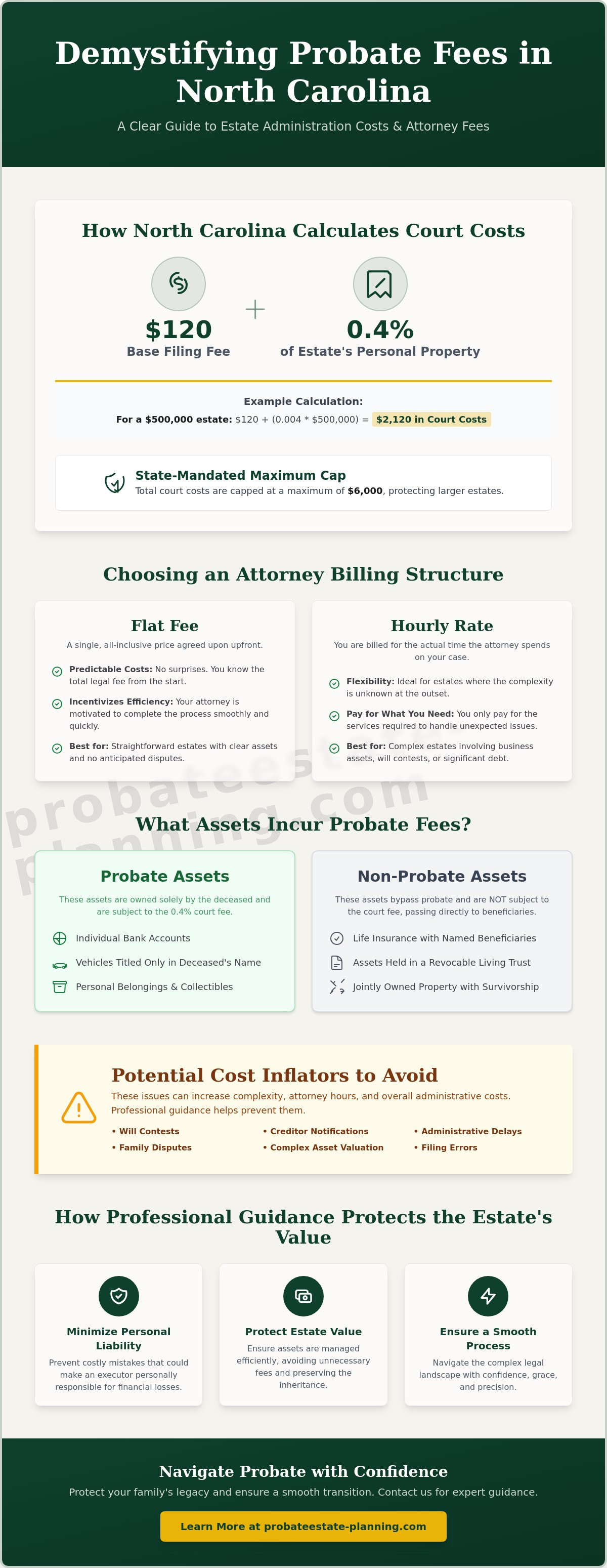
- Learn how North Carolina calculates court costs using a $120 base fee and a specific valuation tax, ensuring you stay under the state-mandated $6,000 ceiling.
- Evaluate the differences between flat fees and hourly billing to choose the most cost-effective structure for your family's unique circumstances.
- Gain transparency regarding probate attorney fees in north carolina so you can protect the estate's value and ensure heirs receive their full intended inheritance.
- Identify hidden "cost inflators" like creditor notifications and will contests to prevent administrative delays and unexpected financial burdens.
- Understand how professional legal guidance minimizes an executor's personal liability and prevents costly mistakes during the complex filing process.
Understanding the Financial Landscape of North Carolina Probate
The legal process of probate is essentially a court-supervised transition. It serves as a formal method to authenticate a Last Will and Testament, pay off valid debts, and distribute what remains to the rightful heirs. While the word "court" often triggers anxiety, this oversight is designed to protect everyone involved. It ensures that creditors don't overreach and that no single heir receives more than they're entitled to under the law. Understanding probate attorney fees in north carolina starts with recognizing that these costs are a necessary investment in the estate's long-term security.
To better understand this concept, watch this helpful video:
One of the most common concerns for executors is the source of these funds. You can breathe a sigh of relief knowing that, in North Carolina, probate fees are generally paid directly from the estate's assets. You aren't expected to pay for legal counsel or court filings out of your own pocket. This structure allows you to focus on the emotional weight of your duties without the added pressure of personal financial liability. It transforms the process from an individual burden into a shared responsibility managed by the estate itself.
The Role of the Clerk of Superior Court in Fee Oversight
In North Carolina, the Clerk of Superior Court in each county acts as a protective gatekeeper. They don't just rubber-stamp paperwork. Instead, the Clerk must review and approve every expenditure the estate makes. This oversight is vital because it prevents the "wasting" of assets through unnecessary or excessive spending. Whether your family's estate is located in North Carolina, South Carolina, Maryland, or Tennessee, having a steady guide helps you navigate these local regulations. The Clerk's duty is to ensure the estate is managed with the highest level of integrity, safeguarding the inheritance for future generations.
Probate vs. Non-Probate Assets: What Incurs Fees?
Not every asset a person owned will pass through the court's hands. Probate assets typically include items owned solely by the deceased, such as individual bank accounts, vehicles, and personal belongings. These assets are subject to the state's 0.4% court fee. Conversely, non-probate assets often include life insurance proceeds with named beneficiaries or assets held in a Revocable Living Trust. These bypass the formal probate process entirely. When calculating probate attorney fees in north carolina, it's helpful to remember that legal fees are typically tied to the complexity and value of the specific assets the attorney is hired to manage. By identifying which items avoid court oversight, you can better predict the overall financial impact on the inheritance.
Breaking Down the Statutory Fees: Court Costs and Attorney Caps
Clarity is the best antidote to anxiety. When you're managing an estate, you deserve to know exactly where every dollar goes. North Carolina law provides a specific framework for these expenses, ensuring that costs remain predictable and fair. By following the official North Carolina court costs, the state creates a system that balances administrative needs with the protection of your family's inheritance. This structure prevents arbitrary charges and offers a ceiling that keeps the process manageable. Under N.C.G.S. § 7A-307, the state even imposes a $6,000 maximum cap on these court costs, providing a clear upper limit for larger estates.
The 0.4% Court Assessment: Calculating Your Costs
The primary court cost you'll encounter is based on the value of the estate's personal property. North Carolina charges a base filing fee of $120 to open the estate. Beyond that, the state applies a tax of $0.40 for every $100 of the estate's value. For example, a $500,000 estate results in a $2,000 court fee. You'll typically pay this when you file the 90-day inventory or the final account. It's helpful to remember that real estate usually stays out of this specific calculation unless the executor must sell the property to pay debts. This distinction often saves families thousands in court taxes. If you're feeling overwhelmed by these calculations, engaging professional probate administration services can ensure your filings are accurate and on time.
The 5% Maximum Rule for Commissions
North Carolina also sets strict limits on how much can be paid out in commissions. Under N.C.G.S. § 28A-23-3, the combined commission for the executor and the attorney generally cannot exceed 5% of the estate's receipts and disbursements. This 5% cap is a vital safeguard for heirs. When people discuss probate attorney fees in north carolina, they often worry about legal costs consuming the entire estate. This statutory limit ensures that doesn't happen.
It's important to understand that "receipts" refers to the value of personal property and income collected during the process, not necessarily the total gross value of everything the deceased owned. For very small estates, the court might approve a reasonable minimum fee to ensure the work is handled correctly, even if the percentage math would result in a lower amount. This approach guarantees that even modest estates receive the professional attention they deserve. Understanding probate attorney fees in north carolina helps you plan for these costs with confidence, knowing the law is on your side to prevent overpayment.
Hourly vs. Flat Fee: Choosing the Right Billing Structure
Every family's situation is unique, and the way you pay for legal guidance should reflect that reality. Choosing how to pay for professional support is one of the first major decisions an executor makes. In North Carolina, there isn't a one-size-fits-all approach. Instead, you'll likely choose between a flat fee or an hourly rate. While some states allow a strict percentage of the estate, North Carolina Clerks of Court are often skeptical of this model. They prefer billing that reflects the actual labor performed rather than a generic slice of the inheritance. According to resources from the UNC School of Government, the focus remains on ensuring the estate isn't overcharged for routine administrative tasks.
To ensure total transparency, North Carolina requires an "Affidavit of Reasonableness" for any attorney fee request. This document is a safeguard for your family. It requires the attorney to justify the probate attorney fees in north carolina by outlining the complexity of the case, the specific tasks completed, and the value provided to the estate. The Clerk of Court reviews this carefully to ensure the fees are fair to the heirs before any payment is authorized. This procedural step provides a layer of protection that many other states lack, reinforcing the idea that the court is a partner in preserving your legacy.
Pros and Cons of Flat Fee Arrangements
A flat fee offers immediate predictability and emotional peace of mind. It's usually best for "simple" estates where the will is clear and the heirs are cooperative. You know the cost upfront, which typically covers the initial filing, creditor notices, inventory preparation, and the final accounting. The primary risk is that you might overpay if the estate settles much faster than anticipated. However, for many families, the certainty of a fixed cost outweighs the possibility of a slight overpayment, as it eliminates the stress of monthly legal bills during a time of grief.
Understanding Hourly Billing in Probate
For complex estates involving business interests, contested wills, or missing heirs, hourly billing is often the most equitable choice. In 2026, hourly rates for probate attorneys in North Carolina typically range from $200 to $450. To manage these costs effectively, many practices utilize a blended rate system. This means paralegals handle routine documentation and filings at a significantly lower rate, saving the estate's resources for high-level legal strategy when it's truly needed. Detailed time logs are a mandatory part of this process. These logs provide a clear, instructional map of how the estate's funds were used, ensuring every dollar spent contributes directly to a secure and predictable outcome.
Factors That Increase Legal Costs (and How to Avoid Them)
While the statutory framework provides a baseline, certain complexities can act as financial inflators. Every estate is a unique puzzle. If you're managing an estate with missing heirs or insolvent accounts, you'll likely see an increase in the time required to reach a resolution. These variables naturally impact probate attorney fees in north carolina because they require more intensive investigation and negotiation. Beyond legal labor, you should also account for mandatory third-party costs. For instance, North Carolina law requires a "Notice to Creditors" to be published in a local newspaper for four consecutive weeks. This public notice typically costs between $200 and $400, depending on the county's publication rates.
Additional expenses often include appraisal fees. If the estate contains real estate, fine jewelry, or specialized collections, the Clerk of Court will require professional valuations to ensure the inventory is accurate. Another common cost is the Fiduciary Bond, which serves as a form of insurance for the heirs. While this bond protects the estate from mismanagement, the premiums add up. You can often avoid this expense if the Last Will and Testament explicitly waives the bond requirement or if all beneficiaries provide a written waiver that the Clerk accepts.
Litigation and Contested Wills
It's a difficult reality, but family disagreements can significantly alter the financial landscape. When a will is contested or an heir files a lawsuit against the estate, the standard 5% commission cap often no longer applies. These are considered "extraordinary services" by the court. Litigation can easily double or triple the total legal spend because it involves depositions, hearings, and extensive evidence gathering. Proactive planning, such as including a "No-Contest Clause" in the original estate plan, is one of the most effective ways to prevent these disputes before they start.
Dealing with Debts and Medicaid Recovery
North Carolina has a robust Medicaid Estate Recovery program. If the deceased received certain long-term care benefits, the state may seek reimbursement from the estate assets. Managing these claims requires a delicate touch. An attorney must often negotiate with the state and other creditors to determine the priority of payments and preserve as much as possible for the family. If you're currently facing a situation where a loved one requires immediate care, our Medicaid Crisis Planning services can help you navigate these rules before probate even begins. Understanding how these factors influence probate attorney fees in north carolina allows you to make informed decisions that safeguard your family's financial future. For personalized guidance on managing these complexities, consider our professional Probate Administration Services.
How Professional Administration Protects the Estate's Value
Choosing to handle probate without professional support often feels like a way to save money, but the reality is frequently the opposite. Attempting a "DIY" approach can quickly become expensive if you miss a court deadline or miscalculate the 0.4% assessment discussed in previous sections. These errors lead to tax penalties and interest that can dwarf the initial probate attorney fees in north carolina. When you partner with experienced professionals, you aren't just paying for paperwork. You're investing in the speed and accuracy required to close the estate as efficiently as possible. Time is a finite resource; a faster closing means heirs receive their inheritance sooner and the ongoing costs of maintaining estate assets, such as insurance and utilities, are significantly reduced.
Our practice serves as a reliable mentor during these sensitive transitions. We prioritize your emotional well-being by handling the cold, clinical technicalities of the court system for you. This partnership provides a sense of quiet confidence, knowing that the organization has navigated these complexities many times before. We focus on functional reliability and practical outcomes, ensuring that the legacy left behind is preserved rather than depleted by administrative mistakes.
Avoiding Personal Liability for the Executor
Many executors don't realize that they carry personal financial risk throughout this process. If you distribute assets to family members before satisfying the state's Medicaid recovery claims or federal tax obligations, the court can hold you personally responsible for those debts. Legal counsel acts as a vital insurance policy against these risks, ensuring every step follows the strict order of priority required by North Carolina law. Fiduciary duty is the legal and ethical obligation of an executor to act in the best interests of the estate and its beneficiaries while prioritizing the payment of all valid debts and taxes. By having a steady guide by your side, you can fulfill this duty with the confidence that your own financial security is never in jeopardy.
Next Steps: Securing Your Legacy
Once the immediate hurdles of probate are cleared, it's the ideal time to look forward. The most effective way to manage future probate attorney fees in north carolina for your own heirs is through proactive preparation today. We often help families transition from the complexities of administration into long-term Estate Planning. By exploring tools like a Revocable Living Trust or a Last Will and Testament, you can ensure that your own future transitions are seamless, private, and predictable. This protective stance ensures continuity and safety for the people who matter most to you.
If you are ready to move forward with professional support, Schedule a consultation with our North Carolina probate team. We are here to offer the wisdom and partnership you need to safeguard your family's future and provide the peace of mind you deserve.
Taking the Next Step Toward Estate Security
You've taken a vital step by seeking clarity on the complex rules governing estate administration. Understanding the 5% commission cap and the specific court assessments ensures you're prepared to manage your loved one's legacy with total transparency. While probate attorney fees in north carolina are regulated by the court, the true value of professional support lies in the prevention of costly errors and the mitigation of your personal liability as an executor.
With over 20 years of specialized experience serving families across North Carolina, South Carolina, Maryland, and Tennessee, our team provides the steady guidance required to navigate these sensitive transitions. We offer transparent, court-approved fee structures designed to provide peace of mind and functional reliability. Schedule your probate consultation today to protect your family's inheritance. You don't have to carry this responsibility alone; we're here to ensure a predictable and secure outcome for your heirs.
Frequently Asked Questions
Is the executor of an estate in North Carolina required to hire an attorney?
No, North Carolina law doesn't strictly require an executor to hire legal counsel. However, most executors find that professional guidance is an essential safeguard because you're personally liable for any administrative missteps. Managing court deadlines and creditor claims alone is a heavy burden. An attorney ensures you fulfill your fiduciary duties correctly, providing the peace of mind that your family's inheritance and your own assets remain protected throughout the process.
Can attorney fees be paid before the estate is closed in NC?
Attorney fees are typically paid from the estate assets only after the Clerk of Superior Court reviews and approves the request. This usually happens toward the end of the process when the final accounting is filed. You won't need to pay probate attorney fees in north carolina out of your own pocket. Instead, the court ensures that the legal costs are reasonable and properly documented before authorizing any disbursement from the estate's funds.
How much is the probate filing fee in North Carolina for a small estate?
The base filing fee for a small estate in North Carolina is $120. If the estate qualifies for "collection by affidavit," which is generally for estates under $20,000 in personal property, you may avoid the more complex 0.4% assessment that applies to larger formal probates. This simplified process is designed to be more accessible for families with modest assets. It's important to wait the mandatory 30 days after the date of death before starting this specific filing.
Does a house go through probate in North Carolina?
In North Carolina, real property often bypasses the formal probate process and passes directly to heirs at the moment of death. However, the property is still potentially reachable if the estate's other assets aren't enough to pay off valid debts or taxes. If the executor must sell the home to satisfy creditors, the house then becomes part of the probate administration. This distinction is a key reason why professional oversight is so valuable for homeowners.
What happens if the estate doesn't have enough cash to pay the lawyer?
If an estate lacks liquid cash, the executor must often sell personal property or real estate to cover administrative costs. This is a common scenario in estates that are rich in land but low on cash reserves. Legal counsel can help you prioritize which assets to sell first to minimize the impact on the heirs. In some cases, an attorney may agree to wait for payment until a specific asset is sold, provided the Clerk of Court approves the eventual fee.
Can an executor waive their commission to save the estate money?
Yes, an executor has the legal right to waive their commission to maximize the inheritance for the beneficiaries. Many family members choose this path to preserve the estate's value for the entire group. It's important to remember that while the inheritance you receive is generally tax-free, an executor's commission is considered taxable income. Waiving the fee can sometimes be a strategic financial decision to avoid a higher personal tax bill on those funds.
How long does the probate process take in NC in 2026?
Most estates in North Carolina take between six months and one year to fully close. This timeline accounts for the mandatory four-month creditor notification period and the time needed to prepare the final accounting. Complex situations involving business interests or contested wills can extend this process significantly. Professional administration helps families avoid the procedural delays that often plague those attempting to navigate the system without experienced guidance during a sensitive time.
Are attorney fees for probate tax-deductible for the estate?
Yes, probate attorney fees in north carolina are generally tax-deductible as an administration expense on the estate's income tax return. This deduction can help lower the overall tax burden on the estate, leaving more for the beneficiaries. It's vital to keep meticulous records of all legal expenditures to ensure they meet the IRS and state requirements. Professional support ensures that these deductions are properly claimed, further protecting the financial legacy your loved one intended to leave behind.
Comments
There are no comments for this post. Be the first and Add your Comment below.
Leave a Comment