

On a quiet Thursday in Rock Hill, you sit at your kitchen table surrounded by stacks of bank statements and a daunting notice from the South Carolina Probate Court. You've recently stepped into the role of executor, and the realization that a single clerical error could lead to personal financial liability is starting to settle in. Partnering with a dedicated probate administration lawyer provides the professional shield you need to navigate these complex state-specific requirements in North Carolina, South Carolina, Tennessee, and Maryland.
You probably feel a deep sense of duty to your family, yet the pressure of managing asset distribution while avoiding interpersonal conflict is immense. It's a heavy burden to carry when you're also grieving a significant loss. This article will show you how to secure your family legacy and move through the estate settlement process with confidence and clarity.
We'll provide a clear roadmap of the probate timeline, including strategies to prevent the 12 to 18 month delays that often plague unguided estates. You'll learn how to handle creditor claims effectively and ensure that your loved one's hard-earned assets reach their intended heirs without unnecessary court intervention or administrative chaos.
Key Takeaways
- Discover how a probate administration lawyer acts as your steady guide, shifting the weight of court deadlines and legal filings off your family's shoulders.
- Learn the essential steps for filing petitions and inventorying assets according to the specific statutes of North Carolina, South Carolina, Tennessee, and Maryland.
- Understand your duties as a personal representative, from securing digital accounts to properly notifying creditors to protect the estate's integrity.
- Uncover strategies to avoid common probate pitfalls, including how to safeguard the family home from the "Medicaid trap" and nursing home costs.
- Identify the critical qualities to look for in local counsel to ensure your family's legacy is preserved with harmony and professional stewardship.
What is a Probate Administration Lawyer and Why is Their Role Vital?
A probate administration lawyer serves as a steady guide during the complex transition of assets after a loved one passes away. While estate planning focuses on creating a roadmap before death, probate administration is the active execution of that plan. It's the difference between drawing a map and navigating the actual terrain. This legal counsel shifts the intense pressure of court-mandated deadlines from your shoulders to the firm's professionals. Families often face statutory requirements that begin as early as 30 days after a death. Missing these dates can lead to financial penalties or personal liability. By stepping into this role, a skilled attorney provides peace of mind as the primary deliverable; they ensure your focus remains on healing rather than filing paperwork.
The Distinction Between Probate and Estate Administration
To understand the necessity of legal help, one must first ask, What is probate? and how does it differ from general administration? Probate is the formal, court-supervised process of validating a Last Will and Testament. In many jurisdictions, estates with assets exceeding $75,000 or those containing real property require this formal oversight. Your probate administration lawyer works to secure "Letters of Administration," which are the legal keys that unlock bank accounts and allow for the sale of property. This process prevents future litigation by confirming the document's validity early in the proceedings.
The Fiduciary Shield: Protecting the Executor
Serving as an executor is a heavy responsibility that carries significant personal liability risks. Without professional guidance, an executor might inadvertently mismanage funds or prioritize creditors incorrectly. A probate administration lawyer acts as a shield, ensuring stewardship by documenting every single transaction for court approval. This meticulous record-keeping protects you from claims of negligence or bias. A fiduciary duty is the highest standard of care and loyalty required by law, demanding that the executor puts the interests of the estate and its beneficiaries above their own. This partnership ensures that the legacy left behind is preserved with harmony and precision.
- Shifting the burden of 30, 60, and 90-day court filings to legal experts.
- Securing Letters of Administration to grant legal authority over assets.
- Protecting the personal assets of the executor from legal claims.
- Ensuring all creditors are paid according to statutory priority.
Navigating Local Probate Laws in NC, SC, TN, and MD
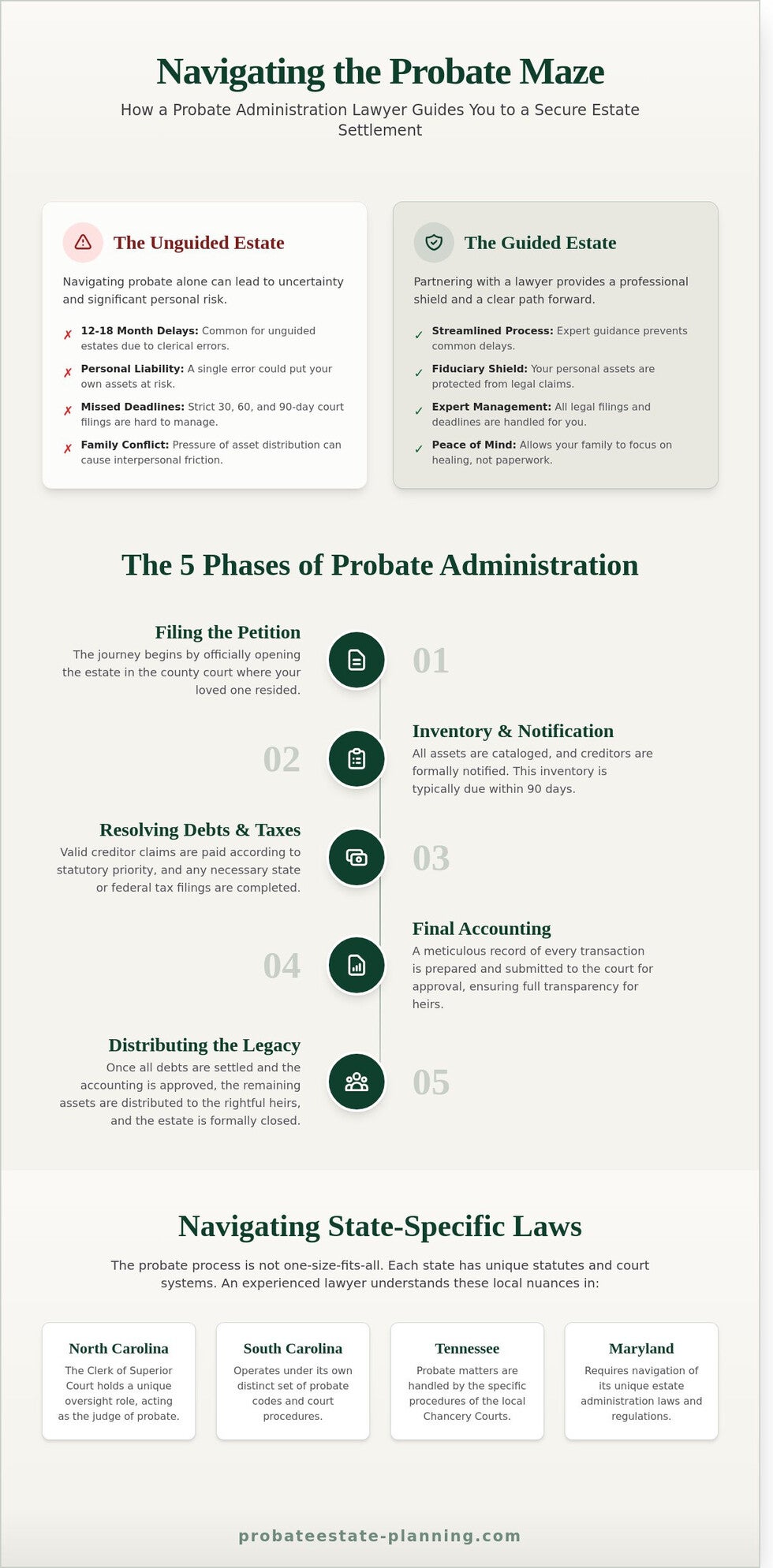
The burden of loss is heavy enough without the weight of legal complexity. When you step into the role of executor, you're assuming a fiduciary duty that requires meticulous attention to detail across five primary phases. This journey begins with filing a petition in the county where your loved one resided. Whether you're filing in Mecklenburg County, North Carolina, or Davidson County, Tennessee, this first step officially opens the estate. Engaging an experienced probate administration lawyer ensures that these initial filings are accurate, preventing the delays that often stem from minor clerical errors.
Once the court grants authority, you must inventory all assets and notify creditors. Most states require this inventory within 90 days of your appointment. You'll then move into resolving valid debts and navigating state-specific tax filings. To understand the specific filings required, families often consult the North Carolina estate administration process, which outlines how the local court oversees every transaction to protect heirs. After debts are settled, you'll provide a final accounting to the court before distributing the remaining legacy to the rightful heirs. The process concludes with a formal closing of the estate, which finally releases you from your legal duties and provides the peace of mind you deserve.
State-Specific Nuances You Must Know
Each state in the Southeast operates under its own set of rules. In North Carolina, the Clerk of Superior Court holds a unique oversight role, acting as the judge of probate. In Tennessee, Nashville residents must navigate the Chancery Courts, which handle probate matters with a specific set of local rules. If you're managing an estate in Rock Hill, South Carolina, you might benefit from simplified "Small Estate" procedures if the total value is under $25,000. Meanwhile, Maryland families in Towson and surrounding areas must work closely with the Register of Wills, an office that maintains a high level of scrutiny over estate accounts.
Timelines and Expectations for Local Families
Probate in this region typically spans 9 to 12 months. This timeline accounts for the mandatory creditor notice periods, which usually last between 3 and 6 months depending on the state. Several factors can extend this window. If the deceased owned property in both Maryland and North Carolina, you'll likely face an "ancillary probate," doubling the administrative workload. A probate administration lawyer helps you avoid common "bounce-backs" where the court rejects filings due to improper formatting or missing documentation. Partnering with a dedicated probate guide can help you maintain family harmony while ensuring every legal requirement is met with precision.
The Responsibilities of the Personal Representative (Executor)
Stepping into the role of a Personal Representative is a profound act of service. It's a position of trust that requires you to act as the legal steward of your loved one's final wishes. Your journey begins with the immediate task of identifying and safeguarding every piece of the estate. This includes physical property like a family home in Nashville and intangible assets such as digital photo archives or cryptocurrency wallets. You're responsible for changing locks, securing jewelry, and ensuring insurance policies remain active to protect the value of the legacy left behind.
A probate administration lawyer helps you manage the delicate balance of estate liquidity. You'll need to keep the lights on and the mortgage paid while the court process unfolds. Beyond maintenance, you must provide formal legal notice to potential creditors. This action starts a specific "claims clock," which typically lasts four months in many jurisdictions. This window limits how long creditors have to seek payment, providing a clear path toward the eventual distribution of assets to heirs according to the Will or state intestacy laws.
Managing Creditors and Estate Debt
Debt management is often the most stressful part of the process. You can't simply pay bills as they arrive in the mail. Most states follow a strict Statutory Priority list. For instance, funeral expenses and administrative costs usually take precedence over unsecured credit card debt. If you pay a low-priority creditor and run out of funds for the IRS, you might be held personally liable for that mistake. A probate administration lawyer defends the estate against invalid or predatory claims, ensuring that only legitimate debts are settled in the legally required order.
Asset Valuation and Appraisal Requirements
Accurate valuation is vital for both tax purposes and fair distribution. If the estate includes real estate in a high-growth market like Charlotte, a formal appraisal by a certified professional is often a court requirement. Your legal team coordinates with financial advisors to value complex holdings like stocks or business interests. It's also vital to distinguish between probate assets and non-probate items. Assets like life insurance policies with named beneficiaries or Revocable Living Trusts bypass the court's jurisdiction entirely, allowing those specific funds to reach your family faster and with more privacy.
Avoiding the "Medicaid Trap" and Other Probate Pitfalls
The most frequent question families ask is whether the state will seize the family home to cover nursing home costs. This fear is a heavy burden for many executors. When a loved one receives Medicaid benefits for long-term care, the state effectively becomes a creditor of the estate. A skilled probate administration lawyer helps you identify "Exempt Property" that remains protected from these claims. This includes specific allowances for surviving spouses and children that creditors cannot touch, regardless of the debt owed.
Transparency is your best tool for maintaining family harmony. When an executor works with a legal guide, they can clearly explain to heirs why certain assets are being held back for potential claims. This professional oversight prevents the suspicion and resentment that often tear families apart during the settlement process. It transforms a high-stakes legal hurdle into a structured act of stewardship.
Medicaid Estate Recovery Explained
State agencies in North Carolina, South Carolina, Tennessee, and Maryland are required by federal law to seek reimbursement for Medicaid costs paid for individuals aged 55 or older. This recovery process targets the value of the deceased person's property to pay back the taxpayers. Medicaid recovery only applies to assets that pass through the probate estate. If your loved one's home or bank accounts are structured to pass outside of probate, they may be shielded from these liens. Legal strategies like life estate deeds or specific trust structures can often protect the family home from being sold to satisfy these state claims, provided they were implemented correctly before death.
Common Mistakes That Derail Settlement
New executors often make the mistake of "Self-Dealing," which occurs when they use estate funds for personal expenses or purchase estate property for less than fair market value. Even if the intent isn't malicious, this creates a breach of fiduciary duty that can lead to lawsuits from other heirs. Another critical error is failing to file the Estate Inventory on time. In North Carolina, for instance, this must be filed within 90 days of qualification. Missing this deadline can result in court sanctions, including the removal of the executor and potential fines.
- Early Distribution: Distributing cash to heirs before the creditor notice period ends is the most common error. If a surprise debt appears later, the executor may have to pay it out of their own pocket.
- Co-mingling Funds: Never mix estate money with your personal bank account. This is a fast track to legal trouble and court audits.
- Ignoring Tax Filings: The estate is a separate taxable entity. Failing to file a final 1040 or an 1041 for the estate can lead to heavy IRS penalties.
You can safeguard your family's legacy by partnering with a probate administration lawyer who knows how to navigate these complex state and federal regulations.
Choosing the Right Probate Administration Lawyer for Your Family
Selecting a probate administration lawyer is a decision that impacts your family's emotional health and financial legacy. When you're managing an estate in Charlotte, Nashville, Rock Hill, or Towson, local knowledge isn't just a convenience; it's a strategic necessity. Every county clerk's office has distinct procedural preferences. A lawyer who walks those halls regularly can often expedite filings that might otherwise sit for weeks. For example, in Mecklenburg County, understanding the specific documentation requirements for small estate affidavits versus full administration can save a family 3 to 5 months of unnecessary waiting.
Look for a firm that understands the intersection of probate and Medicaid Crisis Planning. If the decedent received long-term care benefits, the state may attempt to recover costs from the estate. A firm equipped to handle these nuances protects your inheritance from being depleted by unexpected claims. When evaluating costs, ask for transparency. Most firms utilize one of three structures: hourly rates (typically $275 to $550 per hour), flat fees for predictable estates, or a percentage of the total estate value. A flat fee often provides the most peace of mind, as it removes the fear of a rising bill every time you call for an update.
Questions to Ask During Your Consultation
Your initial meeting should serve as an interview for your peace of mind. Ask the following to gauge their expertise:
- How many estates have you administered in this specific county court in the last 24 months?
- Do you handle contested wills or only uncontested administration?
- What is your process for keeping heirs informed during the 12 month window?
A firm that lacks a structured communication plan often leaves families in the dark. This leads to avoidable friction between siblings and beneficiaries during an already sensitive time.
Partnering with The Probate & Estate Planning Co.
The Probate & Estate Planning Co. acts as your Steady Guide through the complexities of the legal system. Our team holds licenses in multiple states, which simplifies the process if your family owns property in both North Carolina and Tennessee. We don't just file paperwork; we provide a partnership in stewardship that prevents the chaos often associated with asset distribution. Our goal is a predictable outcome where your loved one's wishes are honored without damaging family bonds.
We've helped over 1,200 families navigate these waters with clarity and compassion. We believe that professional authority should always be paired with empathetic reassurance. You deserve a plan that works when it is needed most, backed by a probate administration lawyer who prioritizes your family's harmony.
Schedule your consultation with our probate team today to take the first step toward a secure and predictable outcome for your family's future.
Protecting Your Family Legacy Across State Lines
Navigating the probate process doesn't have to feel like an insurmountable burden for your family. By understanding the specific statutes governing North Carolina, South Carolina, Tennessee, and Maryland, you'll ensure a smooth transition of assets while protecting your loved ones from legal friction. Professional guidance is essential for managing these complexities.
Our firm leverages 20 years of experience in local probate courts to provide the clarity you need. Partnering with a skilled probate administration lawyer provides the steady hand required to manage filings and fiduciary duties with confidence. We prioritize Medicaid Crisis Planning to ensure your assets stay within the family rather than being lost to state recovery programs. You've worked hard to build your life's work; don't let procedural errors diminish that impact.
Secure Your Family Legacy: Schedule a Probate Consultation
Your family deserves the peace of mind that comes with a plan that actually works when it's needed most.
Frequently Asked Questions
Do I need a probate administration lawyer if there is a valid Will?
You generally need professional legal guidance even with a valid Will because the document must still be validated by the Clerk of Superior Court. A Will is simply a roadmap; it doesn't bypass the mandatory legal filings, creditor notices, and inventory requirements. Engaging a probate administration lawyer ensures you meet the strict 90 day deadline for filing the initial inventory. This protection prevents you from making procedural errors that could lead to your removal as executor.
How much does a probate attorney cost in North Carolina or Tennessee?
Probate attorney fees typically range from $250 to $450 per hour depending on the complexity of the estate. Some families prefer a flat fee arrangement for standard administrations to ensure predictable costs. In North Carolina, you must also account for a court filing fee of $0.40 per $100 of estate value, which is capped at $6,000. We provide a clear fee schedule upfront so you can manage the estate's resources with confidence and transparency.
How long do I have to start the probate process after a loved one passes?
You should ideally file the Will with the court within 30 to 60 days of the death. While North Carolina law doesn't set a rigid deadline to open probate, waiting longer than 90 days can create complications with creditors or real estate transfers. If you don't act, interested parties can petition the court to compel you to produce the Will. Starting early provides the peace of mind that comes from knowing the family's legacy is secure.
Can the executor be held personally liable for estate debts?
You aren't personally responsible for the deceased's debts, but you're liable if you mismanage estate funds. For example, if you distribute $20,000 to a sibling before paying a $5,000 valid tax debt, the IRS can hold you personally accountable for that deficiency. This is why a probate administration lawyer is a vital partner. We help you follow the legal priority of payments to shield your personal bank accounts from these fiduciary risks.
What happens if someone contests the Will during administration?
The probate process shifts into a formal "caveat proceeding" where a judge or jury determines if the Will is legally binding. This litigation often extends the timeline by 12 to 18 months and increases costs significantly. Statistics show that roughly 3% of Wills are contested, usually due to claims of undue influence. We guide you through these difficult moments with a steady hand, focusing on maintaining family harmony while defending your loved one's final wishes.
Does all property have to go through the probate court process?
No, only assets owned solely in the deceased's name pass through the court system. Assets like life insurance policies with a named beneficiary or bank accounts with a "payable on death" designation transfer automatically. In Tennessee, estates valued under $50,000 may qualify for a simplified small estate process. Identifying these non-probate assets early helps you avoid unnecessary court delays and ensures heirs receive their inheritance faster, providing immediate financial stability.
How does Medicaid recovery affect the probate of a family home?
The state can file a claim against the probate estate to recover the costs of long term care paid after a person reached age 55. If the home is the only asset, the court may require its sale to satisfy a $70,000 or $100,000 Medicaid lien. This process can be overwhelming for grieving families who want to keep the house. We help you navigate these claims and explore potential hardship waivers that might protect the family home from being sold.
What is the difference between an executor and a personal representative?
These terms describe the same fiduciary role, though "executor" specifically refers to a person named in a Will. If there's no Will, the court appoints an "administrator" to handle the estate. Both people are referred to under the broad umbrella of "personal representative" in many modern statutes. Regardless of the title, you're 100% responsible for protecting assets and following the law. We act as your guide to ensure you fulfill these duties without unnecessary stress or confusion.
Comments
There are no comments for this post. Be the first and Add your Comment below.
Leave a Comment