

What if the decision to divide your estate exactly down the middle is the very thing that drives your children apart? Many parents believe that an equal split is the most logical path to peace, but without clear communication and professional structure, even the best intentions can lead to the probate court. When it comes to preventing inheritance disputes among siblings, the real goal isn't just a mathematical equation; it is the preservation of your family bond. You deserve the peace of mind that comes from knowing your legacy won't become a burden of legal fees and broken relationships.
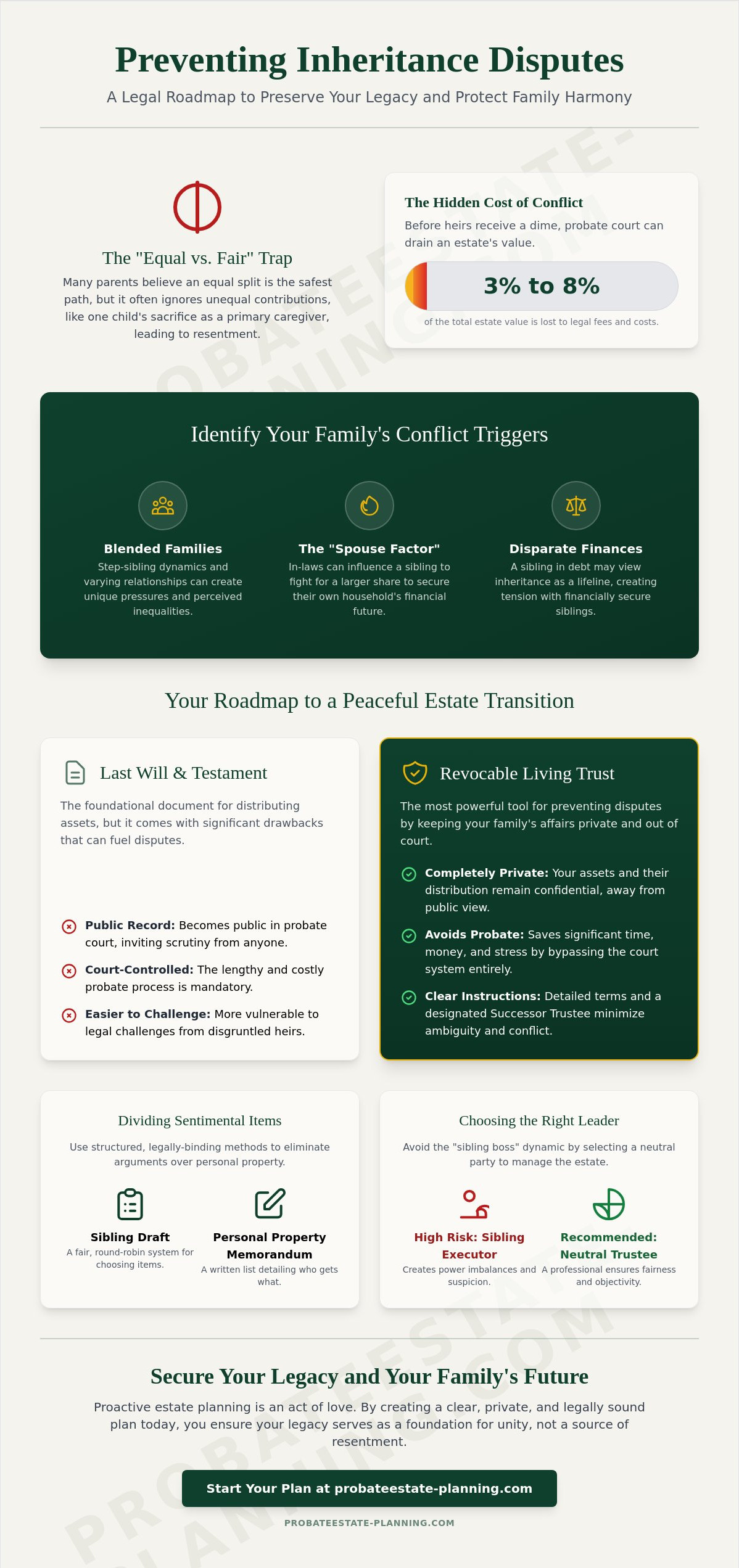
We understand the anxiety of choosing between "fair" and "equal," especially when probate costs can typically consume 3% to 8% of an estate's total value before anyone receives a dime. This guide provides a clear legal roadmap to help you navigate these sensitive transitions with confidence. You will learn how tools like a Revocable Living Trust or a precisely drafted Last Will and Testament can minimize delays and protect your children from unnecessary conflict. By addressing these complexities now, you ensure that your final wishes serve as a lasting foundation for family unity rather than a source of lifelong resentment.
Key Takeaways
- Learn why "equal" isn't always "fair" and how to address the unique contributions of children who served as primary caregivers.
- Discover how a Revocable Living Trust serves as a primary tool for preventing inheritance disputes among siblings by keeping your family's private financial details out of the public record.
- Implement a structured system for heirlooms, such as a "Sibling Draft" or a legally binding Personal Property Memorandum, to eliminate arguments over sentimental items.
- Understand the risks of naming one child as the sole Executor and how a neutral oversight strategy can protect sibling relationships from power imbalances.
- Identify the procedural steps needed to manage property in multiple states to avoid the delays and high costs of ancillary probate cases.
The Psychology of Inheritance: Why Siblings Conflict
Inheritance is rarely just about the transfer of assets; it's a final statement of value and belonging. When siblings gather to settle an estate, they aren't just looking at bank balances. They're often searching for a reflection of their parents' love and recognition of their roles within the family. While understanding inheritance laws provides the legal framework for distribution, it cannot account for the decades of emotional history that resurface once a parent passes away. Old rivalries, long-forgotten slights, and current financial stresses collide, making the probate process a fertile ground for resentment.
The most common catalyst for conflict is the "unpaid caregiver" dynamic. It's frequent for one child to shoulder the daily responsibilities of caregiving, often sacrificing their own career or personal time while others live further away. If the estate plan dictates a perfectly equal split, that caregiver may feel their sacrifice was ignored or minimized. This perceived injustice is a major hurdle in preventing inheritance disputes among siblings. Without proactive planning, these feelings of being undervalued quickly turn into legal challenges that can drain an estate's resources.
To better understand the emotional and practical complexities of these situations, watch this helpful video:
The Fairness vs. Equality Trap
Parents often default to a 50/50 split because it seems like the safest path to avoid showing favoritism. However, mathematical equality can be the architect of sibling resentment. If you provided one child with a significant advancement, such as a down payment on a home or tuition for graduate school, your other children may feel an equal split of the remaining estate is unfair. You should clearly document the reasoning behind your distributions. Explaining your "why" in your legal documents helps prevent claims of undue influence and provides clarity that your children cannot argue with later.
Identifying High-Risk Conflict Scenarios
Certain family structures are naturally more prone to friction. Blended families face unique pressures when step-sibling dynamics and varying lengths of relationships come into play. Additionally, the "Spouse Factor" often complicates matters. In-laws may encourage a sibling to fight for a larger share to secure their own household's future. Disparate financial statuses among heirs also cause tension; a sibling in debt might view the inheritance as a desperate lifeline, while a wealthy sibling may prioritize sentimental items. Identifying these risks early allows you to build protections into your estate plan, ensuring your legacy promotes peace rather than litigation.
Proactive Legal Tools to Prevent Probate Litigation
While a Last Will and Testament provides the basic framework for asset distribution, it's often the bare minimum required to settle an estate. In the absence of a clear plan, state laws dictate the outcome, which rarely aligns with a family's unique needs. To be truly effective in preventing inheritance disputes among siblings, you must utilize legal instruments that leave no room for interpretation or public scrutiny. Clarity is your most effective tool for maintaining family harmony when you are no longer there to mediate.
The Power of a Revocable Living Trust
A Revocable Living Trust is one of the most powerful shields available to your family. Unlike a Will, which must be filed in a public probate court, a trust remains a private document. In states like Maryland and Tennessee, bypassing the public probate process prevents siblings from easily scrutinizing every transaction or asset valuation, a common trigger for resentment. By establishing clear "Successor Trustee" instructions, you remove the ambiguity regarding who is in charge. This privacy protects your heirs from outside influence and keeps sensitive family business behind closed doors.
Drafting Effective No-Contest Clauses
Another strategic layer is the inclusion of a "No-Contest" or In Terrorem clause. This provision states that if a beneficiary challenges the validity of the document in court, they forfeit their inheritance entirely. It functions as a "carrot and stick" approach. To make this effective in probate courts across North Carolina, South Carolina, Maryland, and Tennessee, the gift to a potentially disgruntled heir must be significant enough that they're afraid to lose it. You should be aware that these clauses have limitations. Many courts won't enforce them if a sibling has "probable cause" or "good faith" to believe the document is invalid, so the drafting must be precise.
As we move through 2026, the legal and financial landscape continues to shift. With the federal estate tax exemption currently at $15 million for individuals, your strategy might need to pivot from tax avoidance toward sophisticated conflict mitigation. Regular updates to your comprehensive estate planning strategy ensure that changes in your family, such as new marriages or the birth of grandchildren, don't create "gaps" that invite litigation. Proactive preparation is the most reliable way to ensure your legacy remains a source of comfort rather than a cause for a legal battle. By choosing the right legal structures today, you provide your children with a predictable roadmap for tomorrow.
Strategies for Dividing Tangible Assets and Sentimental Property
While financial assets are easily divided by a calculator, sentimental property often requires a more human-centric approach. Conflict frequently arises not from the size of a bank account, but from who receives the grandfather clock, the family photo albums, or a parent's wedding ring. This is often called the "Emotional Inheritance," and it is a critical component of preventing inheritance disputes among siblings. Without a structured plan for tangible goods, siblings may find themselves arguing over items with high emotional value but low market price.
The Personal Property Memorandum
One of the most effective tools for managing heirlooms is the Personal Property Memorandum. This is a separate document, specifically referenced in your Last Will and Testament, that lists specific items and the individuals you wish to receive them. The primary benefit of this memorandum is its flexibility. You can update the list as you acquire new items or change your mind without needing to execute a full legal amendment to your Will. In North Carolina and South Carolina, these memorandums are legally binding provided they are clearly referenced in your primary estate documents and signed by you. This simple list provides the clarity your children need to avoid second-guessing your intentions.
Fair Systems for Picking Heirlooms
For items not specifically named in a memorandum, you should establish a clear system for distribution. This removes the "first-come, first-served" mentality that often leads to resentment. A structured approach typically follows three steps:
- Professional Appraisals: Before any items are chosen, obtain a professional appraisal for high-value assets like jewelry, art, or antiques. This ensures everyone understands the true financial value of what they are selecting.
- The Sibling Draft: Use a "round-robin" selection order. Siblings can draw lots to determine who picks first. In the first round, sibling A picks one item, then sibling B, and so on. In the second round, the order reverses to ensure fairness.
- Equalization Payments: If one sibling chooses a high-value item, such as a piano, while another chooses a box of old letters, the estate can use cash assets to "level the playing field." This ensures the total value received by each child remains balanced.
The family home presents a more complex challenge. When multiple siblings inherit a single property as "Tenants in Common," they each own an undivided interest. This often leads to "partition" actions, where one sibling sues to force a sale. To prevent this, your plan should specify whether one sibling has the right to buy out the others' interests or if the property must be sold and the proceeds divided. By providing a clear exit strategy for the family home, you protect your children from the high costs of real estate litigation and the permanent damage it causes to sibling relationships.
Communication and Neutral Oversight: Removing the Sibling 'Boss'
One of the most frequent mistakes parents make is naming the "most responsible" child as the sole Executor or Trustee. While this choice usually comes from a place of trust, it inadvertently creates a "boss" dynamic that can destroy family bonds. When one sibling has the power to approve or deny another's inheritance, old childhood rivalries often resurface with newfound intensity. This structural imbalance is a primary obstacle to preventing inheritance disputes among siblings. By placing one child in a position of authority over the others, you may be setting the stage for a conflict that outlasts the probate process.
Why Professional Executors Save Relationships
Choosing a professional fiduciary or a corporate trustee provides an essential layer of neutral oversight. These professionals aren't influenced by family history or personal bias. They ensure that the administration process remains transparent and that all beneficiaries receive frequent, detailed reports. This removes the heavy legal and administrative burden from your children, who are already navigating the grieving process. Many heirs find it much easier to accept financial decisions from a neutral third party than from a brother or sister they've known since childhood. This separation of family and business is often the key to maintaining long-term harmony.
The 'Letter of Intent' (Ethical Will)
While your legal documents outline "what" happens to your assets, a Letter of Intent explains the "why." This is a non-legal document written in your own voice. It allows you to address specific decisions, such as why a certain child received a larger share to compensate for caregiving or why a family business was structured in a specific way. This letter can provide the emotional closure that legal jargon cannot. By speaking directly to your children, you can reduce resentment and affirm your love for each of them, providing a context that discourages legal challenges.
To be effective, this letter should remain supportive and forward-looking. Avoid using it as a final opportunity to settle old scores or critique past behavior. Instead, focus on your hopes for their future relationships and the legacy of unity you wish to leave behind. Combining this personal touch with a clear legal structure is the most reliable way to protect your family from the cost of probate litigation. Preserving your family's unity is the ultimate goal when preventing inheritance disputes among siblings.
If you're unsure how to balance family dynamics with legal requirements, our team provides the guidance necessary to build a secure future. You can learn more about our Probate Administration Services to see how neutral oversight can preserve your family's unity. Setting clear expectations through family meetings before a crisis occurs ensures that everyone is on the same page and that your legacy remains a blessing rather than a burden.
Navigating Multi-State Probate and Estate Planning
Managing assets becomes significantly more complex when your legacy spans multiple jurisdictions. For families with a primary residence in Maryland and a vacation home in South Carolina or Tennessee, the legal requirements for transferring property differ at every border. This geographic spread often triggers "Ancillary Probate," a secondary court process required in every state where you own real estate. These multiple cases lead to increased legal fees, administrative delays, and more opportunities for disagreement, making it a major hurdle in preventing inheritance disputes among siblings. It's a heavy burden for heirs to manage three different court systems while they're grieving.
Coordinating Plans Across the Southeast and Mid-Atlantic
Each state maintains its own set of rules that can stall the distribution of your estate. For instance, Maryland is one of the few states that imposes both an estate tax and an inheritance tax as of 2026. Conversely, Tennessee has no state-level estate tax but follows specific real estate statutes that differ from the Mid-Atlantic. If your plan doesn't account for these variables, your children may face conflicting requirements that prevent them from selling property or accessing funds. By consolidating your holdings into a single Revocable Living Trust, you ensure that your heirs don't have to navigate the probate courts of three different states simultaneously. This unified approach provides the functional reliability your family needs to move forward without friction.
Peace of Mind Through Professional Guidance
Our role is to act as your steady guide through the emotional and legal landscape of long-term planning. We specialize in identifying the specific "conflict triggers" in your family tree, whether those are disparate financial needs or complex multi-state holdings. As we look toward 2026 and beyond, with the federal estate tax exemption at $15 million per individual, the focus of your plan should remain on the preservation of interpersonal connections. We don't just prepare documents; we safeguard your most important relationships. Our methodical process ensures that every detail is addressed, leaving no room for the ambiguity that often leads to litigation.
Taking the first step toward a comprehensive plan is the most effective way to ensure your legacy remains a source of strength. You can protect your children from the costs and delays of ancillary probate by acting now. Our experienced team is ready to help you navigate these sensitive transitions with clarity and confidence. Schedule a consultation with our experienced estate planning team to begin building your roadmap for family harmony. Your proactive preparation today is the greatest gift you can leave for your siblings tomorrow.
Securing Your Family Legacy for the Next Generation
Your legacy should be a source of lasting strength for your children rather than a catalyst for legal conflict. We have explored how proactive steps, such as establishing a Revocable Living Trust and implementing structured systems for sentimental heirlooms, create the clarity necessary for preventing inheritance disputes among siblings. By removing the heavy burden of decision-making from your heirs and utilizing neutral oversight, you protect their lifelong relationships from the strain of administrative responsibility.
The Probate & Estate Planning Co. provides the steady guidance you need to navigate these sensitive transitions with confidence. We are specialists in both Probate Administration and Asset Protection, offering a protective approach that prioritizes your family's emotional well-being alongside their formal security. Our team brings deep multi-state expertise across North Carolina, South Carolina, Maryland, and Tennessee to ensure your plan remains resilient, regardless of where your property is located. Secure your family's future and prevent disputes by contacting The Probate & Estate Planning Co. today. You have worked hard to build your life's work; let's ensure it remains a blessing for those you love most.
Frequently Asked Questions
Can siblings sue each other over an inheritance if there is a valid Will?
Yes, siblings can still file a lawsuit to challenge a Will even if it appears to be validly executed. Legal challenges often center on claims of lack of testamentary capacity, undue influence, or fraud. These disputes can lead to lengthy probate litigation that consumes a significant portion of the estate's value, which is why precise drafting and professional oversight are essential for long-term security.
What is the most common reason siblings fight over an estate?
Perceived unfairness regarding caregiving roles and lifetime gifts is the most frequent trigger for family conflict. While parents often aim for an equal split, a sibling who provided years of unpaid care may feel entitled to more. This emotional disconnect is a major obstacle to preventing inheritance disputes among siblings, as mathematical equality rarely accounts for the personal sacrifices made by individual children.
How does a 'No-Contest Clause' actually work in probate court?
A No-Contest Clause disinherits any beneficiary who unsuccessfully challenges the validity of a Will or Trust in court. It acts as a powerful deterrent by forcing an heir to choose between accepting their guaranteed portion or risking their entire inheritance on a legal battle. However, courts in states like North Carolina and Maryland may not enforce these clauses if the sibling has a "good faith" reason for the challenge.
Should I tell my children what is in my Will before I pass away?
Transparency is generally the most effective approach to ensure family harmony and provide peace of mind. Holding a family meeting to explain your decisions allows you to address potential resentments while you're still here to provide context. When children understand the reasoning behind your estate plan, they're far less likely to feel blindsided or pursue litigation against their siblings after you pass away.
What happens if one sibling wants to sell the family home and the other doesn't?
If siblings inherit a home as "Tenants in Common," any owner can typically file a partition action to force a court-ordered sale. This process is often expensive and may lead to the property being sold below market value. You can prevent this outcome by including specific instructions in your Revocable Living Trust that dictate how a buyout should be handled or when a sale must occur.
Is it better to name a sibling or a professional as the Executor?
Naming a professional fiduciary or corporate trustee is often the safer choice for preserving sibling relationships over the long term. A professional provides neutral oversight and isn't influenced by family history or personal bias. This removes the "power struggle" dynamic that occurs when one child is given authority over their siblings' financial futures, ensuring a more predictable and transparent administration process.
How do I handle a sibling who has already received a 'loan' that was never paid back?
You should explicitly state in your estate plan whether lifetime gifts or unpaid loans should be treated as "advancements" on a child's inheritance. By instructing your Executor to deduct the loan amount from that sibling's final share, you maintain fairness among all your children. Clearly documenting these financial adjustments helps in preventing inheritance disputes among siblings by removing any ambiguity about your intentions.
Can a trust prevent a sibling from contesting my estate plan?
While a Revocable Living Trust doesn't technically "prevent" a challenge, it makes a contest much more difficult than with a Will. Because trusts are private and bypass the public probate process, disgruntled siblings have less information and fewer procedural opportunities to launch a legal battle. The privacy of a trust serves as a significant shield, protecting your legacy from public scrutiny and unnecessary litigation.
Comments
There are no comments for this post. Be the first and Add your Comment below.
Leave a Comment