
We promise that by following this definitive checklist, you'll gain the clarity needed to select a legal partner who provides both professional authority and empathetic reassurance. Finding the right advocate protects your loved one's legacy and your own financial security. We will walk through the specific qualifications, communication styles, and procedural knowledge your attorney must possess to manage the court system with precision and care.
Key Takeaways
- Gain clarity on the unique authority of the NC Clerk of Superior Court and how to navigate mandatory inventory and accounting cycles with confidence.
- Identify the seven essential qualities to look for in a north carolina probate attorney to ensure your legal partner has the specific county-level expertise your estate requires.
- Learn to protect your family's immediate needs by correctly handling the "Year's Allowance" and avoiding common asset-titling errors that lead to unnecessary probate.
- Distinguish between simple document preparation and the active administration required to preserve your legacy and maintain family harmony during a difficult time.
- Discover a "Steady Guide" approach to probate that prioritizes your emotional well-being and provides a clear, methodical path through complex legal requirements.
The Essential Role of a North Carolina Probate Attorney
A north carolina probate attorney is a legal professional who specializes in the court-supervised distribution of a deceased person's assets according to state-specific laws. Many people confuse estate planning with probate administration. While planning involves creating documents like wills or trusts, probate is the active, often stressful process of carrying out those instructions after a loss. This journey involves navigating the Probate process, which requires precise filings and strict adherence to deadlines set by the state.
Relying on a generic national firm often leads to frustration because North Carolina has unique procedural requirements that vary from county to county. A local expert understands the specific expectations of the local Clerk of Superior Court, who acts as the judge of probate in our state. Your attorney serves as a vital buffer, handling the technical communication with the court so you can focus on your family's emotional healing and stewardship of your loved one's legacy.
To better understand this concept, watch this helpful video:
When is a Probate Attorney Legally Necessary in NC?
Not every estate requires full administration. If the assets are valued under $20,000, or $30,000 when the surviving spouse is the sole heir, you might qualify for a simplified "small estate" process. However, if the deceased owned real estate or had significant debts, the North Carolina court system usually requires full administration. This becomes even more complex if someone dies without a will, known as intestate succession. In these cases, North Carolina General Statutes dictate exactly who inherits, which often leads to family conflict without professional guidance. Additionally, North Carolina law requires specific notice to creditors under NCGS 28A-14-1, a step that, if missed, can leave an executor personally liable for unpaid debts.
The Fiduciary Duty: Protecting the Executor
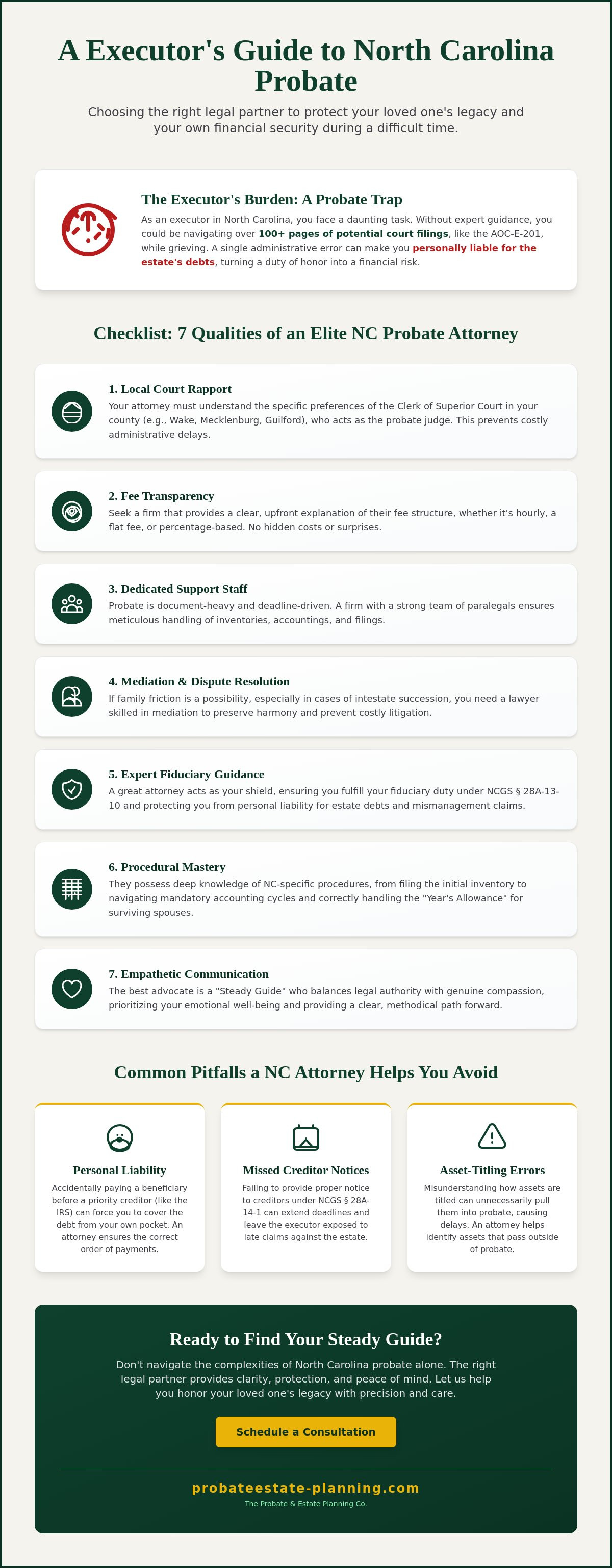
Serving as an executor isn't just an honor; it's a significant legal burden. Under NC General Statute 28A-13-10, executors face personal liability for any mismanagement of estate funds. If you accidentally pay a beneficiary before a priority creditor, you might have to pay that money back out of your own pocket. A north carolina probate attorney provides the protection you need to avoid "breach of fiduciary duty" claims. They ensure every penny is accounted for and every legal requirement is met, preserving your family's harmony and your own financial security. In North Carolina probate, fiduciary duty is the legal obligation of an executor to act with the highest degree of good faith, loyalty, and care when managing estate assets for the benefit of heirs and creditors.
Checklist: 7 Things to Look for in an NC Probate Lawyer
Choosing the right north carolina probate attorney is a decision that impacts your family's peace of mind for years to come. You aren't just looking for someone to file forms; you're seeking a steward for your loved one's legacy. This checklist ensures you find a professional who balances technical mastery with human compassion while protecting the assets you've worked hard to preserve.
- Local Court Rapport: The Clerk of Superior Court in your specific county, whether it's Wake, Mecklenburg, or Guilford, serves as the judge in probate matters. An attorney who understands the specific preferences of local clerks can prevent administrative setbacks.
- Fee Transparency: Avoid firms that are vague about costs. Look for clear explanations of hourly rates, flat fees, or percentage-based arrangements before you sign an engagement letter.
- Dedicated Support Staff: Probate is document-heavy and deadline-driven. A firm with a dedicated team ensures that high-volume filings and complex inventories are handled with precision.
- Mediation Proficiency: If you anticipate family friction, you need a lawyer with a proven track record in dispute resolution to maintain family harmony.
- Probate-Centric Practice: Verify that the firm focuses primarily on estates. You want a specialist, not a generalist who treats probate as a side-practice to other legal areas.
- Technological Proficiency: As North Carolina transitions to the Odyssey e-filing system, your lawyer must be adept at digital submissions to keep the process moving without technical hitches.
- Empathetic Tone: Your guide should speak in plain English, not dense legalese. This clarity is essential when your family is navigating the fog of grief.
Technical Expertise and Local Court Rapport
Understanding the local landscape is vital for a smooth transition of assets. According to the North Carolina Judicial Branch, the probate process involves strict duties for the personal representative, including filing a detailed inventory within 90 days of qualification. A lawyer who knows the local Clerk's office can navigate these requirements more efficiently than someone unfamiliar with the county's specific workflow. They should also demonstrate proficiency with the state's growing E-Filing systems. These digital platforms are currently being rolled out across various counties to streamline court interactions; however, they require a firm that stays updated on modern legal technology to avoid filing errors.
Communication and Empathetic Reassurance
The probate process is often a marathon, not a sprint. You need a "Steady Guide" who responds to time-sensitive inquiries within 24 to 48 hours. During your initial consultation, assess whether the attorney listens more than they speak. They should offer a methodical, step-by-step solution that prioritizes your emotional well-being alongside legal security. If you feel like just another case number, it's a sign that the firm may lack the human-centric focus required for sensitive estate administration. Finding a north carolina probate attorney who values your family's future as much as you do is the first step toward a predictable and secure outcome.
Navigating the North Carolina Clerk of Superior Court System
North Carolina's probate process is distinct because the Clerk of Superior Court serves as the "Ex Officio" Judge of Probate. This means the person overseeing your filings holds judicial authority over the estate's administration. It isn't merely a clerical exercise; it's a legal proceeding where every document is scrutinized. A north carolina probate attorney helps you present a professional case to the Clerk, ensuring your application for "Letters Testamentary" is accurate so you can begin managing assets without unnecessary delays.
The state mandates strict reporting cycles that can feel overwhelming during a time of grief. Within 90 days of your appointment, you must file a comprehensive inventory of all the decedent's assets. Following this, the court requires annual accountings that track every penny entering or leaving the estate. If these deadlines are missed, the court issues a "notice of delinquent filing," which can lead to personal liability or removal from your role. Your attorney acts as a safeguard, maintaining the ledger and ensuring every filing meets the Clerk's specific standards.
One of the most significant phases is the mandatory "Notice to Creditors." You must publish a legal notice in a local newspaper once a week for four consecutive weeks. This triggers a three-month waiting period where creditors can submit claims against the estate. Even if the estate qualifies for a simplified probate procedure, these notice requirements are often non-negotiable. No distributions to heirs should occur until this period ends and all valid debts are settled.
The Timeline of an NC Probate Case
Most estates in North Carolina require a minimum of 12 to 15 months to reach closure. While the creditor period is only 90 days, the total timeline stretches as you liquidate assets and prepare final tax returns. Common speed bumps include the sale of real estate, which often requires additional court petitions if the will doesn't grant specific powers. A north carolina probate attorney keeps the process moving by anticipating these hurdles and preventing the administrative stalls that occur when files sit idle on a clerk's desk.
County-Specific Nuances: Charlotte, Raleigh, and Beyond
While state law is uniform, the "culture" of the courthouse varies significantly between counties. In high-volume areas like Mecklenburg or Wake, the clerks rely heavily on digital proficiency and strict adherence to local scheduling rules. In contrast, rural counties may prioritize physical presence and traditional communication. Understanding these local preferences is essential for a smooth experience. If you are handling an estate in the Queen City, you might find our specific guide on Hiring a Probate Attorney in Charlotte, NC: Key Questions helpful for local insights.
Common Pitfalls an Attorney Helps You Avoid in NC Estates
The North Carolina probate process contains several procedural traps that can derail even the most well-intentioned executor. A skilled north carolina probate attorney serves as your shield against these errors. One frequent mistake involves the 'Year's Allowance.' Under North Carolina General Statutes § 30-15, a surviving spouse is entitled to a $60,000 allowance from the decedent's personal property. If you fail to file for this within one year of the death, that protection is lost. Additionally, children of the deceased may be entitled to a $5,000 allowance under § 30-17, a detail often overlooked by those without legal guidance.
Another risk involves asset titling. Many families assume all property must pass through the court, yet assets held as joint tenancy with right of survivorship or designated as 'Payable on Death' (POD) bypass probate entirely. Forgetting to account for North Carolina's specific tax history also causes delays. While the state repealed its inheritance tax for deaths after January 1, 2013, older estates or those with multi-state holdings still require a precise look at tax liability to avoid penalties.
The Trap of 'DIY' Estate Administration
Attempting to handle the process alone often seems like a way to save money. Though the Clerk of Court's office is often polite, North Carolina General Statute § 84-2.1 prohibits them from providing legal advice. They can't tell you how to interpret a will or which forms protect you from liability. Fixing a filing error after it enters the court record often costs more in legal fees than hiring a north carolina probate attorney from the start. You might spend months trying to correct a simple clerical mistake that a professional would have spotted in minutes. Distributing assets to heirs before settling all valid estate debts places the executor at personal financial risk for those unpaid claims.
Conflict Resolution and Family Harmony
Probate often triggers long-standing family tensions. An attorney acts as a neutral third party, ensuring that asset division follows the letter of the law rather than emotional whims. By providing transparent accounting and adhering to the 90-day notice to creditors required by NCGS § 28A-14-1, the attorney builds a wall of protection around the executor. This professional oversight prevents litigation before it starts, keeping the family's legacy intact rather than lost to courtroom battles. When you have a guide, you aren't just managing money; you're preserving relationships during a vulnerable time.
Protect your family from these common mistakes by working with a trusted North Carolina probate guide today.
Why The Probate & Estate Planning Co. is Your Trusted NC Guide
The legal process following a loss shouldn't feel like a cold, clinical transaction. Our "Steady Guide" philosophy recognizes that you're managing grief while trying to fulfill a final set of obligations. As your north carolina probate attorney, we merge professional authority with the empathetic reassurance your family needs during this transition. We don't just process paperwork; we provide a protective shield against the administrative burdens that often overwhelm executors and beneficiaries alike.
Our expertise extends beyond a single set of borders. With deep roots and legal standing across North Carolina, South Carolina, Maryland, and Tennessee, we solve complex jurisdictional puzzles that many local firms cannot. If your loved one owned a vacation home in the Blue Ridge Mountains but resided in Maryland, you'll likely face "ancillary probate." This secondary court process is notoriously tricky and requires coordinated filings. Our multi-state presence allows us to manage these overlapping requirements seamlessly, ensuring your family's legacy remains intact regardless of where the property sits.
Our Methodical Approach to NC Probate
Your journey begins with an initial stewardship consultation. This isn't a generic intake session; we map out a specific road ahead based on your family's unique dynamics and assets. We focus on functional outcomes. A plan is only successful if it actually works when it's needed most. By handling the logistical chaos and court filings, we create the space you need to focus on emotional well-being. Our goal is a secure, predictable result that avoids the interpersonal friction often caused by legal delays and confusion.
- Detailed asset mapping to identify probate and non-probate property.
- Timely notification of creditors to protect the executor from personal liability.
- Clear communication with heirs to maintain family harmony.
Next Steps: Securing Your Peace of Mind
Transitioning from uncertainty to clarity starts with preparation. To get the most from your first meeting with a north carolina probate attorney, try to gather the original will, recent bank statements, and any real estate deeds. This information allows us to provide an accurate assessment of the estate's needs immediately. Even if you don't have every document yet, starting the conversation early prevents small issues from becoming expensive legal hurdles.
Choosing our firm means entering a partnership in stewardship. We're committed to protecting what your family spent a lifetime building through measured, deliberate action. You don't have to carry this burden alone; we've navigated these complexities for families across four states and know exactly how to steer you toward a secure outcome.
Take the first step toward resolution: Schedule your NC Probate Consultation with The Probate & Estate Planning Co.
Securing Your Family's Future Through Wise Stewardship
Navigating the North Carolina Clerk of Superior Court system requires more than just filling out forms; it demands a strategy that protects your family's harmony. By following this 7 point checklist, you ensure your representative has the specialized expertise needed for complex Medicaid Crisis and Asset Protection scenarios. Managing an estate across state lines adds another layer of difficulty, but our team provides seamless representation across NC, SC, MD, and TN to keep your legacy intact. This multi state reach ensures that no matter where your assets are located, your plan remains functional and secure.
Choosing a dedicated north carolina probate attorney means you aren't just hiring a document preparer. You're gaining a steady guide who understands the emotional weight of this transition. We focus on human centric stewardship to prevent the chaos that often follows an unplanned estate. With a plan that actually works when your family needs it most, you can replace legal anxiety with a sense of quiet confidence. Your family's future deserves the protection of a meticulous and compassionate plan that preserves both your wealth and your relationships.
Secure your family's legacy with a North Carolina Probate Consultation
Frequently Asked Questions
How much does a North Carolina probate attorney typically cost?
Hiring a north carolina probate attorney typically involves either an hourly rate or a flat fee based on the estate's complexity. While North Carolina statutes don't mandate a specific fee schedule, hourly rates for estate specialists often range from $250 to $500 according to 2023 industry benchmarks. You might also encounter flat fees for simple estates, ensuring your family's legacy remains protected from unpredictable costs and financial stress.
Can I handle probate in NC without a lawyer if there is a valid Will?
You can legally handle probate in North Carolina without a lawyer, but you'll be held to the same procedural standards as a licensed professional. The North Carolina Administrative Office of the Courts provides the E-900 forms for self-representation. However, 1 out of 3 self-represented executors face delays due to filing errors. Choosing a north carolina probate attorney helps you avoid these pitfalls and ensures you fulfill your fiduciary duties correctly.
What is the difference between an executor and an administrator in North Carolina?
The primary difference lies in how the individual is appointed to manage the estate. An executor is specifically named in a valid Will to carry out the deceased's wishes. In contrast, if someone dies intestate or without a Will, the Clerk of Court appoints an administrator under NC General Statute 28A-4-1. Both roles carry the same legal weight and the serious responsibility to safeguard assets for the rightful heirs.
How long do I have to open probate after a death in North Carolina?
North Carolina law doesn't set a strict expiration date for opening probate, but you should ideally begin within 60 days of the death. If you wait longer than 90 days, the Clerk of Court may issue a citation to compel the production of the Will under NCGS 28A-2A-4. Starting the process early prevents asset depreciation and ensures creditors are notified within the required 90-day publication window, providing you with much-needed peace of mind.
What happens if the deceased lived in NC but owned property in another state?
You must initiate a secondary legal process known as ancillary probate in the state where the out-of-state property is located. While the primary probate happens in the North Carolina county of residence, the foreign state's court must authorize the transfer of real estate within its borders. This dual process ensures the title transfers correctly and follows the specific land laws of that secondary jurisdiction, preventing future legal chaos for your family.
Is the executor personally responsible for the deceased person's debts in NC?
You aren't personally responsible for the deceased's debts unless you mishandle the estate's assets or fail to follow legal priority for payments. North Carolina law requires you to pay debts in a specific order, such as funeral expenses first, before distributing any inheritance. If you distribute funds to heirs before paying valid 90-day creditor claims, you might become personally liable for those specific amounts. Proper guidance ensures you're protected from these risks.
How do I get 'Letters Testamentary' from the NC Clerk of Court?
You obtain Letters Testamentary by filing an application for probate and the original Will with the Clerk of Superior Court in the county where the deceased lived. You'll need to submit Form AOC-E-201 and pay a filing fee, which is $120 as of 2024. Once the Clerk verifies the documents and your qualification, they'll issue these letters to grant you the legal authority to manage bank accounts and property, acting as your official credentials.
Can a probate attorney help if I want to contest a will in NC?
A legal guide is essential if you intend to file a caveat, which is the legal term for contesting a Will in North Carolina. Under NCGS 31-32, interested parties have 3 years from the date of the application for probate to challenge the document's validity. Your advisor will help gather evidence of undue influence or lack of capacity to ensure the true intentions of your loved one are honored and the family's harmony is preserved.
Comments
There are no comments for this post. Be the first and Add your Comment below.
Leave a Comment