

On a Tuesday morning in Davidson County, a daughter often finds herself staring at a stack of legal notices while still grieving a profound loss. It's a moment where the weight of Tennessee's 120-day creditor notice period feels like an impossible burden to carry alone. Partnering with an experienced nashville probate attorney ensures you don't have to face these hurdles in isolation. You likely want to honor your loved one's wishes without the constant fear that a single procedural mistake will lead to personal liability or fractured family relationships. It's natural to feel overwhelmed by the 2024 TennCare requirements and the pressure of distributing assets fairly.
Discovering how a skilled legal advocate can protect your family's legacy will simplify these complex requirements and restore your sense of control. You don't have to manage this legal chaos without a steady guide by your side. This article provides a clear timeline of the Nashville probate process, including filing with the Davidson County Clerk and Master. We explain how to shield the estate from unnecessary claims so you gain the peace of mind that comes from knowing every detail is handled with professional authority and genuine empathy, ensuring your family's future remains secure.
Key Takeaways
- Learn how navigating Davidson County's specific probate requirements with a steady hand can prevent family chaos during an emotional time.
- Understand the standard 4-to-12 month Tennessee probate timeline and why the actions taken in the first 30 days are vital for the executor.
- Discover the difference between a simple paperwork filer and a nashville probate attorneywho serves as a comprehensive steward of your family's legacy.
- Gain insights into protecting your inheritance from external threats, including the specific risks posed by the TennCare estate recovery process.
- Establish a clear framework for selecting a legal partner who prioritizes long-term family harmony and a plan that actually works when it is needed most.
Understanding Probate in Nashville: Why Local Expertise Matters
Losing a loved one is heavy. Managing their financial legacy shouldn't add to that weight. Probate is the court-supervised process where a judge validates a Last Will and Testament and oversees the distribution of assets to heirs. Understanding the Probate Process is the first step toward finding clarity during a difficult time. In Davidson County, this isn't just a clinical procedure; it's a legal framework designed to transition property with order and dignity. A seasoned nashville probate attorney serves as your steady guide, ensuring that administrative chaos doesn't overshadow the life being honored.
To better understand how this process works in our community, watch this helpful video:
The transition from confusion to a settled legacy depends on following specific Tennessee statutes. While some estates qualify for a "Small Estate" affidavit, others require a full administration. Under Tennessee Code § 30-4-101, estates with personal property valued under $50,000 may bypass the lengthier full probate process. This distinction is vital. Choosing the wrong path can lead to months of unnecessary delays and higher court costs. Our goal is to provide the protection your family needs to move forward with peace of mind.
When is Probate Required in Tennessee?
Probate is necessary when an individual dies owning assets in their name alone. These are "probate assets." Property held in a living trust, life insurance with named beneficiaries, or real estate held as "tenants by the entirety" usually pass by law without court intervention. You must file the original Will with the court. Tennessee law requires anyone in possession of a Will to deliver it to the court or the executor promptly. Delaying this filing creates risks; it can lead to the loss of assets or legal challenges from heirs who feel their inheritance is being withheld.
The Role of the Davidson County Probate Court
The Seventh Circuit Court, located at 1 Public Square in downtown Nashville, handles these matters. Every jurisdiction has its own procedural preferences. A local nashville probate attorney understands these nuances, from how the Clerk & Master manages filings to the specific expectations of the sitting judge. The Clerk & Master's office acts as the administrative backbone of the court, processing the initial petitions and maintaining estate records. Having a partner who knows these local systems ensures your family's stewardship remains on track and compliant with Davidson County's specific local rules.
The Nashville Probate Timeline: Step-by-Step for 2026
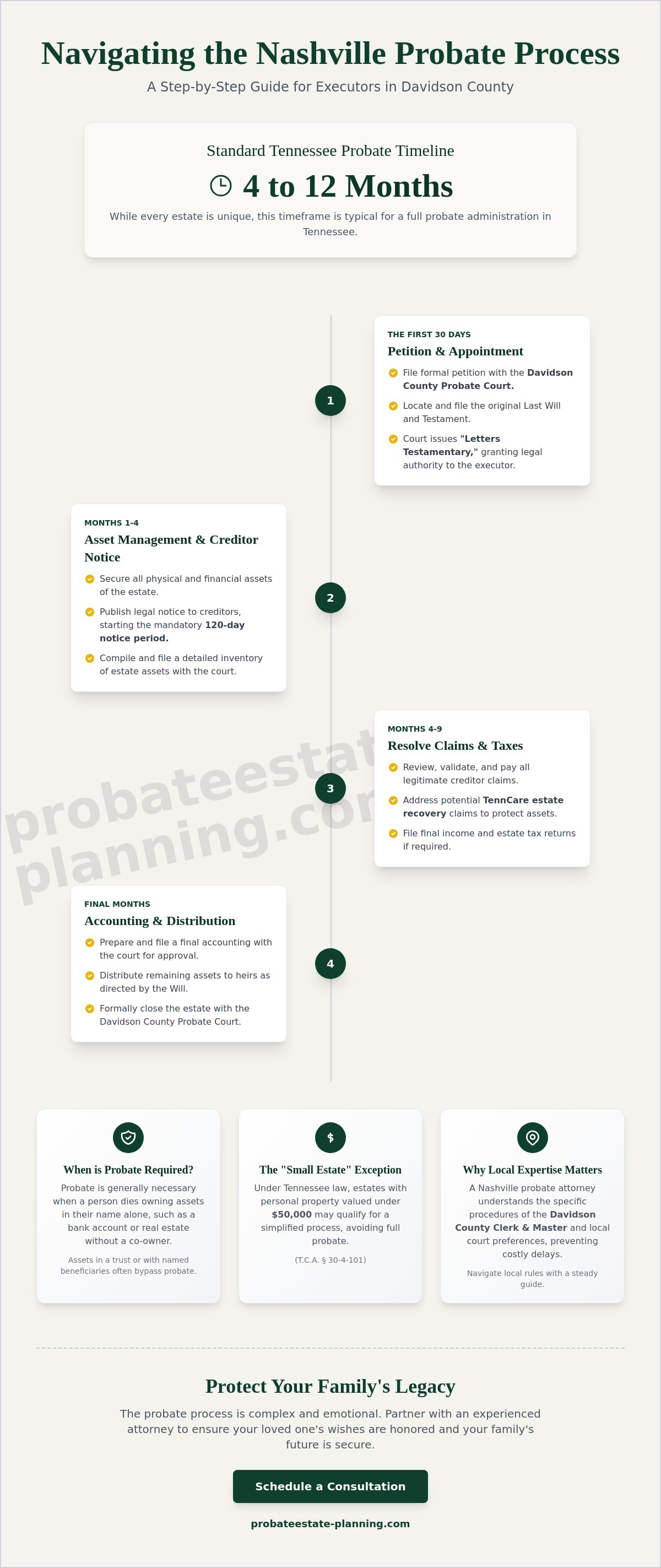
While every family's journey is unique, the standard probate process in Tennessee typically spans between 4 and 12 months. The first 30 days are often the most demanding for an executor. During this initial window, you must locate the original Will, secure physical assets, and prepare the legal filings. This early momentum helps prevent the administrative chaos that can arise when deadlines are missed. Transitioning from a petitioner to a court-authorized personal representative requires precision. Working with an experienced nashville probate attorney ensures that you meet these requirements while maintaining family harmony and protecting the legacy of your loved one.
Step 1: Petition and Letters Testamentary
To begin the process, you must file a formal petition with the Davidson County Probate Court. This document asks the judge to validate the Will and officially appoint you as the personal representative. Once the court approves the petition, it issues "Letters Testamentary." These documents serve as your legal credentials. They allow you to access bank accounts, sell real estate, and manage the decedent's affairs. Unless the Will specifically waives the requirement, Tennessee law usually requires you to post a fiduciary bond to protect the estate's value for the beneficiaries.
Step 2: Inventory and Notice Requirements
Within 60 days of your appointment, you must file a detailed inventory of all estate assets. This includes everything from real property to personal belongings. You are also legally obligated to provide formal notice to all heirs and potential beneficiaries. A unique and critical step in Tennessee is the mandatory requirement to notify TennCare. Under Tennessee Code, you must verify if the decedent received Medicaid benefits to determine if the state has a claim against the estate. This step is vital for protecting your personal liability as an executor and ensuring a clean title for any property sales.
Step 3: Creditor Claims and Final Distribution
Once the court publishes the Notice to Creditors, a 4-month waiting period begins. This gives legitimate creditors time to file claims against the estate. You will need to evaluate each claim, paying valid debts and contesting those that lack merit. After the 4-month window closes and all taxes are settled, you will file a final accounting or a statement in lieu of accounting. This leads to the "Closing of the Estate," where the judge signs an order to discharge you of your duties. Consulting a nashville probate attorney can help you navigate these final hurdles with the steady hand of an experienced guide.
The transition from managing a loved one's belongings to legally closing their estate is a significant responsibility. By following this structured timeline, you can move from a place of uncertainty to a position of quiet confidence. This methodical approach ensures that every legal requirement is met, allowing you to focus on the emotional well-being of your family rather than just the paperwork.
Choosing the Right Nashville Probate Attorney: Comparison and Criteria
Selecting a legal partner for your family's transition is a decision that impacts more than just your bank account. Many families start their search by looking for the lowest price, but this often leads to a "Paperwork Filer" experience. This type of attorney focuses on meeting the bare minimum requirements of the Davidson County Probate Court. They process documents without considering the long-term impact on family dynamics or tax liabilities. In contrast, a "Comprehensive Steward" acts as your steady guide. They don't just file forms; they protect your family's harmony and ensure the legacy remains intact. Selecting the right nashville probate attorney means finding someone who prioritizes your emotional well-being alongside legal accuracy.
Fee Structures: Hourly vs. Flat Fee vs. Percentage
Fee structures in Tennessee generally fall into three categories, and understanding them is vital for transparency. Hourly billing is common for complex estates where the workload is unpredictable, such as those involving contested wills or business valuations. This ensures you only pay for the actual time spent on your case. Flat-fee arrangements often make sense for "Small Estate" filings, which in Davidson County applies to estates valued under $50,000 as of 2024. You shouldn't settle for a vague estimate. Your retainer agreement must clearly outline what's included, from court filing fees to administrative costs, so there are no surprises during an already difficult time. This clarity empowers you to make decisions based on value rather than just the bottom line.
Specialized Expertise: Medicaid and Asset Protection
Specialized knowledge is what separates a generalist from a true advocate. A generalist might miss critical details regarding Tennessee Probate Laws, especially concerning Medicaid. If your loved one received TennCare benefits, the state has a legal right to recover those costs from the estate assets. A specialized nashville probate attorney understands Medicaid crisis planning and the nuances of the Estate Recovery Program. Without this specific expertise, the family home might be sold to satisfy debts that could have been managed through proper legal exemptions. Protecting the home from being lost to medical debt requires a proactive stance that a basic paperwork filer simply won't provide.
True stewardship is about more than just checking boxes on a court list. It's about providing a plan that actually works when your family needs it most. By choosing a partner who values protective guidance, you avoid the chaos that often follows a poorly managed estate. This methodical approach ensures that every detail, from creditor notices to final distributions, is handled with the meticulous attention your family deserves. We believe in providing peace of mind through structured guidance, transforming a daunting legal hurdle into a manageable journey of preservation.
Protecting the Estate from Creditors and Medicaid Recovery
The most common fear families voice during probate is the concern that the government will seize their loved one's home or savings to pay for past medical care. This anxiety is understandable. In Tennessee, the state has a legal mandate to recoup costs paid for long-term care through the TennCare program. Without a proactive strategy, a significant portion of a family's legacy can vanish into state coffers. Your role as a personal representative involves a duty to protect these assets from unnecessary loss while satisfying legitimate legal obligations.
Navigating TennCare Estate Recovery in Tennessee
TennCare estate recovery applies to individuals who received Medicaid benefits after age 55 or who were permanent residents of a medical institution. In every Davidson County probate case, the personal representative must file a "Notice to TennCare" form. This document alerts the state to the individual's passing. If the state identifies a claim, they'll issue a demand for payment against the estate's assets. You don't have to accept every claim at face value. A skilled nashville probate attorney can review these demands for accuracy, ensuring the state isn't overcharging or claiming funds they aren't entitled to receive under federal guidelines. We often identify technical errors or timing issues that can lead to a significant reduction in the total amount owed.
Strategies for Asset Protection During Administration
Tennessee law provides specific safeguards that prioritize your family's well-being over the demands of general creditors. For a surviving spouse or minor children, the "Year's Support" and "Exempt Property" statutes are vital tools. These laws allow certain assets, such as the primary residence or a set amount of cash, to be set aside for the family before creditors can touch them. Under Tennessee Code Title 30, the priority of claims is strictly defined:
- First priority: Costs of administration, including legal fees and court costs.
- Second priority: Reasonable funeral and burial expenses.
- Third priority: Taxes and assessments.
- Lower priorities: General debts and medical bills.
If an estate is insolvent, meaning the debts exceed the total value of the assets, following this hierarchy is essential. We guide you through the process of notifying creditors and settling debts in the correct order, ensuring you aren't held personally liable for the estate's shortfalls. By acting as your steady guide, we help you preserve the maximum amount possible for your beneficiaries. Our firm understands that these financial hurdles feel like an attack on your loved one's hard work, and we're here to provide the stewardship necessary to defend that legacy.
Partnering with The Probate & Estate Planning Co. in Nashville
Navigating the 7th Circuit Court in Davidson County requires more than just legal knowledge; it requires a partner who understands the local landscape. The Probate & Estate Planning Co. serves as a Steady Guide for families who want to honor a legacy without getting lost in the technicalities of Tennessee law. We've seen how easily a lack of direction can lead to family disputes and financial loss. Our commitment is to provide a protective barrier against that chaos, ensuring the transition of assets is handled with dignity and precision.
Our firm brings multi-state expertise to the specific nuances of Nashville's legal environment. We understand that every estate is unique, involving different family dynamics and asset structures. Whether you're dealing with a simple residential property in East Nashville or a complex portfolio of business interests, we provide the steady hand needed to steer the process toward a predictable and secure outcome.
Our Stewardship Approach to Probate
We view our role as one of stewardship. This means we take full responsibility for the administrative burdens that often weigh down an executor. From the moment we are retained, we focus on functional outcomes that prioritize your family's long-term stability. While many firms focus on the volume of documents, we focus on the human impact of every filing.
We guide you through the mandatory four-month creditor period and the final accounting with a compassionate, human-centric approach. Your nashville probate attorney will ensure that the legal requirements are met while your emotional well-being is protected. We handle the heavy lifting so you can focus on what matters most: your family. Our process includes:
- Managing all court filings and deadlines to prevent unnecessary delays.
- Coordinating with financial institutions to secure and value estate assets.
- Resolving potential conflicts before they escalate into litigation.
- Providing clear, instructional guidance at every stage of the process.
Ready to Start? Your Next Steps in Nashville
The path forward starts with a few simple steps. First, locate the original Last Will and Testament and obtain at least three certified copies of the death certificate. These are essential for the initial filing in Davidson County. During your first consultation, we'll sit down to map out the specific needs of the estate. We'll explain the local court rules and help you understand your responsibilities as a personal representative. This conversation is about clarity and confidence. We'll answer your questions about timelines and requirements, providing a predictable roadmap for the journey ahead. A nashville probate attorney from our team will help you replace uncertainty with a concrete plan of action.
Securing Your Family Legacy in Davidson County
Managing an estate involves more than just reading a will; it requires adhering to the specific 2026 Nashville probate timeline and navigating the intricate rules of the Davidson County Probate Court. You now understand that shielding an estate from Medicaid recovery and aggressive creditors is essential for preserving the assets your loved ones worked a lifetime to build. Without a structured plan, the risk of legal delays or financial loss increases significantly.
Partnering with a dedicated nashville probate attorney provides the professional authority and empathetic reassurance you need during this transition. The Probate & Estate Planning Co. specializes in Medicaid Crisis Planning and offers the steady guidance required to navigate probate without the typical stress or family discord. We focus on functional outcomes that protect your interpersonal relationships and provide a clear path forward. Secure your family's legacy with a Nashville probate consultation today. You don't have to carry this burden alone; a predictable and peaceful resolution is within reach.
Frequently Asked Questions
How much does a probate attorney cost in Nashville?
Probate attorney fees in Nashville depend on the estate's complexity and the specific fee structure, which can be hourly or a flat rate. Tennessee Code Annotated § 30-2-606 entitles executors and their legal counsel to reasonable compensation from the estate. You'll also face Davidson County court costs, such as the $353.50 initial filing fee for a standard estate. We help you manage these expenses to protect your family's inheritance.
Can I avoid probate in Tennessee if there is a Will?
A Will doesn't avoid probate; it actually serves as the primary document that guides the Davidson County Probate Court through the process. To bypass court supervision, assets must be held in a Revocable Living Trust or have specific beneficiary designations. Without these protective structures, any property held solely in the deceased's name must pass through probate to legally transfer title to the rightful heirs.
How long do I have to file for probate in Davidson County after a death?
Tennessee law doesn't set a rigid statutory deadline to open an estate, but most families begin the process within 30 days to maintain financial order. Delaying beyond 60 days can complicate property management and the handling of creditor claims. Engaging a nashville probate attorney early ensures you meet the procedural requirements of the Davidson County Clerk and Master's Office before avoidable complications arise for the survivors.
Is an executor personally liable for the deceased's debts in Tennessee?
You aren't personally responsible for a loved one's debts unless you were a co-signer or you mismanage the estate's assets. Your role as an executor is to use the estate's funds to pay valid creditors in the priority order established by state law. If you fail to follow this legal hierarchy, you could face personal liability for the financial loss. We provide the steady guidance needed to fulfill your fiduciary duty safely.
What happens if someone dies without a Will in Nashville?
When someone dies without a Will in Nashville, Tennessee's laws of intestate succession dictate how assets are distributed to surviving relatives. Under TCA § 31-2-104, if there's a spouse and children, the spouse receives either one-third of the estate or a child's share, whichever is greater. This rigid legal formula removes your ability to choose who inherits your legacy, which often leads to unintended outcomes and family friction.
Do I need a lawyer for a small estate affidavit in Tennessee?
You aren't legally required to hire a lawyer for a small estate affidavit if the total estate value is under $50,000. However, even these smaller matters require precise filings with the Davidson County Clerk to transfer titles for vehicles or bank accounts. Working with a nashville probate attorney ensures the 45-day waiting period and creditor notification requirements are handled correctly, preventing future legal hurdles for your family members.
How does the Nashville probate court handle contested Wills?
If a Will is contested in Davidson County, the Probate Court typically transfers the case to the Circuit Court for a formal trial. These disputes often center on claims of undue influence or a lack of testamentary capacity at the time the document was signed. Because litigation can last 12 to 24 months, we focus on meticulous planning to prevent these conflicts and preserve your family's harmony and long-term peace.
Will Medicaid take my parents' house during the Tennessee probate process?
The state of Tennessee can file a claim against the estate to recover the costs of long-term care through the TennCare Estate Recovery program. If your parent was 55 or older and received Medicaid benefits, their home may be sold to reimburse the state unless a specific exemption applies. We help families explore legal strategies to protect the family home and ensure the legacy remains within your family's stewardship.
Comments
There are no comments for this post. Be the first and Add your Comment below.
Leave a Comment