

With nursing home costs in the state often exceeding $10,000 every single month, a family's entire inheritance can be depleted in less than a year. You likely feel a deep sense of urgency to protect what you've built, yet the fear of the five year look-back rule and the common confusion between Medicare and Medicaid often lead to a stressful paralysis. It's exhausting to realize that Medicare won't cover these long-term costs, leaving your legacy vulnerable to the high price of professional care.
You deserve a plan that actually works when your family needs it most. This guide provides the clarity you need to understand medicaid maryland requirements, ensuring you can secure high quality care without sacrificing your family home or your financial peace of mind. We will walk through the specific eligibility thresholds, explain how to legally shield your assets, and provide a steady, step-by-step strategy for your long-term security.
Key Takeaways
- Gain clarity on the 2026 financial and functional requirements needed to successfully qualify for medicaid maryland benefits.
- Learn how the 60-month look-back rule functions and what steps you can take to protect your financial history from uncompensated transfer penalties.
- Evaluate the differences between institutional nursing care and home-based services to choose the right environment for your long-term health needs.
- Discover how proactive legal strategies and irrevocable trusts can safeguard your family's legacy and provide peace of mind for the future.
Understanding Maryland Maryland (Medical Assistance) in 2026
Navigating the complexities of healthcare for an aging loved one often feels like a heavy burden. Maryland Medicaid, officially known as Medical Assistance, is a joint federal and state program designed to lift that weight by providing essential health coverage. While standard insurance handles doctor visits and prescriptions, Medicaid serves as the primary safety net for those who require more intensive, long-term support. In 2026, this program remains the most reliable way for families to secure high-quality nursing home care without completely depleting their hard-earned legacy.
To better understand how this program operates and how to begin the journey, watch this helpful video:
The distinction between general health insurance and Medical Assistance is significant. Most private plans and even Medicare aren't designed to pay for the custodial care required in a nursing facility. With nursing home costs in Maryland often exceeding $12,000 per month, the financial impact of a long-term stay can be devastating. Medicaid steps in as the primary payer for these services, provided the applicant meets specific financial and medical criteria. It's not just a benefit; it's a tool for stewardship that helps preserve family harmony during a difficult transition.
Choosing between proactive planning and crisis planning often determines the level of chaos your family will face. Crisis planning happens in a hospital hallway after a stroke or a fall, where decisions are rushed and options are limited. Proactive planning allows you to build a strategy that actually works when it's needed most, ensuring your assets are protected and your care is guaranteed. This thoughtful approach offers the peace of mind that comes from knowing you've secured your future and protected your loved ones from unnecessary stress.
Medicaid vs. Medicare: Clearing the Confusion
Many people assume that Medicare will cover their long-term needs, but this is a common misunderstanding. Medicare is an age-based program for those 65 and older, focusing on acute medical treatment and short-term rehabilitation. It rarely pays for permanent stays in a nursing facility. Medicaid is a needs-based program that addresses the long-term custodial care Medicare ignores. Medicare is for treatment, Medicaid is for long-term support.
The Role of the Maryland Department of Health
The Maryland Department of Health is the agency that establishes the state-specific eligibility thresholds you must meet. While federal guidelines provide a framework, Maryland has its own rules regarding income limits and asset transfers. Local county offices, known as the Department of Social Services, handle the day-to-day application and verification processes. Staying updated on 2026 medicaid maryland regulatory changes is essential to ensure your application is successful and your family's assets remain protected. Our role is to guide you through these local requirements with steady, experienced hands.
2026 Maryland Medicaid Eligibility: Income and Asset Limits
Qualifying for medicaid maryland involves a two-part evaluation that looks at both your physical health and your financial standing. First, you must meet the medical or functional criteria, which generally means requiring a nursing home level of care. Second, you must satisfy strict financial requirements regarding what you earn and what you own. Maryland recognizes two primary pathways for this: the "Categorically Needy" and the "Medically Needy" programs. The Categorically Needy track is designed for individuals with very low income, often those already receiving Supplemental Security Income. You can find detailed data on how these income thresholds are calculated as a percentage of the federal poverty level through Maryland's Medicaid and CHIP programs. This dual system ensures that even if your finances seem slightly above the threshold, you may still find a path to coverage through proper stewardship of your resources.
Income Limits and the "Spend-Down" Process
If your monthly income is higher than the state's limit, you aren't automatically disqualified from receiving help. Maryland allows a "spend-down" process that functions much like an insurance deductible. You apply your excess income toward recurring medical bills, such as nursing home costs, home health care services, or prescription medications. Once your out-of-pocket medical expenses reduce your remaining income to the state-mandated level, coverage begins for the remainder of the six-month period. This mechanism provides a vital safety net for families who feel caught in the middle. It protects your legacy by ensuring that life-long savings aren't the only way to pay for necessary care. Using medicaid maryland in this way requires careful record-keeping to track every eligible expense correctly.
Countable vs. Exempt Assets in Maryland
The asset test varies depending on your marital status. For a single applicant, the limit for countable assets is typically $2,000. For married couples where only one spouse needs care, the state allows the healthy spouse to keep a significantly higher portion of the couple's assets to prevent their financial hardship. Maryland distinguishes between assets that count toward the limit and those that are exempt.
- Exempt Assets: Your primary residence, one vehicle, and personal effects like clothing or jewelry.
- Countable Assets: Savings accounts, stocks, bonds, secondary properties, and most retirement accounts.
The Maryland 5-Year Look-Back Rule and Asset Transfers
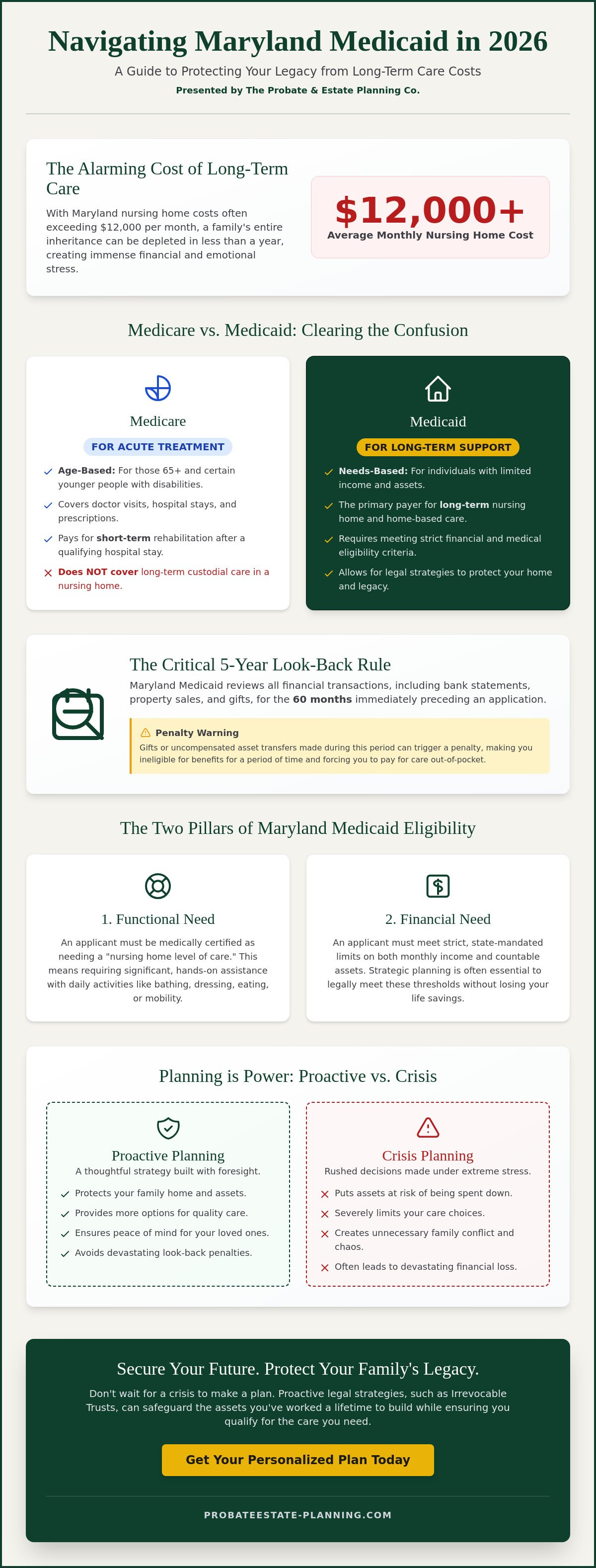
When you apply for medicaid maryland, the state's review process extends far beyond your current bank balance. The Maryland Department of Health performs a rigorous audit of your financial history covering the 60 months immediately preceding your application date. This 60-month window, known as the look-back period, is designed to ensure that applicants haven't intentionally depleted their resources to qualify for public assistance. Every check, bank transfer, and property deed change is subject to scrutiny during this time.
If the state discovers "uncompensated transfers," it'll likely impose a penalty period. This is a specific timeframe during which you're ineligible for Medicaid benefits, even if you meet all other medical and financial requirements. The state calculates this penalty by taking the total value of the assets you gave away and dividing it by the average monthly cost of nursing home care in Maryland. Because this divisor changes periodically based on state data, a gift that seems small today could result in several months of unpaid care costs later. You can find initial eligibility information and resource links through the Maryland Health Connection Official Site, but the look-back audit is a separate, more intensive process conducted by local Departments of Social Services.
A frequent source of confusion involves the IRS annual gift tax exclusion. In 2024, federal law allows an individual to gift up to $18,000 to another person without filing a gift tax return. However, Medicaid rules don't recognize this IRS exemption. Even a gift that's "tax-free" in the eyes of the IRS is still considered a disqualifying transfer for medicaid maryland purposes. Failing to distinguish between tax law and Medicaid eligibility is one of the most common reasons for application denials.
What Constitutes a "Transfer" in Maryland?
A transfer isn't limited to writing a check. It includes any action where you relinquish an asset for less than its Fair Market Value (FMV). Common examples include gifting cash to grandchildren for college, adding a child's name to a property deed, or selling a vehicle to a friend for a "family price." Even charitable donations to your church or a local nonprofit can trigger a penalty if done within the look-back window. The state views these as assets that could've been used to pay for your long-term care.
Exceptions to the Transfer Penalties
Maryland law does provide specific safe harbors to protect family stability. Transfers between spouses are generally exempt from penalties, allowing for the protection of the community spouse's standard of living. You can also transfer a home to a child who's blind or permanently disabled without penalty. Another vital protection is the "Caregiver Child" exception. This applies if a child lived in your home for at least two years prior to your institutionalization and provided a level of care that delayed your need for a nursing home. To avoid accidental penalties, you must document Fair Market Value using professional appraisals or tax assessments to prove that any asset sales were legitimate business transactions rather than hidden gifts.
Long-Term Care vs. Community Medicaid in MD
Choosing between a skilled nursing facility and staying in your own home is a decision that impacts your daily comfort and your family's financial future. Maryland provides two distinct tracks for medicaid maryland coverage: institutional care and Home and Community-Based Services (HCBS). While both require a high level of medical need, their availability and financial structures differ significantly. You shouldn't assume that qualifying for one automatically guarantees access to the other.
Institutional Medicaid is an entitlement. If you meet the clinical and financial requirements, the state provides coverage for nursing home stays without a cap on the number of participants. Community-based programs operate differently. They are managed through waivers that have limited slots. For many families, the reality of a waitlist is the biggest hurdle. As of 2024, the registry for home care services can include thousands of individuals, meaning that waiting until a crisis occurs is often too late. Early planning is the only way to ensure you have a choice in where you receive care.
The Community Options Waiver Program
The Community Options Waiver is the primary tool for those who wish to age in place rather than move to a facility. To qualify, an individual must meet the "nursing home level of care" standard. This means a medical professional determines that without these services, the person would require immediate institutionalization. The program covers essential services including:
- Personal care assistance for daily tasks like bathing and dressing.
- Case management to coordinate medical and social needs.
- Transition services for those moving from a nursing home back to the community.
- Assisted living support in participating Maryland facilities.
Spousal Impoverishment Protections
Maryland law includes specific provisions to ensure that a healthy spouse, known as the "Community Spouse," isn't left without resources while their partner receives care. These protections are vital for maintaining the family home and lifestyle. The Community Spouse Resource Allowance (CSRA) allows the spouse at home to keep a significant portion of the couple's assets. In 2024, this limit can reach up to $154,140 depending on the total value of the estate.
Income is also protected through the Monthly Maintenance Needs Allowance (MMMNA). If the healthy spouse's income falls below a certain threshold, they can keep a portion of the institutionalized spouse's income to meet their own living expenses. In 2024, this allowance can be as high as $3,853.50 per month. Understanding how to maximize these allowances under medicaid maryland rules is a core part of protecting your family's stewardship of its resources.
Strategic Medicaid Planning: Protecting Your Family Legacy
Planning for long-term care involves two distinct paths. Proactive planning happens at least five years before you expect to need assistance. This timeline respects the 60-month look-back period enforced for medicaid maryland. Crisis planning occurs when a senior requires immediate nursing home placement without a prior strategy. While options remain available during a crisis, proactive measures provide the strongest shield for your family home and life savings.
Attempting a DIY application is a significant risk. Small errors in reporting a financial gift or miscalculating an asset's value often lead to months of eligibility disqualification. These mistakes force families to pay out-of-pocket for care that could have been covered. Our legal team serves as a steady guide. We translate complex government rules into a clear plan for your family's future. We act as the bridge between rigid state regulations and your family's long-term security.
Asset Protection Tools: Trusts and Annuities
Irrevocable trusts, specifically Medicaid Asset Protection Trusts (MAPTs), are cornerstone tools in Maryland. Moving assets into a MAPT starts the 5-year clock. Once that window passes, the assets inside the trust are generally not counted toward your eligibility limits. This strategy preserves your legacy for your children rather than exhausting it on medical bills.
- MAPTs: These start the 5-year clock and protect the principal of your estate.
- Medicaid Compliant Annuities: These are used in crisis situations to turn countable assets into an income stream for a spouse remaining at home.
- Maryland Specifics: These tools must be drafted by a qualified Maryland attorney to ensure they meet the unique requirements of the Maryland Department of Health.
The Importance of a Durable Power of Attorney
A standard Power of Attorney often fails when it's needed most. Many basic templates don't include specific "gifting" authority required for effective Medicaid planning. If a senior becomes incapacitated without this specific language, their family may be legally barred from protecting assets or moving them into a trust. This creates a state of paralysis exactly when decisive action is required.
A comprehensive, well-drafted directive ensures your loved ones can take action even if you can't. It allows for the preservation of assets and the seamless transition of management. This document is the difference between a secure legacy and a chaotic legal battle. It ensures that your medicaid maryland strategy remains intact even during a health crisis. To protect your family's harmony and financial future, Schedule a consultation with our Maryland Medicaid planning team today.
Take Control of Your Long-Term Care Strategy
Navigating the complexities of 2026 eligibility requirements doesn't have to be a source of anxiety for your family. By understanding the 60 month look-back rule and the specific income thresholds set for medicaid maryland, you've already taken the first step toward long term security. Effective planning ensures that a lifetime of hard work isn't lost to the high costs of nursing home care. Whether you're planning years in advance or facing an immediate health crisis, strategic asset protection keeps your family legacy intact.
Our firm brings specialized expertise in Maryland Medicaid crisis planning to every consultation. We combine deep local Maryland knowledge with the perspective of a multi-state practice to offer compassionate legal guidance during difficult transitions. You don't have to face these legal hurdles alone. We provide the steady hand and meticulous attention to detail required to safeguard your home and savings from the risks of inaction. Secure your legacy today with a Maryland Medicaid planning consultation.
Take the next step with confidence, knowing your future is protected by a plan that works when it matters most.
Frequently Asked Questions
Is the family home always safe from Medicaid in Maryland?
No, your family home isn't automatically protected from the state's reach. While your primary residence is generally an exempt asset if your equity is below $713,000 in 2024, it remains vulnerable to estate recovery after you pass away. If a spouse or a disabled child lives in the home, the state won't force a sale during your lifetime. Proper stewardship of your property requires advanced planning to ensure your legacy stays within the family.
What is the 5-year look-back rule for Maryland Medical Assistance?
The look-back rule is a 60 month period where the Maryland Department of Health reviews all financial transfers you made before applying for benefits. If you gave away assets or sold property for less than fair market value during these five years, the state imposes a penalty period. This rule prevents individuals from gifting their wealth away just to meet the strict asset limits required for medicaid maryland eligibility without a strategy.
Can I give $15,000 to my children every year and still qualify for Medicaid?
No, you can't use the IRS annual gift tax exclusion, which is $18,000 per recipient in 2024, to qualify for Maryland Medical Assistance. While the federal government allows these tax-free gifts for revenue purposes, Medicaid views them as "uncompensated transfers." Any amount you give away within the 60 month window will trigger a penalty. This delay in coverage often leaves families to cover expensive care costs out of pocket during a vulnerable time.
What happens if I need nursing home care but I am still in the look-back period?
If you require care during the look-back period after making transfers, the state calculates a penalty period during which you're ineligible for benefits. This timeframe is determined by dividing the total value of gifted assets by the average monthly cost of care, a figure the state sets annually. You'll be responsible for paying the facility privately until this penalty expires. This situation can quickly deplete a family's remaining savings without professional legal guidance.
Does Maryland Medicaid cover assisted living costs?
Yes, Maryland provides coverage for assisted living through the Community Options Waiver, though it's not an entitlement like nursing home care. This program has a limited number of slots, and the waiting list often exceeds several years. To qualify for medicaid marylandassisted living benefits, you must meet both financial requirements and a medical "level of care" standard. We help families navigate these waitlists to find the most stable path for their loved ones.
How does Medicaid Estate Recovery work in Maryland after a recipient passes away?
Medicaid Estate Recovery is the process where the state files a claim against your probate estate to recoup the costs of your long-term care. Under federal law established in 1993, Maryland must seek reimbursement for services paid after a recipient turns 55. This often targets the family home if it wasn't shielded by a trust or specific deed. Our goal is to provide protection for these assets, ensuring your family's harmony isn't disrupted by state claims.
Can a Maryland Medicaid lawyer help if I have already moved into a nursing home?
Yes, a lawyer can provide vital guidance even if a loved one is already in a facility through a process known as crisis planning. We use legal tools like specific annuities or structured gifting to protect roughly 40% to 50% of remaining assets. Taking action now provides a clear path forward, ensuring your family finds peace of mind. It's never too late to implement a plan that works when your family needs it most.
Comments
There are no comments for this post. Be the first and Add your Comment below.
Leave a Comment