

Imagine receiving a nursing home bill for $12,500 and realizing your lifelong savings could vanish in just eighteen months. For many families in North Carolina, South Carolina, Maryland, and Tennessee, this isn't a "what-if" scenario; it's a Tuesday morning reality. You likely feel trapped by the five-year look-back rule, believing that because you didn't plan years ago, your family home is now at risk. This is where medicaid crisis planning becomes your most vital tool. You don't have to watch your legacy disappear to pay for care that, according to Genworth's 2023 survey, now averages over $9,700 per month for a private room.
We understand the weight of this moment and the fear that your hard work will be consumed by medical costs. It's a heavy burden, but you don't have to carry it alone. This guide reveals how you can achieve immediate Medicaid eligibility and shield your assets from recovery, even after a loved one has already entered a facility. We'll provide a clear legal roadmap to stop the financial hemorrhaging and ensure your heirs receive the inheritance you intended for them.
Key Takeaways
- Understand that a sudden medical emergency does not have to result in financial ruin or the loss of your family's legacy.
- Learn how to navigate the five-year look-back rule to secure eligibility even after a long-term care crisis has already begun.
- Identify the specific legal thresholds and regional nuances that affect Medicaid qualification across NC, SC, MD, and TN.
- Discover how professional medicaid crisis planning utilizes strategic spend-downs and compliant annuities to safeguard your life's work.
- Replace uncertainty with a methodical, step-by-step path that ensures your long-term care plan works when it is needed most.
What is Medicaid Crisis Planning? Defining the "Emergency" Scenario
Medicaid crisis planning involves specific legal and financial strategies used when a senior requires immediate long-term care but hasn't established a plan in advance. It's a reactive approach designed to protect assets even after a medical emergency has already occurred. According to Medicaid, the program is a joint federal and state venture that provides health coverage, but its complex asset and income limits often create a barrier for families facing a sudden health decline.
Most families encounter this at the "Nursing Home Door." This scenario happens when a medical necessity, such as a stroke or a severe fall, precedes financial eligibility. You're suddenly forced to choose a facility and figure out how to pay for it simultaneously. Traditional estate planning often fails in these active health crises because standard wills or basic powers of attorney don't address the specific spend-down rules and look-back periods required for state assistance.
To better understand how these strategies protect your family assets, watch this helpful video:
An elder law attorney serves as a steady guide during this high-pressure transition. Instead of allowing a family to spiral into financial panic, the attorney provides a methodical path to qualify for benefits while preserving a legacy. This partnership prioritizes your emotional well-being by handling the dense legal requirements, ensuring that the focus remains on the senior's care rather than the paperwork.
Signs You Are in a Medicaid Crisis
You may be in the middle of a crisis if your family is experiencing these specific pressures:
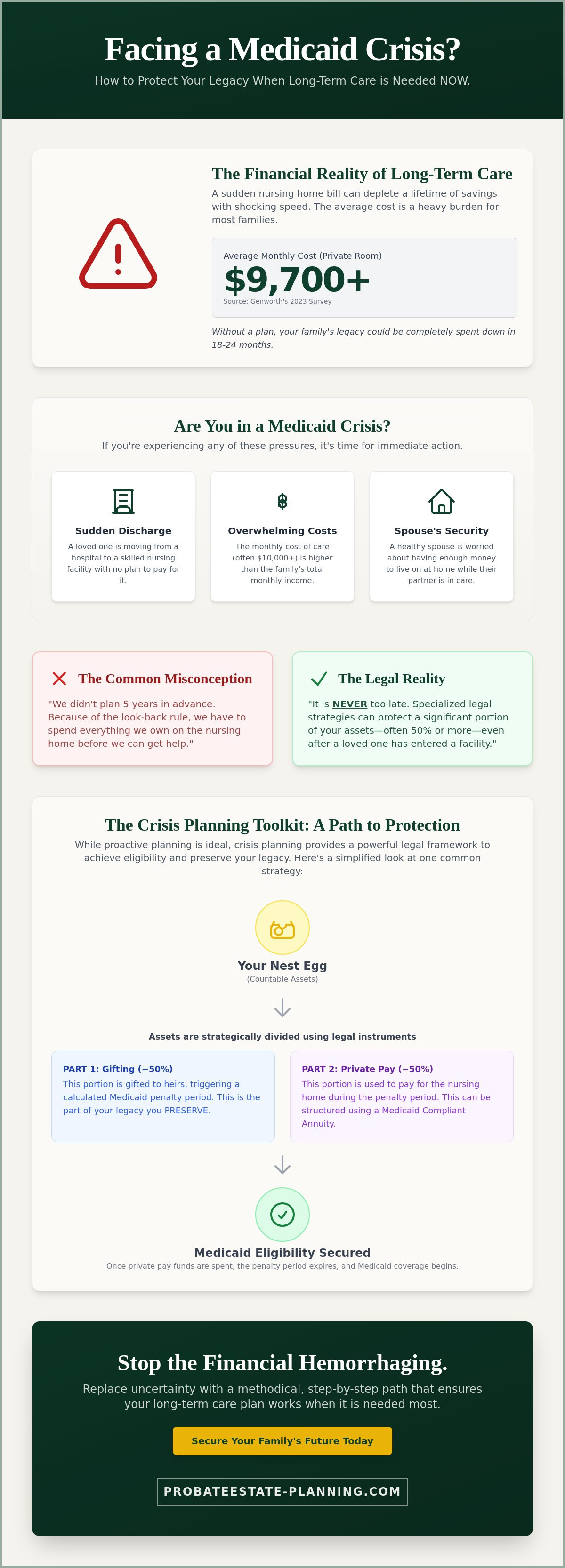
- A loved one is being discharged from a hospital directly to a skilled nursing facility with no plan to pay for it.
- The monthly cost of professional care, which can exceed $10,000 in states like Maryland or North Carolina, is higher than the family's total monthly income.
- A healthy spouse is worried about having enough money to live on at home while their partner is in a facility.
The High Cost of Inaction
Waiting to seek professional help can lead to the rapid depletion of a lifetime's worth of hard work. Spending down assets without a strategic plan can exhaust a couple's savings in just a few months. There's also a long-term risk of losing the family home to Medicaid Estate Recovery after the individual passes away. The "private pay" trap occurs when families pay the full market rate for care because they mistakenly believe they must spend every penny before they can qualify for assistance. Using medicaid crisis planning early in the process helps you avoid these pitfalls and maintain stewardship over your family's future.
Crisis vs. Proactive Planning: Why It's Never "Too Late"
Many families believe that if they haven't planned five years in advance, their hard-earned assets are lost to nursing home costs. This is a common misconception that often leads to unnecessary financial loss. While proactive planning is the gold standard, medicaid crisis planning allows families to protect a significant portion of their estate even after a loved one has entered a care facility. Medicaid evaluates eligibility based on two distinct categories: what you own (assets) and what you make (income). In 2024, most states set an individual asset limit at $2,000, but this doesn't mean you must spend every penny before help arrives.
Effective medicaid crisis planning utilizes specialized legal instruments to bypass the typical waiting periods that trap the unprepared. One core tactic is the "Half-Loaf" strategy. This approach involves gifting approximately half of the remaining assets to heirs while using the other half to pay for care during the resulting penalty period. By the time the private funds are exhausted, the penalty period has expired, and Medicaid begins coverage. This method often preserves 50% or more of a family's legacy that would otherwise be spent on institutional care. These protections are vital when accessing Long Term Services & Supports, as the cost of care in NC, SC, MD, and TN can easily exceed $8,000 per month.
Challenging the 5-Year Look-Back Myth
The 60-month look-back rule isn't an absolute bar to eligibility; it's a calculation tool. Medicaid reviews transfers made within the last five years to identify "uncompensated transfers," which are gifts given without receiving fair market value in return. However, "exempt transfers" exist. For example, transferring a home to a blind or disabled child or a sibling with an equity interest doesn't trigger a penalty. If you've already made gift mistakes, we can often "cure" the gift by returning the funds or using specific legal filings to minimize the penalty's impact. It's a matter of stewardship rather than a loss of control.
Protecting the Community Spouse
When one spouse enters a nursing home, the spouse staying at home, known as the community spouse, shouldn't be left in poverty. The Community Spouse Resource Allowance (CSRA) is designed to prevent this exact scenario. In 2024, the maximum CSRA is $154,140, though the exact amount depends on the couple's total assets at the time of the first continuous period of institutionalization. We use legal strategies to shift assets from the institutionalized spouse to the community spouse, ensuring the family home and necessary funds remain secure. If you're feeling overwhelmed by these complex rules, a consultation regarding comprehensive estate planning can provide the steady guidance your family needs during this transition.
Regional Medicaid Nuances: NC, SC, MD, and TN
While Medicaid is a federal program, local state enforcement varies significantly. This distinction often determines whether a family successfully preserves their legacy or faces total asset depletion. In North Carolina, the state operates under a Medically Needy framework. This allows individuals with high medical expenses to spend down their income to qualify for benefits. Conversely, South Carolina is an Income Cap state. As of 2024, if your monthly income exceeds $2,829, you are ineligible unless you establish a Qualified Income Trust, also known as a Miller Trust. Without this specific legal instrument, medicaid crisis planning in South Carolina can stall before it begins.
Maryland and Tennessee present their own unique hurdles. Maryland maintains a home equity limit of $713,000 for 2024. If your residence's value exceeds this threshold, it may be counted as a resource unless a spouse or dependent child resides there. In Tennessee, the TennCare program follows strict spousal impoverishment rules. For 2024, the Community Spouse Resource Allowance (CSRA) allows the healthy spouse to keep up to $154,140 in countable assets. Understanding these specific numbers prevents the chaos of a rejected application and ensures your spouse's financial security is not sacrificed for your care.
Navigating Local Regulations
The North Carolina Department of Health and Human Services (NCDHHS) requires exhaustive documentation of every financial transaction within the five-year look-back period. Any gift or transfer for less than fair market value results in a penalty period. In Tennessee, the TennCare CHOICES program governs how long-term care services are delivered. It's vital to identify which CHOICES group you fall into, as this dictates the level of care and asset protection available. Looking ahead, the Maryland Department of Health (MDH) is implementing stricter electronic auditing for 2026 filings. This shift means that manual errors in reporting will be caught more frequently by automated state systems, making professional oversight essential for a successful outcome.
State-Specific Exempt Assets
Most states in our region exempt one primary residence and one vehicle from asset calculations. However, the protection of these assets after the applicant passes away varies by state law. South Carolina families often utilize Life Estate deeds to ensure the home passes directly to heirs without entering the probate process. This strategy can sometimes shield the home from estate recovery. In Maryland, the rules surrounding Life Estates are more complex; if the deed wasn't executed properly before the look-back period, the state may still attempt to recover costs from the property's value. Effective medicaid crisis planning requires choosing the right tool for the right state to ensure your family home remains in the family.
- North Carolina: Requires a "spend down" for those over income limits.
- South Carolina: Mandatory use of Miller Trusts for income over $2,829.
- Maryland: Home equity capped at $713,000 for individual applicants.
- Tennessee: CSRA limits protect up to $154,140 for the community spouse.
The Crisis Planning Toolkit: Legal Strategies for Immediate Relief
When a medical emergency forces a move to long-term care, the financial pressure feels immediate. Effective medicaid crisis planning isn't about waiting for a five-year clock to run out. It's about using state-approved legal tools to protect your family's home and savings right now. We focus on turning "countable" assets into protected resources so you don't have to spend every penny on nursing home bills before receiving help.
The Medicaid Compliant Annuity is a primary tool for married couples. It allows you to take a lump sum of cash that would otherwise disqualify you and turn it into a monthly income stream for the spouse staying at home. This strategy provides immediate relief by satisfying asset limits while maintaining the household's purchasing power. We also utilize Personal Care Contracts. These legal agreements allow you to pay a family member for the care they provide. It's a way to reduce your estate while keeping the wealth within the family circle, provided the pay rate reflects the 2024 local market averages for professional caregivers. Unlike proactive trusts used years in advance, an Irrevocable Trust in a crisis is often paired with an annuity to bridge the gap during a shorter penalty period.
Spend-Down Strategies that Work
You can reduce your countable assets by investing in items that Medicaid ignores. This isn't "giving away" money; it's a strategic reinvestment in your family's stability and legacy. Effective strategies include:
- Home Improvements: Using excess cash to replace an aging roof, install a walk-in tub, or upgrade a heating system increases the value of an exempt asset.
- Vehicle Upgrades: Purchasing a reliable, Medicaid-qualified vehicle ensures the healthy spouse has dependable transportation without exceeding asset limits.
- Debt Liquidation: Paying off a $40,000 mortgage or high-interest credit card debt is a valid way to spend down resources while improving your overall financial health.
- Pre-paid Funerals: Setting up an irrevocable funeral trust removes those funds from the Medicaid calculation and spares your children from making difficult decisions during a time of grief.
The Power of the Durable Power of Attorney
Your legal authority is only as strong as the ink on the page. A standard document often lacks the specific "Gifting" and "Medicaid" language required to move assets during medicaid crisis planning. If these powers aren't explicitly stated, your family might be forced into a long, expensive court guardianship process. We review your Durable Power of Attorney to ensure it grants the specific authority needed to protect the estate. Even if a loved one has already lost the capacity to sign new documents, our team has experience navigating the judicial system to obtain the necessary permissions to protect the family legacy. This stewardship ensures that a health crisis doesn't lead to financial chaos.
How The Probate & Estate Planning Co. Secures Your Future
Medicaid crisis planning requires a meticulous hand and a deep understanding of state-specific regulations in North Carolina, South Carolina, Maryland, and Tennessee. We don't just offer advice. Our team provides a comprehensive management system that protects your assets under extreme pressure. This process starts with an exhaustive audit of all holdings to identify potential vulnerabilities. We then guide you through the final submission of the Medicaid application, acting as your steady guide in the courtroom and at the Medicaid office. This level of oversight ensures that your family isn't left guessing about the future of their inheritance or the quality of care their loved one receives.
A Partnership in Stewardship
Attempting a DIY Medicaid application during a medical emergency often results in immediate denials. In states like Maryland or South Carolina, even a small technical error regarding a life insurance policy or a property deed can trigger a penalty period. This leaves the family to pay out-of-pocket for nursing home costs that often exceed $7,000 per month. Our firm steps into the gap to handle this legal complexity. We prioritize family harmony by taking the administrative burden off your shoulders. This allows you to focus on emotional support and care decisions while we manage the chaos of the state bureaucracy. We don't just prepare documents; we provide a shield for your family's financial security and long-term peace of mind.
Emergency Consultation Process
When time is of the essence, our streamlined process moves quickly to stabilize the situation. During your first meeting, we review your specific financial landscape to determine the fastest path toward eligibility. To make this initial session productive, please gather the following items:
- Bank statements from the last 60 months to address look-back requirements
- Real estate deeds and recent property tax assessments
- Existing estate planning documents like wills or powers of attorney
- Health insurance cards and any existing long-term care policies
Our goal is to achieve Medicaid Pending status as rapidly as possible, often within a few weeks of receiving your full financial disclosure. This status allows your loved one to remain in their care facility while the state reviews the application. You don't have to face the state office alone. If you're facing an immediate placement need, schedule your Medicaid Crisis Consultation today to protect what matters most.
Take Control of Your Future Now
Facing a sudden move to long-term care feels overwhelming. Many families believe the 60-month Medicaid look-back period means their assets are lost if they haven't planned years in advance. This isn't the case. Effective medicaid crisis planning allows you to navigate the specific statutes of North Carolina, South Carolina, Maryland, and Tennessee to protect what you've built. Our team brings multi-state expertise to every case, focusing on immediate asset protection strategies that prevent financial exhaustion. We move beyond simple paperwork to provide a functional plan that works when the pressure is highest.
You don't have to face these complex legal hurdles alone. We prioritize your emotional well-being alongside your legal security, ensuring your family stays whole during a crisis. Our specialized focus on elder law across these four regions means we understand the nuances that save homes and life savings. By acting now, you replace chaos with a structured path forward. We're here to offer the steady guidance you need to secure a predictable outcome for your loved ones. You've worked hard for your legacy, and it deserves to be protected. Let's start building your shield today.
Protect your life savings today—Contact our Medicaid Crisis Planning team
Frequently Asked Questions
Is it too late to start Medicaid planning if my spouse is already in a nursing home?
It's not too late to protect your assets. This scenario is exactly why medicaid crisis planningexists. Even after a spouse enters a facility, legal strategies can safeguard a significant portion of your estate. In North Carolina, the healthy spouse can keep up to $154,140 in 2024 under the Community Spouse Resource Allowance. Taking action now prevents the total depletion of your life savings and provides peace of mind for your family's future.
Will Medicaid take my house if I need long-term care in North Carolina?
Medicaid won't take your home while you're living in it, but the state may seek reimbursement from your estate after you pass away. In North Carolina, your primary residence is exempt if your equity is below $713,000 in 2024 and you intend to return home. If a spouse or disabled child resides there, the home is fully protected. We use specific legal structures to ensure your property remains a legacy for your heirs.
What is the 5-year look-back rule and how does it affect crisis planning?
The 5-year look-back rule is a mandatory review of all financial transfers made within 60 months of your Medicaid application. If you gave away assets for less than fair market value during this time, the state imposes a penalty period of ineligibility. During a crisis, we don't have the luxury of waiting five years. We use court-approved methods to navigate these rules, allowing you to qualify for benefits while protecting as much as possible.
Can I give my money away to my children to qualify for Medicaid?
Giving money directly to children often creates a penalty that delays your care. Medicaid calculates this delay by dividing the gifted amount by the average monthly cost of care, which was $7,483 in South Carolina according to 2023 Genworth data. If you gave away $75,000, you'd face roughly 10 months of private pay. It's better to use structured legal tools that satisfy state auditors while still providing for your children's inheritance.
What assets are exempt from the Medicaid spend-down in South Carolina?
South Carolina allows you to keep specific exempt assets, including your primary home with an equity limit of $713,000 for 2024. Other non-countable items include one vehicle of any value, household goods, and certain small life insurance policies. Your individual countable resources must stay below $2,000. We help you identify which assets are safe and which need to be restructured to meet these strict financial requirements without losing everything you've built.
How much does a Medicaid crisis planning attorney cost compared to nursing home fees?
Legal fees are typically a small fraction of the cost of just one year in a facility. According to the 2023 Genworth Cost of Care Survey, a private room in a Maryland nursing home costs a median of $11,437 every month. Professional guidance focuses on saving hundreds of thousands of dollars in long-term costs. This investment ensures your spouse isn't left in poverty and your children receive the stewardship they deserve.
What is a Medicaid Compliant Annuity and how does it help in a crisis?
A Medicaid Compliant Annuity is a specialized financial contract that turns countable cash into an income stream for the healthy spouse. This is a vital tool in medicaid crisis planningbecause it immediately reduces your assets to the required eligibility levels. To work, the annuity must be irrevocable and follow Social Security Administration life expectancy tables. It's a reliable way to preserve capital while ensuring the spouse at home has enough monthly income.
Does Tennessee have different Medicaid rules than Maryland?
Yes, Tennessee and Maryland have distinct rules regarding income limits and application procedures. Tennessee's TennCare program requires a "Qualified Income Trust" if your monthly income exceeds $2,829 in 2024. Maryland uses different "Medically Needy" standards that may allow for more flexibility in certain medical expenses. Our firm understands these regional differences, ensuring your plan complies with the specific administrative codes of your state to avoid unnecessary delays or denials.
Comments
There are no comments for this post. Be the first and Add your Comment below.
Leave a Comment