

What if your family's most cherished assets aren't actually lost the moment a nursing home admission begins? Many families in our state believe they've run out of time to plan, but a skilled medicaid crisis elder law attorney maryland can often find legal paths to protection even during a health emergency. It's natural to feel a sense of panic when you're told you must spend down your life savings to meet the $2,500 individual asset limit. You've worked hard for what you have, and the thought of losing the family home to estate recovery is deeply unsettling.
We understand the weight of these decisions and the confusion surrounding Maryland's strict 60-month look-back rules. You deserve a clear path forward that prioritizes your family's well-being alongside legal security. In this article, you'll discover how to qualify for essential care without becoming destitute. We'll walk through the practical steps to protect your savings and navigate the new requirements of the One Big Beautiful Bill Act, giving you the steady guidance needed to manage this transition with confidence and peace of mind.
Key Takeaways
- Learn how to bridge the gap between high private pay nursing home costs and your family's life savings during an immediate health crisis.
- Understand how the 60-month look-back rule and the penalty period are applied in 2026 to prevent the loss of your family home.
- Discover how a medicaid crisis elder law attorney maryland uses specific legal tools like half-a-loaf strategies and caregiver agreements to preserve assets.
- Navigate a methodical five-step process to audit your finances and design a protection plan that ensures long-term security and eligibility.
- Recognize why local expertise is essential for managing the nuances of Maryland's medically needy spend-down requirements and county-level casework.
What is a Medicaid Crisis in Maryland?
A Medicaid crisis occurs the moment a loved one requires immediate long-term care but lacks a structured plan to pay for it. It isn't just a health emergency; it's a financial race against time. For many families, this realization hits during a hospital stay or right after a sudden diagnosis. You might feel forced to choose between your loved one's care and your family's financial future, but this is a choice you don't have to make alone.
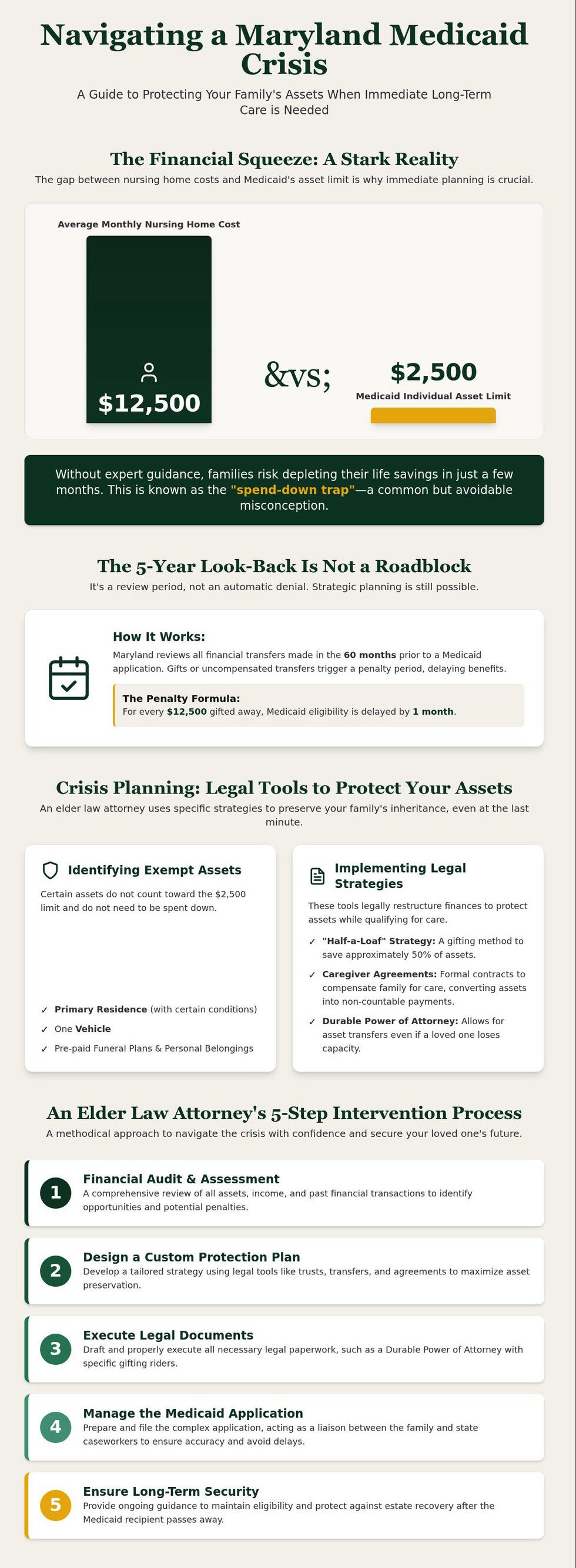
In Maryland, the stakes are exceptionally high. The average monthly cost for a nursing home is approximately $12,500. When you compare that to the individual asset limit of just $2,500, it's easy to see why families feel overwhelmed. Medicaid was designed to help, but the eligibility rules are strict and often unforgiving. Partnering with a medicaid crisis elder law attorney maryland can help you navigate these numbers before your savings are entirely depleted.
To better understand the foundational differences between your coverage options, watch this helpful video:
The "spend-down trap" is a common danger where families believe they must pay out of pocket until they're destitute before the state will step in. This is a misconception that can cost your family their entire inheritance. Waiting for the "perfect time" to plan often results in the loss of thousands of dollars that could have been legally protected. Because Maryland uses a 60-month look-back period, every month you delay can limit your options for asset preservation.
Signs You Are in a Medicaid Crisis
- A loved one is currently in a hospital awaiting discharge to a long-term care facility.
- A nursing home administrator has informed you that your "private pay" funds are nearly exhausted.
- A Medicaid application has already been denied because of "excess assets" or "improper transfers" made in the past.
The Role of an Elder Law Attorney in Intervention
A medicaid crisis elder law attorney maryland serves as a steady guide through this storm. They act as a liaison between your family, the care facility, and state caseworkers to ensure paperwork is filed accurately. Beyond administrative tasks, they identify "exempt" assets, such as a primary residence or a vehicle, that don't need to be liquidated. They also draft essential legal documents like a Durable Power of Attorney with specific gifting riders. These riders allow for asset transfers even after a loved one has lost the capacity to sign documents themselves, providing a vital safety net when time is of the essence.
The Maryland 5-Year Look-Back Rule: Why It Is Not Too Late
The most common fear families face is the belief that they have missed their window of opportunity. You might have heard that if you didn't transfer your assets five years ago, you're now forced to lose everything to the nursing home. This is a misconception. While the 60-month look-back rule is a real component of Maryland Medical Assistance, it's a review period, not a flat denial of benefits. Even if a loved one is already in a facility, a medicaid crisis elder law attorney maryland can often implement strategies to protect a significant portion of the estate.
When you apply for coverage, the state reviews every financial transaction from the previous five years. If they find "uncompensated transfers"—money or property given away for less than fair market value—they calculate a penalty period. In 2026, Maryland uses a penalty divisor of approximately $12,500. This means for every $12,500 gifted, the state will withhold payment for one month of care. Understanding this math is the first step toward reclaiming control. Crisis planning focuses on transforming countable assets into exempt ones, ensuring that the "spend-down" process doesn't leave the family with nothing.
Many families also worry that the state will take their house the moment they apply. This doesn't happen. In Maryland, your primary residence is generally considered an exempt asset during your lifetime, provided you or certain family members reside there. The real risk is "estate recovery" after a loved one passes away. Professional Medicaid Crisis Planning can help protect the home from these future claims, even when care is needed immediately.
The Truth About Asset Transfers
Simply "giving the house to the kids" is one of the most dangerous moves you can make without a legal plan. This creates a massive penalty period that leaves the applicant without benefits and without the funds to pay for care. However, these transfers can often be corrected. We can work to "cure" a gift or utilize specific Maryland-compliant transfers that the state recognizes as legal exceptions. This distinction between an improper gift and a compliant transfer is what saves a family's legacy.
Maryland-Specific Eligibility Thresholds for 2026
For 2026, the asset limits remain strict. A single applicant is limited to just $2,500 in countable assets, while a couple applying together is limited to $3,000. For married couples where only one spouse needs care, the "Community Spouse Resource Allowance" (CSRA) is a vital protection. The healthy spouse can retain up to $162,660 in assets. Because Maryland is a "medically needy" state, we can also use spend-down strategies for those whose income exceeds the monthly limits, ensuring care is accessible regardless of your starting point.
Asset Protection Strategies for Immediate Nursing Home Care
Proactive planning is often a marathon, but crisis planning is a sprint that requires a different set of legal instruments. While an Irrevocable Trust is an excellent tool when you have five years to wait, a medicaid crisis elder law attorney maryland can deploy specific crisis tools designed for immediate intervention. You don't have to wait for the clock to run out; instead, we can use the law to protect what you've built even after a loved one has entered a facility.
One of the most effective methods in these situations is the "Half-a-Loaf" strategy. This technique involves gifting a portion of assets to family members while using the remaining funds to purchase a Medicaid Compliant Annuity. This specialized annuity is designed to pay for the nursing home during the penalty period triggered by the gift. By the time the annuity funds are exhausted, the penalty period has ended, and the applicant qualifies for coverage. Because these annuities must meet strict federal and state requirements, seeking the guidance of a medicaid crisis elder law attorney maryland is the most effective way to ensure these complex tools are executed correctly.
Another powerful but often overlooked tool is the "Caregiver Child" exception. If an adult child has lived in the parent's primary residence for at least two years prior to their admission to a nursing home, and provided care that delayed that admission, the home can often be transferred to that child without any Medicaid penalty. This recognizes the immense value of family caregiving and serves as a vital way to keep the family home within the family legacy.
Protecting the Primary Residence
Maryland law offers several protections for the family home, but you must navigate them carefully to avoid future complications. During the application process, the home is generally exempt if the applicant expresses an "intent to return home," even if that return seems unlikely from a medical standpoint. However, simply staying exempt during your lifetime isn't enough. Without proper Medicaid Crisis Planning, the state may pursue estate recovery after a loved one passes away to recoup the costs of care. We focus on legal transfers and life estate deeds to ensure the home remains a family asset rather than a source of state reimbursement.
Strategies for Married Couples
For married couples, our primary goal is to ensure the "community spouse" living at home isn't left in financial ruin. We look for ways to expand the Community Spouse Resource Allowance (CSRA) to its maximum limit, which is $162,660 in 2026. If assets exceed this amount, we may utilize "Spousal Refusal." This is a last-resort tactic where the healthy spouse formally refuses to contribute their assets toward the ill spouse's care. While this can be a complex path, it's a legal right in Maryland that can prevent a healthy spouse from becoming destitute due to staggering facility costs.
How a Maryland Elder Law Attorney Intervenes: The 5-Step Process
Navigating a health crisis requires a methodical approach to ensure no detail is overlooked. When you partner with a medicaid crisis elder law attorney maryland, we move beyond the initial panic toward a structured, legal solution. This process is designed to bring order to chaos, protecting your family's dignity and financial future simultaneously. It's a partnership in long-term management where we handle the technicalities so you can focus on your loved one's care.
The first step is the Initial Crisis Audit. We review every financial move made over the last 60 months. This isn't just about bank balances; it's about understanding the story your finances tell the state. From there, we move to Strategy Design. We analyze whether a spend-down, a gifting strategy, or an annuity-based protection plan offers the best outcome for your specific circumstances. Once the path is clear, we begin Document Execution. This often involves updating a Durable Power of Attorney or establishing an Irrevocable Trust to facilitate the necessary asset transfers.
The final phases involve the Medicaid Application Submission and ongoing maintenance. Dealing with the Maryland Department of Health requires precision. A single missing receipt or an unexplained transfer can trigger a denial. We manage the entire submission process and remain by your side through Approval and Maintenance. This ensures that as state regulations change, your loved one's eligibility remains secure and any inquiries from state caseworkers are handled promptly.
The Asset Audit: What You Need to Gather
Gathering the necessary documentation is often the most stressful part for families. To prepare for a successful application, you'll need to compile five years of bank statements, federal and state tax returns, and property deeds. We also look for assets that the state counts toward the $2,500 individual limit. These include the cash value of life insurance policies or certain types of burial plots. If you're applying under the medically needy rules, documenting every medical expense is essential to meeting the spend-down requirements correctly.
Navigating the Maryland Medicaid Bureaucracy
The state's application process is notoriously complex. Many self-filed applications face significant delays or initial denials because of minor procedural errors. When the state issues a Request for Information (RFI), you often have a very narrow window to respond. A medicaid crisis elder law attorney maryland acts as your advocate, ensuring every response is legally sound and submitted on time. For many families, this transition is just one part of a larger plan. Learn more about our Probate Administration services for holistic family protection that extends beyond the current crisis.
Don't face the Maryland Department of Health alone. If you're ready to secure your family's future, schedule your Medicaid Crisis Planning consultation today to begin your asset audit.
Choosing the Right Maryland Elder Law Advocate
Selecting legal representation during a health emergency is a decision that impacts your family's financial security for years to come. While a general practice lawyer may understand basic contract law, they often lack the specialized focus required to manage a Medicaid crisis. The regulations governing long term care in our state are dense and change frequently. A dedicated medicaid crisis elder law attorney maryland brings the precision needed to navigate these shifts without risking your family's life savings. We don't just offer legal advice; we provide a partnership in long term management that prioritizes your emotional well-being alongside your formal security.
Local knowledge is another critical factor in a successful outcome. Maryland's Medicaid application process can vary significantly depending on the county where you apply. Understanding the specific requirements and communication styles of caseworkers in different jurisdictions can prevent unnecessary delays. We maintain a professional authority that stems from years of experience in these local offices, allowing us to act as a steady guide through the bureaucracy. Our goal is to stop the financial bleed immediately, ensuring that every day your loved one is in a facility, we are working toward a sustainable payment solution.
The Value of an Integrated Legal Team
Effective crisis intervention requires a holistic view of your family's legal needs. We combine expertise in Estate Planning, Asset Protection Planning, and Probate Administration Services to ensure your plan is comprehensive. For example, if a loved one is receiving a settlement from Personal Injury Legal Representation, those funds must be structured carefully. Without specific legal tools, a sudden influx of cash could immediately disqualify a resident from Medicaid benefits. We provide a steady hand during these transitions, ensuring that every piece of your financial puzzle fits into a larger strategy for continuity and safety.
Protecting Your Legacy Starting Today
The true outcome of professional Medicaid Crisis Planning is peace of mind. It's the relief that comes from knowing your parent is receiving high-quality care while your children's inheritance remains protected. It is a common misconception that once a person enters a nursing home, all is lost. In reality, it is rarely too late to save something significant. Whether you are facing a sudden hospital discharge or a looming spend-down, there are legal paths available to safeguard your home and savings. Taking the first step today can prevent future complications for your heirs and preserve the interpersonal connections that matter most.
You don't have to face this transition alone. Schedule your Medicaid Crisis Consultation with The Probate & Estate Planning Co. today to begin protecting your family's future and securing the care your loved one deserves.
Securing Your Family's Legacy and Peace of Mind
Navigating a health emergency is one of the most significant transitions your family will ever face. We've explored how crisis planning allows you to protect your home and savings even when care is needed immediately. By understanding the nuances of the 60-month look-back rule and utilizing a methodical five-step intervention, you can ensure your loved one receives high-quality care without sacrificing everything you've worked for. A skilled medicaid crisis elder law attorney maryland provides the technical precision required to handle complex Department of Health regulations while maintaining a human-centric focus on your family's emotional well-being.
Our practice offers comprehensive protection that covers everything from Irrevocable Trusts and Wills to specialized asset safeguarding. We act as your steady guide, ensuring that every legal document and application is executed with meticulous attention to detail. You don't have to carry this burden alone; it's never too late to take action and find a predictable outcome for your family's future. We are here to offer the wisdom and experience needed to safeguard your most important interpersonal connections.
Protect Your Family Assets—Contact Our Maryland Elder Law Team Today to schedule your consultation and begin the journey toward long-term security.
Common Questions About Medicaid Crisis Planning in Maryland
Can Maryland take my house if I go into a nursing home?
Maryland does not seize your home the moment you enter a nursing home. Your primary residence is typically considered an exempt asset during your lifetime, provided you express an intent to return home or a spouse still lives there. The danger lies in the future, as the state may file a claim against your estate after you pass away to recoup care costs. This is why legal protection is vital even when the home is currently exempt.
What is the "Half-a-Loaf" strategy in Maryland Medicaid planning?
The "Half-a-Loaf" strategy is a crisis planning technique used to protect roughly 40% to 50% of your assets even after care has started. You gift a portion of your savings to your heirs and use the remaining funds to purchase a Medicaid-compliant annuity. This annuity provides the income necessary to pay for your care during the penalty period triggered by the gift. It's a methodical way to preserve a legacy when time is short.
How much money can a spouse keep when the other enters a nursing home in MD?
In 2026, the healthy spouse, known as the community spouse, can keep up to $162,660 in countable assets. This is known as the Community Spouse Resource Allowance. If your joint assets exceed this limit, a medicaid crisis elder law attorney maryland can help you implement legal strategies to protect the excess rather than spending it all on facility bills. This ensures the healthy spouse remains financially secure at home.
Is a 5-year look-back always required for Medicaid in Maryland?
Yes, Maryland applies a 60-month look-back period for all long-term care Medicaid applications. The state reviews every financial transaction to ensure you haven't given away assets just to qualify for benefits. While the look-back is a standard procedural hurdle, certain transfers to disabled children or specific caregiver agreements may be exempt from penalties if they are structured correctly under current state law.
What assets are exempt from the Medicaid spend-down in Maryland?
Several assets are not counted toward the $2,500 individual limit during the spend-down process. These include your primary home, one vehicle, household goods, and personal effects. You may also keep certain prepaid burial contracts and life insurance policies, provided the face value stays below specific state thresholds. Identifying these exemptions is a key part of preventing the unnecessary liquidation of your personal property.
Can I apply for Medicaid myself or do I need an elder law attorney?
You have the legal right to apply on your own, but the process is fraught with procedural obstacles that often lead to denials. A medicaid crisis elder law attorney maryland identifies legal exceptions and asset protection tools that state caseworkers aren't required to disclose to you. Professional guidance ensures your application is filed correctly the first time, preventing costly delays and protecting your family from avoidable financial loss.
How does Maryland's Estate Recovery program work?
Maryland's Estate Recovery program seeks to reimburse the state for the costs of your long-term care after you pass away. The state may file a claim against your probate estate, which often includes your home if it wasn't protected through prior legal planning. Our role is to use proactive strategies that minimize the impact of these claims, ensuring your assets pass to your loved ones rather than the state.
What happens if I gifted money to my children in the last five years?
Gifts made within the five-year look-back period trigger a penalty period during which Medicaid will not pay for your care. This period is calculated by dividing the total gift amount by the state's average monthly nursing home cost, which is approximately $12,500 in 2026. It's often possible to "cure" these gifts or use other legal offsets to reduce or eliminate the penalty, but you must act quickly to implement these solutions.
Comments
There are no comments for this post. Be the first and Add your Comment below.
Leave a Comment