

Imagine standing in the Register of Wills office in Annapolis, holding a stack of paperwork and realizing that one oversight could make you personally liable for a decedent's debts. You aren't alone. Many executors struggle to manage the 12 month timeline typically required to close a standard estate. Partnering with experienced maryland probate lawyers ensures you don't have to face these complexities in isolation. It's natural to feel the weight of this role. You're trying to honor a loved one's legacy while facing the technical demands of the court.
We understand that you want to protect your family's inheritance and move through this process with grace. This guide provides a clear framework for selecting a legal partner who will safeguard your assets and handle the administrative burden with quiet competence. We'll explore how to distinguish between Small and Regular estates under current 2026 guidelines, strategies to shield the family home from Medicaid recovery, and the specific steps to reach legal closure without sparking unnecessary conflict.
Key Takeaways
- Gain a clear understanding of the Maryland probate timeline and the essential role the Register of Wills plays in authenticating your loved one's final wishes.
- Navigate your role as a Personal Representative with confidence by learning how to fulfill your fiduciary duties while protecting yourself from legal liability.
- Protect the estate's assets from Medicaid recovery programs and learn the legal priority for settling debts to ensure more of the inheritance stays with your family.
- Use our buying guide to evaluate and hire the right maryland probate lawyers based on their specific experience in your local Orphan's Court and their ability to handle complex litigation.
- Move from administrative chaos to a sense of peace by implementing a structured strategy that preserves your family's legacy and long-term financial security.
Understanding the Maryland Probate Process in 2026
Losing a loved one brings a heavy emotional burden. The legal transition that follows shouldn't add to your distress. In Maryland, the probate process is the court-supervised method used to authenticate a will, pay final debts, and distribute assets to the rightful heirs. Experienced maryland probate lawyers act as your steady guide through this transition, ensuring that your family's legacy remains protected and your interpersonal relationships stay intact.
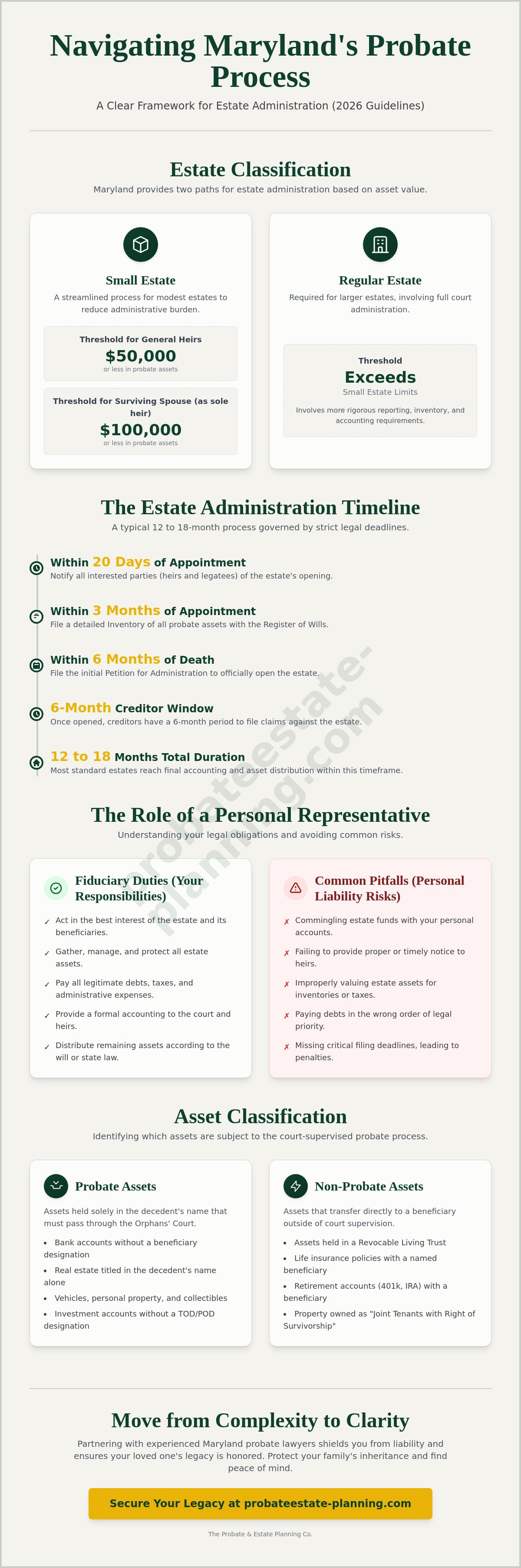
Each county in Maryland operates its own Register of Wills. This office serves as the clerk for the Orphans' Court, where all estate matters are filed and reviewed. As of January 1, 2026, new administrative regulations have tightened the window for document submissions. Missing a filing deadline now triggers immediate administrative penalties. This shift makes meticulous record-keeping and professional oversight more critical than ever for personal representatives.
To better understand how these court procedures work in practice, watch this helpful video:
You must distinguish between probate and non-probate assets to manage the estate effectively. Probate assets are those held in the deceased person's name alone. Non-probate assets, such as those held in a revocable living trust or through joint tenancy with right of survivorship, pass directly to beneficiaries outside of court supervision. This distinction often determines how much court involvement your family will face and how quickly assets can be accessed.
Small Estate vs. Regular Estate Thresholds
Maryland law provides a streamlined path for smaller estates to reduce the administrative burden on grieving families. If the value of probate assets is $50,000 or less, you can utilize the Small Estate process. This limit increases to $100,000 when the surviving spouse is the sole heir. As of 2026, the Maryland Small Estate limit is defined as $50,000 for general heirs and $100,000 for surviving spouses. Regular estates exceeding these amounts require full administration, which involves more rigorous reporting and inventory requirements.
The Timeline of Maryland Estate Administration
Time is a factor you can't ignore during administration. You must file the initial petition for administration within 6 months of the decedent's passing to remain in compliance with state law. Once the estate opens, Maryland mandates a 6-month window for creditors to file claims against the estate's assets. Most families find that probate takes between 12 and 18 months to reach a final distribution. Delays often stem from complex tax filings, real estate sales, or disputes among heirs. Working with maryland probate lawyers helps you anticipate these hurdles before they stall your progress.
Responsibilities of a Maryland Personal Representative
In Maryland, the individual tasked with managing a deceased person's estate is known as the Personal Representative. This role is a significant undertaking that moves beyond mere paperwork; it is a position of high legal trust known as a fiduciary duty. When you accept this appointment, you're legally bound to act in the best interest of the estate and its beneficiaries. Mistakes, even honest ones, can lead to personal financial liability. If assets are mishandled or taxes are underpaid, creditors or heirs can hold you personally responsible for the deficit.
Common pitfalls often catch well-meaning individuals off guard. Commingling funds, which involves mixing your personal money with estate bank accounts, is a frequent error that can trigger court sanctions. Other risks include failing to notify heirs within the mandatory 20-day window or providing improper asset valuations. Experienced maryland probate lawyers act as a protective shield for the Personal Representative. They ensure every procedural step follows the Maryland Code, effectively insulating you from claims of negligence or breach of duty.
Mandatory Filings and Inventories
The probate process is governed by strict deadlines. Within three months of your appointment, you must file an Inventory and an Information Report. These documents provide the Orphan's Court with a snapshot of the decedent's assets and non-probate property. By the nine-month mark, the First Account is due. This is a comprehensive ledger showing every cent that has entered or left the estate. To ensure you're using the correct forms, you should reference the Maryland Register of Wills publications which outline the specific requirements for each county. Accuracy is vital, especially regarding real estate. You'll need professional appraisals from licensed Maryland appraisers to establish a date-of-death value that stands up to court and tax scrutiny.
Managing Estate Litigation and Disputes
Emotional tension often surfaces during estate administration. When a family member challenges the validity of a will, it's known as a "Caveat" proceeding in the Maryland Orphan's Court. These disputes can be incredibly draining and complex. Disagreements frequently arise over "sentimental" personal property, such as jewelry or family heirlooms, which may not have a high market value but hold immense emotional weight. Maryland probate lawyers serve as essential mediators in these moments. By providing a steady, objective voice, legal counsel can resolve conflicts and prevent a permanent rift between survivors. If you find yourself caught in the middle of family friction, reaching out to supportive legal counsel can help restore order and protect your peace of mind while you fulfill your duties as a steward of the family legacy.
Protecting the Estate from Medicaid Recovery and Creditors
Managing an estate involves more than just distributing heirlooms; it requires a shield against claims that could diminish your loved one's legacy. When a person passes away in Maryland, their assets become a pool from which legal debts and taxes must be paid before any heir receives a distribution. If the debts exceed the total value of the assets, the estate is considered "insolvent." In these cases, maryland probate lawyers provide the necessary guidance to ensure you don't accidentally pay a low-priority creditor with funds that should have been reserved for the state or the funeral home.
Maryland law establishes a strict priority of claims to maintain order and fairness. Creditors aren't paid on a first-come, first-served basis. The hierarchy generally follows this order:
- Funeral Expenses: Maryland law allows up to $15,000 for funeral costs to be paid as a high-priority claim.
- Family Allowance: A surviving spouse is entitled to $10,000, and each minor child of the deceased is entitled to $5,000 for their immediate support.
- Taxes: Federal and state tax obligations must be satisfied.
- Medical Expenses: Costs associated with the decedent's final illness receive priority over general debts.
- General Creditors: Credit card companies and personal loans are usually last in line.
Following this Maryland estate administration guide helps personal representatives understand the sequence of these payments to avoid personal liability for mismanaged funds.
Navigating Maryland Medicaid Recovery Rules
The Maryland Medicaid Estate Recovery Program seeks reimbursement for long-term care services provided to individuals aged 55 or older. The state identifies probate assets, such as the family home, to recoup these costs. However, the state cannot recover funds if there's a surviving spouse, a child under age 21, or a child of any age who's blind or permanently disabled. Maryland probate lawyers can assist in filing hardship waivers for Medicaid recovery if the recovery would deprive an heir of their primary residence or cause undue financial distress.
Tax Obligations of the Maryland Estate
Tax compliance is a critical step in the stewardship of an estate. For 2026, the Maryland Estate Tax threshold remains at $5 million, meaning estates valued below this amount generally don't owe state-level estate tax. Conversely, the Federal Estate Tax exemption is projected to drop to approximately $7 million in 2026 due to the sunset of the Tax Cuts and Jobs Act.
You must also distinguish between estate taxes and the Maryland Inheritance Tax. While lineal descendants like children, parents, and spouses are exempt, more distant relatives or friends must pay a 10% tax on the value of the property they receive. The personal representative is responsible for filing the final individual income tax return (Form 1040) and the fiduciary income tax return (Form 1041) if the estate generates more than $600 in annual income during the administration period.
Buying Guide: How to Choose the Best Maryland Probate Lawyers
Selecting a legal partner during a time of grief requires a balance of logic and intuition. You need a steady guide who understands that behind every "estate" is a family trying to find their footing. When you search for maryland probate lawyers, your goal is to find a firm that offers both technical mastery and emotional intelligence.
Start by evaluating local experience. Maryland's probate system is decentralized, with 24 distinct jurisdictions including Baltimore City. Each Orphan's Court has its own procedural preferences and local nuances. A lawyer who frequently practices in Montgomery County might not be as familiar with the specific clerks or judges in Anne Arundel County. Ask the firm if they've handled at least 15 cases in your specific county within the last 24 months. This local familiarity prevents administrative delays that can stall an estate for several months.
Verify how the firm handles complex issues. Some practitioners only manage "administrative" probate, which works fine if every heir agrees and the assets are simple. However, if a disgruntled relative challenges the will or a creditor files a surprise claim, you need a firm equipped for litigation. You also want integrated support. If the deceased was receiving state benefits, the Maryland Medicaid Estate Recovery Program may seek reimbursement from the estate. A comprehensive firm identifies these risks before they become crises, protecting the harmony of your family's future.
Transparency regarding costs is non-negotiable. Maryland law, specifically the Estates and Trusts Article § 7-601, provides a framework for attorney fees, but you must understand the specific billing structure. Ask whether they charge a flat fee for standard filings or an hourly rate for more involved tasks. A written fee agreement should be provided at the very beginning of the relationship to protect your family's inheritance and ensure everyone is on the same page.
Questions to Ask During a Legal Consultation
Preparation is the key to a predictable outcome. During your initial meeting, ask these three specific questions:
- How many estates have you administered in this specific Maryland county? Local knowledge is your best defense against avoidable court backlogs.
- Who will be my primary point of contact? You deserve to know if you'll be speaking with your attorney or a paralegal for your weekly updates.
- What is your strategy for minimizing Maryland inheritance taxes? Maryland is one of the few states with a separate inheritance tax. Your lawyer should have a plan to protect non-exempt heirs from unnecessary financial loss.
Red Flags to Avoid in Probate Representation
Trust your instincts if a firm makes bold claims that seem unrealistic. Avoid lawyers who promise a "speedy" resolution in under six months. Maryland law requires a mandatory six-month waiting period for creditors to file claims, so any promise to finish faster is legally impossible. Another red flag is a lack of clear communication regarding this creditor period. If they don't mention the statutory timelines, they aren't being thorough enough to protect you. Finally, never hire a firm that refuses to provide a written fee agreement upfront. Clear boundaries create the peace of mind your family needs during this transition.
Strategic Estate Stewardship with The Probate & Estate Planning Co.
When a loved one passes, the sudden weight of legal responsibility often feels like a secondary trauma. The Probate & Estate Planning Co. transforms this period of chaos into a structured legacy. We serve as your steady guide through the 24 unique jurisdictions of Maryland, from the specific procedural requirements in Baltimore City to the distinct local rules in Montgomery County. Our approach combines technical precision with a human touch. We ensure your family's emotional well-being remains as protected as your financial assets.
Our expertise lives at the intersection of probate and asset protection. We don't just process paperwork; we safeguard the wealth your family spent generations building. Maryland law is complex, especially regarding the $50,000 small estate threshold or the $100,000 limit for surviving spouses. Our team of maryland probate lawyers navigates these specific figures to ensure you're using the most efficient administration path available. We provide the quiet confidence you need to move forward without the fear of missing a critical deadline or mismanaging a fiduciary duty.
Comprehensive Legal Support for Maryland Families
Our support extends beyond the probate court's walls. We assist families with Medicaid crisis planning, ensuring that long term care costs don't consume the entire inheritance. If a loved one suffered a personal injury before their passing, we manage those claims as part of the estate's assets. We've seen how a single unresolved injury claim can stall an entire probate process. Our team works to secure fair compensation for these injuries, treating them as a vital component of the family's future security. It's about looking at the whole picture, not just the death certificate. Contact us for a consultation in Maryland to secure your family's future and resolve these overlapping legal challenges.
Peace of Mind for the Personal Representative
The role of a Personal Representative is often exhausting and thankless. You're expected to handle 100 plus pages of filings while managing grieving relatives and aggressive creditors. We take that burden off your shoulders. Our firm handles the heavy lifting of court filings and creditor negotiations, protecting you from personal liability. We've refined a process that prioritizes clarity and speed. You won't have to guess about the next step or worry about a mistake in the inventory report. Our promise is a plan that works when your family needs it most. Schedule a consultation with our Maryland probate team today and let us provide the professional authority you need to close this chapter with dignity.
Secure Your Family's Future and Legacy
Navigating the Maryland Orphan's Court system requires more than just filling out forms; it demands a strategy that anticipates 2026 legal shifts. You've learned how critical it's to shield assets from Medicaid Estate Recovery and manage the heavy responsibilities of a Personal Representative. These tasks are often overwhelming for families grieving a loss. Our team brings decades of specific experience in Maryland probate proceedings to your side, standing as the maryland probate lawyers you need to handle complex family dynamics with a human-centric touch. We focus on protecting your inheritance from creditors while ensuring every fiduciary duty is met with precision. We'll help you transform a daunting legal process into a manageable path forward that preserves harmony among heirs. You can move forward with the confidence that your loved one's wishes are being honored by experts who prioritize your emotional well-being. Schedule a Consultation with our Maryland Probate Lawyers to begin protecting your family's future today. You don't have to carry this burden alone; a secure and predictable outcome is within your reach.
Frequently Asked Questions
How much does a probate lawyer cost in Maryland?
Attorney fees in Maryland are typically governed by Maryland Code § 7-601, which limits combined commissions and legal fees to 9 percent of the first $20,000 and 3.6 percent of the remaining estate value. These caps ensure that the costs of hiring maryland probate lawyersremain predictable for your family. You'll also encounter court filing fees that range from $2 to over $1,500 based on the total asset value of the estate.
Is probate required in Maryland if there is a will?
Probate is required in Maryland even if a valid will exists if the deceased person owned assets in their sole name. The will serves as a roadmap for the court, but it doesn't bypass the legal process of transferring title. According to the Maryland Office of the Register of Wills, any estate with assets exceeding $50,000, or $100,000 if the spouse is the sole heir, must undergo full administration to ensure legal clarity.
How long does an executor have to settle an estate in Maryland?
An executor generally has 9 months from the date of the decedent's death to file the initial inventory and 12 months to complete the final distribution. Complex estates involving federal estate tax filings or real estate sales often take 18 to 24 months to fully resolve. This timeline protects creditors and ensures that every heir receives their intended legacy without the risk of future legal disputes or administrative chaos.
Can I handle Maryland probate without a lawyer?
You can legally handle probate without an attorney, but the Maryland Register of Wills reports that many self-represented executors struggle with the 20 plus forms required during the process. Missing a single filing deadline can lead to personal liability for the executor. Most families find that maryland probate lawyers provide the steady guidance needed to avoid these pitfalls and maintain family harmony during a difficult and emotional time.
What assets are exempt from probate in Maryland?
Assets that pass by operation of law, such as life insurance with a named beneficiary or property held in a revocable living trust, are exempt from probate. Accounts designated as Payable on Death (POD) or Transfer on Death (TOD) also bypass the court system entirely. These tools allow your loved ones to access funds within 30 days rather than waiting for the months-long court process to conclude, providing immediate financial protection.
What happens if someone dies without a will in Maryland?
If someone dies without a will, Maryland's laws of intestate succession determine who inherits the property based on strict family hierarchies. Under Maryland Code § 3-102, if a spouse and minor children survive, the spouse receives only one-half of the estate. This rigid structure often contradicts a person's actual wishes, which is why proactive planning is vital to ensure your family's protection and long-term security after you're gone.
Does Maryland have an inheritance tax in 2026?
Maryland continues to impose a 10 percent inheritance tax on transfers to collateral heirs, such as siblings, nieces, or nephews, in 2026. Direct descendants like children, grandchildren, and spouses remain exempt from this specific tax. It's important to distinguish this from the Maryland estate tax, which applies to estates exceeding $5 million, a threshold that remains a critical benchmark for high-value legacy planning and asset protection this year.
How do I find the Register of Wills for my Maryland county?
You can find the Register of Wills for your specific county by visiting the official Maryland Judiciary website at registers.maryland.gov. This central portal provides contact information for all 24 jurisdictions, from Allegany to Worcester. Each local office manages the probate of wills and the appointment of personal representatives, serving as the primary hub for your estate administration tasks and the filing of all necessary legal documents.
Comments
There are no comments for this post. Be the first and Add your Comment below.
Leave a Comment