

Imagine a 72-year-old homeowner in Annapolis who spent 35 years paying off their mortgage, only to discover that a single year in a skilled nursing facility could cost $158,000 and drain their entire life's work. This scenario is a reality for many families who feel blindsided by the strict maryland medicaid income limits 2025 and 2026 require for eligibility. You shouldn't have to choose between receiving quality medical care and leaving a legacy for your children. It's a heavy burden to carry when the state's complex rules seem to penalize your years of hard work and careful saving.
It's natural to feel overwhelmed by the 60-month look-back penalty or the confusing distinction between MAGI and Non-MAGI categories. You've built a life of stability, and the fear of losing it to clinical legal requirements is deeply stressful. This guide provides the exact financial thresholds for the coming years and offers a clear strategy to qualify for assistance while keeping your home and assets safe. We'll walk through the specific 2025 and 2026 numbers and the legal pathways that turn a daunting system into a manageable plan for your long-term security and peace of mind.
Key Takeaways
- Distinguish between MAGI and Non-MAGI pathways to ensure you are applying under the correct eligibility rules for your specific health and financial stage.
- Navigate the maryland medicaid income limits 2025 with clarity and discover how the "Medically Needy" program provides a bridge for those who exceed standard income caps.
- Protect your primary residence and family legacy by identifying which assets are exempt and understanding how the five-year look-back rule affects your planning.
- Explore proactive strategies like irrevocable trusts to secure your eligibility early and avoid the emotional and financial chaos of a sudden nursing home admission.
- Learn why professional legal guidance is essential for safeguarding your family's future, providing the protective stewardship that government caseworkers cannot offer.
Understanding Maryland Medicaid Income Limits for 2025 and 2026
Maryland Medicaid isn't a single program. It's a complex system with different pathways based on your age, health status, and financial resources. For most families, the journey begins by identifying whether they fall under the MAGI (Modified Adjusted Gross Income) category or the Non-MAGI category. MAGI programs, often accessed through Maryland HealthChoice, primarily serve low-income adults, children, and pregnant women. In contrast, Non-MAGI programs are designed for the Aged, Blind, and Disabled (ABD) population. These distinctions matter because the rules for what counts as income vary significantly between the two.
Your household size is the primary variable when you apply through the Maryland Health Connection. The state looks at your tax household, which includes you, your spouse, and any dependents you claim. A larger household results in a higher income ceiling. While the federal government releases new Federal Poverty Level (FPL) guidelines every January, the Maryland Department of Health typically implements these adjustments on February 1st. Consequently, the maryland medicaid income limits 2025 will shift slightly in early 2026 to account for inflation and cost-of-living changes.
There's a critical difference between "Adults" coverage and "Nursing Home" coverage. Standard adult Medicaid focuses on preventative care and doctor visits. Nursing home or Long-Term Care (LTC) Medicaid involves a much stricter evaluation. For LTC Medicaid, the state doesn't just look at your ability to pay; it requires you to contribute nearly all your monthly income toward care costs, leaving you with only a small personal needs allowance. Planning ahead is the only way to protect your legacy from being entirely consumed by these costs.
2025 and 2026 Monthly Income Limits by Group
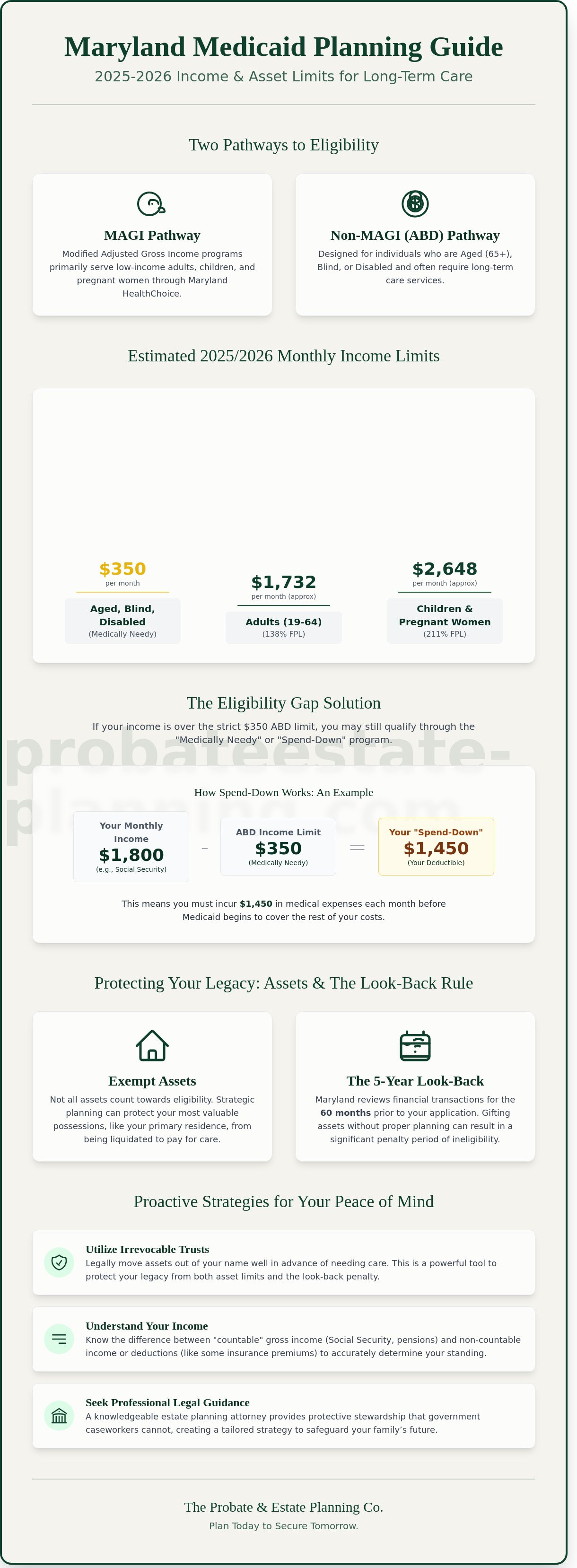
The following figures represent the estimated monthly income maximums for various groups. These numbers are based on the 138% FPL standard for adults and the specific 211% FPL standard for children and pregnant women. Staying informed about the maryland medicaid income limits 2025 ensures you aren't caught off guard by a sudden loss of eligibility.
- Adults (Ages 19-64): Approximately $1,732 per month for an individual.
- Children and Pregnant Women: Approximately $2,648 per month for an individual.
- Aged, Blind, and Disabled (Medically Needy): $350 per month for an individual.
If your income exceeds the $350 limit for the ABD group, you may still qualify through a "spend-down" program. This works like a deductible; you must incur medical expenses equal to your excess income before Medicaid begins to cover your costs. Because these limits update every February 1st, we recommend a yearly review of your financial standing to maintain continuous coverage.
Countable vs. Non-Countable Income
Most applicants assume that every dollar they receive counts toward the limit. This isn't always the case. Maryland Medicaid looks at your "gross income" rather than your "net income." This means they count your total earnings before taxes or insurance premiums are deducted. Common countable sources include Social Security benefits, private pensions, wages, and interest from investments.
However, certain exclusions can help you qualify. For example, specific veteran benefits like Aid and Attendance are often treated differently depending on whether you're seeking community or institutional care. Additionally, if you're in a spend-down situation, the premiums you pay for health insurance can sometimes be deducted from your countable income. Distinguishing between these categories is vital. A mistake in calculating your gross income can lead to an immediate denial, but a strategic understanding of exclusions can provide the path to eligibility you didn't know existed.
The Eligibility Gap: Why ABD Limits Seem Impossible
The $350 monthly income limit for the Aged, Blind, and Disabled (ABD) category often causes immediate panic for Maryland seniors. If your Social Security benefit is $1,800, you might assume you're instantly disqualified. This is a common misconception. Maryland recognizes that living expenses and medical costs far exceed $350. To bridge this gap, the Maryland Department of Health utilizes the Medically Needy program, often referred to as a spend-down. This mechanism allows you to qualify by subtracting your medical expenses from your monthly income. It ensures that those with high care needs aren't left without protection simply because their pension or Social Security exceeds a baseline threshold.
When assessing your eligibility, the state calculates your cost of care against your total income. If your medical bills are high enough to "consume" your excess income, you can still access benefits. This process turns a seemingly impossible financial barrier into a manageable path toward coverage. Understanding how the maryland medicaid income limits 2025 apply to your specific situation is the first step in securing your future.
How the Maryland Spend-Down Program Works
Think of the spend-down as a health insurance deductible. Maryland caseworkers typically look at a 6-month budget period to determine eligibility. For example, a resident in Towson with a monthly income of $2,500 would have $2,150 in "excess income" relative to the $350 limit. Over a six-month period, this total excess equals $12,900. If that individual has $13,000 in medical bills, nursing home costs, or health insurance premiums during that same window, they meet the spend-down requirement. High medical bills aren't a burden in this context; they're the key to unlocking coverage. Proactive estate planning and asset protection can help you navigate these calculations without depleting your family's legacy.
The Personal Needs Allowance in Maryland
Once you're approved for Long-Term Care Medicaid, your income goes toward your care, except for a small portion called the Personal Needs Allowance (PNA). In Maryland, the 2025 and 2026 PNA rate is $83 per month. This money is yours to keep. It's intended for personal items that the nursing facility doesn't provide. You can use these funds for:
- Professional haircuts or salon services.
- New clothing, pajamas, or comfortable shoes.
- Specific toiletries or hobby materials.
- Small gifts for family members or grandchildren.
Maryland regulations require nursing homes to maintain a separate patient fund account for these stipends if the resident chooses. It's vital to monitor this account. If the balance grows too large and pushes your total countable assets above the $2,000 individual limit, you could face a temporary loss of benefits. Proper stewardship of these small funds is just as important as managing your larger assets to ensure your maryland medicaid income limits 2025 compliance remains intact.
Asset Limits and the 5-Year Look-Back Rule in Maryland
While understanding the maryland medicaid income limits 2025 is a critical first step, your assets play an equally decisive role in eligibility. Maryland enforces a strict $2,500 limit on "countable" resources for individuals. This threshold often feels like an impossible hurdle for seniors who've spent a lifetime building a modest nest egg. However, the state distinguishes between what you own and what you're allowed to keep to maintain your dignity and legacy.
Exempt Assets: What You Can Keep
Maryland law protects certain assets from being "spent down" before you qualify for care. Your primary residence is generally exempt if your equity falls below the state threshold. For 2025 and 2026, this home equity limit is projected to exceed $713,000. You must also express an "intent to return" to the home, even if medical professionals find it unlikely. Other protected items include:
- One vehicle of any value used for transportation.
- Personal belongings, furniture, and family heirlooms.
- Irrevocable burial contracts or specific burial funds up to $1,500.
- The Community Spouse Resource Allowance (CSRA), which allows a healthy spouse to retain up to $154,140 in 2024, with annual inflation adjustments expected for 2025.
The Maryland 5-Year Look-Back Explained
The state doesn't just look at what you own today. Maryland auditors meticulously review every financial transaction from the 60 months preceding your application. If you transferred property or gave cash gifts without receiving fair market value in return, you'll likely face a penalty period. This is a timeframe where Medicaid refuses to pay for your care, leaving your family to cover the bill out of pocket.
The penalty is calculated by dividing the gifted amount by the average monthly cost of nursing home care in Maryland. If you gave away $100,000 and the state's divisor is roughly $10,400, you'd be ineligible for nearly 10 months. There are narrow exceptions. Transfers to a blind or disabled child, or to a "Caretaker Child" who lived in the home for two years and provided care that delayed your institutionalization, may be exempt from these penalties.
Giving your home to your children is often the most dangerous mistake a Maryland senior can make. It's a direct violation of the look-back rule that can trigger years of ineligibility. Beyond the Medicaid penalty, this move strips you of control and can create massive capital gains tax burdens for your heirs. Proper stewardship requires a plan that protects the home through legal trusts rather than simple quitclaim deeds. This ensures your property remains a source of security rather than a liability that prevents you from receiving the care you need.
Strategic Options for Marylanders Over the Limits
Finding out your assets or income exceed the maryland medicaid income limits 2025 often triggers a sense of immediate panic. You might worry that a lifetime of hard work will be consumed by nursing home costs in a matter of months. It's vital to understand that it's rarely too late to take protective action. Even in a crisis situation, legal strategies exist to safeguard a family's home and savings from total depletion. You don't have to spend every penny before asking for help.
Irrevocable Medicaid Trusts
A Medicaid Asset Protection Trust (MAPT) serves as a primary tool for Marylanders who want to plan ahead. There's a significant difference between a standard Revocable Living Trust and a MAPT. While a revocable trust avoids probate, Medicaid still views those assets as "countable" because you can access them at any time. A MAPT, however, removes assets from your control, which starts the 60 month look-back clock. You can transfer your primary residence into this trust while retaining the legal right to live in the home for the rest of your life. This preserves the property for your heirs rather than seeing it sold to satisfy a state lien.
Spousal Impoverishment Protections
Maryland law includes specific provisions to prevent the "Community Spouse" from falling into poverty when their partner enters long-term care. For 2025, the Minimum Monthly Maintenance Needs Allowance (MMMNA) ensures the spouse at home can keep a significant portion of the couple's income, often reaching up to $3,853.50 per month. If the healthy spouse's independent income is lower than this threshold, a portion of the institutionalized person's income is diverted to them. Beyond income, families can engage in strategic "spending down." This involves using excess cash to pay for exempt items that don't count against the limit, such as:
- Major home repairs like a $20,000 roof replacement or new energy-efficient windows.
- Purchasing a new, reliable primary vehicle for the community spouse.
- Paying off an existing mortgage or other personal debts.
- Establishing irrevocable pre-paid funeral contracts.
A Towson estate planning attorney can also utilize Medicaid-compliant annuities to protect the remaining estate. These specialized financial instruments convert "countable" cash into a fixed stream of income for the healthy spouse. Because the state no longer sees the lump sum as an available resource, the applicant can meet the maryland medicaid income limits 2025 more quickly. By working with a steady guide, you can bridge the gap between your current financial reality and the strict state requirements. If you're concerned about your future security, contact an estate planning expert to build a plan that preserves your dignity and your family's inheritance.
Navigating a Medicaid Crisis: Why Professional Guidance Matters
A sudden nursing home admission often triggers a cascade of panic. Families in Maryland find themselves balancing emotional grief with the urgent need to secure long-term care funding. While the state provides caseworkers to process paperwork, these employees aren't permitted to offer legal advice or asset protection strategies. They won't explain how to shield a family home or optimize transfers. Their primary role is to verify eligibility based on the maryland medicaid income limits 2025, not to ensure your family's long-term financial survival. Relying solely on a state worker means you're navigating a complex legal landscape without an advocate in your corner.
The emotional toll of a medical crisis is heavy enough. You shouldn't have to carry the weight of complex legal filings at the same time. We act as your steady guide, ensuring that your family's interpersonal relationships aren't strained by financial pressure or legal confusion. By choosing a partnership in stewardship, you're not just hiring a firm; you're gaining a protector for your family's future. This proactive approach ensures that the transition to long-term care is handled with dignity and precision, giving you the peace of mind that comes from a plan that works when you need it most.
The Risks of DIY Medicaid Applications
Attempting to navigate this process without professional help often leads to devastating financial outcomes. A single mistake regarding the maryland medicaid income limits 2025 or the five year look-back period can trigger a lengthy penalty period. In 2024, the average cost for a nursing home in the Baltimore-Towson area surpassed $13,500 per month. If a DIY application is denied or delayed by just 60 days, a family could lose $27,000 of their inheritance. We focus on strict adherence to the Code of Maryland Regulations (COMAR) to prevent these unnecessary spend-downs. Our goal is to replace the chaos of a crisis with a methodical legal framework that preserves what you've spent a lifetime building.
Your Next Steps for Stewardship
Effective stewardship starts with clear information and organized records. The first step involves gathering 60 months of financial history, including bank statements, life insurance policies, and property valuations. This transparency allows us to evaluate your specific situation and identify potential hurdles before they become denials. Whether you're planning years in advance or facing an immediate medical emergency, we provide the wisdom and experience to steer you toward a predictable outcome. We invite you to move beyond the stress of the unknown. Protect your legacy—contact our Towson office for a Medicaid planning consultation and secure a plan that protects your family's harmony and financial security.
Take Control of Your Long-Term Care Strategy
Navigating the maryland medicaid income limits 2025 requires more than just meeting a number on a spreadsheet. You've seen how the 5-year look-back rule creates a significant hurdle for those who haven't prepared in advance. Many Maryland families find themselves stuck in the eligibility gap where their income exceeds the strict Aged, Blind, and Disabled thresholds, yet isn't enough to cover the $12,000 or more monthly cost of skilled nursing care. You don't have to face these financial pressures alone or risk the total exhaustion of your legacy.
By implementing strategic planning today, you can bridge this gap and ensure your spouse remains protected. Our team provides specialized guidance for Maryland Medicaid crisis planning from our offices in Towson. We prioritize a human-centric approach that goes beyond simple document preparation to safeguard your family's harmony and financial stewardship. It's time to replace anxiety with a concrete plan that actually works when your family needs it most. Secure your family's future with a Maryland Medicaid planning consultation today. You can move forward with the quiet confidence that your path is secure and your future is protected.
Frequently Asked Questions
What is the Medicaid look-back period in Maryland?
Maryland uses a 60 month look-back period to review all asset transfers made before your application date. This five year window ensures you didn't give away property or cash to meet the maryland medicaid income limits 2025 requirements. If the state finds uncompensated transfers, they'll impose a penalty period where you must pay for care out of pocket. We help families document these transactions to protect their eligibility and avoid unnecessary delays.
Can Maryland take my house if I go on Medicaid?
Maryland cannot take your house while you're living in it, but the state may file a claim against your estate after you pass away. This process, known as Medicaid Estate Recovery, seeks reimbursement for the total cost of long-term care services provided. You can protect your family's legacy through proactive planning tools like life estate deeds or specific trusts. These strategies prevent the home from becoming part of the probate estate subject to recovery.
What is the income limit for Maryland Medicaid for a single senior in 2025?
The projected income limit for a single senior seeking long-term care in Maryland is $2,901 per month for 2025. This figure is based on 300% of the Federal Benefit Rate and typically updates every January. If your monthly checks exceed this amount, you aren't automatically disqualified. We use specialized legal tools to help you remain eligible while ensuring your medical needs are fully met without exhausting every dollar you've saved.
How much can a married couple have in assets and still qualify for Medicaid in MD?
A married couple can generally keep up to $157,000 in countable assets for the healthy spouse while the applicant spouse retains $2,500. This protection, called the Community Spouse Resource Allowance, prevents the spouse living at home from falling into poverty. Certain assets like your primary vehicle and household goods don't count toward this total. Proper structuring of these resources provides the financial security your family needs during a difficult transition.
What happens if I exceed the Maryland Medicaid asset limit?
If you exceed the $2,500 asset limit, you must spend down the excess funds on qualified expenses before Maryland approves your application. You can pay off existing debts, pre-pay funeral expenses, or make necessary home repairs to reach the required threshold. Don't simply give money away, as this triggers the 60 month penalty period. We guide you through a strategic spend-down plan that preserves as much of your wealth as possible for your loved ones.
Is the primary residence always exempt from Medicaid in Maryland?
Your primary residence is exempt from the maryland medicaid income limits 2025 asset test if your equity is below $713,000 and you intend to return home. The home is also protected if your spouse, a minor child, or a disabled child still lives there. However, this exemption only applies during your lifetime. Without a legal strategy to move the home out of your probate estate, it remains vulnerable to state recovery efforts after you're gone.
Does Maryland have a "Medically Needy" spend-down program?
Maryland operates a Medically Needy program that allows you to qualify for coverage even if your income exceeds the standard limits. You must spend down your excess income on medical bills until you reach the state's designated income level for a six month budget period. This program acts like a deductible, where Medicaid starts paying once you've incurred a specific amount of health costs. It's a vital safety net for seniors with high recurring pharmacy expenses.
How do I apply for Medicaid for long-term care in Maryland?
You apply for long-term care Medicaid in Maryland through the myMDTHINK online portal or by submitting a paper application to your local Department of Social Services. The process requires extensive documentation, including five years of bank statements and proof of all gross income. Most applications take 45 to 90 days for the state to process. Starting early allows us to organize your records and address potential hurdles before the need for care becomes an emergency.
Comments
There are no comments for this post. Be the first and Add your Comment below.
Leave a Comment