

What if the state of Maryland, rather than your own heart, decided who receives your family home and life savings? It's a common fear that the government might simply "take" property when someone dies without a will, but the reality is a rigid legal formula that often ignores modern family dynamics. If you haven't documented your wishes, the maryland intestate succession laws act as a default plan that might not reflect your true intentions. This is especially concerning given the major legislative updates from October 1, 2023, which fundamentally shifted how assets are divided among surviving spouses and registered domestic partners.
We understand that thinking about these "what-ifs" feels heavy, and the anxiety of potential family infighting is real. You've worked hard to build a life, and you deserve to know that your legacy is secure. This guide offers a clear, empathetic path through the current hierarchy of heirs, including the $100,000 threshold for spouses when children from other relationships are involved. We'll show you exactly which assets bypass these default rules and provide the next steps to move from uncertainty to a place of lasting peace for those you love most.
Key Takeaways
- Grasp the legal hierarchy that dictates how your assets are divided among spouses, partners, and children under current maryland intestate succession laws.
- Learn how to protect your family from the "Common Disaster" rule, which requires heirs to survive you by at least 120 hours to inherit.
- Uncover the connection between intestacy and Medicaid Estate Recovery to prevent the state from claiming your family home after you're gone.
- Distinguish between probate and non-probate assets so you can identify which parts of your legacy are already safe from the state's default rules.
- Navigate the practical next steps for petitioning the Register of Wills or securing your estate with a plan that prioritizes your family's harmony.
What Does 'Intestate' Mean Under Maryland Law?
When a Maryland resident passes away without a valid Last Will and Testament, they're said to have died "intestate." In these cases, the state essentially steps in to draft a "default will" for you. This isn't a malicious seizure of property; it's a rigid set of rules designed to find your next of kin based on bloodlines and legal partnerships. To understand What Does 'Intestate' Mean in a broader sense, it's the legal status of an estate when no governing document exists to guide the distribution of property. Maryland intestate succession laws serve as the legal hierarchy used to distribute assets when no valid will exists as of 2026.
To help you visualize how this process unfolds in the local court system, watch this helpful overview:
Probate vs. Non-Probate Assets
It's a common misconception that every penny you own is subject to these laws. In reality, these rules only govern "probate assets," which are items held in your name alone with no designated beneficiary. Many of your most valuable assets might bypass this process entirely. For instance, life insurance policies and 401(k) accounts typically go directly to the person you named on the beneficiary form. Similarly, property held in joint tenancy or accounts with "payable on death" (POD) designations transfer automatically. One of the most effective ways to protect your legacy is through a Revocable Living Trust, which removes assets from the probate estate and ensures they're distributed according to your specific wishes rather than state formulas.
The 2023-2026 Legislative Context
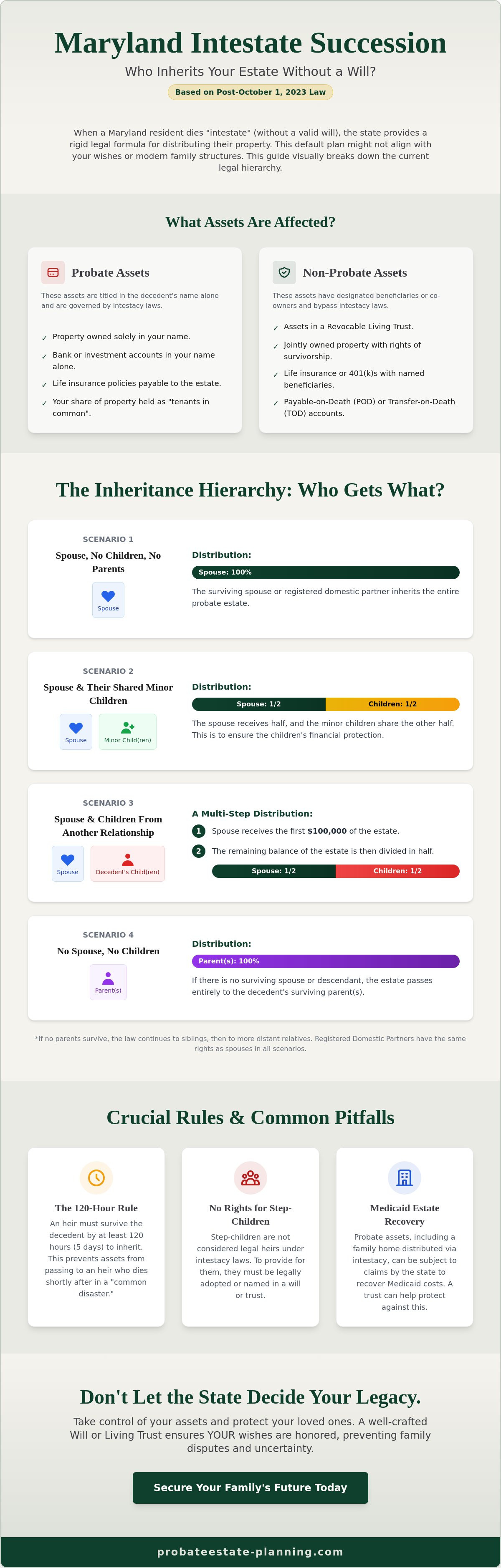
The legal landscape shifted significantly on October 1, 2023, when Maryland updated its succession statutes. These changes were designed to simplify inheritance for surviving spouses and, for the first time, formally included Registered Domestic Partners in the hierarchy. If you're reading older legal guides, be careful. Previous versions of the law often allowed parents to inherit a portion of the estate even if a spouse was still living. Under the current 2026 standards, if a decedent has a surviving spouse and no children, that spouse typically receives the entire estate, even if the decedent's parents are still alive. This shift prioritizes the immediate household but makes it even more vital to have a clear plan if your family structure is more complex.
The Maryland Inheritance Hierarchy: Who Gets What?
The Maryland Estates and Trusts Code provides a rigid roadmap for asset distribution when no will exists. This hierarchy isn't a suggestion; it's a mandate that the Orphans' Court follows strictly. Since the significant legislative updates on October 1, 2023, the rules have become more protective of surviving spouses, but they still create scenarios that might surprise many families. Understanding the nuances of maryland intestate succession laws is the first step toward ensuring your family's stability and avoiding unnecessary legal friction.
Scenario 1: Surviving Spouse and Children
Distribution becomes complex when a spouse and children both survive the decedent. If there are minor children involved, the law prioritizes their long-term protection by granting the surviving spouse only one-half of the estate. The remaining half is divided among the children. However, if all surviving children are adults and also the descendants of the surviving spouse, that spouse now inherits the entire estate. This is a major shift from pre-2023 rules. If those adult children are from a prior relationship, the surviving spouse receives the first $100,000 of the estate plus one-half of the remaining balance. It's also vital to understand Common Pitfalls and Misconceptions regarding step-children; unless they were legally adopted, they don't have a right to inherit under these default rules.
Scenario 2: No Surviving Children or Spouse
When there is no surviving spouse or children, the law searches further down the family tree. Under the 2023 update, parents only inherit if there is no surviving spouse and no descendants. This means a surviving spouse now receives the entire estate even if the decedent's parents are still living, regardless of the length of the marriage. If there are no parents, the estate moves to siblings and their descendants. Maryland law doesn't allow for an infinite search for distant relatives, a concept sometimes called the "Laughing Heir" limit. If no relatives can be located within the degrees of kinship defined by the state, the assets will eventually "escheat" to the state, typically for the benefit of the local Board of Education.
Relying on these default rules often leads to unintended consequences and family tension. If you want to ensure your property passes to specific individuals or charities rather than a state-mandated list, pursuing a comprehensive estate planning strategy is the only way to maintain control. This proactive stewardship protects your loved ones from the rigid, and sometimes cold, formulas of the probate court.
Common Pitfalls and Misconceptions in Maryland Intestacy
One of the most persistent fears we hear is that the state of Maryland will seize your bank accounts and home if you die without a will. This is rarely the case. While the state manages the distribution, "escheatment"-the process where the state takes ownership-only occurs if the court cannot find a single living relative within the degrees of kinship defined by law. The real danger isn't the state taking the money; it's the state giving it to the wrong people or creating a logistical nightmare for your survivors.
A technical detail often overlooked is the "Common Disaster" rule. Under maryland intestate succession laws, an heir must survive you by at least 120 hours (exactly five days) to legally inherit. If a husband and wife are in a tragic accident and one passes away four days after the other, the law treats the second spouse as if they had died first. This can lead to assets flowing to unexpected branches of the family tree, potentially bypassing the people you cared for most. Similarly, Maryland law treats "half-blood" siblings exactly the same as "whole-blood" siblings. If you have a half-sibling you haven't spoken to in decades, they may be entitled to the same share of your estate as the sibling you saw every day.
Unmarried Partners and Blended Families
Maryland does not recognize "common law" marriage. You could live with a partner for 40 years, share every bill, and raise children together, but if you aren't legally married or registered as domestic partners, they have zero inheritance rights under intestacy. This often leaves long-term partners in a state of sudden financial crisis. Blended families face similar risks. Step-children you raised as your own are legally invisible in this process. Unless you have legally adopted them, the state's default plan will completely disinherit them in favor of distant biological relatives.
The Personal Representative's Burden
When there's no will to name an executor, the court must appoint a Personal Representative to manage the estate. This often triggers a "race to the courthouse" among siblings or relatives, leading to the very family infighting most people hope to avoid. Because there is no will to waive the requirement, the appointee must usually post a fiduciary bond. This is essentially an insurance policy that protects the heirs from mismanagement, and the estate must pay the premiums. Between the bond costs, increased court oversight, and the potential for litigation, dying intestate almost always results in higher legal fees and more stress for your family than a structured plan would have required.
Intestacy and Asset Protection: The Medicaid Connection
Dying without a will does more than just confuse the distribution of your assets; it often leaves your estate vulnerable to external claims you never intended to prioritize. Under maryland intestate succession laws, assets that pass through the probate court become part of a public record, making them easily identifiable to creditors. This includes the state itself. Specifically, Maryland's Department of Health can claim probate assets to reimburse Medicaid costs incurred for long-term care or medical services provided during your lifetime.
This intersection of probate and public benefits is where many families lose their most significant asset: the family home. When property stays in your name alone and passes through the standard hierarchy of heirs, it's essentially left unprotected from the reach of the state. Understanding this connection is vital for any family, especially those who haven't yet established a formal plan to shield their legacy from the costs of aging.
The Medicaid Estate Recovery Risk
If a Maryland resident over the age of 55 receives Medicaid benefits for nursing home care or home-based services, the state is legally mandated to seek reimbursement from their estate after they pass away. Because intestacy forces your property into the probate process, your home becomes a "sitting duck" for state liens. Without the protection of a trust or other legal instruments, the court-appointed Personal Representative may be forced to sell the house to pay back the Department of Health before any family member receives a dime. Even if a loved one has already passed, it's often possible to engage in Medicaid Crisis Planning to mitigate these claims and preserve what remains of the family's inheritance.
Protecting Heirs with Special Needs
The state's default distribution plan is entirely blind to the individual circumstances of your beneficiaries. If one of your heirs has a disability and relies on government benefits like Supplemental Security Income (SSI) or Medicaid, a direct inheritance can be a financial disaster. These programs typically have strict asset limits, often capped at just $2,000 for individuals. Receiving a share of an estate through maryland intestate succession laws can immediately disqualify a vulnerable family member from their essential healthcare and monthly income. Instead of providing a lifetime of support, the inheritance is quickly "spent down" to regain eligibility. Correcting this after the fact usually requires a court-ordered Supplemental Needs Trust, which is significantly more expensive and stressful than including protective language in a proactive estate plan.
Taking the Next Steps: Administration or Prevention
If you've recently lost a loved one who didn't leave a will, the path ahead often feels like a heavy fog. While you're navigating the personal weight of grief, the legal clock starts ticking. The first 30 days are a critical window for discovery. You'll need to locate bank statements, real estate deeds, and life insurance policies to determine what actually falls under the maryland intestate succession laws. Your primary goal during this time is to move from a state of chaos to one of orderly stewardship, ensuring your loved one's final affairs are handled with the dignity they deserve.
To begin the formal process, you must petition the Register of Wills in the specific county where the decedent lived, whether that's in Baltimore, Montgomery, or elsewhere in the state. This petition asks the court to issue "Letters of Administration," which grant a person the legal authority to manage the estate. Since the legislative updates on October 1, 2023, the court's oversight has become even more precise regarding who has priority to serve in this role. Taking these steps correctly from the start prevents family friction and protects the assets from being tied up in avoidable litigation.
Navigating the Probate Process
The complexity of your next steps depends largely on the value of the assets. Maryland distinguishes between a "Small Estate" and a "Regular Estate." As of 2026, a small estate is generally defined as having assets valued at $50,000 or less. If the surviving spouse is the sole heir, this limit increases to $100,000. These smaller estates follow a simplified, faster process. However, if the assets exceed these amounts, you'll face the more rigorous "Regular Estate" filing. A probate attorney serves as a steady guide through these filings, ensuring that inheritance taxes are calculated correctly and that all legal heirs receive their rightful shares according to the state's hierarchy.
Creating a Plan That Works
While administration is necessary after a death, prevention is the ultimate gift you can leave for your own family. 2026 is the year to move away from the state's default plan and toward a custom family legacy. You don't have to leave your home or your children's future to a rigid legal formula. By utilizing a Revocable Living Trust, you can bypass the public probate process entirely. This ensures your private financial matters stay private and your assets transfer to your loved ones immediately upon your passing. You gain the peace of mind that comes from choosing your own fiduciaries rather than letting a court decide who should be in charge. To move from uncertainty to a place of total protection, Schedule a consultation with our Maryland probate team to secure your legacy.
Protecting Your Legacy Beyond Maryland's Default Plan
Leaving your family's future to a state-mandated formula creates unnecessary risks for your home and your heirs' stability. The significant 2023 updates to maryland intestate succession laws prioritize certain relatives but still leave unmarried partners and blended families in a vulnerable position. Without a proactive plan, your estate remains an open target for Medicaid recovery claims and the high costs of court-monitored probate oversight. You've worked too hard to let a rigid legal hierarchy determine the fate of your life's work.
Our firm provides specialized expertise in Maryland probate and Medicaid crisis planning, offering the steady guidance needed to preserve your legacy across multiple states. We understand the weight of these decisions and provide the empathetic support families need during times of transition. We believe every family deserves a plan that actually works when it's needed most, moving you from the uncertainty of state law to the security of a custom-tailored estate.
Secure your family's future with a plan that works; contact The Probate & Estate Planning Co. today.
You don't have to navigate these complexities alone. Taking this first step today ensures your family remains in harmony and your assets stay protected for generations to come.
Frequently Asked Questions
Does a surviving spouse inherit everything in Maryland if there is no will?
Not necessarily. Under the updated 2023 laws, a spouse inherits the entire estate only if there are no surviving children or if all surviving children are also descendants of that spouse. If you have minor children, your spouse receives 50% of the estate, while your children receive the remaining half. If you have adult children from a different relationship, your spouse receives the first $100,000 plus only half of the remaining balance.
What happens to a house if the owner dies without a will in Maryland?
If the house is titled in your name alone, it becomes a probate asset distributed according to the hierarchy of heirs. However, property held in joint tenancy with "right of survivorship" bypasses probate and transfers automatically to the surviving owner. If the property must go through probate, the court-appointed Personal Representative may need to sell the home to satisfy debts or divide the value among multiple heirs.
Can a girlfriend or boyfriend inherit under Maryland intestacy laws?
No, unmarried partners have no legal inheritance rights unless they are formally registered as domestic partners under the 2023 legislative updates. Maryland does not recognize common law marriage, regardless of how many years you've lived together. Without a Last Will and Testament or a Revocable Living Trust, your partner could be legally excluded from your home and assets in favor of distant biological relatives.
How long does the intestate probate process take in Maryland?
A regular estate administration typically takes between 9 and 18 months to complete in Maryland. Small estates, which involve assets valued at $50,000 or less, can often be settled more quickly. Delays often occur during the mandatory six month creditor claim period or if family members disagree on the choice of a Personal Representative to lead the administration.
What is the difference between an heir and a beneficiary in Maryland?
An heir is a person legally entitled to inherit your property under maryland intestate succession laws when no will exists. In contrast, a beneficiary is someone you specifically name in a legal document, such as a will, trust, or life insurance policy. While your heirs are determined by bloodlines or marriage, you have the freedom to choose any individual or organization as your beneficiary through proactive planning.
Do I need a lawyer if my parent died without a will in Maryland?
While you aren't legally required to hire an attorney, navigating the Register of Wills without guidance can be overwhelming. Legal counsel is particularly vital if the estate includes real estate, faces potential Medicaid Estate Recovery, or involves disagreements among siblings. An experienced advisor ensures that all court filings are accurate and that you're protected from personal liability while serving as the Personal Representative.
What happens if an heir cannot be located in a Maryland probate case?
The Personal Representative must make a diligent effort to locate all legal heirs, which may include hiring a private investigator or publishing notices in local newspapers. If an heir still cannot be found, their share of the estate is typically held in an escrow account or paid to the local Board of Education after a specific period. This ensures the estate can still be closed while protecting the missing individual's potential interests.
Can I contest the distribution of an intestate estate?
You can challenge the administration of an intestate estate if you believe the hierarchy of heirs is being applied incorrectly. Common grounds for a challenge include disputes over paternity, the validity of a marriage, or whether a specific asset should be considered a probate asset. Because maryland intestate succession laws are so rigid, these cases often require clear evidence to prove your legal standing within the family tree.
Comments
There are no comments for this post. Be the first and Add your Comment below.
Leave a Comment