

If you were unable to speak for yourself tomorrow, would your family be forced to guess which medical treatments you would want, or would they have the clarity of your own voice guiding them? It is a heavy emotional burden to leave your children with the task of deciding whether to keep you on life support. You likely agree that true stewardship of your legacy means creating a living will to remove the burden of choice from those you love most during their most vulnerable moments.
According to a 2017 study published in Health Affairs, only 37% of adults in the United States have completed an advance directive. This lack of preparation often leads to the very chaos and family conflict you want to avoid. This guide provides the peace of mind you deserve by explaining how these documents secure your medical autonomy and protect your dignity in North Carolina, South Carolina, Maryland, and Tennessee. You will learn the state-specific terms and legal requirements needed to ensure your healthcare wishes are honored without question. We will walk through the steps to build a legally binding plan that protects your interpersonal relationships and provides a clear path forward for your medical team.
Key Takeaways
- Learn how a living will protects your medical autonomy by documenting your end-of-life preferences before a crisis occurs.
- Understand the vital distinction between specifying your medical instructions and appointing a trusted representative to make decisions on your behalf.
- Identify which medical interventions to include in your directive to ensure your care remains a reflection of your personal values.
- Discover the specific legal formalities required in NC, SC, MD, and TN to ensure your documents are binding and recognized by healthcare providers.
- Recognize how professional guidance prevents future litigation and shields your family from the emotional burden of uncertainty.
What is a Living Will in NC, SC, MD, and TN?
A living will is a vital legal document that serves as your voice when you can't speak for yourself. It specifically outlines your preferences for end-of-life medical treatments, ensuring that your values guide your care even if you're incapacitated. It's different from a traditional Last Will and Testament; while a traditional will handles your financial assets and property after death, a living will is a medical document that functions while you're still alive. This distinction is crucial for comprehensive stewardship, as it protects your physical person rather than just your estate. A living will is a specific type of Advance healthcare directive that provides clear instructions to doctors and family members about life-prolonging procedures.
To better understand how this document protects your medical wishes and provides peace of mind, watch this helpful video:
This document only takes effect when you're unable to communicate your own decisions and are facing a terminal condition or permanent unconsciousness. The primary goal is preserving your dignity and preventing unnecessary suffering. By documenting your choices in advance, you shield your loved ones from the heavy emotional burden of making life-or-death guesses during a crisis. It's a proactive step that replaces potential family conflict with a clear, guided path forward.
State-Specific Terminology You Should Know
Legal labels vary across state lines, and it's essential to use the correct framework for your primary residence. In North Carolina, the document is officially known as an "Advance Directive for a Natural Death" under General Statutes Chapter 90. South Carolina residents sign a "Declaration of a Desire for a Natural Death," governed by Title 44 of the state code. In Maryland and Tennessee, these instructions are typically integrated into a broader "Advance Directive" form. This form combines your medical instructions with the appointment of a healthcare proxy, creating a unified approach to your future care.
The Role of the Living Will in Your Estate Plan
We view a living will as a foundational pillar of a complete legacy plan. It acts as a safeguard for your interpersonal relationships, ensuring that your family isn't left in chaos when medical emergencies strike. True protection means having a plan that's functional across the states we serve. Whether you're in the mountains of Tennessee or the coast of Maryland, your plan must meet specific statutory requirements to be honored by hospitals. By treating this document as a tool for stewardship, you ensure your medical care aligns with your personal beliefs, providing a secure and predictable outcome for your family.
Living Will vs. Healthcare Power of Attorney: Comparing Your Directives
Understanding the difference between these two documents is the first step toward a plan that actually works when your family needs it most. While they fall under the same legal umbrella, they serve distinct functions. Your living will outlines the "what," detailing specific medical treatments you accept or refuse during end-of-life care. Conversely, a Healthcare Power of Attorney (POA) identifies the "who," naming a specific agent to act on your behalf. According to Johns Hopkins Medicine on Advance Directives, these tools ensure your values are respected even if you're incapacitated. Having both is essential for 2026 planning because it eliminates ambiguity for medical providers in NC, SC, MD, and TN.
When the Living Will Takes Precedence
A living will specifically activates during end-of-life scenarios. These are legally defined as a "terminal condition" where death is imminent or a "persistent vegetative state" with no reasonable hope of recovery. By documenting your choices now, you provide a clear roadmap for your appointed agent. This foresight removes the agonizing burden of guessing from your loved ones. When you make the hard choices in advance, you aren't just giving instructions; you're giving your family the gift of a clear conscience. You're ensuring that the weight of these life-altering decisions rests on your shoulders, not theirs.
The Limits of a Healthcare Power of Attorney
A Healthcare POA is a powerful tool, yet it has inherent limitations. Without a clear written directive, an agent might feel paralyzed by uncertainty during a crisis. They may know your general values but struggle with specific medical nuances, such as the use of ventilators or feeding tubes. This lack of clarity often sparks family disputes, as different relatives may interpret your wishes differently. A formal document provides legal cover for your agent. It proves they're following your direct orders rather than making their own subjective calls. This structure prevents the chaos of litigation and preserves family harmony during a time of grief. If you're ready to secure your legacy, you can begin by exploring our comprehensive estate planning resources to build a strategy tailored to your family's needs.
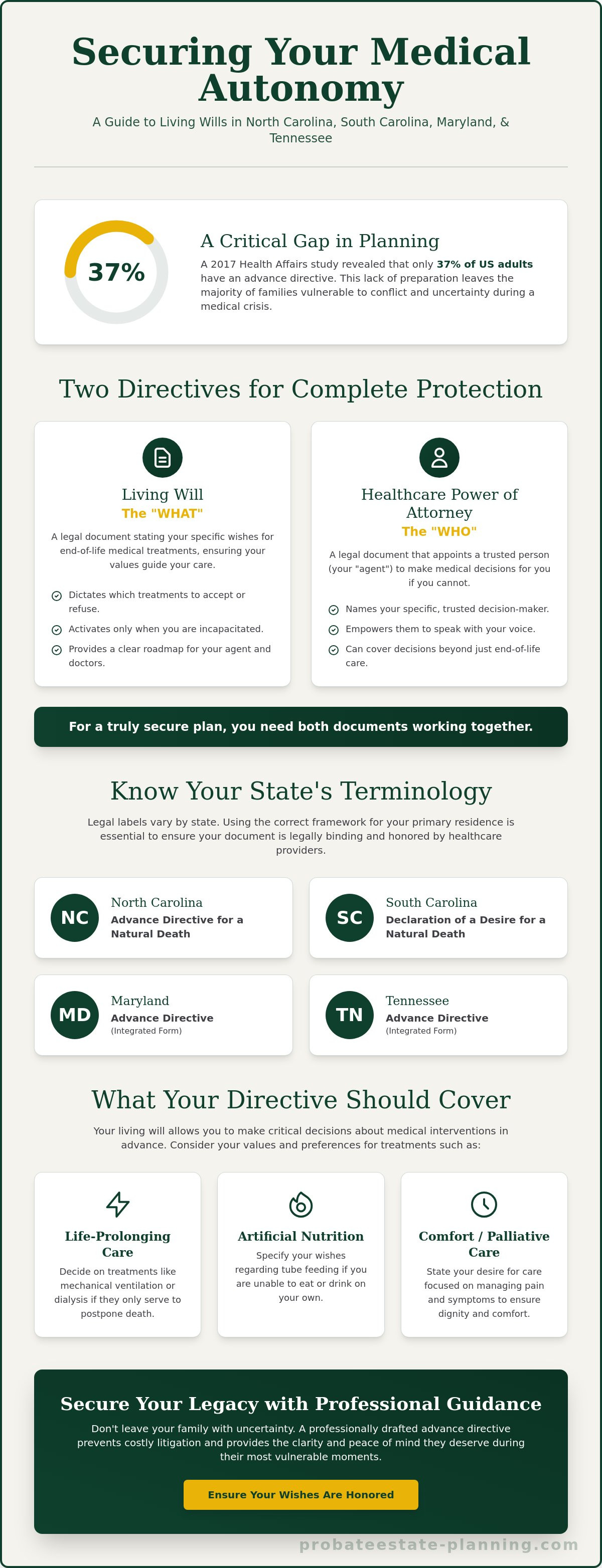
Navigating End-of-Life Decisions: What Your Directive Should Cover
Deciding on end-of-life care often feels heavy, but it's one of the most profound ways you can protect your family from future uncertainty. You aren't just checking boxes on a legal form; you're defining what a meaningful life looks like to you. Your living will serves as a bridge between your personal values and the medical reality of a crisis. It ensures that if you cannot speak for yourself, your voice is still heard in the hospital room.
Medical technology moves fast. A procedure that was standard ten years ago might be handled differently today. Because of this, your choices should be viewed as a living document. We recommend reviewing your directive every few years or after a significant health change. This proactive stewardship keeps your plan relevant and effective, ensuring it works exactly when your loved ones need it most.
Common Life-Sustaining Treatments to Consider
When you sit down to outline your wishes, you'll encounter specific medical interventions. Understanding these helps strip away the clinical coldness and allows you to make choices grounded in your personal legacy.
- Mechanical ventilation: This machine takes over the work of breathing if your lungs fail. You can specify if you want a short-term trial to see if you recover, or if you prefer to avoid intubation entirely.
- Artificial nutrition and hydration: If you can no longer eat or drink, doctors use tubes or IV fluids. Some people view this as basic comfort, while others feel it unnecessarily prolongs a natural passing.
- Cardiopulmonary Resuscitation (CPR): If your heart stops, medical staff will attempt to restart it. A Do Not Resuscitate (DNR) order is a specific instruction to allow a natural death, which many choose when a recovery to a baseline quality of life is unlikely.
Palliative Care and Comfort Measures
A common fear is that declining life-sustaining treatment means you'll be left without care. This is a misconception we work hard to clear away. Choosing to limit aggressive interventions actually shifts the focus toward intensive comfort and dignity. Palliative care is a specialized medical approach that prioritizes pain relief and emotional support over curative measures.
According to Mayo Clinic's guide to living wills, clearly stating your preferences for comfort care helps your medical team manage symptoms like pain, breathlessness, or anxiety effectively. You can include instructions for hospice care, spiritual support, and even environmental preferences. This level of detail provides your family with the peace of mind that they're honoring your spirit, not just following a set of rules. It replaces potential chaos with a structured, compassionate path forward.
State-Specific Legal Requirements for Advance Directives
A living will is more than a statement of intent; it is a formal legal instrument that must meet exacting standards to be enforceable. If these technicalities are ignored, your medical providers may be legally unable to honor your wishes, leaving your family in the very state of uncertainty you sought to prevent. We act as your steady guide, ensuring every signature and seal aligns with the specific statutes of your home state.
Many families fall into the DIY trap by using generic internet templates. These forms often fail because they don't account for the nuanced witness disqualification rules that vary significantly between Raleigh and Baltimore. For example, a form that is valid in one region might be rejected in another because the witnesses held a prohibited relationship to the declarant. If you maintain seasonal residences, such as a summer home in Maryland and a winter retreat in South Carolina, your documents must be reviewed for multi-state compliance. We ensure your protection travels with you across state lines.
Witness and Notarization Rules by State
- North Carolina and South Carolina: Both states maintain rigorous standards. In North Carolina, under General Statute § 32A-25.1, you must have two qualified witnesses and a notary public. Your witnesses cannot be related to you by blood or marriage, nor can they be beneficiaries of your estate or your attending physician.
- Maryland: Maryland law requires the signatures of two adult witnesses. While notarization isn't strictly required for the document to be valid, it's highly recommended for clarity. Your appointed healthcare proxy cannot serve as a witness.
- Tennessee: Under TN Code § 68-11-1803, you have a choice. You can either have the document witnessed by two individuals or signed in the presence of a notary public. Tennessee also mandates that at least one witness cannot be a relative or an heir to your estate.
Storing and Sharing Your Living Will
A perfect legal document is useless if it's inaccessible during a medical crisis. Placing your only copy in a safe deposit box is a failed plan. Banks are often closed when emergencies happen, and family members may not have immediate authorization to access the box. This creates a dangerous delay in your care.
You should provide digital or physical copies to your primary care physician and any local hospital systems where you receive treatment. Most modern healthcare systems will upload these directly to your electronic medical record. Most importantly, ensure your designated Healthcare Power of Attorney has a copy. They are the ones who will stand by your bedside and ensure your living will is followed to the letter. We help you organize this distribution so your legacy of harmony remains intact.
Don't leave your medical future to chance or generic forms. Reach out to us today for professional estate planning services that secure your peace of mind.
Securing Your Legacy: Why Professional Guidance Matters
Estate planning isn't just about signing papers; it's an act of stewardship for your future and your family's well-being. At The Probate & Estate Planning Co., we act as your steady guide through the complexities of end-of-life decisions. A professionally drafted living will ensures your voice remains the final authority, even when you can't speak for yourself. We move beyond generic templates to create a robust legal shield that prevents future probate disputes or healthcare litigation. This attorney-backed approach provides a level of certainty that DIY forms simply can't match.
The Risk of Inaction: What Happens Without a Living Will?
If you don't have a formal directive, your family might face a grueling legal process known as a guardianship proceeding. In these scenarios, a judge in North Carolina, South Carolina, Maryland, or Tennessee decides who makes your medical decisions, often bypassing the people you trust most. These public legal battles frequently lead to deep-seated resentment and conflict among survivors. According to 2023 legal industry data, contested guardianship cases can drain estate assets quickly through court costs and attorney fees. The true cost of inaction is the permanent fracture of family harmony that no amount of money can repair.
How Our Firm Simplifies the Process
We don't believe in one-size-fits-all solutions. Our methodical approach begins by identifying your specific goals and the unique dynamics of your family. We focus on making sure your medical directives and financial powers of attorney work in perfect harmony. This prevents the document gaps that often lead to confusion in hospital settings. Our team prioritizes functional outcomes, ensuring your plan works exactly as intended when it's needed most. We offer more than just legal services; we offer a partnership that prioritizes your emotional well-being and legal security.
- Detailed analysis of your specific healthcare preferences.
- Coordination between medical directives and financial estate plans.
- State-specific compliance for NC, SC, MD, and TN.
- Strategic planning to avoid court intervention and public filings.
You've worked hard to build your life and your relationships. Don't leave the final chapter of your story to chance or the cold interpretation of state laws. It's time to move from awareness to action to safeguard the people you love. Schedule a consultation with our experienced estate planning team today.
Take Control of Your Healthcare Legacy
Securing your medical preferences isn't just about signing paperwork; it's about preserving your dignity and preventing family conflict during a crisis. You now understand how a living willfunctions as a clear roadmap for your medical team, standing as a distinct pillar alongside your healthcare power of attorney. Whether you reside in North Carolina, South Carolina, Maryland, or Tennessee, your directives must meet specific state statutes to remain legally binding and effective. Without these precise protections, your family could face the heavy burden of making impossible choices without your guidance.
The Probate & Estate Planning Co. brings specialized multi-state expertise to help you build plans that work when they're needed most. Our empathetic, client-centered approach prioritizes your emotional well-being alongside your legal security. We've guided many families through these complex elder law decisions, providing the steady stewardship required to safeguard your future and ensure your voice is heard in every clinical setting.
You can move forward with confidence knowing your wishes are protected by a plan designed specifically for your life and your family's harmony.
Frequently Asked Questions
Is a living will the same as a Do Not Resuscitate (DNR) order?
No, a living will is not the same as a Do Not Resuscitate (DNR) order. Your living will is a legal document that outlines your preferences for various medical treatments if you become terminally ill or permanently unconscious. In contrast, a DNR is a specific medical order signed by a physician that instructs emergency responders not to perform CPR if your heart stops. The 1991 Patient Self-Determination Act ensures you have the right to use both to protect your healthcare journey.
Can I change or revoke my living will after it is signed?
You can change or revoke your living will at any time as long as you possess the mental capacity to make decisions. To update your wishes, you should sign a new document that meets current state requirements or physically destroy the old version to avoid any confusion. Under North Carolina General Statute 90-321, you can revoke your declaration through a written statement or by communicating your intent to your attending physician. This flexibility ensures your plan always reflects your current values.
Do I need a lawyer to create a living will in North Carolina or South Carolina?
You aren't legally required to hire a lawyer to create a living will in North Carolina or South Carolina, but it's a vital step for ensuring your documents are enforceable. Both states maintain strict execution requirements; for example, North Carolina requires two qualified witnesses and a notary public. Missing a single signature can invalidate your entire plan. A professional ensures your documents comply with 2024 state standards so your family avoids legal chaos during a medical crisis.
What happens if I move from Maryland to Tennessee? Is my living will still valid?
Your Maryland living will is generally valid in Tennessee, but you should have it reviewed by a professional to ensure it meets local standards. Tennessee Code 34-6-215 states that a healthcare power of attorney or living will executed in another state is valid if it complied with that state's laws at the time of signing. However, different states use different terminology. Updating your documents after a move prevents delays and ensures Tennessee doctors understand your instructions without hesitation.
Can my family override my living will if they disagree with my choices?
Your family cannot legally override your living will if it's properly executed and you're deemed terminal or permanently unconscious. The document serves as your voice when you can't speak for yourself, protecting your loved ones from the burden of making impossible choices. While family members might disagree, healthcare providers are legally bound to follow your documented wishes. Clear planning preserves family harmony and prevents the 30 percent of end-of-life cases that typically result in family disputes.
Does a living will cover my financial assets or property distribution?
A living will does not cover your financial assets, real estate, or personal property distribution. Its sole purpose is to direct your medical care during your lifetime when you're unable to communicate. To manage your estate and protect your financial legacy, you need a Last Will and Testament or a Revocable Living Trust. These separate documents work together to provide a comprehensive shield for both your physical well-being and your hard-earned assets after you pass away.
How do I start the conversation about my living will with my adult children?
Start the conversation by explaining that your living will is a gift of clarity for them. Choose a quiet time and share your values regarding quality of life rather than just listing medical procedures. Data from The Conversation Project shows that while 90 percent of people think talking about end-of-life care is important, only 27 percent have actually done it. Being open now reduces their future stress and ensures they aren't forced to guess your intentions.
What is a 'persistent vegetative state' in the context of a living will?
A persistent vegetative state describes a condition of permanent unconsciousness where a person has sleep-wake cycles but lacks cognitive function or awareness. In this state, the brain stem continues to manage basic functions like breathing, but the higher brain centers no longer work. Defining your preferences for this specific scenario is vital. It allows you to decide whether you want life-sustaining treatments, like feeding tubes, continued if recovery is deemed medically impossible by two independent physicians.
Comments
There are no comments for this post. Be the first and Add your Comment below.
Leave a Comment