
 What if the life insurance policy you've faithfully maintained for 20 years is actually worth more to you right now than it is to your heirs in the future? For many families in the Carolinas, Maryland, and Tennessee, a policy that was once a safety net has become a financial burden, especially as the average cost of a private room in a nursing home has climbed to over $108,000 per year. You likely feel the pressure of rising premiums or the worry that your current coverage doesn't address your immediate medical needs. A life insurance settlement offers a strategic way to unlock the value of your policy today, providing the liquid cash necessary to fund your care or protect your other assets from being depleted.
We understand that you want to provide for your loved ones without leaving behind a legacy of legal chaos or probate delays. This guide will show you exactly how a settlement impacts your estate plan and your Medicaid eligibility based on the specific 2024 regulations in your state. You'll discover how to transform an unneeded policy into a tool for financial stewardship. We'll walk through the logical steps to ensure your planning works exactly when your family needs it most, keeping your interpersonal relationships and your hard-earned assets secure.
Key Takeaways
- Understand when selling a policy for a lump sum is a more strategic choice than letting it lapse, especially when premiums become a financial burden.
- Learn how a life insurance settlement impacts your Medicaid eligibility and how to navigate the strict five-year look-back periods in Maryland and North Carolina.
- Discover the essential steps for updating your Last Will and Testament to ensure your estate plan remains functional after the loss of a death benefit.
- Identify why legal counsel is vital to protect your interests against institutional buyers, ensuring your financial decisions preserve family harmony.
- Gain clarity on the appraisal and closing process to move forward with the quiet confidence that your legacy is being properly stewarded.
What is a Life Insurance Settlement and Why Consider One in 2026?
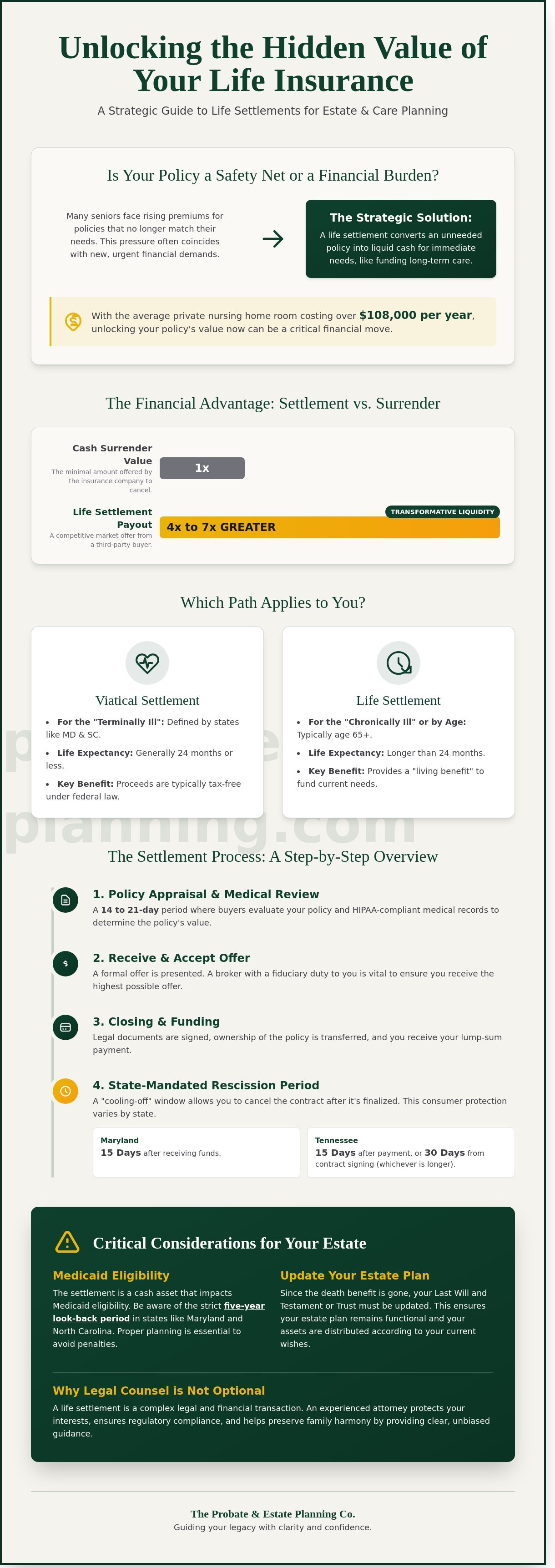
A life insurance settlement is the strategic sale of an existing life insurance policy to a third party for a lump sum. This payment is significantly higher than the cash surrender value but lower than the total death benefit. By 2026, the life settlement market is projected to reach $5.2 billion as more families realize their policies are actually tangible assets. You might find that the high monthly premiums have become a financial burden. Or perhaps the original reason you bought the coverage, like protecting a 30-year mortgage, no longer exists. Instead of letting the policy lapse, you can reclaim its value.
Understanding the mechanics of a life settlement is the first step toward securing your family's future. State regulators, including the North Carolina Department of Insurance (NCDOI) and the Tennessee Department of Commerce and Insurance, provide oversight for these transactions. They ensure that the process remains transparent and that your privacy is protected throughout the sale. This regulatory framework offers peace of mind when you're making a major shift in your estate plan. It ensures that your transaction follows the strict consumer protection laws established in your state.
The Financial Logic of Selling Your Policy
Insurance companies often offer the lowest possible return through a "cash surrender value." Data shows that a life insurance settlement can yield a payout that is roughly 4 to 7 times greater than what the insurer would pay to cancel the policy. For seniors in Rock Hill or Charlotte, this capital can be transformative. You can use the proceeds to fund a Revocable Living Trust, providing a clear path for your heirs and avoiding the chaos of probate. It's a shift from a future death benefit to a "living benefit" that supports your immediate healthcare needs or long-term care goals. This liquidity allows you to maintain control over your assets while you are still here to manage them.
Viatical vs. Life Settlements: Which Applies to You?
The distinction between these two options depends on your current health status and life expectancy. Viatical settlements are reserved for those diagnosed as "terminally ill," which Maryland and South Carolina laws generally define as having a life expectancy of 24 months or less. Under federal law IRC Section 101(g), viatical proceeds are typically tax-free. Life settlements apply to those who are "chronically ill" or over the age of 65. Because your health dictates the offer, the legal timeline for these transactions can vary from 3 to 6 months. Choosing the right path ensures your life insurance settlement works when your family needs it most, providing a sense of harmony and protection for your legacy.
The Legal Mechanism: How the Settlement Process Works
Converting a policy into a life insurance settlement isn't a simple transaction. It's a formal legal reclassification of a personal asset into a third-party investment. The process typically begins with a 14 to 21 day appraisal period. During this time, the buyer evaluates your medical records and the specific terms of your policy. You're legally required to provide access to your health history through HIPAA-compliant releases. While this may feel invasive, it's a necessary step for the buyer to calculate life expectancy and determine a fair offer.
Once an offer is made, the legal protections vary significantly by geography. If you live in Maryland, state law mandates a 15 day rescission period after you receive your funds. This "cooling off" window allows you to cancel the contract and return the money if you have second thoughts. Tennessee residents benefit from a similar 15 day window starting from the date of payment, or 30 days from the date the contract was signed, whichever comes first. These protections exist to prevent families from making hasty decisions during times of financial or emotional stress.
The Role of the Life Settlement Broker
A broker's primary responsibility is their fiduciary duty to you. This means they're legally obligated to seek the highest possible offer for your policy. This stands in contrast to institutional buyers, who focus on their own internal rate of return. Before you commit, you should carefully review FINRA's guidance on life settlements to understand the potential risks and costs involved.
Commission structures are a critical part of your legal review. In many cases, broker fees can range from 20% to 30% of the total settlement amount. You must verify that your broker is properly licensed in your state. For instance, North Carolina and South Carolina have specific statutes requiring brokers to maintain active life settlement licenses to operate legally. Confirming these credentials ensures that your estate plan remains protected by a qualified professional who understands local regulations.
Closing the Deal: Transfer of Ownership
The closing process involves a permanent shift in legal rights. You'll sign "change of ownership" and "change of beneficiary" forms that are filed directly with the insurance carrier. This officially moves the policy out of your estate and into the hands of the investor. To ensure you aren't left vulnerable, the industry uses independent escrow accounts.
The buyer deposits the settlement funds into escrow before the ownership change is finalized. The escrow agent only releases those funds to you once the insurance company confirms the transfer is complete. This 3 step verification process protects you from fraud. It ensures that you receive your payment at the exact moment the policy ceases to be your personal property. This methodical transition is vital for maintaining the harmony and predictability of your long term financial goals.
Strategic Impact on Medicaid and Asset Protection
Receiving a settlement often feels like a long-awaited relief, yet it can quickly become a legal liability if you rely on state benefits. The primary danger is immediate Medicaid disqualification. For a senior in Towson or Nashville, a sudden cash influx can push assets far beyond the $2,000 limit required for long-term care assistance. This isn't a minor hurdle; it's a total loss of benefits until those funds are exhausted on medical costs. You shouldn't have to choose between your settlement and your healthcare. Without a proactive strategy, a windfall intended to provide security can actually create a period of financial instability.
Medicaid Eligibility and the "Look-Back" Rule
In North Carolina and Maryland, Medicaid offices examine every financial transaction from the last 60 months. This 5-year look-back period is unforgiving. If you receive a life insurance settlement and then transfer those funds to family members to qualify for assistance, the state labels this an "uncompensated transfer." They'll penalize you by withholding coverage for a period tied directly to the gift's value. Understanding life settlements in estate planning is crucial because selling a policy below market value can trigger these exact penalties. Crisis planning is mandatory if nursing home care is required within that 60-month window, as the state views the difference between the sale price and the fair market value as a gift.
Asset Protection and Irrevocable Trusts
You can protect your settlement from being drained by medical expenses. Our team helps clients convert liquid proceeds into protected legal instruments. By using life insurance settlement proceeds to fund an Irrevocable Trust, you effectively remove the assets from your "countable" estate. This ensures they remain available for your specific needs or your heirs' inheritance while maintaining your eligibility for state support. The Probate & Estate Planning Co. structures these trusts to house settlement funds securely, shielding them from future creditors or legal judgments. This approach offers several layers of protection:
- Asset Preservation: Keeps the settlement intact for your legacy rather than spending it down to zero.
- Legal Shielding: Protects the funds from potential lawsuits or collection efforts that often follow a public settlement.
- Predictable Outcomes: Ensures your care is covered by Medicaid while the trust provides for your "extras" and personal comfort.
In Nashville and Towson, we often implement spend-down strategies to manage excess assets. This might involve paying off a primary mortgage or making necessary home modifications, which are considered exempt assets. In Maryland, where the 2024 income limit for certain Medicaid programs is $2,829 per month, these strategies aren't just helpful; they're vital for financial survival. The Probate & Estate Planning Co. specializes in crafting trusts that align with state-specific regulations, ensuring your settlement serves your family's long-term harmony. We focus on stewardship, making sure your hard-won settlement provides the peace of mind you deserve.
Integrating the Settlement into Your Estate Plan
Receiving a life insurance settlement changes the fundamental structure of your financial legacy. It transforms a future, contingent death benefit into immediate, liquid capital. This shift requires a deliberate update to your legal strategy to ensure your family remains protected and your intentions are honored. You've moved from a "set it and forget it" policy to an active asset that demands careful stewardship.
To maintain a plan that actually works when it's needed most, follow these four essential steps:
- Step 1: Audit your Will. You must review your Last Will and Testament to reflect the loss of the anticipated death benefit. If your current Will allocates specific dollar amounts to heirs based on a payout that no longer exists, you risk leaving some loved ones with nothing while others receive a disproportionate share.
- Step 2: Update beneficiary designations. Since the policy is sold, you should re-evaluate the beneficiaries on your other accounts, such as IRAs or 401(k)s. This rebalancing helps maintain family harmony and ensures your total estate is distributed according to your current wishes.
- Step 3: Evaluate Maryland tax thresholds. If you live in Maryland, you face a unique challenge. While the federal estate tax exemption is high, Maryland's estate tax threshold sits at $5 million for 2024. A large cash settlement can push an estate over this limit, potentially triggering a 16 percent state tax that a tax-free death benefit might have avoided.
- Step 4: Coordinate with your Durable Power of Attorney. Ensure your designated agent has the specific authority to manage settlement proceeds if you become incapacitated. Without this clarity, the cash could become locked in a court-supervised guardianship, creating the very chaos you're trying to prevent.
Avoiding Probate Chaos
Selling a policy effectively removes that asset from your future probate estate. This is a significant advantage because probate in cities like Nashville or Charlotte can often drag on for 9 to 12 months. By converting the policy to cash now, you can place those funds into a revocable living trust, allowing them to pass to your heirs instantly. You must inform your Executor about the life insurance settlement immediately. If you don't, they may waste weeks of billable time searching for a "zombie" policy that no longer exists. Clarity today prevents administrative nightmares tomorrow.
Tax Implications for Heirs and Sellers
The IRS applies a three-tier tax structure to these transactions. First, the portion of the settlement up to your "basis" (the total premiums you've paid) is tax-free. Second, the amount up to the policy's cash surrender value is taxed as ordinary income. Third, any remaining profit is treated as capital gains. In Maryland, where the top state income tax rate reaches 5.75 percent, failing to account for this can lead to a massive surprise bill. A proactive legal consultation is always more affordable than a state revenue audit. We can help you structure your estate plan to mitigate these tax burdens and preserve more of your hard-earned legacy for the next generation.
Why Legal Counsel is Essential for Life Settlements
Brokers and settlement companies operate on a commission-driven model. Their primary objective is to close the transaction, but they rarely account for how a life insurance settlement ripples through your broader estate plan. An attorney serves as your steady guide, ensuring that the liquid cash you receive doesn't dismantle the tax protections or Medicaid eligibility you've worked hard to establish. While a broker sells a policy, our firm protects your legacy by verifying that every move aligns with your long-term stewardship goals.
The intersection of a settlement and active litigation is particularly delicate. If you're currently involved in a negligence or personal injury claim, an influx of capital can alter the optics of your financial need or impact the calculation of damages. We provide a holistic review that considers these variables. For example, in states like North Carolina, failing to report a change in assets within 30 days can jeopardize needs-based benefits. We help you avoid these traps by coordinating your settlement with your existing probate and estate goals, ensuring that one financial win doesn't cause a loss elsewhere.
The Dangers of the "Do-It-Yourself" Settlement
Attempting to manage a life insurance settlement without legal oversight often leads to expensive oversight. In South Carolina and Maryland, contract laws regarding "recourse clauses" can be predatory. Some contracts contain hidden language that leaves the original policyholder liable for future premiums if the purchasing company faces financial instability. An objective third-party review identifies these risks before you sign away your rights. We've seen cases where unvetted contracts created tax liabilities that consumed 30 percent of the total payout, leaving families with far less than they anticipated.
Next Steps: Securing Your Financial Future
Preserving your family's harmony requires a plan that actually works when it matters most. To ensure your settlement strengthens rather than complicates your estate, we invite you to schedule a strategic review at our Charlotte, Nashville, Rock Hill, or Towson offices. During this consultation, we'll examine how your windfall fits into your existing fiduciary structure. Please bring the following items to your appointment:
- A copy of your current life insurance policy and any recent annual statements.
- A brief summary of your current health status or recent medical certifications.
- Your existing Will, Trust documents, and Power of Attorney designations.
Don't leave your family's future to chance or the fine print of a broker's contract. Protect your legacy-contact The Probate & Estate Planning Co. today for a strategic review.
Secure Your Legacy and Protect Your Family's Future
Managing your financial legacy for 2026 requires a clear vision for your family's lasting harmony. A life insurance settlement serves as a powerful tool to transform an underperforming policy into immediate liquidity for specialized Medicaid crisis planning or urgent long-term care needs. By integrating this legal mechanism into your broader estate plan, you ensure your strategy remains fully compliant with the specific statutes governing NC, SC, MD, and TN. Our firm provides the steady guidance needed to navigate these multi-state regulations while prioritizing asset protection and the avoidance of future probate chaos.
You've spent a lifetime building your assets. We're here to help you safeguard them with a plan that functions exactly when your loved ones need it most. We'll walk through these complex decisions together; we'll ensure every detail reflects your unique goals and provides the peace of mind you deserve. Taking this step today creates a predictable outcome for your family's tomorrow.
Schedule Your Strategic Estate Planning Consultation
You don't have to navigate these heavy decisions alone; we're here to help you build a future of certainty and peace.
Frequently Asked Questions
Is a life insurance settlement taxable in North Carolina or Maryland?
You'll generally owe taxes only on the portion of the payout that exceeds the total premiums you've paid into the policy. In North Carolina, the gain is taxed as ordinary income at a flat rate of 4.75%, while Maryland's state tax rates reach up to 5.75% plus local surcharges. This means the money you invested to maintain the policy returns to you tax-free, protecting your hard-earned basis.
Can I sell my life insurance policy if I am healthy but just don't want it anymore?
You can sell your policy through a life settlement even if you're in good health, provided you're typically 65 or older. Most providers require a minimum death benefit of $100,000 to make the transaction viable for institutional buyers. This strategy allows you to convert an unneeded expense into a liquid asset to fund your retirement or simplify your legacy planning.
Will selling my life insurance policy affect my Medicaid eligibility in Tennessee?
Selling your policy will likely impact your Medicaid eligibility because Tennessee limits individual countable assets to just $2,000. The cash you receive from the sale counts as a resource, which may disqualify you until those funds are spent on qualified care. It's vital to plan this 60 months in advance to navigate the state's strict five-year look-back period for asset transfers.
How long does the life insurance settlement process typically take?
The life insurance settlement process usually takes between 12 and 16 weeks from the initial application to the final funding. You'll spend about 4 to 6 weeks waiting for medical providers to release necessary records and another 21 days for the insurance carrier to process the change of ownership. This measured pace ensures every legal detail is handled with the meticulous attention your financial security deserves.
What is the difference between a life settlement and a viatical settlement?
A life settlement involves a policyholder who is 65 or older with a standard life expectancy, while a viatical settlement is reserved for those with a terminal illness. Under the Health Insurance Portability and Accountability Act of 1996, viatical payouts are often 100% tax-free at the federal level. Life settlements are taxed more like a standard investment, with gains treated as ordinary income or capital gains.
Do I need my beneficiaries' permission to sell my life insurance policy?
You don't need permission from your beneficiaries unless you've specifically designated them as "irrevocable" in your policy documents. Data shows that roughly 98% of policyholders use revocable beneficiaries, meaning you retain full stewardship and control over the asset. If the beneficiary is irrevocable, they must sign a release before the sale can proceed to ensure their legal rights are protected.
What happens if the life settlement company goes bankrupt after I sell my policy?
Your financial payout is secure because the buyer places the full purchase price in an escrow account before you transfer the policy title. Once the funds land in your bank account, the future solvency of the settlement provider doesn't affect you or your family. The new owner assumes all responsibility for future premiums, shielding your estate from any further financial obligations or risks.
How does a settlement impact my probate administration process?
Selling your policy removes the asset from your estate, which prevents the death benefit from ever entering the probate administration process. This move protects your family from the 4% to 7% in statutory fees that executors and attorneys often charge on the gross value of an estate. By converting the policy to cash now, you can place those funds into a trust to ensure a private and harmonious transfer of wealth.
Comments
There are no comments for this post. Be the first and Add your Comment below.
Leave a Comment