According to the 2024 Wills and Estate Planning Study, 68% of Americans still lack a last will and testament, a statistic that often translates into months of unnecessary probate delays for grieving families. You want to protect your children and ensure your assets are distributed fairly, but the fear of making a technical mistake often leads to inaction. It's common to feel overwhelmed by the subtle differences in state laws or skeptical that a cheap online form can truly safeguard a lifetime of hard work.
You deserve the peace of mind that comes from a plan that works exactly when it's needed most. This guide provides the clarity you need to create a legally binding last will and testament tailored to the specific requirements of North Carolina, South Carolina, Maryland, and Tennessee. We'll examine how to select a reliable executor and navigate local statutes so your legacy remains a source of harmony rather than a cause for confusion.
Key Takeaways
- Protect your family from the "cost of silence" by understanding how state laws in the Southeast and Mid-Atlantic distribute assets when no plan exists.
- Master the essential legal formalities required to create a valid last will and testament, ensuring your voice remains clear and legally binding.
- Identify the subtle flaws in DIY templates that often lead to family conflict and learn how to safeguard your legacy against expensive legal contests.
- Gain a methodical roadmap for organizing your assets and choosing the trusted individuals who will act as the stewards of your final wishes.
- Discover how a human-centric approach to estate planning transforms complex legalities into a source of enduring peace and family harmony.
What is a Last Will and Testament and Why Does it Matter in 2026?
A What is a Last Will and Testament? At its most fundamental level, it's a legally binding document that outlines exactly how your assets should be distributed and who should care for your minor children after you pass away. In 2026, as our lives become increasingly digital and family structures grow more complex, this document serves as the cornerstone of a responsible estate plan. It's your final opportunity to exercise stewardship over your hard-earned legacy, ensuring your wishes are honored without ambiguity or conflict.
To better understand this concept, watch this helpful video:
If you die without a last will and testament in North Carolina, South Carolina, Maryland, or Tennessee, you enter a state known as "intestacy." This means the local government decides who gets your property based on rigid state statutes. In Maryland, for instance, under the Estates and Trusts Article, your spouse and children might be forced to split assets in a way that doesn't account for your specific family needs. This process is often expensive, slow, and emotionally draining for your survivors. A Will prevents this chaos by providing a clear letter of intent that maintains family harmony during a difficult time.
It's vital to distinguish this document from a "Living Will." While they sound similar, they serve different purposes. A standard Will addresses your estate after death. A Living Will is a healthcare directive that specifies your medical preferences if you become incapacitated. Having both is essential for a complete protection plan.
Terminology Every Testator Should Know
The Testator is the person who creates the Will. You'll name an Executor, the trusted individual responsible for managing your estate and following your instructions. Those who receive your assets are your Beneficiaries. If you need to make minor updates later, you can use a Codicil, which is a legal amendment to the original document. All these elements eventually move through the Probate Court, the judicial body that validates your Will and oversees the distribution process.
Common Misconceptions About Wills
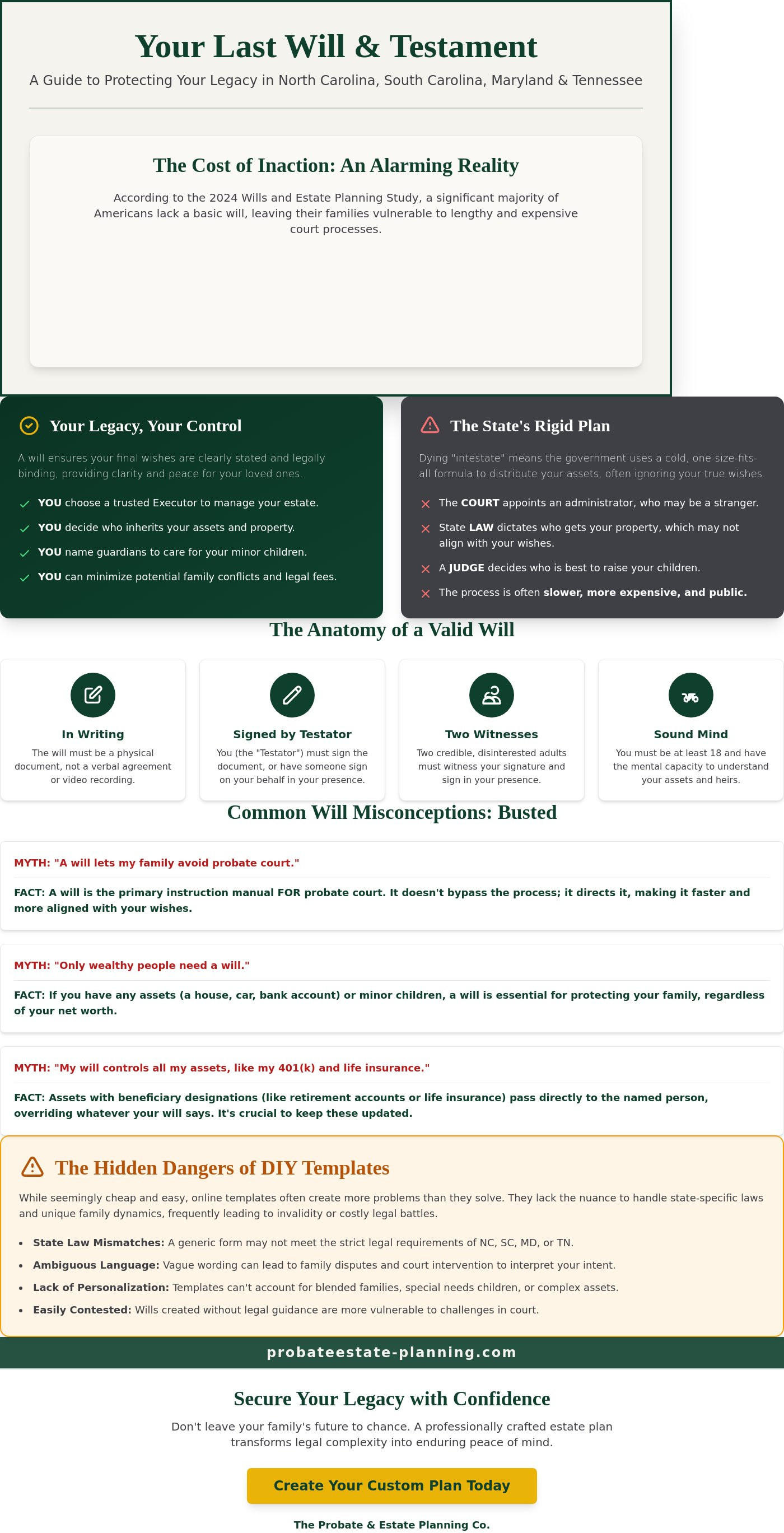
- Myth: Wills avoid probate. In reality, a Will is the primary document used during probate. It doesn't bypass the court; it guides the court's decisions.
- Myth: Only the wealthy need a Will. If you own a home, have a bank account, or have children, you need a plan. Estate planning is about protection, not just the size of your bank balance.
- Myth: A Will covers your life insurance or 401k. These are non-probate assets. They go directly to the person you named on the account's beneficiary form, regardless of what your last will and testament says.
Legal Requirements for a Valid Will in NC, SC, MD, and TN
Creating a last will and testament is a profound act of stewardship. It requires more than just a list of intentions; it demands strict adherence to specific legal standards to ensure your family avoids unnecessary chaos during an already difficult time. Each state we serve has its own unique statutes, yet they all share a foundation of "capacity." To sign a valid document, you must be at least 18 years old and of "sound mind," meaning you understand the nature of your assets and the identity of your heirs at the moment of execution.
While the temptation to quickly handwrite a "holographic" will is common, these documents are notoriously risky. In states like Maryland and South Carolina, a handwritten will that lacks proper witnessing often fails to meet the Legal Requirements for a Valid Will, leaving your estate to be distributed according to default state laws rather than your specific wishes. Most jurisdictions in our region require the "Two-Witness" rule. This means two disinterested individuals must watch you sign and then sign the document themselves in your presence. These witnesses shouldn't be beneficiaries, as this can create a conflict of interest that invites legal challenges later.
State-Specific Nuances to Watch For
- North Carolina: Under NC General Statutes, "attested" wills are the gold standard. They require the testator to sign in the presence of two witnesses who must also sign in the presence of the testator.
- South Carolina: The SC Probate Code includes specific provisions for "Exempt Property." This allows a surviving spouse or children to claim up to $31,100 in personal property, such as vehicles or furniture, even if the last will and testament suggests a different distribution.
- Maryland: In Towson and across the state, Maryland law is particularly strict about the "credible witness" rule. If a witness stands to inherit, their testimony regarding the will's validity could be discounted, potentially jeopardizing the entire document.
- Tennessee: Tennessee is one of the few states that still recognizes "Nuncupative" or oral wills. However, these are extremely limited. They only apply to those in "imminent peril of death" who actually die from that peril, and they generally cannot dispose of real estate or personal property exceeding $1,000 in value.
The Role of the Notary
Many people assume a notary makes the will "official," but their primary role is actually centered on the Self-Proving Affidavit. While your signature and the witnesses' signatures make the will legally binding, the affidavit is what streamlines the process after you're gone. A self-proving affidavit is the key to avoiding witness testimony during probate. Without it, the probate court may require your witnesses to appear in person or submit sworn statements years after the fact to prove the document is authentic.
A properly notarized affidavit acts as a shield, preventing future legal challenges regarding the document's execution. It provides the court with immediate proof that the signing followed every legal formality. Securing your family's future involves more than just filling out forms; it requires a plan that actually works when it is needed most. You can take the first step toward this peace of mind by reviewing professional estate planning resources tailored to your local laws.
Wills vs. DIY Templates: Protecting Your Family from Chaos
Choosing a template from a generic website might feel like a shortcut to peace of mind, but it often creates a false sense of security. These digital forms frequently fail to account for the specific case law and statutory requirements unique to North Carolina, South Carolina, Maryland, or Tennessee. A last will and testament that is legally valid in one state might be completely unenforceable in another due to subtle differences in how witnesses must be present or how self-proving affidavits are structured. Without the guidance of a steady advisor, you risk leaving behind a legacy of confusion rather than a legacy of love.
For a deeper look at these legal requirements, NC State Extension's Guide to Wills outlines the fundamental concepts that every family should understand before signing a document. Relying on a template means you're acting as your own attorney without the benefit of years of probate experience. This often leads to "Will Contests," where family members spend months or years in court arguing over your true intentions because the document was drafted with vague or contradictory terms.
When DIY Goes Wrong: Real-World Risks
- The Missing Witness: In many jurisdictions, a last will and testament must be signed by two witnesses who are physically present at the same time. If one witness steps into another room for a moment, the entire document can be invalidated during probate.
- The Ambiguity Trap: DIY forms often use "one-size-fits-all" language. Using a phrase like "I leave my estate to my children" without defining what happens if a child predeceases you can lead to years of litigation between grandchildren and surviving siblings.
- The True Cost: While a DIY kit might cost $50, the legal fees to resolve a contested estate or fix a drafting error after death often reach $15,000 to $50,000. Paying for a professional plan today prevents a 10x increase in costs for your grieving family later.
Integrating Your Will with Asset Protection
A template is a static document, but your life is dynamic. Professional planning ensures your Will works in harmony with Revocable Living Trusts to maintain family privacy and keep your affairs out of the public record. If you're concerned about long-term care, a standard template won't include the specific language needed to coordinate with Medicaid eligibility strategies. This oversight could force your family to spend down their entire inheritance on nursing home costs that could have been protected through proactive planning.
A Will is only one piece of a comprehensive stewardship plan.
Our role is to serve as your trusted advisor, navigating the delicate family dynamics and unique legacies that a computer program simply cannot understand. We focus on functional outcomes, ensuring that your plan actually works when your family needs it most. By moving away from cold legalism toward a human-centric approach, we provide the calm, methodical guidance necessary to protect your family from the chaos of an uncertain future.
How to Create Your Last Will and Testament: A 5-Step Guide
Crafting a last will and testament is a deliberate act of stewardship that protects your family from unnecessary chaos. While the process may feel daunting, breaking it down into methodical steps ensures your legacy remains secure across state lines. According to 2024 industry surveys, roughly 67% of Americans still lack a basic estate plan; taking these five steps places you in a proactive minority that prioritizes family harmony.
- Inventory your assets: List everything you own. This includes real estate in Nashville, family heirlooms in Charlotte, and digital assets or brokerage accounts. Clear identification prevents disputes during the probate process.
- Select your fiduciaries: You must appoint an Executor to manage your estate and a Successor if your first choice is unavailable. These individuals handle the logistics of your final wishes.
- Name guardians for minor children: This is the most emotional part of the process. You are deciding who will provide the daily care and emotional support your children need if you aren't there.
- Draft and review with a multi-state attorney: Legal requirements in Maryland differ from those in South Carolina. A professional review ensures your document complies with the specific statutes of your home state.
- Store the original safely: Probate courts typically require the original "Blue Ink" signed copy. If your family cannot find the original document, the court may presume it was revoked, leading to a complicated legal battle.
Choosing Your Executor and Guardian
Your Executor should be someone organized, trustworthy, and ideally located near your primary residence to handle local court filings. It's vital to name backup guardians to prepare for the unthinkable. You should also understand the distinction between a Guardian of the Person, who handles daily upbringing, and a Guardian of the Estate, who manages the child's inheritance. These can be the same person or two different individuals depending on their specific strengths.
Updating Your Plan Over Time
A last will and testament is not a static document. Life events such as marriage, divorce, the birth of a child, or moving between states like Tennessee and North Carolina should trigger an immediate review. You should meet with your steady guide every 3 to 5 years to ensure your plan still reflects your current goals. Outdated wills often fail to account for new tax laws or family changes, which creates the exact legal friction you intended to avoid. Consistent updates ensure your protective shield remains intact as your life evolves.
If you are ready to secure your family's future with a plan that works when it is needed most, contact our team today for a consultation.
Securing Your Legacy with The Probate & Estate Planning Co.
Planning for the end of life isn't just about paperwork; it's about the people you love. At The Probate & Estate Planning Co., we take a human-centric approach to every last will and testament we draft. We recognize that your goals are rooted in family harmony and the protection of your life's work. Our team operates with deep expertise across North Carolina, South Carolina, Maryland, and Tennessee. Because we know the local courts and state-specific statutes in these regions, we can ensure your documents comply with the exact requirements of your jurisdiction.
Our strategy goes beyond the basic distribution of assets. We integrate comprehensive Medicaid planning and probate administration into our services to provide a holistic shield for your estate. If a plan doesn't account for the high costs of long-term care or the specific procedural hurdles of local probate courts, it risks failing the very people it was meant to protect. We focus on these details so you don't have to. Peace of mind starts with a straightforward conversation about your family's future and the legacy you wish to leave behind.
A Partnership in Stewardship
We're here to help you avoid the "Probate Chaos" that frequently overwhelms surviving family members when a plan is unclear or incomplete. Our firm prioritizes functional outcomes. We don't just hand over a folder of papers; we provide a plan that actually works when your family needs it most. By acting as a steady guide, we transform a daunting legal process into a manageable path forward. You can find our dedicated team ready to assist you with a consultation in Charlotte, Columbia, Towson, or Nashville.
- Local Knowledge: We understand the specific nuances of probate laws in NC, SC, MD, and TN.
- Conflict Prevention: Our documents are drafted to minimize the risk of family disputes and litigation.
- Asset Protection: We use proven strategies to safeguard your home and savings from unnecessary depletion.
Next Steps for Your Peace of Mind
Taking the first step is often the hardest part of the process. To make it easier, you can download our estate planning checklist to begin organizing your thoughts and assets. This tool helps you identify the key decisions you'll need to make regarding your executors, guardians for minor children, and the distribution of your property. Once you've reviewed the checklist, schedule a consultation with our team to discuss your unique family dynamics.
We're ready to help you build a plan that stands the test of time and protects those you care about most. Don't leave your family's future to chance or the default laws of the state.
Secure your family's legacy today with a professional Last Will and Testament.Take the First Step Toward Lasting Peace of Mind
Planning for the future isn't just about legal paperwork; it's about protecting the people you love most. You've seen how a valid last will and testament must adhere to specific state statutes in North Carolina, South Carolina, Maryland, and Tennessee to remain enforceable in 2026. Relying on generic templates often leads to expensive probate delays or unintended tax consequences that can drain a family's inheritance. By following a structured 5-step process, you ensure your legacy remains a source of harmony rather than a cause for legal dispute.
The Probate & Estate Planning Co. provides specialized expertise across these 4 states, focusing on the intersection of probate law and Medicaid crisis planning. Our team utilizes combined experience to help families navigate these sensitive transitions with clarity and confidence. You don't have to navigate these complexities alone. We prioritize your emotional well-being by offering logical, protective strategies that work when they're needed most. You deserve a partner who understands the unique legal landscapes of your home state and stands ready to safeguard your family's financial stewardship.
Start protecting your family legacy today with a custom estate plan.
Your family's future is too important to leave to chance, and we're ready to help you secure it today.
Frequently Asked Questions
Is a handwritten will legal in North Carolina or Tennessee?
Yes, both states recognize handwritten documents, known as holographic wills, but they must meet strict legal standards. In North Carolina, NCGS § 31-3.4 requires the entire document to be in your handwriting and found in a safe place after your death. Tennessee law, specifically TCA § 32-1-105, requires that your signature and all material provisions are written by your hand. Relying on these documents often leads to 12 to 18 months of probate litigation, so a formal last will and testament is a much safer way to protect your family.
Can I change my last will and testament after it's signed?
You can modify your estate plan at any time as long as you're mentally competent. Most families update their documents after major life events, such as a 2023 divorce or the 2024 birth of a child. You can use a legal amendment called a codicil, but it's often cleaner to sign a new last will and testament that revokes all previous versions. Never cross out words or write notes on your original document. These small marks can invalidate the entire will in a local probate court.
What happens to my minor children if I die without a will?
The court system decides who raises your children if you haven't legally named a guardian. A judge will choose a person they believe is fit, but this individual might not be the relative you'd prefer. This process can trigger painful family disputes that last for years. By naming a guardian in your will, you ensure your children are raised by someone who shares your values. This simple step provides your children with stability and gives you profound peace of mind.
How much does it cost to have a lawyer draft a last will and testament?
Legal fees for estate planning vary based on the complexity of your family's needs. A 2023 industry report from Martindale-Nolo indicates that most individuals pay between $300 and $1,200 for professional estate planning documents. While DIY templates seem cheaper, they often lack the specific language required by North Carolina or Maryland statutes. Investing in a lawyer-drafted last will and testament prevents the high costs of probate errors, which frequently exceed $5,000 in court and legal fees.
Does my spouse automatically get everything if I don't have a will?
Your spouse doesn't always inherit your entire estate if you die without a plan. In North Carolina, under NCGS § 29-14, if you leave a spouse and two children, your spouse only receives the first $60,000 of personal property and one-third of the remaining assets. The children inherit the rest. This can create a financial crisis if your spouse needs those assets to maintain their home. Proper planning ensures your spouse is cared for without interference from state-mandated distribution rules.
Where should I keep my original last will and testament?
Keep your original document in a fireproof safe or a secure cabinet at home where your executor can easily find it. In Maryland, you can file your original will with the Register of Wills for a $5 fee while you're alive. Don't keep the only copy in a bank safe deposit box. Banks often seal these boxes immediately upon a death, which can cause weeks of delays for your family. A clear roadmap only works if your loved ones can access it when they need it most.
Can I disinherit someone in my will in South Carolina or Maryland?
You can generally disinherit adult children, but state laws protect surviving spouses from being left with nothing. In South Carolina, Section 62-2-201 allows a spouse to claim an elective share of one-third of your probate estate regardless of what your will says. Maryland law provides similar protections to ensure a spouse isn't abandoned financially. If you want to limit an inheritance for an adult child, you must use specific, clear language to prevent a successful challenge in court after you're gone.
What is the difference between a last will and a revocable living trust?
A will only takes effect after you pass away and must go through the public probate court process. A revocable living trust is a tool that manages your assets during your life and allows them to pass to your heirs privately without court involvement. While a will is a foundational document, a trust offers more protection if you become incapacitated. Choosing the right path depends on your goals for privacy and how quickly you want your family to receive their inheritance.
Comments
There are no comments for this post. Be the first and Add your Comment below.
Leave a Comment