

What if the most expensive lawyer you hire is the one who isn't there when your family needs them most? You want more than just a stack of legal documents; you want the peace of mind that comes with knowing your legacy is truly protected. It's natural to feel torn between the personalized care of a solo office and the perceived stability of a massive regional firm. Many families in North Carolina and South Carolina find themselves asking: 4. Should I Hire a Large Firm or Solo Practitioner for Estate Planning? You shouldn't have to choose between paying for a "big law" name or worrying that a solo attorney might retire before your plan is ever executed.
This guide will show you how to evaluate firm structures based on "institutional continuity" so you can choose a partner who will be there for your children and grandchildren. We'll compare the differences in billing transparency and personalized attention to help you find a steady guide for your long-term security. By understanding these critical distinctions, you can ensure your estate plan remains a functional reality rather than an administrative burden for those you leave behind.
Key Takeaways
- Learn to distinguish between solo practitioners, boutique firms, and large organizations to find the right level of support for your family's long-term security.
- Address the central question, "4. Should I Hire a Large Firm or Solo Practitioner for Estate Planning?", by weighing personalized attention against the need for deep institutional resources.
- Discover why "institutional continuity" is the most critical factor in preventing your estate plan from failing if your original attorney retires or passes away.
- Identify the specific scenarios, such as complex business structures or international assets, where the vast resources of a large law firm become a legal necessity.
- Find the "sweet spot" in specialized firms that offer flat-fee transparency and the collaborative expertise of multiple attorneys to safeguard your family legacy.
Understanding the Legal Landscape: Solo, Boutique, and Big Law
Choosing an estate planning partner is a decision that extends far beyond the price of drafting a Last Will and Testament. It's about building a relationship with an entity that will stand by your family when you are no longer there to guide them. Across North Carolina and South Carolina, the legal market is divided into distinct types of law firms, each offering a different balance of intimacy, expertise, and longevity. Understanding these categories is the first step in answering the question: 4. Should I Hire a Large Firm or Solo Practitioner for Estate Planning?
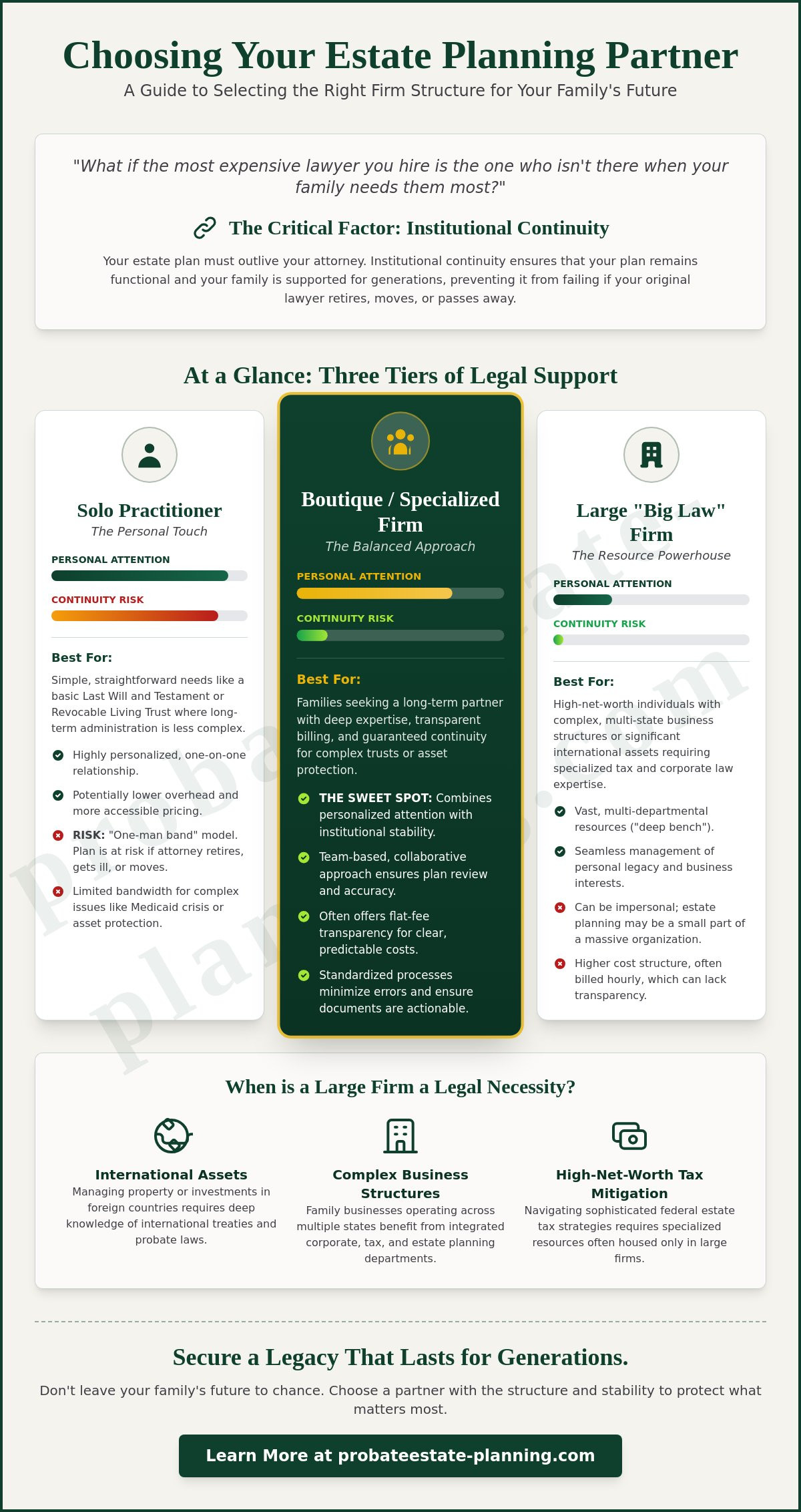
A solo practitioner operates as a single attorney, often handling every aspect of your case personally. A boutique or mid-sized firm offers a team-based approach with specialized depth in areas like asset protection planning. Finally, "Big Law" refers to massive, multi-practice organizations where estate planning is often just one of dozens of departments. Your choice impacts the long-term reliability of your documents and the level of support your heirs will receive during probate administration.
To better understand how these firm structures differ in practice, watch this helpful video:
The Solo Practitioner Model
Solo lawyers often provide the most approachable entry point for basic documents. Because they maintain low overhead, their pricing for a simple Revocable Living Trust might be more accessible. You'll likely speak directly to the lead attorney for every question, which creates a very personal connection. However, this "one-man band" approach carries a specific risk. If that one individual retires, moves, or falls ill, your family may lose their primary point of contact and their institutional knowledge of your wishes. Additionally, a solo lawyer might lack the specialized bandwidth needed for complex Medicaid crisis planning or immediate asset protection when life changes quickly.
The Large Firm and Mid-Sized Boutique Models
Large and mid-sized firms provide a "deep bench" of expertise that a single person cannot replicate. When you work with a structured firm, your plan benefits from collaborative review. This means multiple attorneys may look at your Irrevocable Trust to ensure it meets current tax standards and legal requirements. These firms use standardized processes to minimize errors and ensure functional reliability. While the initial investment might be higher than a solo practitioner's fee, you are paying for institutional continuity. If one lawyer is unavailable, another is ready to step in. This ensures your Durable Power of Attorney or Healthcare Power of Attorney is accessible and actionable the moment it is needed. These firms also have the resources to handle personal injury legal representation or complex probate litigation if your estate faces unexpected challenges.
When a Large Law Firm is the Right Choice for Your Estate
While many people wonder, "4. Should I Hire a Large Firm or Solo Practitioner for Estate Planning?", the answer often depends on the scale and location of your assets. If your family owns significant international holdings or operates complex business structures across multiple states, the resources of a large firm provide a protective layer that smaller entities might struggle to match. These firms house multiple departments, from corporate law to tax litigation. This allows for a seamless transition between managing your personal legacy and your business interests under one roof.
Complexity and Cross-Border Assets
Managing property in foreign countries requires a deep understanding of international treaties and specialized probate requirements. Large firms often have satellite offices or established partnerships with overseas counsel to facilitate these transitions. This level of coordination is vital for high-net-worth individuals who must navigate sophisticated federal estate tax mitigation. According to guidance from estate planning experts, selecting an attorney with the specific technical capacity for your asset class is paramount. However, families should realize that "prestige" can be a double-edged sword. While the name on the letterhead carries weight, it doesn't always translate to the personal relationship you might expect during a sensitive life transition.
The Cost of Infrastructure
Large law firms maintain high-rise offices and hundreds of support staff; this directly influences their billing structure. You'll likely encounter the traditional billable hour rather than the predictable flat-fee models found in specialized boutique practices. This can lead to anxiety over every phone call or email. There's also the risk of the "associate hand-off." You might meet with a senior partner who earns your trust, only to have your estate planning documents drafted by a junior associate you've never met. This can feel cold and clinical for a process that's deeply personal.
If you anticipate high-conflict litigation or a "scorched earth" legal battle over a contested will, the sheer manpower of a large firm is a strategic advantage. They have the stamina for long-term courtroom disputes. But for the average family in North or South Carolina, you must evaluate whether you're paying for specialized legal skill or simply subsidizing a firm's massive overhead. The goal is to find a partner who prioritizes your emotional well-being as much as your formal security.
The Hidden Risks of Hiring a Solo Practitioner
The personal connection you feel with a solo attorney can be a source of comfort. However, the administrative fragility of a one-person office is a risk that often goes unspoken. When families ask, "4. Should I Hire a Large Firm or Solo Practitioner for Estate Planning?", they are often looking for the cheapest entry point. They don't always consider the long-term logistical hurdles that arise when a single individual is responsible for every moving part of a legal practice. A solo practitioner is often a "jack of all trades" who must manage their own IT, billing, and scheduling while trying to stay current on complex legal shifts.
This lack of support can lead to significant administrative bottlenecks. If your attorney is in court for another client or taking a rare vacation, your document revisions may sit on a desk for weeks. In situations requiring urgent Asset Protection Planning or immediate updates to a Healthcare Power of Attorney, these delays can have serious consequences. You need a partner whose infrastructure is as robust as the legal advice they provide.
The Continuity Crisis
The most significant danger of the solo model is the "Key Person" failure. If your lawyer retires, relocates, or passes away, your family is left in a precarious position. You must ask where your original documents are stored and who has the authority to access them if the office suddenly closes. Without a firm to provide institutional continuity, your heirs might struggle to find someone to assist with Probate Administration Services. Institutional memory is the vital thread that keeps a long-term trust functional across generations; it ensures the "why" behind your decisions isn't lost when the person who wrote the document is no longer practicing.
Depth of Knowledge vs. Breadth of Practice
Estate planning isn't a static field. It requires a deep, daily commitment to monitoring legislative changes in North and South Carolina. A solo practitioner who also handles real estate closings or general litigation may lack the specialized focus required for Medicaid Crisis Planning. These generalists often miss the nuanced tax implications that a dedicated team would catch during a collaborative review. While a solo lawyer might draft a Last Will and Testament, they may lack the meticulous support staff needed to handle the rigorous filings of complex probate cases. Relying on a single person's capacity can leave your legacy vulnerable to oversight and procedural errors.
Continuity and Depth: Why Firm Structure Matters for Your Legacy
Many people view estate planning as a single transaction where they receive a stack of papers and never look back. This perspective overlooks the reality that your plan may not be executed for thirty or forty years. When you evaluate the question, "4. Should I Hire a Large Firm or Solo Practitioner for Estate Planning?", you are actually deciding on the longevity of your legal protection. A firm with a robust structure offers a "Legacy Guarantee" that a solo practice cannot match. It ensures the organization will still be standing to support your heirs when the time comes to settle your affairs.
A collaborative environment provides a critical safety net. When multiple attorneys review an Irrevocable Trust or a Last Will and Testament, they catch nuances that a single set of eyes might overlook. This team-based approach also allows for resource scaling. A firm that helps you with Asset Protection Planning today can seamlessly transition to providing Personal Injury Legal Representation if an unexpected accident threatens your financial security tomorrow. This breadth of service provides a holistic shield for your family's well-being.
The Advantage of a Specialized Team
Efficiency in Probate Administration Services is often driven by the support staff. Paralegals and junior attorneys handle the meticulous procedural filings that can otherwise stall in a solo office. For instance, in South Carolina, the small estate threshold increased to $45,000 in May 2025. A specialized team stays current on these specific regulatory shifts, ensuring your estate qualifies for the fastest possible processing. Having a dedicated Medicaid Crisis Planningspecialist on staff means you won't have to wait for your lawyer to research new rules; the expertise is already built into the firm's institutional memory.
Multi-State Assets and Regional Expertise
Modern families are mobile. You might live in North Carolina but own a vacation home in South Carolina or have family interests in Maryland or Tennessee. A firm with a regional footprint understands the specific probate codes of the Southeast and Mid-Atlantic. This multi-state expertise is vital because a Living Will that works in one jurisdiction might require specific adjustments to be fully enforceable in another. A firm licensed in multiple jurisdictions protects you from the friction of hiring new counsel every time you cross a state line. To ensure your legacy remains intact across state borders, schedule a consultation for comprehensive estate planning today.
The Sweet Spot: Why a Specialized Multi-State Firm is Often Best
You don't have to sacrifice personalized attention for the sake of institutional security. While the question, "4. Should I Hire a Large Firm or Solo Practitioner for Estate Planning?", often feels like a choice between two extremes, there is a middle ground that serves most families best. A specialized boutique firm provides the intimate, one-on-one relationship of a solo lawyer while maintaining the robust resources and "deep bench" of a larger organization. This structure ensures that your Revocable Living Trust or Asset Protection Planning is handled with meticulous care by a team that will outlive any single attorney.
One of the most significant advantages of this "sweet spot" is the shift toward transparent, flat-fee pricing models. Unlike large firms that often rely on the billable hour, specialized practices increasingly offer project-based fees. This encourages open communication. You can call to discuss your Durable Power of Attorney or update your Living Will without the anxiety of "clock-watching" or receiving an unexpected invoice for a five-minute conversation. This transparency builds a partnership based on trust rather than transactions.
The Checklist for Choosing Your Partner
To ensure your family legacy is truly safeguarded, use this structured framework to evaluate potential partners. Your choice should be based on functional reliability and the long-term protection of your interpersonal connections.
- Verify Exclusivity: Confirm the firm specializes in Estate Planning, Medicaid Crisis Planning, and Probate Administration Services. Avoid generalists who divide their attention across unrelated legal fields.
- Ask About Succession: A responsible firm should have a clear "Succession Plan" for its own practice. This guarantees that your original documents and institutional memory remain accessible even if a lead partner retires.
- Evaluate Multi-State Reach: If you own property in North Carolina and South Carolina, or have interests in Maryland or Tennessee, your firm must be licensed and experienced in those specific jurisdictions.
- Confirm Fee Predictability: Seek out firms that prioritize flat-fee arrangements. This ensures you know the total investment required to secure your Last Will and Testament or Irrevocable Trust from the very beginning.
The Probate & Estate Planning Co. Approach
We believe that effective legal counsel requires a blend of professional authority and empathetic reassurance. Our approach moves away from cold, clinical technicalities; instead, we act as a steady guide through the sensitive transitions of life. When you ask, "4. Should I Hire a Large Firm or Solo Practitioner for Estate Planning?", we offer an answer rooted in continuity. We provide the specialized depth needed for complex Probate Administration Services while maintaining the human-centric focus that prioritizes your family's emotional well-being. Our team is here to ensure that your plan actually works when your loved ones need it most. Schedule a consultation with our multi-state team to secure your legacy and experience a partnership designed for the long term.
Choosing Your Partner for the Long Term
Protecting your legacy is a journey that requires a reliable mentor by your side for decades. You've seen that the choice between different legal structures is about more than just initial fees; it's about ensuring your family has a steady guide when life transitions occur. When you ask, "4. Should I Hire a Large Firm or Solo Practitioner for Estate Planning?", you're truly looking for a partner who offers both personalized empathy and the institutional depth to see your plan through to completion.
Our team provides the functional reliability your family deserves. With multi-state expertise across North Carolina, South Carolina, Maryland, and Tennessee, we offer a specialized focus on Medicaid Crisis Planning and Asset Protection. Our team-based approach means your plan isn't dependent on a single individual. We're built to provide the continuity and peace of mind you need to safeguard your interpersonal connections for generations to come.
You can move forward with confidence knowing your future is in capable, protective hands.
Frequently Asked Questions
Is it always more expensive to hire a large estate planning firm?
Large firms generally have higher costs because of significant overhead like high-rise offices and expansive support staffs. They often rely on billable hours, which means your final total can be unpredictable. While smaller or specialized firms might have more efficient operations, the total cost depends on the complexity of your assets. You should evaluate whether the higher price at a massive firm is for actual legal expertise or simply to cover their corporate expenses.
What happens to my estate plan if my solo attorney retires or dies?
Your estate plan remains legally valid, but your family faces a significant logistical challenge. If a solo practitioner's office closes, locating your original Last Will and Testament or Revocable Living Trust can become difficult. Without a team-based structure, there's no institutional memory to guide your heirs through probate administration services. This is why many families ask, "4. Should I Hire a Large Firm or Solo Practitioner for Estate Planning?", to ensure long-term continuity for their beneficiaries.
Can a solo practitioner handle complex Medicaid crisis planning?
A solo practitioner can technically offer these services, but they may lack the dedicated bandwidth required for immediate action. Medicaid crisis planning is time-sensitive and requires meticulous attention to rapidly changing state regulations. A specialized firm often has dedicated staff to monitor these legislative shifts daily. This team-based approach prevents administrative bottlenecks that could jeopardize your eligibility for benefits or your asset protection planning goals.
Do large firms provide the same level of personal attention as solo lawyers?
Large firms often struggle to maintain the same level of intimacy found in smaller practices. It's common for a senior partner to conduct the initial meeting, only to hand the actual drafting of your healthcare power of attorney to a junior associate. This can make the process feel clinical rather than personal. A specialized boutique firm often provides the best of both worlds, offering deep resources without losing the human-centric connection that prioritizes your emotional well-being.
Why should I look for a firm with a multi-state footprint?
A multi-state footprint is essential if you own property in different jurisdictions, such as North Carolina and South Carolina. Each state has unique probate codes and tax laws that your attorney must understand deeply. If your firm is licensed in multiple states like NC, SC, MD, and TN, they can ensure your documents remain functional across borders. This prevents the friction of hiring new counsel every time you move or acquire a vacation home.
What is the difference between a "generalist" and a specialized estate planning firm?
A generalist lawyer handles many types of cases, from real estate to litigation, while a specialized firm focuses exclusively on estate and elder law. Specialized firms possess a deeper understanding of nuanced tools like an irrevocable trust. They are more likely to catch subtle tax implications that a generalist might overlook. When you prioritize specialization, you're investing in a partner who lives and breathes the complexities of your specific legal needs.
Should I choose a firm that bills hourly or one that offers flat fees?
Flat-fee models are generally better for estate planning because they provide cost predictability. When a firm offers flat fees, you don't have to worry about being billed for every phone call or email. This encourages you to ask questions and stay engaged in the process. Hourly billing, which is common in large firms, can create a barrier to communication and lead to anxiety over the final cost of your plan.
How often should I review my estate plan with my chosen firm?
You should review your plan every three to five years or whenever a major life event occurs. Changes in tax laws, such as the 2026 federal exemption adjustments, or personal transitions like a birth, death, or marriage, require a professional evaluation. Regular reviews ensure your durable power of attorney and other documents remain legally sound. This proactive maintenance is a core part of answering the question, "4. Should I Hire a Large Firm or Solo Practitioner for Estate Planning?", as you need a firm that will be there for the long haul.
Comments
There are no comments for this post. Be the first and Add your Comment below.
Leave a Comment