

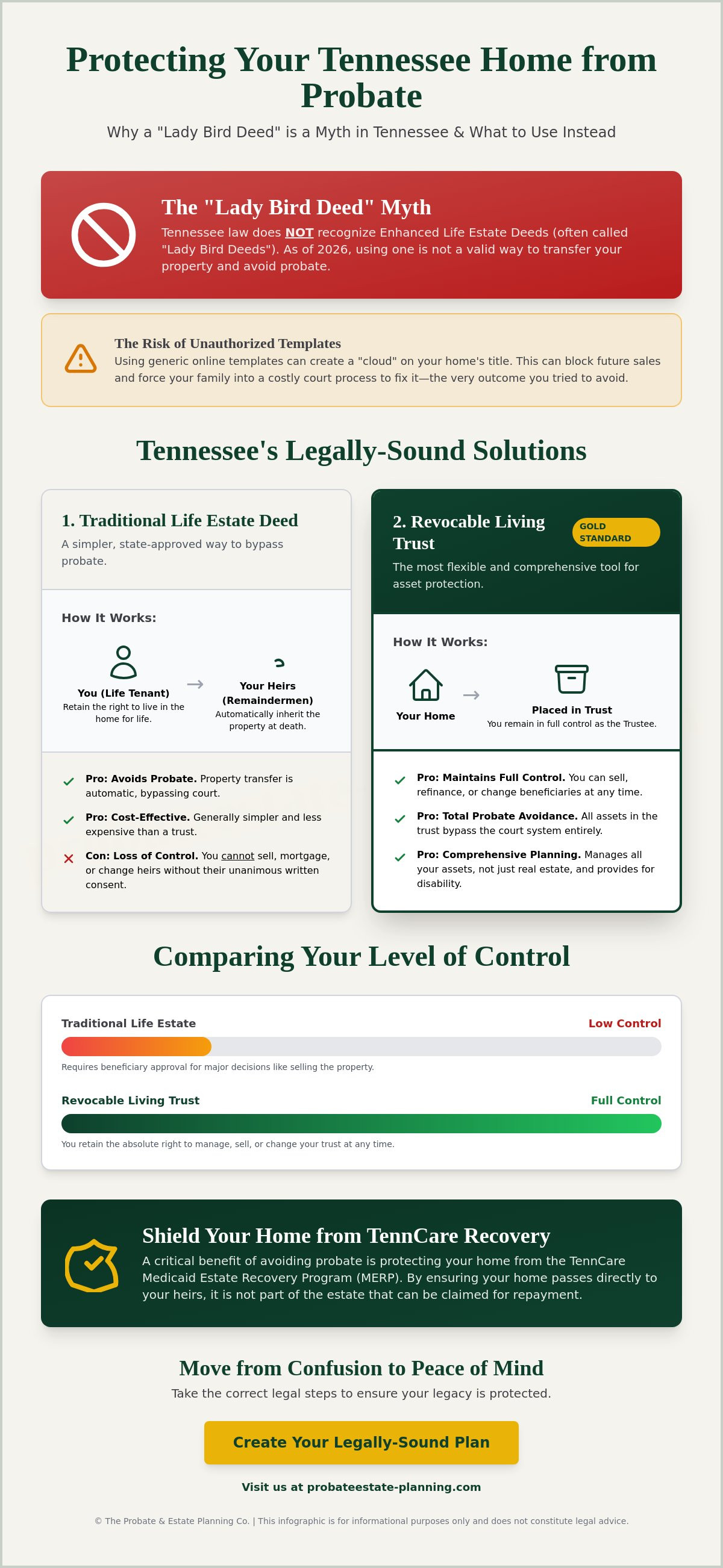
The deed you are looking for to protect your home from probate doesn't actually exist in the state of Tennessee. While you may have heard that an "enhanced life estate" is the perfect solution for avoiding court, the reality is that lady bird deed tennessee rules do not recognize these documents as valid in 2026. This often creates a sense of confusion and worry for families who are simply trying to ensure their home stays in the family. It's vital to understand that following the wrong advice can lead to title complications or unexpected probate costs that your loved ones shouldn't have to face.
We believe that your legacy shouldn't be left to chance or complicated by legal myths. You've worked hard for your home, and you deserve a plan that offers genuine security and functional reliability. This guide will clarify Tennessee's specific stance on property transfers and introduce you to the actionable alternatives, like revocable living trusts and traditional life estates, that work under our state's current laws. You'll learn how to navigate these options to avoid Medicaid estate recovery and keep your family's future predictable and safe.
Key Takeaways
- Understand that Tennessee does not recognize enhanced life estate deeds, requiring a state-specific approach to protect your residence from the probate process.
- Navigate the lady bird deed tennessee rules by exploring approved alternatives like Traditional Life Estate Deeds to ensure your home transfers smoothly to your heirs.
- Discover why a Revocable Living Trust is considered the gold standard for maintaining full control over your property while providing the protections a Lady Bird deed cannot offer in Tennessee.
- Learn how keeping your home out of probate can effectively shield it from the TennCare Medicaid Estate Recovery Program (MERP).
- Identify the methodical steps needed to move from confusing online research toward a finalized legal structure that provides lasting peace of mind.
Lady Bird Deed Tennessee Rules: Are They Valid in 2026?
Many homeowners look for Lady Bird deeds because they want to bypass the court system without losing control of their property. In states like Florida or Texas, these "Enhanced Life Estate Deeds" allow you to name a beneficiary while retaining the absolute right to sell or mortgage the house. However, lady bird deed tennessee rules are quite different. As of May 2026, Tennessee remains a state that does not recognize this specific legal instrument by statute. If you attempt to use one here, you aren't just filing a document; you're potentially creating a legal tangle for your heirs.
It's a common misconception that Tennessee allows for an easy "Transfer on Death" (TOD) deed for real estate. While legislation has been introduced to move toward these types of transfers, the law is not yet in effect. This leaves many families in a vulnerable position where they rely on incorrect online information. Understanding the distinction between a valid Tennessee life estate and an unauthorized Lady Bird deed is the first step toward protecting your family home and ensuring your legacy remains intact.
Why Tennessee Rejects the "Enhanced" Life Estate
Tennessee property law is built on the concept of a "present interest" transfer. When you sign a deed, the law generally expects that you are conveying a real, immediate legal interest to the recipient. Traditional life estates work because you give a "remainder interest" to your heirs while keeping the right to live on the property. Lady Bird deeds try to have it both ways. They claim to transfer property while letting the owner take it back at any time without the beneficiary's permission. Tennessee courts and statutes don't currently support this "enhanced" level of control within a deed structure. Without the enactment of the Tennessee Uniform Real Property Transfer on Death Act, these deeds lack the legal foundation needed to be enforceable in our state.
The Risk of Using Unauthorized Deed Templates
You might find "Tennessee Lady Bird Deed" templates on various legal document websites, but using them is a significant risk. These generic forms often fail to meet the strict recording and language requirements used across Tennessee counties. When a deed is improperly structured, it creates what lawyers call a "cloud" on the title. This means that when your family eventually tries to sell the home, a title company will likely refuse to insure the transaction. Instead of the smooth Probate Avoidance you intended, your family could be forced into a complex court process to clear the title. Tennessee title companies frequently reject unauthorized deed formats because they don't comply with established state statutes or judicial precedents, leaving your property's future in doubt.
Traditional Life Estate Deeds: The Tennessee-Approved Alternative
Since lady bird deed tennessee rules prevent the use of the "enhanced" version of a life estate, the traditional life estate deed stands as the most common state-approved alternative. This legal structure divides ownership into two distinct parts based on time. You, as the current owner, become the "Life Tenant," maintaining the absolute right to live in and use the property for the rest of your life. Your heirs are designated as "Remaindermen."
When you record this deed, you're making an immediate transfer of a "Remainder Interest." This means your heirs technically own a piece of the property the moment the deed is filed, even though they can't take possession until you pass away. Because the transfer is already legally established, the property passes to them automatically by operation of law. This bypasses the probate court entirely, sparing your family from the typical four to six month wait and the associated legal fees often found in Tennessee probate administration.
Pros and Cons of a Standard Life Estate in TN
Choosing a traditional life estate is often a matter of balancing simplicity against control. While it's a straightforward way to protect your home, you should be aware of the functional limitations that distinguish it from the deeds used in other states. Consider these factors before moving forward:
- Pro: Cost-Effectiveness. Executing a deed is generally a simpler process than establishing a comprehensive trust structure.
- Con: Loss of Autonomy. You cannot sell, mortgage, or gift the property without the written consent of every remainderman named on the deed.
- Con: Creditor Exposure. Because the remainderman has a current legal interest, their personal financial troubles, such as bankruptcy, divorce, or lawsuits, could potentially create a lien against your home.
Tax Implications for Tennessee Homeowners
One of the most significant reasons families choose this path is the "step-up in basis." When your heirs inherit the home through a life estate, their tax basis is adjusted to the property's fair market value at the time of your death. This can save them thousands of dollars in capital gains taxes if they decide to sell the home later. However, the initial transfer is technically a gift. In 2026, the annual gift tax exclusion is $19,000 per recipient. If the value of the remainder interest exceeds this amount, you may need to file a gift tax return, even if no tax is actually owed due to the $15 million federal exemption. Exploring Estate Planning options with a professional ensures these nuances are handled correctly to protect your family's financial health.
Probate Avoidance: Revocable Living Trusts vs. Life Estates
While a traditional life estate offers a path around the probate court, many Tennessee families find its lack of flexibility restrictive. This is where the Revocable Living Trust emerges as the gold standard for estate planning. If you were originally searching for lady bird deed tennessee rules, you likely wanted the ability to avoid probate while keeping full control over your property. A trust provides exactly that "enhanced" control that a Lady Bird deed would offer in other states, but it does so through a more robust legal framework recognized by Tennessee law.
Privacy is another major advantage of choosing a trust over a deed. When you file a life estate deed, the transfer of interest becomes a matter of public record at the county register's office. Anyone can see who will inherit your home. In contrast, a trust is a private document. Only your chosen trustees and beneficiaries need to know the details of your estate plan. This layer of confidentiality provides peace of mind for families who prefer to keep their financial transitions out of the public eye.
Why a Trust Wins on Control and Flexibility
The true strength of a Revocable Living Trust lies in its ability to adapt to life's uncertainties. Unlike a life estate, which requires you to get permission from your heirs to sell or mortgage your home, a trust allows you to act alone. You stay in control. You can change your beneficiaries at any time or even dissolve the trust if your circumstances shift. Additionally, you can name successor trustees who will step in to manage your property if you ever become incapacitated, ensuring your home is cared for without a court-ordered conservatorship. Trusts also offer protection for your heirs; if a beneficiary faces a divorce or bankruptcy, the assets held within the trust are often shielded from those specific legal complications. A trust allows you to name contingent beneficiaries, ensuring your home has a clear path forward even if your primary heir passes away unexpectedly.
Cost and Complexity Comparison
It's true that establishing a trust involves a higher upfront investment and more detailed preparation than a simple deed. However, this proactive step often results in significant long-term savings for your family. By avoiding the probate process, which typically takes between four and six months in Tennessee, you spare your loved ones from procedural delays and administrative burdens. To make the trust effective, you must complete a process called "funding," which involves signing a new deed that transfers the property from your individual name into the name of your trust. A life estate might be "enough" for an individual with a very simple family structure and a single property, but a Revocable Living Trust is necessary for those who prioritize total autonomy, privacy, and protection against the unexpected turns of life.
Protecting Your Tennessee Home from Medicaid Estate Recovery
The Tennessee Medicaid Estate Recovery Program (MERP) is often a source of significant anxiety for families facing the reality of long-term care. While TennCare provides vital support for nursing home costs, federal law requires the state to seek reimbursement from your estate after you pass away. Because lady bird deed tennessee rules don't allow for the "enhanced" deed structures found in other states, many homeowners worry that their residence is an easy target for these recovery efforts. It's a heavy burden to think that the home you've spent a lifetime building could be sold to pay for medical bills, leaving your heirs with nothing.
In Tennessee, the key to safeguarding your home lies in understanding how the state defines your "estate." Currently, Tennessee law limits Medicaid recovery to assets that pass through the probate court. This creates a specific opportunity for proactive protection; if your home is transferred through a non-probate mechanism, it's generally shielded from MERP claims. While some states have expanded their recovery definitions to include all assets, Tennessee has maintained a more traditional stance through early 2026, focusing recovery solely on the probate estate.
The "Probate Asset" Loophole in Tennessee
By using the alternatives we discussed earlier, such as traditional life estates or revocable living trusts, you effectively remove the home from your probate estate. Since the property transfers to your beneficiaries by operation of law or through trust instructions, it never enters the court's jurisdiction. This distinction is critical. If the home isn't part of the probate process, the state currently has no statutory authority to place a lien on it for Medicaid reimbursement. We monitor legislative sessions closely, and as of May 2026, there have been no successful efforts to expand Tennessee's MERP definitions to reach non-probate assets like those held in a trust.
Medicaid Eligibility vs. Asset Protection
There's a vital difference between qualifying for TennCare and protecting your home from later recovery. For eligibility purposes, your primary residence is usually considered an "exempt asset" if your equity is below $752,000 in 2026. However, being exempt for eligibility doesn't mean it's exempt from recovery. You must also account for the five-year lookback period. Any deed transfer, including the creation of a life estate, is viewed as a gift. If you make this transfer within sixty months of applying for long-term care, you could face a penalty period of ineligibility. This is why waiting until a health crisis occurs is often too late for traditional planning. You can Consult our Medicaid planning experts to safeguard your home to ensure your strategy accounts for both immediate eligibility and long-term asset preservation. Taking a methodical approach to Medicaid Crisis Planning can provide the peace of mind that your family's future is secure.
Creating a Legally Sound Estate Plan in Tennessee
Moving from awareness to action is the most critical phase of protecting your home. While the internet offers countless templates, lady bird deed tennessee rules mean that generic forms often lead to expensive title defects rather than the security you intended. A document that works in Texas or Florida will likely fail here. Protecting your residence requires a strategy that respects Tennessee's specific statutes while coordinating with your broader goals for asset protection and family harmony.
A deed does not exist in a vacuum. To be truly effective, your real estate plan must be synchronized with other vital documents like your Last Will and Testament and your Durable Power of Attorney. If you transfer your home into a trust but fail to update your homeowner's insurance or mortgage records, you could face administrative hurdles later. We focus on functional reliability, ensuring that every piece of your plan works together to prevent future complications for your loved ones.
Step-by-Step Implementation
Success starts with a methodical approach. We guide our clients through a clear process to ensure no detail is overlooked:
- Step 1: Conduct a full asset review. We analyze your home's current equity and mortgage status. In 2026, the home equity interest limit for TennCare eligibility is $752,000, making this data point essential for Medicaid planning.
- Step 2: Determine your priority. We help you decide if your primary goal is a lower-cost probate avoidance tool, like a Traditional Life Estate, or the total autonomy provided by a Revocable Living Trust.
- Step 3: Draft Tennessee-compliant documents. Our team prepares the specific deed or trust language required to meet state recording standards and judicial precedents.
- Step 4: Execute and record. Documents must be signed before a notary and filed with the local County Register of Deeds. In Davidson County, for example, the base recording fee is $12.00 for the first two pages, with a state conveyance tax of $3.70 per $1,000 of property value.
The Role of The Probate & Estate Planning Co.
Our practice serves as a steady guide through the complexities of Tennessee law. We understand that you aren't just looking for paperwork; you're looking for the peace of mind that comes from knowing your home is safe. By focusing on Asset Protection Planning and Estate Planning tailored to our state's unique environment, we help you avoid the common pitfalls that trap many families. We offer a partnership in long-term management, ensuring your plan remains robust even as laws evolve. You don't have to face the anxiety of probate or the fear of estate recovery alone. Schedule your Tennessee estate planning consultation today to begin building a predictable and secure future for your family.
Building Your Protective Strategy for the Future
Your home is more than just an asset; it's the foundation of your family's history and future. While searching for lady bird deed tennessee rules may have led you to believe there's a simple "enhanced" shortcut, the reality of Tennessee law requires a more methodical approach. We've seen that while these specific deeds aren't recognized here, you still have powerful tools at your disposal. By choosing between a traditional life estate or a robust revocable living trust, you can successfully bypass the probate court and shield your property from Medicaid estate recovery efforts.
Our firm brings specialized expertise in Tennessee probate and elder law to every consultation, offering the empathetic guidance you need during sensitive family transitions. With a practice spanning the Southeast and Mid-Atlantic, we understand the nuances of multi-state planning and functional reliability. Don't leave your most important interpersonal connections to the uncertainty of generic forms or outdated advice. We're here to offer a partnership in long-term management that prioritizes your emotional well-being alongside your legal security.
Secure Your Family Legacy with a Tennessee-Specific Estate Plan today and find the peace of mind you deserve.
Frequently Asked Questions
Does Tennessee have Transfer on Death (TOD) deeds for houses?
No, Tennessee doesn't currently have an active statute that authorizes Transfer on Death deeds for real property. While the Tennessee Uniform Real Property Transfer on Death Act has been introduced in the legislature, its provisions aren't expected to become effective until July 1, 2026, at the earliest. Until that law is officially enacted, you must rely on established tools like revocable living trusts or traditional life estates to transfer your home outside of the probate process.
Can a nursing home take my house in Tennessee?
A nursing home can't literally take your home, but the state can seek reimbursement for care costs through the Medicaid Estate Recovery Program. If you receive TennCare benefits for long-term care, the state may place a claim against your probate estate after you pass away. Protecting your home requires moving it out of the probate estate before you need care, ideally more than five years before applying to avoid lookback penalties.
What is the difference between a Life Estate and a Lady Bird deed?
The primary difference is the level of control you retain over the property during your lifetime. Under lady bird deed tennessee rules, which aren't recognized in our state, an owner could sell or mortgage the home without the beneficiary's consent. In a traditional Tennessee life estate, you're the life tenant and must obtain written permission from your remaindermen if you wish to sell or change the property's legal status.
How much does it cost to avoid probate for a home in Tennessee?
Avoiding probate involves upfront legal and recording fees that are much lower than the eventual cost of court proceedings. While Tennessee probate costs for a typical estate often range from $2,000 to $7,500, proactive planning saves your family from these expenses and months of delays. You should also account for county recording fees, such as the $12 base fee for the first two pages in Davidson County.
Does a Revocable Living Trust protect my home from Medicaid in TN?
A Revocable Living Trust doesn't protect your home from being counted as an asset for Medicaid eligibility, but it can shield it from estate recovery. Since assets in a trust don't pass through probate, they currently fall outside the reach of the Tennessee Medicaid Estate Recovery Program. For total protection during your lifetime, an irrevocable trust is often necessary to meet the strict $2,000 asset limit for single applicants.
Can I sell my house if I have a Life Estate deed in Tennessee?
You can sell your house, but you can't do it alone. Because a traditional life estate deed transfers a remainder interest to your heirs the moment it's recorded, those heirs have a legal stake in the property. To sell or mortgage the home, every remainderman listed on the deed must sign the closing documents. This lack of total autonomy is a primary reason many families choose a trust instead of a deed.
What happens if the remainderman dies before the life tenant in TN?
If a remainderman passes away first, their interest in your home typically passes to their own heirs or estate. This can create a complicated situation where you end up co-owning the future interest of your home with a son-in-law, daughter-in-law, or even a stranger's creditor. This risk highlights why lady bird deed tennessee rules are often sought after, as they would've allowed for easier beneficiary changes that traditional deeds don't permit.
How do I record a deed in Tennessee to ensure it is valid?
To record a valid deed, you must file the original, notarized document with the Register of Deeds in the county where the property is located. You must pay the required recording fees and the state conveyance tax, which is $3.70 per $1,000 of property value. Ensuring the legal description is perfectly accurate and the document meets all local formatting standards is essential to prevent a cloud on the title or future probate issues.
Comments
There are no comments for this post. Be the first and Add your Comment below.
Leave a Comment