

The most frustrating obstacle in settling an estate isn't always a complex legal battle; often, it's the simple car sitting in the driveway. You're likely dealing with enough emotional weight without the added burden of DMV paperwork and the fear of unexpected taxes. Learning how to transfer car title after death in nc should be a straightforward process that respects your time and your grief, yet the bureaucracy often feels designed to do the opposite.
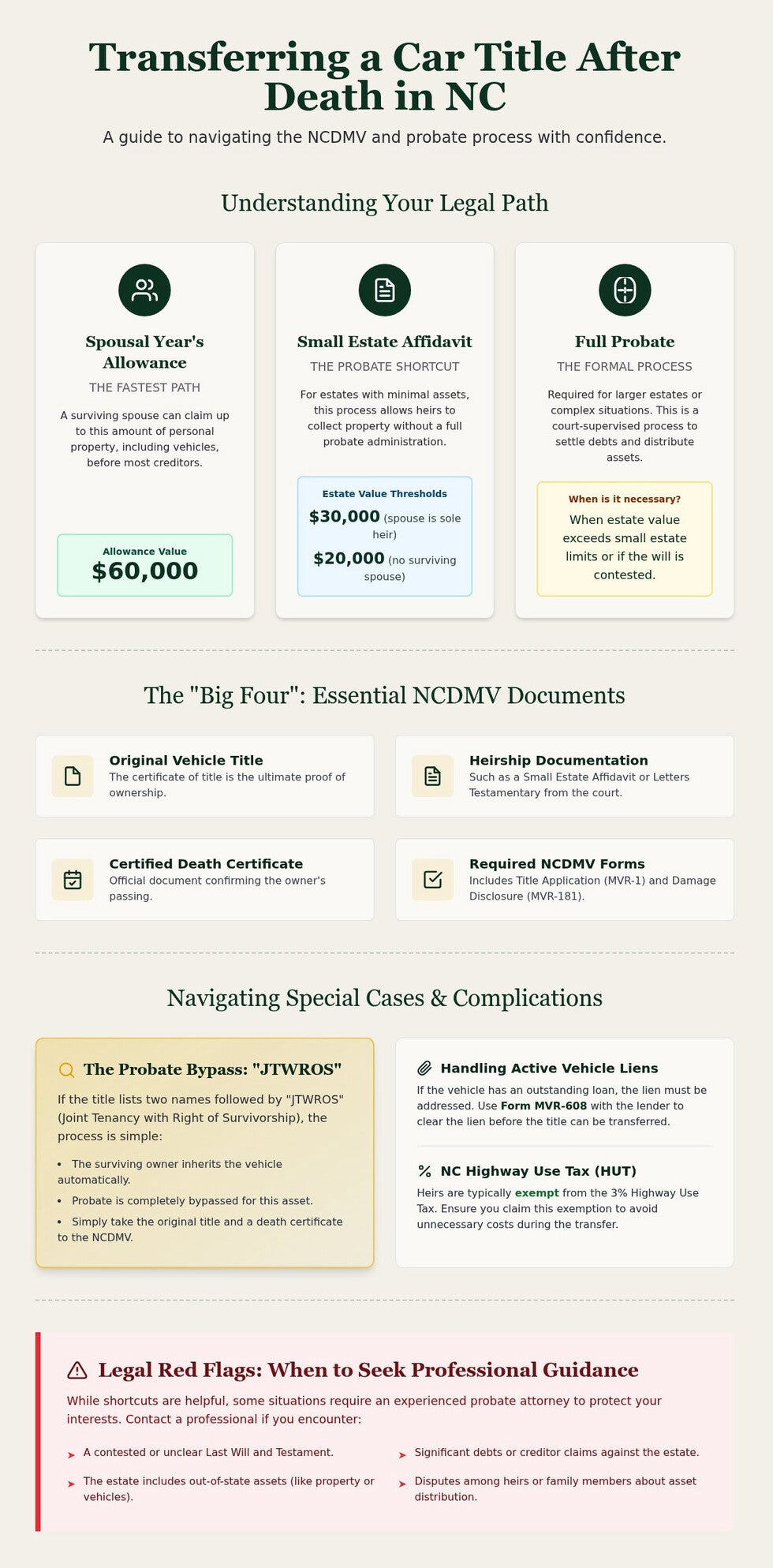
We understand that you want to protect your family's assets while avoiding unnecessary costs like the 3% Highway Use Tax. This guide provides the professional clarity you need to move forward with confidence. You'll discover exactly how to navigate North Carolina's small estate thresholds, which currently stand at $20,000 for general heirs and $30,000 for surviving spouses. We'll walk you through the specific NCDMV forms required and explain how the $60,000 Year's Allowance might simplify your path, ensuring you can resolve these administrative tasks and return your focus to your family's well-being.
Key Takeaways
- Identify whether your specific situation qualifies for the Spousal Year's Allowance or a Small Estate Affidavit to bypass the lengthy full probate process.
- Learn how to transfer car title after death in nc by gathering the "Big Four" essential documents required by the NCDMV to ensure a smooth transition of ownership.
- Understand the specific legal criteria for exempting heirs from the 3% North Carolina Highway Use Tax (HUT) to prevent unnecessary financial strain.
- Gain clarity on handling active vehicle liens using Form MVR-608 so that outstanding loans do not stall the administrative transfer.
- Recognize the legal "red flags," such as contested wills or out-of-state assets, that signal when professional probate guidance is necessary to protect your personal interests.
Understanding Your Options for Vehicle Title Transfer in North Carolina
Transferring a vehicle is more than just a clerical task; it's a legal requirement that ensures the car's registration and insurance remain valid. In North Carolina, the certificate of title for a vehicle serves as the ultimate proof of ownership. When the owner passes away, this document becomes part of their estate. If you fail to move the title into the correct name, you risk losing insurance coverage or facing significant delays when you eventually decide to sell the vehicle. The state requires a clear chain of ownership to maintain the integrity of public records and protect the interests of heirs.
Your first step depends on whether the deceased left a valid Last Will and Testament. If they died "testate" (with a Will), the document typically names an executor who has the authority to handle assets. If they died "intestate" (without a Will), North Carolina law dictates who inherits the property. This distinction determines which legal path you must follow: the Spousal Year's Allowance, a Small Estate Affidavit, or full probate. Each path has specific requirements based on the total value of the estate and your relationship to the deceased.
To better understand this concept, watch this helpful video:
Most families feel overwhelmed by the dual nature of this process. You aren't just dealing with the North Carolina Division of Motor Vehicles (NCDMV); you must also coordinate with the Clerk of Superior Court in the county where the deceased lived. The Clerk's office validates your legal right to the car, while the NCDMV handles the actual administrative change. Understanding how to transfer car title after death in nc begins with identifying which of these three paths is the most efficient for your specific situation. Choosing the path of least resistance can save you months of administrative delays.
The Role of Joint Ownership with Right of Survivorship
Check the title for the letters "JTWROS." This stands for Joint Tenancy with Right of Survivorship. If this designation is present, the vehicle bypasses the probate process entirely. The surviving owner can simply take the original title and a death certificate to the NCDMV to update the records. However, North Carolina law does not assume survivorship rights by default. If the title simply lists two names without that specific phrasing, the deceased's portion of the car must still pass through the estate process before the title can be fully transferred.
Why You Cannot Simply "Drive the Car" Under the Deceased's Name
It's tempting to keep driving the vehicle under the deceased's name, but this creates immense liability. Insurance companies typically write policies for specific individuals. If the policyholder is deceased, the coverage may be void, leaving you unprotected in an accident. Furthermore, if an accident occurs, the estate could be held liable for damages, potentially depleting other assets meant for heirs. You should aim to begin the transfer process within 30 to 60 days to avoid registration expiration and ensure the asset remains protected under a valid insurance policy.
The NC Probate Shortcuts: Year's Allowance and Small Estate Affidavits
Many families assume that a complex court case is the only way to move a vehicle's ownership after a loss. In North Carolina, the law provides simplified procedures designed to help you avoid the exhaustion of full probate. These shortcuts are particularly useful when a car is the primary asset requiring attention. If you are researching how to transfer car title after death in nc, you should first determine if the estate's value falls under specific statutory limits that allow for an expedited process.
The state offers two primary relief mechanisms: the Year's Allowance and the Small Estate Affidavit. For a surviving spouse, the Year's Allowance is a powerful tool. It allows you to claim up to $60,000 of the deceased's personal property, including vehicles, before creditors can make a claim. If there is no surviving spouse, or if assets exceed that allowance, the Affidavit for Collection of Personal Property of Decedent provides a secondary path. This process is available for estates where the total value of personal property, minus liens, doesn't exceed $20,000. This threshold increases to $30,000 if the surviving spouse is the sole heir.
These thresholds are designed to protect smaller estates from the costs and delays of formal administration. However, accuracy is vital when calculating these values. If you misinterpret the estate's worth or miss a filing deadline, you could face personal liability or procedural setbacks. Working with a professional for probate administration services can provide the protective guidance needed to ensure these shortcuts are used correctly and safely.
How to File for the Spousal Year's Allowance
To begin this process, the surviving spouse must file Form AOC-E-100 with the Clerk of Superior Court in the county where the deceased lived. This is often the fastest way for a widow or widower to secure a vehicle because it grants the car priority status over other estate obligations. Once the Clerk approves the application, you'll receive a certified copy. This document acts as your legal authority when you visit the NCDMV, allowing you to move the title into your name without waiting for the entire estate to be settled.
Navigating the Small Estate Affidavit (AOC-E-203)
If the Year's Allowance isn't applicable, heirs can use Form AOC-E-203, also known as "Collection by Affidavit." You must wait exactly 30 days after the date of death before you can file this document with the court. During this period, you should determine the vehicle's Fair Market Value (FMV). You'll need to list this value accurately on the affidavit. If the total value of all personal property stays under the $20,000 or $30,000 limit, the Clerk will certify the affidavit, giving you the power to transfer the title at the DMV office.
Step-by-Step Guide to Transferring the Title at the NCDMV
Once you've secured the necessary court authorization, your focus shifts from the legal system to the administrative environment of the North Carolina Division of Motor Vehicles. Precision during this phase is essential to prevent multiple trips to the agency. Understanding how to transfer car title after death in nc involves more than just bringing the right papers; it requires following a specific sequence of administrative actions. You must arrive prepared with what we call the "Big Four" documents: the original vehicle title, a certified copy of the death certificate, the appropriate probate document from the Clerk of Court, and your valid government-issued identification.
If the original title was lost or destroyed, you'll need to complete Form MVR-4 to request a duplicate simultaneously. Every signature on the back of the title or the application (Form MVR-1) must be notarized. This is a non-negotiable security measure in North Carolina. If the vehicle is less than 10 years old, you must also provide an Odometer Disclosure Statement (Form MVR-180). This ensures the vehicle's history is accurately preserved for future owners and maintains the integrity of the state's records.
Completing the MVR-317 Affidavit of Heirship
In specific circumstances where the deceased died without a Will and the total net value of the estate's property doesn't exceed $15,000, Form MVR-317 may allow you to bypass the Clerk of Court entirely. This is a specialized DMV shortcut. However, it requires all legal heirs to sign the document in the presence of a notary. This form serves as a protective declaration that all debts of the deceased have been paid and that all heirs agree on who should receive the vehicle. It's a useful tool for simple family transitions but requires total consensus among surviving relatives.
Visiting the License Plate Agency
Many people mistakenly visit a DMV driver license office for title work. In North Carolina, you must go to a License Plate Agency (LPA) instead. These offices handle vehicle registration and titling exclusively. You should be prepared to pay the standard $56 title fee, along with any applicable registration or notary costs. If you need the title immediately, an "instant title" service is available for $105.75. If you're the named executor in a Will, always bring a certified copy of that Will. It provides the clear, documented authority the LPA staff needs to process your request without hesitation.
Navigating Taxes, Liens, and Common Complications
When figuring out how to transfer car title after death in nc, many families worry about the financial impact of the state's 3% Highway Use Tax (HUT). While this tax is a standard part of most vehicle purchases, North Carolina law provides specific relief for those inheriting a vehicle. Beyond taxes, you may encounter obstacles like active loans or missing paperwork that can stall the transfer. Addressing these complications early prevents the estate from incurring unnecessary costs or legal delays.
Claiming the Highway Use Tax Exemption
Heirs and beneficiaries are generally exempt from the 3% Highway Use Tax that typical car buyers must pay. To secure this exemption, you must indicate that the transfer is occurring via "Will or Intestacy." When you present your probate documents at the License Plate Agency, ensure the clerk applies the correct exemption code to your transaction. This simple step protects the estate's liquidity and ensures that the beneficiary receives the full value of their inheritance without an immediate tax bill. It's a vital protection designed to support families during a period of transition.
Dealing with Outstanding Auto Loans
If the vehicle has an active loan, the title won't be "clear" until the debt is satisfied. The executor of the estate is typically responsible for using estate assets to pay off the remaining balance. Once the loan is paid, the lender must provide a lien release. In some cases, you may need to use Form MVR-608 to document the status of the lien for the NCDMV. If the vehicle is "underwater," meaning it's worth less than the outstanding loan, the executor must decide whether to continue payments or allow the lender to repossess the asset. This decision requires a careful review of the estate's total obligations. If you find yourself managing complex debts or contested assets, our probate administration services can help you identify the safest path forward for the estate and its beneficiaries.
Other complications frequently arise, such as a lost or destroyed original paper title. If the title is missing, the executor must file Form MVR-4 to request a duplicate before the transfer can proceed. The "out-of-state" problem is another common hurdle. If the deceased lived in North Carolina but the vehicle is still titled in another state, you must generally provide the original out-of-state title along with your North Carolina probate documents. The NCDMV will then issue a new North Carolina title in the heir's name. Each of these scenarios requires precise documentation to ensure the chain of ownership remains unbroken and legally sound.
When to Seek Professional Guidance from a Probate Attorney
Settling a loved one's affairs often starts with a single car, but it rarely ends there. While you now understand the mechanics of how to transfer car title after death in nc, certain "red flags" indicate that the process is moving beyond a simple DMV transaction. If the deceased owned vehicles in multiple states, or if family members disagree on who should inherit the car, the situation requires a higher level of legal scrutiny. DIY efforts in these scenarios can lead to procedural gridlock or fractured family relationships that take years to repair.
Executors often feel pressured by relatives to distribute assets quickly. However, you must remember that you are a fiduciary with a legal obligation to the estate's creditors as well as the heirs. Distributing a vehicle before the mandatory 30-day waiting period for small estates, or before ensuring all priority debts are settled, can expose you to personal liability. If the estate is later found to be insolvent, creditors may look to the executor to replace the value of the assets that were given away too early. This risk is especially high if the vehicle is high-value or if the estate has significant outstanding medical or credit card debt.
Protecting the Executor from Liability
Even the Spousal Year's Allowance, which provides a significant $60,000 protection for personal property, is not entirely immune to challenges. Creditors can sometimes contest these filings if they believe the estate's value was misrepresented or if the allowance was not processed with a proper formal inventory. Seeking legal counsel ensures that your court filings and NCDMV paperwork are perfectly synchronized. This protective approach prevents the Clerk of Court from rejecting your accounting and shields your personal finances from estate-related lawsuits. We help you maintain the thoroughness required to satisfy both the court and the DMV.
Comprehensive Estate Administration Services
Managing a vehicle transfer is just one piece of a much larger puzzle. Our Probate Administration Services provide full-service support to handle the entire "paperwork headache" while you focus on your family's emotional recovery. We move beyond mere administrative preparation to offer functional reliability, ensuring every asset, from the car in the driveway to complex investment accounts, is handled with meticulous attention to detail. You don't have to carry this administrative burden alone. We invite you to schedule a consultation with our NC probate team to gain the peace of mind that comes from professional guardianship and a predictable legal outcome.
Securing Your Family's Legacy and Assets
Moving through the administrative requirements of an estate is a significant responsibility, but it doesn't have to be an overwhelming one. You've learned that North Carolina provides specific pathways, such as the $60,000 Year's Allowance for spouses or the $20,000 Small Estate Affidavit, to simplify your journey. By understanding how to transfer car title after death in nc, you can avoid common pitfalls like unnecessary tax payments or insurance gaps. These steps ensure that the vehicle remains a secure asset rather than a source of legal confusion or liability for the estate.
While the procedural steps are now clear, complex family dynamics or significant debts often require a more tailored approach. Our experienced North Carolina probate attorneys offer compassionate guidance for grieving families, providing the professional security you need during sensitive transitions. We specialize in comprehensive estate planning and asset protection to safeguard your financial future. If you feel burdened by the weight of these administrative tasks, Get Professional Help with NC Probate Administration. Taking this proactive step provides the peace of mind that your loved one's legacy is handled with the meticulous attention it deserves.
Frequently Asked Questions
Do I have to go through probate just to transfer a car title in NC?
You don't always need to open a full probate case to move a vehicle's ownership. If the car was owned with "Right of Survivorship," the transfer happens automatically. For other situations, North Carolina offers simplified procedures like the Spousal Year's Allowance or a Small Estate Affidavit. These options allow you to handle the vehicle without the time and expense of a formal court administration.
How long do I have to transfer a vehicle title after someone dies in North Carolina?
The NCDMV doesn't set a rigid deadline, but you should aim to begin the process within 30 to 60 days. Acting quickly is vital because insurance policies often become void once the provider learns the policyholder has passed. Promptly learning how to transfer car title after death in ncensures the vehicle remains protected and legal to drive while you settle other estate matters.
What if the deceased person died without a Will (Intestate)?
When someone dies without a Will, North Carolina's intestacy laws determine the legal heirs. You'll typically use Form MVR-317, the Affidavit of Heirship, if the estate's total value is under $15,000. For larger estates, you must file a Small Estate Affidavit with the Clerk of Court. These documents provide the NCDMV with the legal proof needed to identify the rightful new owner according to state law.
Can I sell the car before the title is in my name?
No, you cannot legally sell a vehicle until you have established clear ownership through the NCDMV. You must first transfer the title into your name or the name of the estate's executor. Once the state issues a new certificate of title, you have the legal authority to sign it over to a buyer. Attempting to sell the car before this step is known as "title jumping" and is illegal.
How much does the NC DMV charge for a title transfer after death?
The standard fee for a new certificate of title in North Carolina is $56. If you require the document immediately, you can request an "instant title" for a fee of $105.75. You should also account for small additional costs, such as notary fees for the required signatures and any applicable charges for new license plates or registration tags during the visit to the License Plate Agency.
What is a Spousal Year's Allowance and how does it help with car titles?
A Spousal Year's Allowance is a legal right that lets a surviving spouse claim up to $60,000 in personal property from the estate. This allowance takes priority over most creditors, meaning the spouse can often secure the car even if the estate has outstanding debts. By filing Form AOC-E-100, the spouse receives a court order that the NCDMV accepts as total authority for the title transfer.
What if there are multiple heirs who all want the car?
The executor must follow the specific instructions left in the Will or adhere to state intestacy laws if no Will exists. If the car isn't specifically left to one person, it is considered part of the general estate. Heirs must either reach a written agreement on who keeps the vehicle or the executor may need to sell the car and distribute the cash proceeds among all beneficiaries equally.
How do I get a new title if the original one is lost?
If the original title is missing, you must file Form MVR-4, the Application for Duplicate Title, with the NCDMV. The executor or the person authorized by the Small Estate Affidavit must sign this form. It's often possible to process the duplicate request and the ownership transfer at the same time. This ensures that a lost document doesn't permanently stall your ability to settle the estate's vehicle assets.
Comments
There are no comments for this post. Be the first and Add your Comment below.
Leave a Comment