

Last Tuesday, Sarah sat in a North Carolina hospital hallway, unable to authorize her father's surgery or pay his mortgage because his bank accounts were frozen and his dementia had progressed too far to sign a Power of Attorney. When a medical crisis or cognitive decline leaves a loved one vulnerable, the standard court process feels painfully slow. If you're facing this reality, seeking emergency guardianship for parent in north carolina, legally known as an Interim Guardianship, is often the only way to intervene before irreparable harm occurs.
You likely feel overwhelmed by the weight of this responsibility and the complexity of the North Carolina court system. It's frightening to watch a parent's safety or assets hang in the balance while you wait for a clerk's signature. This guide will show you how to secure immediate legal authority to protect your parent's health and estate. We'll walk through the specific filing fees, including the $120.00 petition fee and the $20.00 motion fee, and explain the critical 45 day timeline for interim orders so you can restore stability to your family's life.
Key Takeaways
- Understand the legal distinction between Interim Guardianship and standard proceedings to ensure you choose the fastest path for your parent's safety.
- Learn how to prove the "imminent risk" standard required when seeking emergency guardianship for parent in north carolina to bypass standard notice periods.
- Discover the specific 45-day timeline for interim orders and the procedural requirements for the mandatory hearing held before the Clerk of Superior Court.
- Identify why court-supervised guardianship is the necessary alternative when a parent can no longer legally execute a Power of Attorney due to cognitive decline.
- Gain a clear understanding of the roles played by the Guardian ad Litem and the sheriff's service to ensure your petition moves through the system without delay.
What is Interim (Emergency) Guardianship in North Carolina?
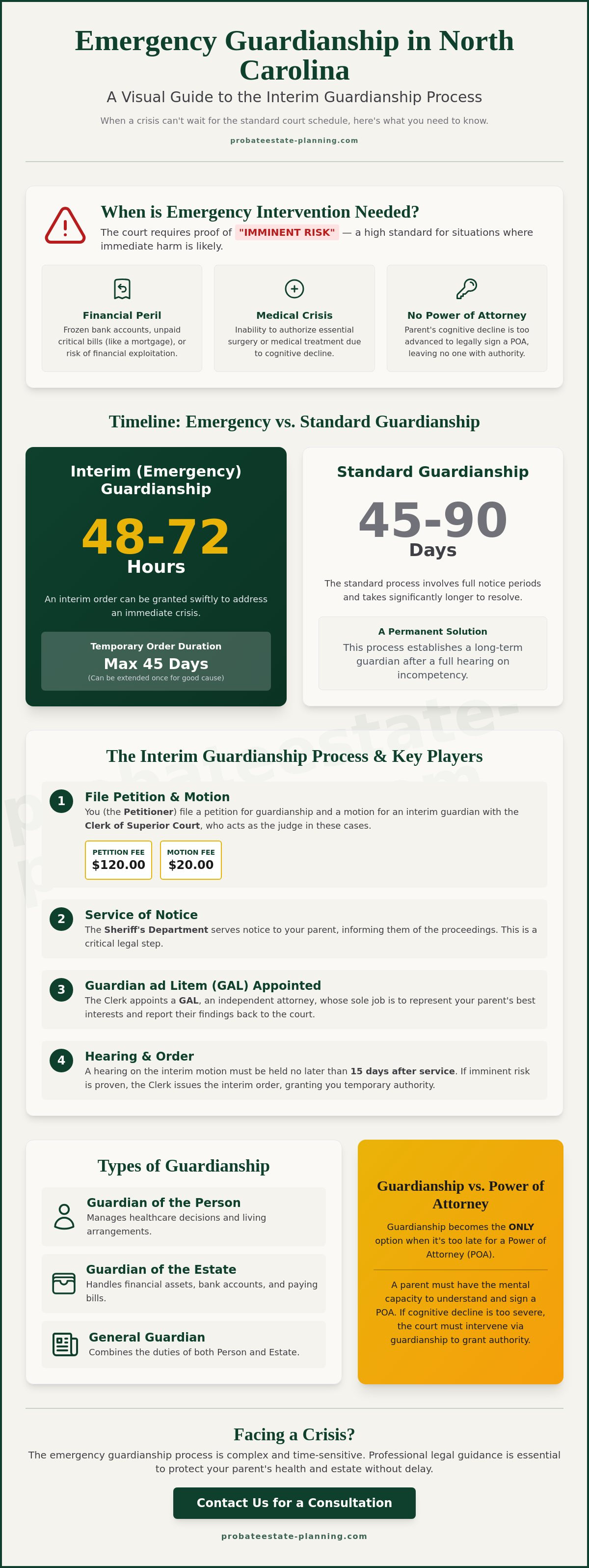
In North Carolina, the law recognizes that some crises won't wait for a standard court schedule. While most families search for emergency guardianship for parent in north carolina, the technical term used in our state's legal system is Interim Guardianship. Under North Carolina General Statutes Chapter 35A, this process allows a family member or concerned party to step in immediately when a parent is at risk of imminent harm. Unlike standard civil cases, these matters are decided by the Clerk of Superior Court, who acts as the primary judicial official in guardianship proceedings.
When you petition the court, you must decide what type of Legal Guardian your parent needs. A Guardian of the Person manages healthcare decisions and living arrangements. A Guardian of the Estate handles financial assets, bank accounts, and bills. If your parent needs help with both, you'll seek a General Guardian. The interim status serves as a temporary protective bridge. It ensures your parent's safety while the court prepares for a permanent hearing, preventing a total collapse of their care or finances.
To better understand how the court views these sensitive matters, watch this helpful video:
Interim vs. Permanent Guardianship: The Timeline
Time is your most valuable asset during a medical or financial crisis. A standard guardianship case in North Carolina often takes between 45 and 90 days to resolve. In contrast, an interim order can be granted in as little as 48 to 72 hours if you can prove imminent risk. However, this authority is strictly temporary. According to the North Carolina Judicial Branch, an interim guardianship order lasts for a maximum of 45 days. The court must hold a hearing on the interim motion no later than 15 days after your parent has been served with notice. While the order can be extended once for an additional 45 days for good cause, it's designed to expire once the full incompetency hearing occurs.
Who Can Be Appointed as an Emergency Guardian?
The Clerk of Superior Court generally prefers to appoint a family member who is familiar with the parent's wishes. To qualify, you must be a resident of North Carolina or appoint a resident process agent. You also cannot have a criminal history that disqualifies you from fiduciary duties. During this process, the Clerk will appoint a Guardian ad Litem (GAL). This person is an independent attorney whose sole job is to represent your parent's best interests. They'll visit your parent and report back to the court. This safeguard prevents abuse and ensures the emergency intervention is truly necessary for your parent's stewardship.
When Does a Parent Qualify for Emergency Intervention?
Seeking emergency guardianship for parent in north carolina requires more than just showing that a loved one is struggling with age. The North Carolina Clerk of Superior Court applies a strict "imminent risk" standard to interim petitions. To succeed, you must demonstrate that a delay in the legal process will likely result in immediate physical harm to your parent or significant damage to their financial estate. The court views this as a high speed intervention designed to stop a crisis in its tracks. It's not meant for long term care planning that could have been handled through standard notice periods.
Common triggers for these filings include sudden medical events like a severe stroke or the rapid onset of late stage dementia. In many cases, families realize too late that their parent never signed a Power of Attorney (POA). Without a valid POA, doctors cannot share information due to HIPAA laws and banks will refuse to let children manage accounts. If your parent already lacks the cognitive capacity to understand a legal document, they can't sign a new POA. At that point, the court supervised path of guardianship becomes the only legal way to secure the authority needed for their protection. You can find more details on these distinctions through the North Carolina Guardianship Information portal provided by the state judicial branch.
It is also vital to distinguish between "bad decisions" and legal "incompetency." North Carolina law protects the right of adults to make choices others might find unwise. To qualify for an interim guardian, the parent must lack the capacity to manage their own affairs or communicate important decisions. If you are unsure whether your situation meets this legal threshold, consulting with a professional about comprehensive estate planning and guardianship can provide the clarity you need to move forward with confidence.
Medical Crises and Healthcare Decisions
When a medical crisis occurs, the absence of a Living Will or Health Care Power of Attorney creates a dangerous vacuum. Under NCGS 35A-1107, medical necessity is defined as a situation where a respondent requires immediate medical treatment to prevent death or serious physical injury. An interim guardian gains the immediate legal standing to authorize surgeries, access medical records, and move a parent into a skilled nursing facility if their current home environment has become unsafe due to self neglect.
Financial Emergencies and Asset Protection
Financial exploitation is a primary driver for emergency guardianship for parent in north carolina. If you discover a "new friend" is draining your parent's retirement account or if a house is facing immediate foreclosure, the court can grant interim authority to freeze assets. This stewardship allows you to pay essential bills, stop predatory scams, and begin the complex process of Medicaid crisis planning. Protecting the estate today ensures that resources remain available for your parent's long term care and legacy.
The 5-Step Process to Filing for Interim Guardianship in NC
The process of securing emergency guardianship for parent in north carolina is a methodical legal journey that begins with specific paperwork. You don't just ask for help; you provide the court with a structured roadmap of the crisis. This five step path ensures the court has enough evidence to justify removing your parent's rights while moving fast enough to prevent a tragedy.
First, you file the Petition for Adjudication of Incompetence (Form SP-200). This document officially asks the court to declare your parent incompetent. Second, you must simultaneously file a Motion for Appointment of Interim Guardian. This second filing is what triggers the "emergency" status. Third, the Clerk of Superior Court reviews your filings and appoints a Guardian ad Litem (GAL), an attorney who represents your parent's interests. Fourth, an interim hearing is held, usually within 15 days of your parent being served with notice. Finally, if the Clerk finds sufficient evidence of imminent risk, they'll issue Letters of Appointment. These letters are your "keys" to the kingdom, giving you the legal standing to talk to doctors and manage bank accounts.
Gathering Necessary Evidence Quickly
Success in an interim hearing depends on the quality of your proof. You should obtain a physician's statement or detailed medical records that clearly outline your parent's diagnosis and functional limitations. If there's a risk of financial loss, gather bank statements showing unauthorized withdrawals or unpaid bills. Affidavits from other family members or professional caregivers can provide the Clerk with a broader view of the daily dangers your parent faces. The court often looks for a connection between the medical condition and the specific risk of harm, a concept discussed in resources regarding Guardianship and Adult Protective Services.
Navigating the NC Clerk of Superior Court
You must file your petition in the county where your parent resides, such as Mecklenburg, Wake, or Guilford. The costs are fixed. You'll pay a $120.00 filing fee for the petition, a $30.00 fee for the sheriff to serve the papers, and a $20.00 fee for the interim motion. If your parent is a low income senior, you may qualify for a "pauper's petition" to waive these costs. While the Clerk's staff can help you find forms, they cannot give you legal advice or tell you what to write. Having a clear, organized file when you walk into the courthouse ensures your request for emergency guardianship for parent in north carolina moves forward without delay.
Guardianship vs. Power of Attorney: Is it Too Late?
Many families hope a simple signature on a Power of Attorney (POA) can solve their crisis, but legal documents require "capacity." If your parent already suffers from advanced dementia or a severe medical impairment, they cannot legally sign a POA. They must understand the nature of the document and the authority they are giving away. When this window of opportunity closes, seeking emergency guardianship for parent in north carolina becomes the only legal path to secure the authority needed for their care. While a POA is a private arrangement, guardianship is a public, court supervised process that ensures a higher level of oversight for a vulnerable adult.
Choosing this path means stepping into a role of stewardship under the watchful eye of the Clerk of Superior Court. Unlike a POA, where you act independently, a guardian must file annual accountings and status reports. These reports document every penny spent from the parent's estate and provide updates on their physical well being. This transparency protects the parent's remaining autonomy, as North Carolina law requires the court to consider the least restrictive alternative possible. If you find yourself in this position, it's vital to consult with a legal professional about guardianship to ensure you meet these rigorous reporting standards from day one.
The Cost of Inaction
Waiting too long to act often leads to a "frozen" estate. Without a POA or court order, bank accounts remain inaccessible even as nursing home bills, which can exceed $8,000 per month in some North Carolina facilities, begin to pile up. A primary risk of delay involves Medicaid eligibility. An incapacitated parent cannot sign a Medicaid application, and the state will not process one without legal authority. By securing emergency guardianship for parent in north carolina, you gain the immediate standing to sign these applications, protecting the family legacy from being entirely consumed by out of pocket medical costs during the 45 to 90 day wait for a permanent hearing.
Can Guardianship Be Reversed?
Guardianship does not have to be a permanent sentence. North Carolina provides a legal process called "Restoration to Competency." If a parent's health improves, perhaps after recovering from a stroke or a temporary medical crisis, an attorney can petition the Clerk to restore their rights. The court may also move from a "General Guardian" to a "Limited Guardian," allowing the parent to regain control over specific areas of their life, such as where they live, while you continue to manage complex financial duties. This flexibility ensures the legal structure evolves alongside your parent's actual needs, maintaining harmony between their safety and their dignity.
Why Professional Legal Guidance is Essential in NC Guardianship
The weight of protecting a parent is heavy enough without the added burden of complex legal filings. When you're seeking emergency guardianship for parent in north carolina, the margin for error is razor thin. A single mistake on Form SP-200 or an incorrectly served notice can cause the Clerk of Superior Court to reject your petition. This forces you to start over from the beginning while your parent remains at risk. Professional guidance ensures that your petition is legally sound and moves through the system with the speed your situation demands.
Family dynamics often complicate these sensitive matters. If siblings disagree on who should serve as guardian or how a parent's assets should be managed, the courtroom can quickly become a place of conflict rather than resolution. We act as a steadying force in these moments. By providing clear evidence and focused legal arguments, we help the court reach a decision that prioritizes your parent's safety and preserves family harmony. This approach moves the focus away from interpersonal friction and back toward the stewardship of your parent's well being.
Legal precision is also necessary for integrating guardianship with Medicaid crisis planning. Securing immediate authority is only half the battle. You must also ensure that the actions you take as a guardian don't accidentally disqualify your parent from government benefits or lead to personal liability. We help you manage these overlapping responsibilities with confidence, ensuring that every financial decision aligns with both court requirements and long term care goals.
Our Role as Your Steady Guide
We take on the heavy lifting of court filings and sheriff services so you can focus on being a child to your parent. Our team has extensive experience in North Carolina Clerk of Court hearings across counties like Wake, Forsyth, and Guilford. We know what local clerks look for and how to present a case for interim authority effectively. If you're ready to take the next step toward securing your family's future, you should schedule a consultation with our NC guardianship team.
Securing Your Parent's Legacy and Peace of Mind
Our work doesn't end once the interim order is signed. We help you navigate the long term reporting requirements, including the initial inventory and annual accountings, to ensure you remain in good standing with the court. This meticulous attention to detail prevents the chaos that often follows unplanned incapacity. Providing a plan that actually works when it is needed most is our signature promise. By establishing a clear path for guardianship, you aren't just handling paperwork; you're safeguarding your parent's dignity and your family's peace of mind.
Restoring Stability to Your Parent's Future
You now have a roadmap for navigating the complexities of North Carolina's interim guardianship process. By understanding the "imminent risk" standard and the strict 45 day timeline for emergency orders, you can take the necessary steps to secure your parent's health and financial estate. This court supervised path offers a vital bridge to safety when a Power of Attorney is no longer an option. Seeking emergency guardianship for parent in north carolinaensures that your parent's care is guided by legal authority rather than the chaos of a medical or financial crisis.
Our team brings decades of experience in NC Clerk of Court proceedings and specialized expertise in Medicaid crisis planning to every case we handle. We prioritize a human centric, protective stance that values your family's interpersonal harmony alongside legal security. Protect your parent today—contact The Probate & Estate Planning Co. for an emergency consultation. You don't have to navigate this journey alone. We are ready to serve as your steady guide toward a secure and predictable outcome for your loved one.
Frequently Asked Questions
How fast can I get emergency guardianship in North Carolina?
An interim order can be issued in as little as 48 to 72 hours in cases of extreme medical or financial crisis. However, North Carolina law requires a formal hearing to be held no later than 15 days after your parent is served with the motion. This rapid intervention provides a temporary bridge of legal authority that lasts for a maximum of 45 days while the court prepares for a permanent hearing.
Do I need a lawyer to file for guardianship for my parent in NC?
You aren't legally required to hire an attorney, but the process is procedurally demanding and leaves little room for error. Clerk of Court staff are prohibited from giving legal advice or helping you draft the petition. Given the high stakes of seeking emergency guardianship for parent in north carolina, a mistake in filing can lead to immediate dismissal. Most families find that a lawyer's guidance prevents the chaos of rejected paperwork during a crisis.
What is the difference between a Guardian of the Person and a Guardian of the Estate?
A Guardian of the Person manages healthcare, housing, and daily care decisions for the parent. A Guardian of the Estate focuses solely on financial stewardship, including managing bank accounts, real estate, and bill payments. If your parent needs help in both areas, the court appoints a General Guardian. This distinction allows the court to tailor the legal authority to your parent's specific needs while preserving as much of their autonomy as possible.
Can a parent fight a guardianship petition in North Carolina?
Your parent has a legal right to contest the petition and can hire their own attorney to represent them in court. If they don't hire a lawyer, the court appoints a Guardian ad Litem to protect their interests and advocate for their wishes. The Clerk of Superior Court will weigh your evidence against your parent's testimony and the findings of the Guardian ad Litem before making a final determination on incompetency.
How much does it cost to get emergency guardianship for a parent?
The total initial court cost for an interim filing is $170.00 as of April 2026. This includes a $120.00 petition fee, a $30.00 sheriff's service fee, and a $20.00 motion fee for the interim order. These costs are set by the North Carolina Judicial Branch and must be paid at the time of filing. These fees don't include costs for medical evaluations or legal representation, which vary based on the complexity of the estate.
What happens if my parent already has a Power of Attorney?
An existing Power of Attorney (POA) is considered a less restrictive alternative to guardianship. If a valid POA is in place and the agent is acting in the parent's best interest, the Clerk may dismiss the guardianship petition to respect the parent's prior choices. However, if the POA is being abused or the agent is unable to act, the court can override the document to ensure your parent's protection through court supervised stewardship.
Does guardianship allow me to sell my parent's house in NC?
Being appointed as a guardian doesn't give you the automatic right to sell your parent's real estate. You must file a separate special proceeding with the Clerk of Superior Court to obtain specific permission to sell the property. The court requires proof that the sale is necessary to pay for the parent's care or is otherwise in their best interest. This extra step protects the parent's legacy and financial security from unnecessary liquidation.
What is the role of the Guardian ad Litem in an emergency hearing?
The Guardian ad Litem (GAL) acts as an independent advocate for your parent's best interests during the legal proceedings. They'll visit your parent, interview family members, and review medical records before the hearing takes place. The GAL then submits a report to the Clerk of Superior Court. Their role is to ensure the court understands your parent's perspective and that any emergency guardianship for parent in north carolina is truly necessary for their protection
Comments
There are no comments for this post. Be the first and Add your Comment below.
Leave a Comment