

A signed living trust is essentially just a stack of expensive paper until you take the final, essential step of moving your assets into it. Many South Carolinians spend weeks drafting their legal documents, only to leave their families vulnerable because they never actually learned how to fund a living trust in south carolina. It's completely natural to feel overwhelmed by the prospect of retitling your home or navigating complex DMV paperwork. You've worked hard for everything you own, and the stress of potentially missing a single bank account and landing your heirs in probate anyway is a heavy burden to carry.
We understand that you want more than just a folder on a shelf; you want the quiet certainty that your family is protected. This 2026 guide provides the exact roadmap you need to transfer your property, accounts, and investments with total confidence. We'll walk through the specific South Carolina requirements for real estate deeds and financial retitling, ensuring your trust functions exactly as intended when your loved ones need it most. By following these methodical steps, you can replace confusion with a clear plan for your legacy.
Key Takeaways
- Understand why a signed document alone cannot avoid probate and why retitling your South Carolina real estate is the first step toward true security.
- Master the specific process of how to fund a living trust in south carolina by moving bank accounts and investments into the trust's name while maintaining your privacy.
- Learn how a Certificate of Trust allows you to manage assets at local financial institutions without disclosing the private details of your estate plan.
- Discover how a Pour-Over Will acts as a critical safety net to catch forgotten assets and ensure they eventually reach your trust's protection.
- Establish a routine for maintaining your trust as your life changes, ensuring every new asset you acquire in 2026 is properly titled from day one.
Understanding "Funding": Why an Empty Trust Fails in South Carolina
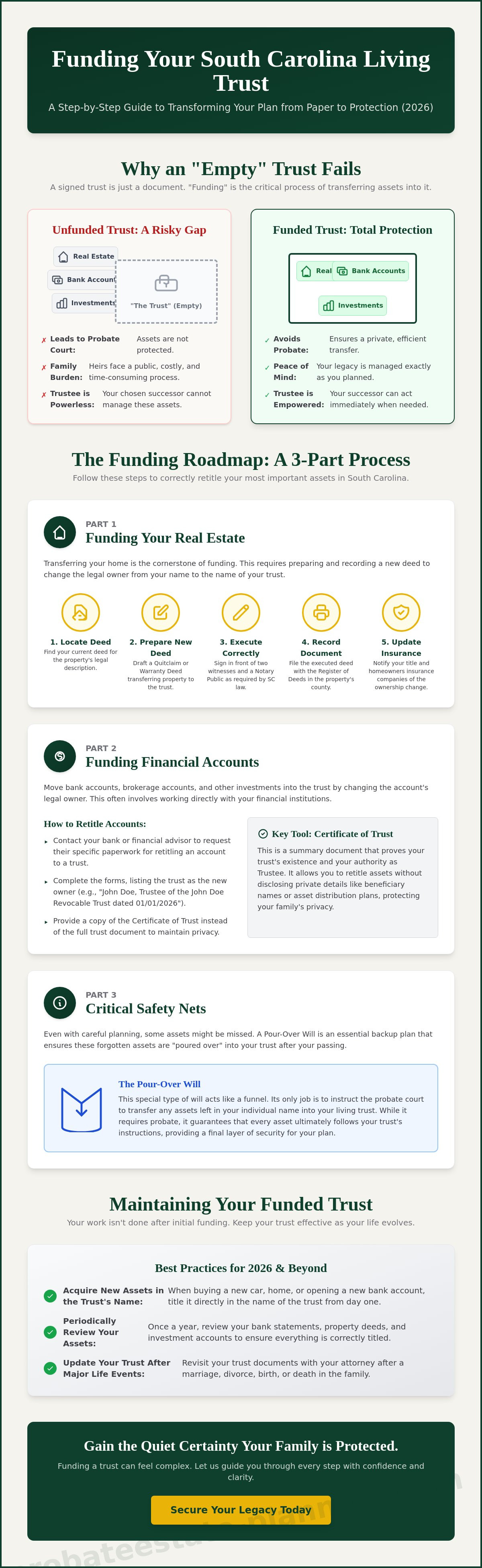
Creating a revocable living trust is a significant milestone in securing your family's future. However, many people stop once the ink is dry on their legal documents. This pause creates a "paper-only" trust that lacks the power to protect anything. In the legal world, "funding" is the formal process of transferring ownership of your assets from your individual name into the name of your trust. It is the essential bridge in understanding estate planning that transforms a document into a functional shield.
Think of your trust as a sturdy suitcase. While the suitcase itself is valuable, its purpose is to carry your belongings safely to their destination. If you don't pack your assets inside, the suitcase arrives empty while your property remains exposed. In South Carolina, a signed trust document alone does not avoid probate. The court only recognizes what the trust officially owns. Learning how to fund a living trust in south carolina is the only way to ensure your privacy is maintained and your heirs aren't forced into a public, time-consuming court process. Knowing the exact steps of how to fund a living trust in south carolina allows you to move from a place of uncertainty to a position of quiet confidence.
The Legal Consequences of an Unfunded Trust
When assets are left in your individual name, they are governed by your Last Will and Testament or, if you lack one, South Carolina intestacy laws. This means your family must enter the probate system to gain legal authority over your property. If you own real estate in neighboring states like North Carolina or Tennessee, an unfunded trust leads to "ancillary probate." This is a secondary, often expensive legal proceeding in those states. Your Successor Trustee, the person you've chosen to lead your estate, remains legally powerless over any asset that wasn't properly retitled before your passing.
The "Funding Gap": A Common Estate Planning Mistake
We often see families experience a "funding gap" because they feel the work is finished after the initial signing ceremony. This oversight often stems from the confusion surrounding legal terminology or the stress of bank paperwork. Leaving this gap creates a significant emotional toll on your heirs; they are left to resolve the very complexities you intended to avoid. Our practice views this process as a partnership. We act as a steady guide to ensure you cross this bridge, providing the methodical support needed to move every asset into its protected "suitcase" so your legacy remains secure and predictable.
Funding Real Estate: Navigating South Carolina Deed Transfers
Your home is often the cornerstone of your legacy. To protect it, you must move beyond the "empty vessel" stage and officially change the owner of the property from yourself to your trust. This process is the most critical part of learning how to fund a living trust in south carolina. It requires a methodical approach to ensure the chain of title remains clear and your family avoids the very probate process you're working to bypass. Learning how to fund a living trust in south carolina involves more than just signing papers; it requires following these specific recording steps to ensure the transfer is legally binding.
- Step 1: Locate your current deed. You'll need the exact legal description of the property, often found in the "Description" or "Exhibit A" section of your existing deed.
- Step 2: Prepare a new deed. Most families use a Quitclaim Deed or a Warranty Deed to transfer the property to the Trust. This document must precisely name the Trustee and the date the trust was created.
- Step 3: Execute the deed correctly. South Carolina law requires you to sign the deed in the presence of two witnesses and a Notary Public.
- Step 4: Record the document. The deed must be filed with the Register of Deeds in the county where the property is located.
- Step 5: Update your insurance. Notify your title insurance company and homeowners insurance provider to ensure your coverage remains valid under the new ownership.
SC County-Specific Requirements
While the general process is the same, each county from Richland to Horry may have slight variations in their recording procedures. In South Carolina, the standard filing fee for recording a deed is approximately $15. You must also include an "Affidavit of True Consideration." It's important to note that while transfers from a trust to a beneficiary are often exempt from recording fees, the initial transfer of real estate into your trust generally incurs a deed recording fee of $1.85 for every $500 of the property's value. Precision is vital; if the name of your trust on the deed doesn't perfectly match your legal documents, it can create significant title issues later. If you feel uncertain about these technicalities, seeking professional estate planning guidance can provide the reassurance you need.
Special Considerations for Mortgages
Many homeowners worry that transferring a mortgaged home will trigger a "due on sale" clause. Fortunately, the federal Garn-St. Germain Act generally prevents lenders from calling a loan due when a primary residence is transferred into a revocable living trust. We still recommend notifying your mortgage servicer in writing to ensure your escrow payments and tax records continue without interruption. Primary residences are granted these federal protections to encourage responsible planning, while commercial SC real estate transfers may be subject to different lender requirements and should be reviewed carefully.
Financial Assets: How to Retitle Bank and Investment Accounts
After securing your real estate, the next step in protecting your legacy involves your liquid assets. Moving your financial life into a trust is a powerful way to ensure continuity for your family without the delays of the court system. When you're learning how to fund a living trust in south carolina, it's vital to distinguish between retitling an account and simply naming a beneficiary. Retitling changes the actual owner of the account from you as an individual to you as the Trustee. This shift ensures that if you become incapacitated or pass away, your Successor Trustee can step in immediately to manage bills and expenses without waiting for a judge's approval.
To maintain your privacy during this process, you will use a document called a Certificate of Trust. This is a condensed version of your trust that proves your authority to act without revealing private details like who your beneficiaries are or how your assets are distributed. Most financial institutions, including South State Bank and Wells Fargo, are well-versed in these transitions. They will use this certificate to update your non-retirement brokerage accounts and certificates of deposit (CDs), ensuring these funds are fully integrated into your protective plan. Mastering how to fund a living trust in south carolina means ensuring every dollar is accounted for in this methodical manner.
Working with Your Financial Institution
When you visit your bank, you should bring your government-issued ID, your Certificate of Trust, and your current account information. It's a common relief for many to learn that you don't usually need to change your existing checks or debit cards. Most banks allow you to keep using your current supplies until they run out, as the underlying account number often stays the same. While national banks have standardized procedures, South Carolina credit unions may have unique internal forms or specific membership requirements you'll need to navigate. We recommend calling ahead to see if they have a dedicated "trust desk" to make your visit more efficient.
The Nuance of Retirement Accounts (IRAs and 401ks)
Retirement accounts require a different strategy. You generally don't retitle an IRA or 401k into the name of your trust while you're alive; doing so could trigger an immediate and significant tax bill. Instead, you protect these assets by updating your "Primary" and "Contingent" beneficiary forms. You might name your spouse as the primary beneficiary and the trust as the contingent. This setup provides a safety net if your primary beneficiary is unable to inherit. If you're currently exploring Medicaid Crisis Planning or Asset Protection Planning, these designations are especially critical. How you name these beneficiaries can impact long-term care eligibility and the tax burden your heirs will eventually face, making this a vital part of your partnership with your legal guide.
Common Pitfalls and the SC Pour-Over Will Safety Net
Even with a methodical approach, it's common to worry about a stray asset slipping through the cracks. Perhaps it's a vehicle title you didn't update or a medical refund check that arrives after your passing. This is known as the "forgotten asset" syndrome. While you're learning how to fund a living trust in south carolina, you must also prepare for these oversights by establishing a legal safety net called a Pour-Over Will. This document serves as a protective "catch-all" for any property that remained in your individual name at the time of your death.
A Pour-Over Will is a specific type of Last Will and Testament that directs the probate court to move any stray assets into your trust. However, it's essential to view this as a "Plan B" rather than a primary strategy. Because a Pour-Over Will is still a will, it must be filed with the South Carolina probate court. This means the very assets you missed will still be subject to the public records and procedural delays you sought to avoid. Understanding how to fund a living trust in south carolina correctly from the beginning is the only way to ensure your estate remains entirely private and outside the court's jurisdiction.
The Limits of the Safety Net
Relying on the safety net brings inherent complications. Probate involves mandatory waiting periods and administrative costs that can burden your Successor Trustee. In South Carolina, if the total value of these "forgotten" personal assets is under $45,000, your family might use a simplified "collection by affidavit" process. This threshold was increased from $25,000 in May 2025 to help streamline smaller estates. Despite this relief for smaller amounts, the most reliable way to preserve your family's peace of mind is to maintain a comprehensive asset list and ensure your trust is fully funded from the start.
Handling Titled Personal Property (Vehicles and Boats)
Transferring vehicles and watercraft requires specific interactions with state agencies. For cars and trucks, you must visit the South Carolina DMV to retitle the vehicle in the name of the trust. Interestingly, some clients choose to keep their primary vehicles in their individual names for liability reasons, as the trust's assets could potentially be exposed in the event of a significant accident. For those with a life on the water, the South Carolina Department of Natural Resources (DNR) requires a specific titling process for watercraft and outboard motors to ensure the trust's ownership is properly recorded. If you find these administrative tasks daunting, our team provides the Estate Planning mentorship needed to ensure no detail is overlooked.
Maintaining Your Funded Trust: Best Practices for 2026 and Beyond
Completing the initial transfers of your home and bank accounts is a major achievement, but the work of protecting your legacy doesn't end there. A revocable living trust is called "living" because it's designed to evolve alongside your life and your portfolio. Many families make the mistake of treating their trust like a time capsule, only to discover years later that new assets were never properly integrated. Mastering how to fund a living trust in south carolina is an ongoing commitment to ensuring every new investment or property you acquire is placed under the trust's protective umbrella from the moment of purchase.
The golden rule for any new acquisition in 2026 and beyond is to "take title as Trustee." If you purchase a new vacation home in the mountains of Tennessee or a rental property in the Lowcountry, you shouldn't buy it in your individual name with the intention of moving it later. Instead, the buyer listed on the deed should be you in your capacity as Trustee. This proactive approach eliminates the need for future deed transfers and ensures the asset is never exposed to the probate process. We recommend conducting an annual "Asset Audit" every January. This simple review involves checking your bank statements and property records to confirm no new accounts or titles have accidentally remained in your individual name.
Triggers for a Trust Review
While an annual audit is a healthy habit, certain life events require a more formal consultation with your legal guide. Major milestones such as marriage, divorce, or the birth of a grandchild often necessitate updates to your distribution plan. Changes in the law can also impact your strategy. For instance, the federal estate tax exemption is $15 million per individual in 2026. If your estate is approaching this threshold, or if you're utilizing South Carolina's 2025 extension of the Rule Against Perpetuities to 360 years for a dynasty trust, professional oversight is essential. Moving out of state is another critical trigger, as laws in North Carolina or Maryland may require specific adjustments to maintain your trust's effectiveness.
Partnering for Long-Term Security
The Probate & Estate Planning Co. doesn't just provide documents; we offer a partnership in long-term management. We understand the technicalities of Asset Protection Planning and Medicaid Crisis Planning can feel daunting as you age. By maintaining a relationship with a steady guide, you ensure your plan remains functionally reliable even as tax codes and family dynamics shift. This methodical oversight provides the ultimate peace of mind, knowing your meticulous preparation will lead to a predictable and secure outcome for those you love most. If you haven't reviewed your assets lately, now's the time to ensure your bridge to the future remains strong. Schedule a trust review with our South Carolina legal team to verify your legacy is fully protected.
Taking the Final Step Toward Lasting Security
Funding your trust isn't just a final administrative hurdle; it's the defining act that ensures your hard work actually protects your family. By now, you've learned that a signed document is only the first step. True security comes from the methodical retitling of your South Carolina home and the strategic management of your financial accounts. Mastering how to fund a living trust in south carolina requires attention to detail, but it's the only way to replace the uncertainty of probate with the quiet confidence of a protected legacy.
Our firm offers more than just legal forms. We provide a partnership grounded in deep expertise of the South Carolina Probate and Trust Code. Whether you're retitling a local property or need multi-state support for assets in North Carolina, Tennessee, or Maryland, our team is here to guide you with empathy and precision. You don't have to navigate these complex administrative processes alone. Secure your legacy today with a professional trust funding consultation and take the final step toward lasting peace of mind. Your family's future is worth the thoroughness you're providing today.
Frequently Asked Questions
Do I need to change my Social Security number on my accounts once they are in the trust?
No, you do not need a new tax identification number for a standard revocable trust. While you are alive, the IRS treats the trust as an extension of yourself. You will continue using your own Social Security number for all bank and brokerage accounts. This simplicity ensures your daily financial life remains unchanged while your legacy is being built.
Will funding my trust in South Carolina increase my property taxes?
No, transferring your primary residence into a revocable trust will not increase your property taxes. South Carolina law protects your 4% owner-occupied assessment rate during this transfer. You must simply ensure the property remains your legal residence. This allows you to gain the benefits of probate avoidance without losing essential tax exemptions.
Can I still sell my house if it is owned by my revocable living trust?
Yes, you retain full control over your property and can sell it at any time. When you are learning how to fund a living trust in south carolina, it is important to remember that you are the Trustee. You will simply sign the closing documents in your capacity as Trustee rather than as an individual. The process is straightforward and does not require court permission.
What happens if I buy a new car after my trust is already set up?
When you acquire a new vehicle, you can choose to title it in the name of the trust at the South Carolina DMV. However, many people keep vehicles in their individual names for liability reasons. If a car is in the trust and is involved in a major accident, the trust's other assets could potentially be at risk. We can help you decide which path offers the most security for your specific situation.
Does a living trust protect my assets from a nursing home in South Carolina?
A revocable living trust does not protect your assets from nursing home costs or Medicaid recovery. To achieve that level of protection, you would typically need to explore an irrevocable trust or specific Medicaid crisis planning. Revocable trusts are primarily designed for probate avoidance and family privacy rather than shielding assets from long-term care expenses.
Do I need a separate tax return for a funded revocable living trust?
No, a funded revocable trust does not require a separate tax return while you are living. All income generated by trust assets is reported directly on your personal Form 1040. This keeps your administrative responsibilities manageable while providing the protective structure your family needs. The trust only becomes a separate taxpayer after the grantor passes away.
Is it possible to fund a trust after the grantor has passed away?
It is not possible to fund a trust after the grantor has passed away because the grantor no longer has the legal capacity to sign transfer documents. This is why understanding how to fund a living trust in south carolina during your lifetime is so vital. Any assets left outside the trust will be caught by your Pour-Over Will and must pass through probate before reaching the trust's protection.
How much does it cost to record a deed in South Carolina for trust funding?
The standard filing fee for recording a deed in South Carolina is approximately $15. Additionally, the initial transfer into the trust is subject to a deed recording fee of $1.85 for every $500 of the property's value. While transfers from a trust to a beneficiary are exempt from this fee, the funding stage requires this specific investment to ensure your real estate avoids the probate court.
Comments
There are no comments for this post. Be the first and Add your Comment below.
Leave a Comment