

Did you know that your family's private financial legacy becomes a public record the moment it enters the North Carolina court system? Most families believe a simple will is enough to protect their heirs, but in reality, a will is often a one way ticket to the Clerk of Superior Court. If you are searching for how to avoid probate in north carolina, you likely want to spare your loved ones from the mandatory 0.40 percent fee on estate assets and the months of public scrutiny. We understand that your priority is preserving family harmony and ensuring that your hard earned assets aren't depleted by avoidable administrative costs.
You deserve the peace of mind that comes with a plan that actually works when it is needed most. This 2026 guide will provide you with the specific legal strategies and North Carolina tools, such as revocable living trusts and transfer on death designations, to bypass the court entirely. We will walk you through a clear roadmap to ensure a private transfer of your legacy while providing your survivors with immediate access to necessary funds. By the end of this article, you'll have a methodical plan to maintain your family's privacy and safeguard their financial future without the stress of a public courtroom.
Key Takeaways
- Understand how the public nature of the NC court system affects your privacy and why bypassing the Clerk of Superior Court is a vital step for your family's peace of mind.
- Explore the "Gold Standard" of estate planning and learn why a properly funded Revocable Living Trust is the most robust way to ensure a seamless transition of your legacy.
- Discover how to leverage North Carolina's unique "Tenancy by the Entirety" laws and strategic beneficiary designations to transfer assets automatically by operation of law.
- Determine if you qualify for simplified legal alternatives and learn the specific strategies for how to avoid probate in north carolina using small estate affidavits.
- Gain a clear, step-by-step roadmap to inventory your assets and choose the right legal tools to protect your heirs from unnecessary delays and court fees.
Understanding the North Carolina Probate Process (and Why You Want to Bypass It)
Probate isn't just a legal formality. It's a court-supervised marathon overseen by the North Carolina Clerk of Superior Court in the county where the deceased resided. While many families search for how to avoid probate in north carolina to save money, the primary driver is often a desire for privacy. By Understanding the Probate Process, you'll see that this journey turns your private family legacy into a matter of public record. Anyone can visit the courthouse to view your assets, your debts, and the names of your beneficiaries.
To better understand this concept, watch this helpful video:
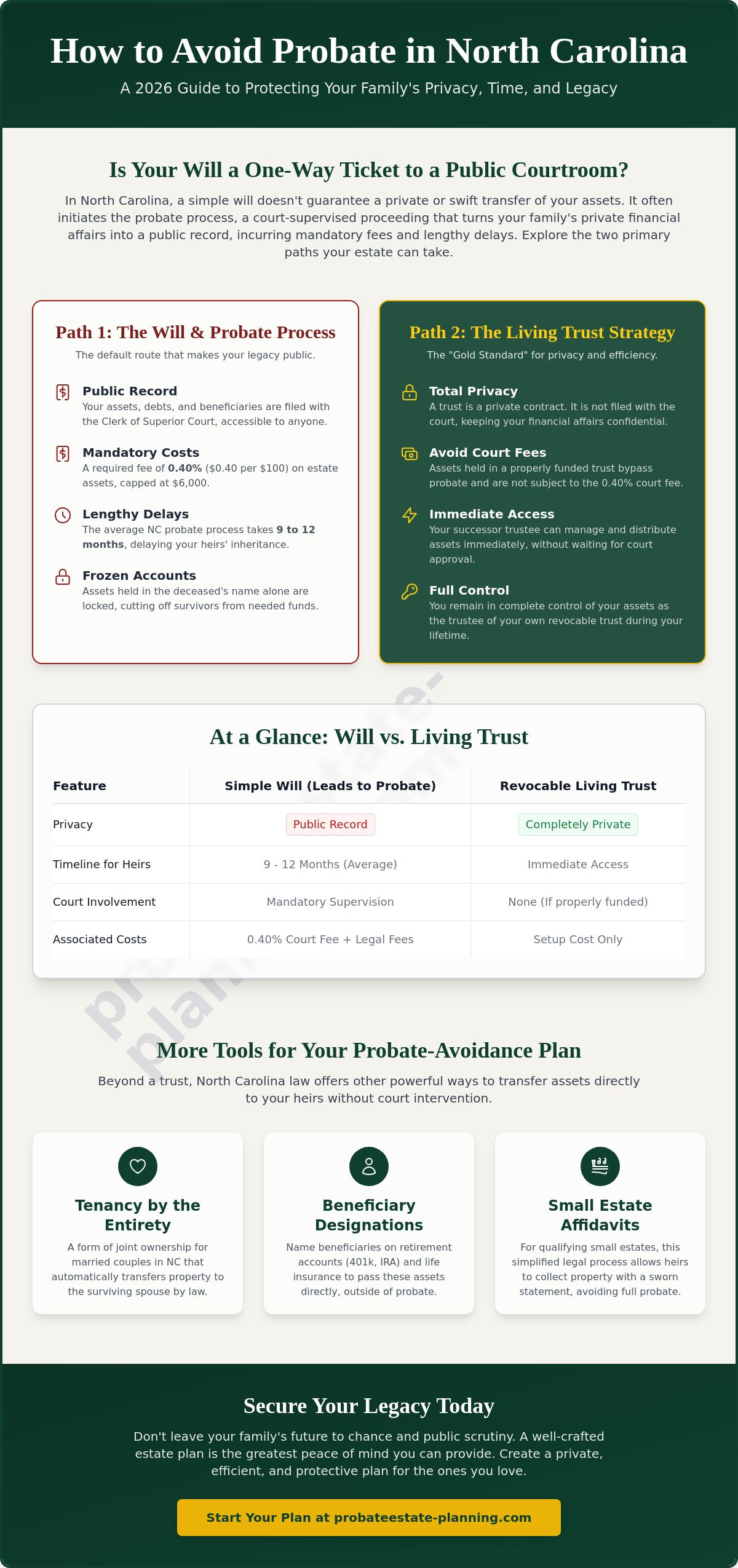
North Carolina imposes a mandatory probate fee that many residents view as a "death tax" in disguise. This fee is calculated at $0.40 per $100 of the estate's value, capped at $6,000. While non-probate transfers like living trusts offer immediate access to assets, the average NC probate case takes between 9 and 12 months to close. This timeline creates a period of uncertainty that can strain even the most harmonious families.
The Role of the Clerk of Superior Court in NC
In our state, the Clerk of Superior Court acts as a specialized judge for all probate matters. They have the final say on the validity of a will and the appointment of an executor. One of the most significant hurdles is the "Notice to Creditors" requirement. Executors must publish a notice in a local newspaper for four consecutive weeks, starting a 90-day clock for creditors to file claims. This mandatory window prevents any significant asset distribution for months. During this time, your executor must also file detailed inventory reports and annual accountings under oath, ensuring every penny is tracked under strict court scrutiny.
Common Probate Pitfalls for NC Families
The most immediate crisis families face is the "Frozen Account" problem. When a primary breadwinner passes away, accounts held solely in their name are typically locked until the court issues "Letters Testamentary." This can take weeks, leaving a surviving spouse without funds for daily expenses or funeral costs. These delays often lead to property mismanagement or even foreclosure if there isn't enough liquid cash to cover mortgage payments during the 12-month probate cycle. If you don't have a plan, your estate is subject to Intestate Succession, which is the state's default legal formula for distributing your assets to your heirs regardless of your personal relationships or intentions. Learning how to avoid probate in north carolina is the most effective way to protect your family from these rigid, public, and costly state requirements.
The Revocable Living Trust: North Carolina's Most Robust Probate Avoidance Tool
A Revocable Living Trust stands as the gold standard for those researching how to avoid probate in north carolina because it prioritizes your family's privacy and peace of mind. Unlike a standard will, a trust functions as a private contract. It doesn't require the supervision of a judge or the public filing of your personal assets. However, the document's power depends entirely on "funding." This is the legal process of retitling your bank accounts, real estate, and investments into the name of the trust. If you leave your assets in your individual name, your family will still face the court system. When you fund your trust, you're essentially moving your legacy into a protective vessel that you still control as the trustee.
Privacy is a significant motivator for many families. When an estate goes through probate, the inventory of everything you owned becomes a public record that anyone can access. A trust keeps these details confidential between you and your beneficiaries. You also name a Successor Trustee. This person steps in immediately upon your passing or if you become unable to manage your affairs. They have the legal authority to manage your assets without waiting for a letter of appointment from a clerk. This ensures a seamless transition of power that protects your loved ones from the anxiety of frozen accounts or legal delays.
How a Living Trust Bypasses the NC Clerk of Court
Assets held in a trust are legally classified as non-probate property. Since the trust already "owns" the assets, there's no need for the court to transfer title after you pass away. You should also have a Pour-Over Will. This document acts as a safety net, catching any forgotten assets and "pouring" them into your trust. While you still want to understand North Carolina's official estate procedures to see what you are bypassing, a trust allows your trustee to distribute property in weeks rather than the year or more typically required by the court system.
Trusts vs. Wills: A Practical NC Comparison
Many people believe a will is the best way to handle their estate. In reality, a will is simply a letter to the court; it is the ticket to probate, not a way around it. While a trust requires a higher upfront investment for drafting and funding, it often saves families thousands in court costs and executor commissions later. Beyond death, a trust provides protection while you're still living. If you become incapacitated, your Successor Trustee can manage your care and finances immediately. A will cannot do this. If you are exploring how to avoid probate in north carolina, this dual protection is why the trust is so highly recommended. Protecting your family from unnecessary legal hurdles is a gift of clarity. You can start this process by reviewing your current estate goals with a professional who understands these nuances.
Beyond Trusts: Strategic Asset Titling and Beneficiary Designations in NC
While trusts offer robust protection, they aren't the only tools in your stewardship toolkit. Many families find that "Operation of Law" provides a streamlined path to transfer property. This legal mechanism allows assets to bypass the North Carolina Clerk of Superior Court entirely, moving directly to your loved ones the moment they're needed. Understanding these designations is a fundamental step in learning how to avoid probate in north carolina while maintaining your family's privacy.
For married couples, North Carolina provides a unique protection called Tenancy by the Entirety. This form of ownership treats a married couple as a single legal unit. If one spouse passes away, the survivor automatically owns the entire property without filing a single probate document. It also offers a shield against creditors who only have a claim against one spouse. Beyond real estate, you can apply similar logic to financial holdings through Payable on Death (POD) and Transfer on Death (TOD) designations. These simple forms turn your bank and brokerage accounts into "will substitutes" that pay out immediately upon proof of death.
However, you should be cautious of the "Joint Tenant with Right of Survivorship" trap. Adding a non-spouse, such as a child, to your accounts or deeds might seem like a shortcut. In reality, it often creates legal friction and tax complications that can disrupt your legacy and cause interpersonal harmony to dissolve.
Right of Survivorship in North Carolina Real Estate
To trigger probate avoidance in North Carolina, your deed must contain specific language. Simply listing two names isn't enough. The document should explicitly state the owners are "joint tenants with rights of survivorship and not as tenants in common." Without this phrasing, the state assumes a tenancy in common, which forces the deceased person's share into probate. You should also consider the tax implications. Adding a child to a deed is viewed as a gift by the IRS. If the interest value exceeds the $18,000 annual exclusion (the 2024 and 2025 limit), you're required to file Form 709. A Life Estate deed is often a more secure alternative, allowing you to retain control during your lifetime while ensuring the home transfers automatically to your "remainderman" later.
The Danger of Simple Joint Ownership for Medicaid Planning
Adding a co-owner can jeopardize your long-term security. North Carolina Medicaid (DHHS) enforces a 60-month look-back period for asset transfers. If you add a child to your property title within five years of needing long-term care, it's often flagged as a "transfer of asset" penalty, which can lead to a denial of benefits. Furthermore, your home becomes vulnerable to your co-owner's life events. If a child you've added to your deed faces a divorce, bankruptcy, or a lawsuit, their creditors can potentially seize their portion of your home. To provide true asset protection and peace of mind, an Irrevocable Trust is a much safer alternative. It secures your eligibility for care while keeping your property safe from the unpredictable risks of a co-owner's financial life.
Small Estate Alternatives: When Full Probate Isn't Necessary Under NC Law
While your primary goal is likely to learn how to avoid probate in north carolina entirely, state law provides a "Probate Lite" path for smaller estates. These alternatives don't bypass the Clerk of Superior Court's office completely, but they drastically reduce the paperwork and time required. Understanding these thresholds is essential for families who didn't establish a living trust but still want to protect their inheritance from a year-long court process.
Under N.C.G.S. § 28A-25-1, an estate qualifies for simplified procedures based on the total value of personal property. If the assets are valued at $20,000 or less, the estate is eligible for an expedited process. If you're the surviving spouse and the sole heir, this limit increases to $30,000. These figures are strict. If the assets exceed these amounts by even a few dollars, you'll likely be pushed into full estate administration, which involves more rigorous reporting and higher costs.
Qualifying for the NC Small Estate Affidavit
The Affidavit for Collection of Personal Property, known as Form AOC-E-203, is the most common tool for small estates. You must wait exactly 30 days after the date of death before you can file this document with the court. This waiting period ensures that no one else has applied for full letters of administration. It's important to remember that this process only covers personal property. This includes items like:
- Bank accounts without a "payable on death" beneficiary
- Vehicles and watercraft
- Stocks, bonds, or brokerage accounts held in the decedent's name alone
- Personal belongings and household furniture
Real estate isn't included in the $20,000 or $30,000 calculation. In North Carolina, real property generally "unrols" or passes directly to heirs at the moment of death unless the will specifically directs the executor to sell it to pay debts. Filing fees for the affidavit are significantly lower than full probate, typically involving a small fraction of the estate's value rather than the more substantial costs associated with a full court proceeding.
Summary Administration for Surviving Spouses
If you're a surviving spouse and the only person entitled to the property, Summary Administration is often the fastest way to clear titles and move forward. This process skips the requirement for a formal inventory and periodic accounting to the court. It's designed to provide a sense of harmony and swift resolution during a difficult transition.
However, this speed comes with a trade-off. By using Summary Administration, you may become personally liable for the decedent's debts up to the value of the assets you receive. If the estate has significant medical bills or outstanding credit cards, this shortcut might be a mistake. We don't recommend this path for estates with high debt loads, as it could put your own financial stability at risk. Choosing the right method is about more than just speed; it's about stewardship of the legacy left behind.
Creating Your North Carolina Probate Avoidance Plan: A Step-by-Step Strategy
Moving from the theoretical understanding of estate law to a functional plan requires a methodical approach. Learning how to avoid probate in north carolina is not a one-time event but a strategic process. When you follow a structured sequence, you replace uncertainty with a clear roadmap for your family's future. This transition from "what if" to "it is handled" provides the clarity you need to move forward with confidence.
- Step 1: Inventory your assets and titling. Create a comprehensive list of everything you own, from real estate in Wake County to brokerage accounts and sentimental personal property. You must identify exactly how each asset is currently titled, as this determines whether it will pass through the Clerk of Superior Court or bypass it entirely.
- Step 2: Consult with an NC attorney. Every family dynamic is unique. A legal professional will help you weigh the benefits of a Revocable Living Trust versus a title-based plan using "Transfer on Death" or "Payable on Death" designations.
- Step 3: Execute legal documents. This involves the formal signing and notarizing of your Trust, Durable Power of Attorney, and Healthcare Directives. These documents must strictly adhere to North Carolina's execution requirements to be valid.
- Step 4: Complete the 'Funding' phase. A trust is merely a stack of paper until it is funded. You must update your real estate deeds and change beneficiary forms on financial accounts. If an asset is not correctly retitled or designated, it may still end up in probate court.
- Step 5: Review and update. Life is fluid. You should audit your plan every 3 to 5 years. Major changes, such as the 2019 SECURE Act or the 2022 updates to retirement distribution rules, can significantly impact your existing strategy.
Why Professional Guidance is Essential in NC
The rise of DIY online forms has led to a surge in the "unauthorized practice of law" and, more importantly, failed estate plans. North Carolina probate law is governed by specific statutes, including the North Carolina Uniform Trust Code under Chapter 36C. A generic form often fails to account for these local nuances. When a document is rejected by the court because of a technical signing error, the resulting legal fees often far exceed the cost of professional drafting. An attorney ensures your plan actually works when your family needs it most.
Finalizing Your Legacy: The Stewardship Approach
True estate planning is about stewardship. It is the act of protecting your loved ones from the chaos of a public, expensive, and slow court process. While many focus solely on what happens after death, a complete strategy includes a Durable Power of Attorney. This protects you during your lifetime if you become unable to manage your own affairs. By addressing both life's "what-ifs" and your ultimate legacy, you ensure family harmony remains intact. Don't leave your family's future to the default rules of the state. Schedule your NC Estate Assessment with The Probate & Estate Planning Co. to begin your journey toward a secure, probate-free future.
Take Control of Your Estate and Preserve Family Harmony
Navigating the legal system shouldn't be a burden you leave for your loved ones. By implementing a revocable living trust and updating your beneficiary designations, you ensure assets transfer directly to your heirs without the 9 to 12 month delay typical in North Carolina courts. Learning how to avoid probate in north carolina is the first step toward true stewardship. Our practice brings specialized expertise in NC probate and Medicaid crisis planning across four states, including NC, SC, MD, and TN. We focus on creating a plan that works when it's needed most, preventing the chaos that often follows an unplanned estate.
You've worked hard to build your legacy; now it's time to protect it. Our team provides the steady guidance you need to move from uncertainty to a secure, predictable outcome. Don't wait for a crisis to force your hand. Take the proactive step today to safeguard your family's future and maintain the interpersonal relationships that matter most. We're ready to help you navigate these complexities with confidence and care.
Secure Your Family's Future: Book a North Carolina Probate Avoidance Consultation
Your family deserves the peace of mind that comes with a meticulously crafted plan, and we're here to guide you every step of the way.
Frequently Asked Questions
Does a Will avoid probate in North Carolina?
No, a Last Will and Testament doesn't avoid probate; instead, it serves as your formal instruction manual for the Clerk of Superior Court. While a Will clarifies your final wishes, the document must still be validated through the public court process before your assets can be distributed to your loved ones. This process often takes 9 to 12 months to complete, depending on the complexity of your estate.
To truly bypass the court system, you'll need to look at alternative strategies like living trusts or beneficiary designations. These tools allow your family to manage your legacy privately and without the oversight of a judge.
How much does an estate have to be worth to go through probate in NC?
In North Carolina, formal probate is generally required if the decedent's personal property exceeds $20,000 in value. This threshold increases to $30,000 if the surviving spouse is the sole heir. If your estate falls below these specific dollar amounts, you might qualify for a simplified "Small Estate" filing under North Carolina General Statutes Article 25. This path reduces the administrative burden on your family during a difficult time.
Can I use a Transfer on Death (TOD) deed for real estate in North Carolina?
North Carolina doesn't currently recognize Transfer on Death (TOD) or "Lady Bird" deeds for real estate. To keep your home out of the probate court, you must use other legal tools such as a Revocable Living Trust or titling the property as Joint Tenants with Rights of Survivorship. These methods ensure the deed transfers immediately upon death without the lengthy delay often found in the standard court process.
What is the North Carolina probate fee for 2026?
The North Carolina probate court fee for 2026 is calculated at $0.40 per $100 of the estate's value. This court cost is capped at a maximum of $6,000 for any single estate. For example, an estate valued at $500,000 would incur a $2,000 filing fee paid directly to the Clerk of Court. Understanding these costs is a vital part of learning how to avoid probate in north carolina and protecting your family's inheritance.
How long do you have to open probate after someone dies in NC?
There's no strict statutory deadline to open probate in North Carolina, but the court can compel the production of a Will if it's not filed within 60 days of death. If the named executor doesn't apply for letters testamentary within this 60 day window, any interested party or creditor can petition the court to start the process. Acting within the first 30 days helps prevent asset mismanagement and ensures your family's legacy remains secure and orderly.
Is a Revocable Living Trust better than a Will in North Carolina?
A Revocable Living Trust is often superior to a Will because it keeps your private financial matters out of public court records. While a Will must be filed with the Clerk of Court, a trust operates privately and allows for the immediate transfer of assets to your beneficiaries. This tool provides a seamless transition for your heirs, avoiding the typical 12 month probate timeline and the associated court fees.
Can I avoid probate if I have a small estate in NC?
You can use a simplified process called "Collection by Affidavit" if your estate's personal property is valued under $20,000. This process involves a 30 day waiting period and allows heirs to collect assets without a full probate administration. It's an effective way to simplify the transition, though it still involves filing paperwork with the Clerk of Court. Knowing these limits is essential for anyone researching how to avoid probate in north carolina effectively.
What assets are exempt from probate in North Carolina?
Assets with named beneficiaries, such as life insurance policies and 401(k) accounts, are exempt from probate and pass directly to your loved ones. Real estate held as "Tenants by the Entirety" or bank accounts with "Payable on Death" (POD) designations also bypass the court. By structuring your accounts this way, you ensure that 100 percent of these funds are available to your family immediately, providing them with essential financial stability.
Comments
There are no comments for this post. Be the first and Add your Comment below.
Leave a Comment