

What if the most difficult part of managing an estate isn't the complex legal paperwork, but the months of waiting that keep your family's future in limbo? You're likely asking, how long does probate take in north carolina, because you feel a deep responsibility to provide closure for your loved ones while facing the pressure of pending estate debts. It's common to feel frustrated by court delays or confused by the specific deadlines required by the Clerk of Superior Court.
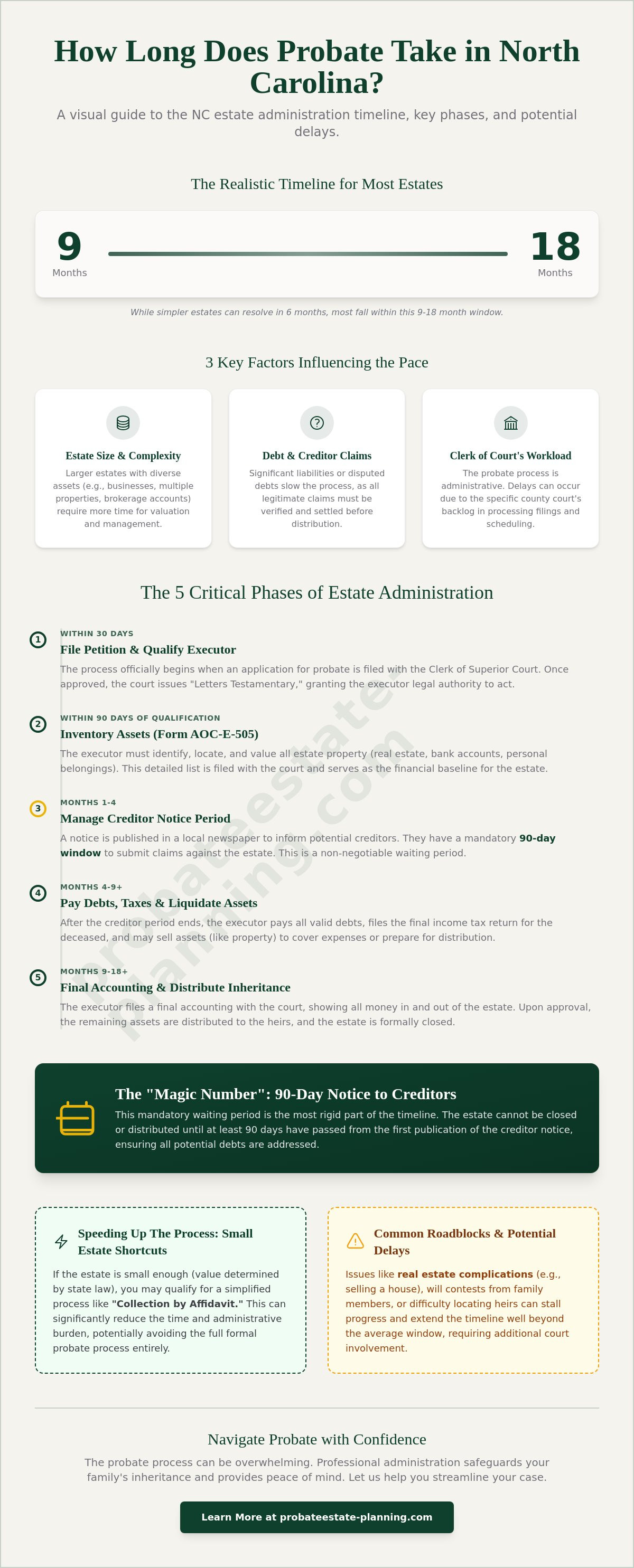
We believe that clarity is the best remedy for the anxiety of estate administration. While most probate cases in our state take between 9 and 18 months to complete, the process doesn't have to feel like a passive wait. This guide explains the realistic milestones and potential delays of the North Carolina probate process so you can move forward with confidence. We will walk through a clear calendar of events, including the mandatory 90-day creditor notice period, and share strategies to avoid common pitfalls. Our goal is to help you reach a final distribution of assets and secure the peace of mind your family deserves.
Key Takeaways
- Most families want to know how long does probate take in north carolina, and while the standard window is 6 to 12 months, the actual duration depends on administrative precision.
- You'll learn the five critical phases of estate administration, beginning with the initial 30-day filing window and the mandatory 90-day waiting period for creditors.
- Identify common roadblocks like real estate complications that can stall your progress, and learn how to manage these hurdles without unnecessary stress.
- Discover if your situation qualifies for "Small Estate" shortcuts, such as the Collection by Affidavit process, which can significantly reduce the time required for distribution.
- Explore how professional Probate Administration Services can safeguard your family's inheritance while preventing the exhaustion often associated with acting as an executor.
The Realistic Timeline for North Carolina Probate in 2026
Gaining a foundational understanding of What is Probate? is the first step toward managing your family's expectations. While simpler estates might resolve in six months, the typical answer to how long does probate take in north carolina is between 9 and 18 months. This timeline doesn't start the moment a loved one passes away. It begins officially when you "open the estate" by filing an application for probate with the court. This initial move starts the legal clock and sets the administrative process in motion.
Several variables influence the speed of your case. While every situation is unique, three primary factors usually dictate the pace:
- Estate Size: Larger estates with diverse assets like brokerage accounts, multiple vehicles, or business interests require more time to catalog and value.
- Debt Complexity: If the deceased had significant liabilities or disputed debts, the process slows down while you verify and settle these obligations.
- Court Backlog: The current workload of the local clerk's office can create delays in scheduling hearings or processing your filings.
To better understand this concept, watch this helpful video:
The Role of the Clerk of Superior Court
In North Carolina, probate is overseen by the Clerk of Superior Court in the county where the deceased resided. This is an administrative process rather than a courtroom trial. Because each county manages its own docket, your experience in a rural county might differ significantly from a busy urban center. Once the clerk reviews your petition and finds everything in order, they'll issue "Letters Testamentary," which serve as your official permission to manage the estate's assets and accounts.
Why 90 Days is the Magic Number
While the answer to how long does probate take in north carolina involves many steps, the 90-day "Notice to Creditors" is a mandatory milestone you cannot bypass. You're required to publish a notice in a local newspaper to alert anyone the deceased owed money to about the ongoing proceedings. This three-month window is designed to protect the estate by flushing out potential claims before assets are distributed to heirs. If a creditor files a claim on day 89, it must be addressed before the estate can move toward closure. This rigid period ensures all financial responsibilities are met, providing you with the security that no surprise debts will emerge after the assets are gone.
The 5 Critical Phases of North Carolina Estate Administration
Understanding the sequence of events helps transform a vague concern about how long does probate take in north carolina into a manageable checklist. The process moves through five distinct stages, each requiring specific attention to detail and strict adherence to court-mandated deadlines. While these phases provide a logical flow, they often overlap as you manage the daily responsibilities of the estate.
Phase 1 begins with filing the petition and qualification of the executor, which typically happens within the first 30 days. Phase 2 focuses on asset discovery and valuation, concluding with a formal report to the court. During Phase 3, which spans months three through six, you'll manage the creditor claim period while the estate's legal notice runs in the local newspaper. Phase 4, occurring between months six and nine, involves liquidating assets and filing necessary tax returns. Finally, Phase 5 concludes the journey with the final accounting and distribution of the remaining inheritance, usually between months nine and twelve.
Filing the Inventory (Form AOC-E-505)
Within 90 days of your qualification, you must file Form AOC-E-505. This document is a comprehensive list of all the decedent's personal and real property as of the date of death. Accuracy is paramount; this form serves as the baseline for every financial transaction that follows. If the estate includes unique items like fine art, vintage vehicles, or specialized business equipment, securing professional appraisals is a wise step to ensure the values stand up to court scrutiny. Following North Carolina's Official Probate Process requires a meticulous approach to these early filings to prevent procedural delays that can stall your progress for weeks.
Final Accounting and Closing the Estate
The finish line of probate is the final accounting. This detailed report shows the Clerk of Superior Court every penny that entered or left the estate account since the process began. You'll need to provide proof of payment for all debts and taxes, along with "receipts and releases" signed by every heir. These signatures confirm that the beneficiaries received their rightful share and agree to release you from further liability. Once the Clerk reviews and approves this accounting, you are officially "discharged" from your duties. This final step provides the legal closure you need to move forward. If the weight of these administrative tasks feels heavy, seeking professional probate administration services can provide the steady guidance needed to navigate each phase successfully and answer the lingering question of how long does probate take in north carolina for your specific case.
Common Roadblocks That Extend the Probate Process
"Why is my lawyer taking so long?" is a question that often arises when families feel the weight of an estate's unresolved details. It's a natural reaction to the silence that sometimes follows the initial flurry of filings. The reality is that while court deadlines are rigid, the external factors influencing your case are often unpredictable. If you're wondering how long does probate take in north carolina after hitting the six-month mark without a resolution, you're likely encountering one of several common hurdles that require patience and precision to clear.
One of the most significant delays comes from a "Will Caveat," which is a formal legal challenge to the validity of the Will. When a contest is filed, the normal administrative process effectively stops. The court must first determine which document, if any, is the valid Last Will and Testament before the executor can move forward. This litigation can add years to the timeline. Similarly, if the decedent had a large estate subject to federal estate tax or owned complex business interests, the need for specialized appraisals and IRS clearances can keep an estate open for a significant period.
Dealing with Difficult Real Estate
Real estate is a frequent source of friction in North Carolina probate. If a property is considered "heir property," where multiple siblings or relatives inherit a single home, reaching a consensus on whether to sell or keep the land can take months. If the Will doesn't grant the executor specific "power of sale," you may need to petition the Clerk of Superior Court for permission to sell the real estate to pay debts or distribute proceeds. This requires formal notice to all interested parties and a potential hearing. During this wait, you're responsible for maintaining the property, paying property taxes, and keeping insurance active. If a home needs significant repairs before it can be sold, the time required for contractors and inspections will directly extend your overall timeline.
Tax Clearances and Final Debts
Managing the financial obligations of the deceased requires a strict adherence to priority. You can't simply pay bills as they arrive; North Carolina law dictates a specific order for settling claims. For instance, Medicaid recovery claims are considered priority debts that must be satisfied before general creditors or heirs receive anything. As an executor, you're personally liable if you distribute funds in the wrong order and cannot cover a high-priority debt later. You must also file the decedent's final 1040 income tax return and potentially a 1041 fiduciary return if the estate generates more than $600 in annual income. Waiting for tax forms to be processed by the IRS is a common reason why the answer to how long does probate take in north carolinaoften stretches toward the 18-month mark.
Small Estate Shortcuts: Can You Avoid Full Probate?
Not every family must endure the standard 9 to 18-month court process. If the estate you're managing is relatively small, North Carolina law provides simplified procedures that can significantly reduce the time and stress involved. While the question of how long does probate take in north carolina usually leads to a discussion about year-long timelines, these shortcuts can often be completed in just 30 to 60 days. This efficiency provides immediate relief when you're trying to settle final expenses or distribute modest inheritances to family members.
These shortcuts aren't universal. They generally apply to personal property like bank accounts, vehicles, or household goods. If the decedent owned real estate that doesn't automatically transfer through a deed or a trust, you'll likely still need to go through the full probate process regardless of the estate's total value. Understanding these nuances early prevents the frustration of starting one process only to be redirected by the Clerk of Superior Court later.
Collection by Affidavit (AOC-E-203)
The most common shortcut is known as "Collection by Affidavit." This path is available if the decedent's personal property is valued at $20,000 or less. If the surviving spouse is the sole heir, this threshold increases to $30,000. Under this process, you must wait 30 days after the date of death before filing the affidavit with the Clerk of Superior Court. The primary advantage here is speed. Because this process bypasses the mandatory 90-day notice to creditors, you can often transfer assets to the rightful heirs as soon as the clerk signs off on the document. It's a methodical way to handle smaller estates without the administrative burden of a full accounting.
Summary Administration for Spouses
When a surviving spouse is the sole beneficiary of an estate, North Carolina offers an even more streamlined path called Summary Administration. This allows the spouse to skip the detailed inventory and periodic accounting requirements that define the standard process. It's designed to prioritize the financial stability of the survivor during a difficult transition. You might also utilize a "Year's Allowance," which sets aside a specific portion of the estate's personal property for the spouse and minor children before any creditors are paid. Proactive Estate Planning can ensure these protections are ready when they're needed most. If you're currently facing the complexities of a larger estate, our Probate Administration Services can help you determine if your situation qualifies for these time-saving measures or if a more comprehensive approach is required to protect the inheritance.
How The Probate & Estate Planning Co. Streamlines Your Case
The weight of administrative responsibility often hits when you're least prepared for it. Managing an estate isn't just about filing forms; it's about safeguarding a family's history and ensuring their future security. We don't just provide Probate Administration Services; we offer a partnership that prioritizes your emotional well-being alongside legal accuracy. When you partner with us, the question of how long does probate take in north carolina becomes less about a generic calendar and more about a methodical, efficient plan designed for your specific circumstances.
Professional administration prevents executor burnout, a common state of exhaustion that leads to mistakes and unnecessary delays. By acting as your steady guide, we handle the meticulous court filings and coordinate with appraisers, realtors, and tax professionals on your behalf. This comprehensive approach ensures that every asset is valued correctly and every liability is addressed in the proper legal order. You gain the peace of mind that comes from knowing every deadline is met without the stress of managing the process alone.
Proactive Management vs. Reactive Waiting
Our firm utilizes internal checklists that mirror the exact requirements of the Clerk of Superior Court. This proactive stance prevents the frustration of rejected filings, which is a primary cause of the temporal delays discussed in previous sections. Beyond the paperwork, we act as a neutral buffer in sensitive family dynamics. Having a professional voice can often de-escalate tensions and prevent the disputes that lead to a "Will Caveat." Our experience extends across North Carolina, South Carolina, Maryland, and Tennessee, allowing us to manage complex multi-state estates with quiet confidence and wisdom.
Next Steps: Securing Your Legacy
The first step toward closure is a personalized assessment of your loved one's estate. We invite you to schedule a consultation to determine a realistic timeline and identify any potential roadblocks early. While we help you navigate the present, we also encourage you to look toward your own future through Asset Protection Planning. Securing your legacy means ensuring your own heirs won't face the same procedural obstacles you're navigating now. You deserve a partner who understands that you aren't just managing a list of assets, but preserving the most important interpersonal connections of a lifetime. We are here to help you steer through the complexity of how long does probate take in north carolina and reach a secure, predictable outcome.
Moving Forward with Clarity and Confidence
Navigating the estate of a loved one is a journey that requires both legal precision and emotional endurance. We've explored why the standard timeline often spans 9 to 18 months and how specific phases, like the 90-day creditor notice, serve to protect the estate's integrity. You now have the tools to identify whether your situation qualifies for a small estate shortcut or if complex assets require a more detailed administrative approach.
While the question of how long does probate take in north carolina depends on the unique details of your family's assets, you don't have to carry this burden alone. Our firm provides empathetic guidance backed by multi-state legal expertise in NC, SC, MD, and TN. We focus on specialized areas like Medicaid crisis planning and asset protection to ensure your family's security is preserved through every transition. If you're ready to replace frustration with a methodical, step-by-step plan, Schedule a Consultation to Streamline Your Probate Process. You've already taken the most important step by seeking information. With a steady guide by your side, you can reach a predictable outcome and find the peace of mind you deserve.
Frequently Asked Questions
Do I need a lawyer for probate in North Carolina?
While North Carolina law doesn't strictly require you to hire an attorney, the complexity of the filings often makes professional guidance essential for your peace of mind. The Clerk of Superior Court is an administrative official and cannot provide legal advice or help you fill out forms. Having a steady guide ensures that you meet your fiduciary duties and avoid personal liability if debts or taxes are handled incorrectly.
What is the fastest way to get through probate in NC?
Utilizing simplified procedures like "Collection by Affidavit" is the most efficient path to resolution. This option is available if personal property is valued at $20,000 or less, or $30,000 if the surviving spouse is the sole heir. These shortcuts bypass the mandatory 90-day creditor notice, allowing you to distribute assets in as little as 30 to 60 days after the initial waiting period.
How much does probate cost in North Carolina in 2026?
North Carolina charges a court fee of 0.4% of the estate's value, which is capped at a maximum of $6,000, plus an initial filing fee of approximately $120. These costs are set by North Carolina General Statutes § 7A-307. You should also factor in executor commissions, which can be as high as 5% of the estate's assets depending on the complexity of the administration.
Can I sell the deceased person's house before probate is finished?
You can sell the house before probate concludes if the Will specifically grants the executor the "power of sale" or if you obtain a formal court order. Selling real estate early is often necessary to pay estate debts or prevent the property from falling into disrepair. However, the proceeds must usually stay in a protected estate account until the Clerk of Superior Court approves the final distribution.
What happens if the executor doesn't meet a deadline?
If an executor misses a deadline, the Clerk of Superior Court may issue a notice or an "order to show cause" to compel action. Repeated negligence or failure to file the inventory within the first 90 days can lead to the executor's removal. This is a primary reason why how long does probate take in north carolina can stretch beyond the typical 12-month window if the administrator isn't proactive.
Does a Will speed up the probate process in North Carolina?
A Will clarifies the decedent's wishes and can grant the executor specific powers, but it doesn't bypass the statutory 90-day waiting period for creditors. The primary way a Will speeds up the process is by preventing the "intestate" complications that arise when the court must determine heirs. Clear instructions reduce the risk of family disputes, which are the most common cause of multi-year litigation.
How long does an executor have to distribute assets in NC?
An executor is generally expected to file a final accounting and distribute assets within one year of their qualification. While how long does probate take in north carolina varies, most cases resolve between 9 and 18 months. If the estate is complex, the executor can file for extensions, but they must provide the court with regular status updates to ensure the process continues moving forward.
What is the "Year's Allowance" and how does it affect the timeline?
The "Year's Allowance" is a legal provision that prioritizes the financial support of a surviving spouse and minor children. It allows a set amount of personal property to be distributed to the family immediately, even before creditors are paid. Because this happens at the beginning of the process, it provides essential security for the family while the longer administrative tasks of probate continue in the background.
Comments
There are no comments for this post. Be the first and Add your Comment below.
Leave a Comment