

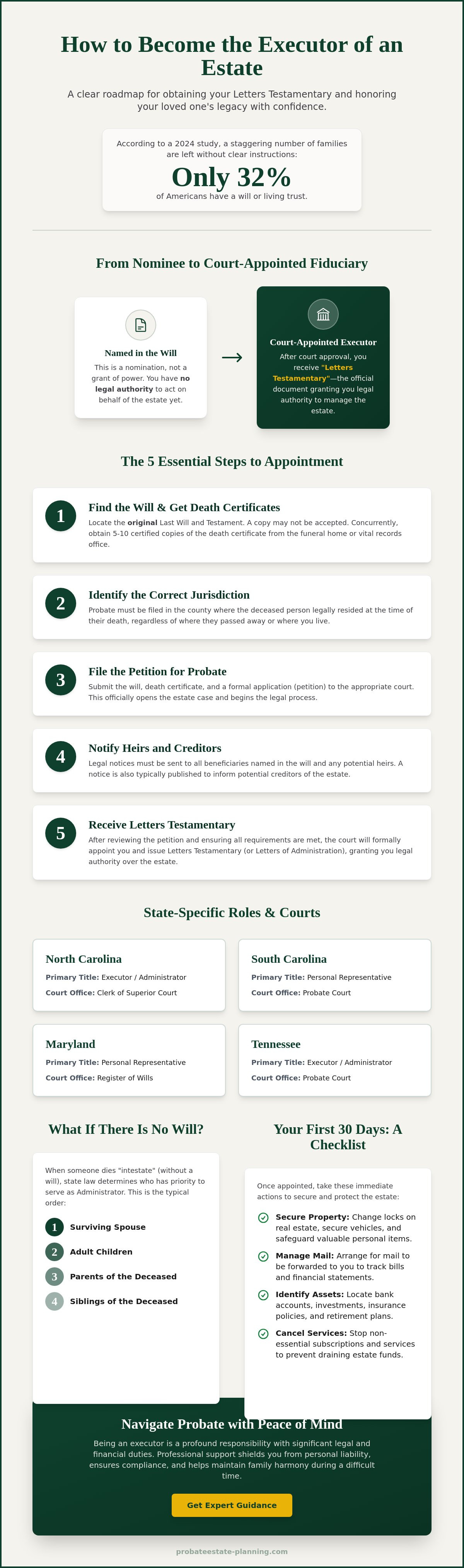
Imagine sitting at your dining room table on a Tuesday morning, surrounded by your father's unopened mail and a stack of legal documents that feel like a foreign language. You want to honor his legacy, but if you're asking yourself how do you become executor of estate, the fear of making a financial mistake can feel paralyzing. According to the 2024 Wills and Estate Planning Study by Caring.com, only 32 percent of Americans have a will, which often leaves families searching for clarity while they're still processing a deep loss.
You likely already know that settling a loved one's affairs is a heavy responsibility. It's a task that requires more than just good intentions. This guide provides a clear roadmap for obtaining your Letters Testamentary and filing the necessary court documents across North Carolina, South Carolina, Maryland, and Tennessee. We'll demystify the different court names and requirements across our service area so you can move forward with confidence. You deserve to know your family's stewardship is in good hands.
Key Takeaways
- Learn the vital distinction between being named in a will and receiving the formal court authorization required to serve as a protective fiduciary.
- Discover the five essential steps regarding how do you become executor of estate, including how to identify the correct jurisdiction for filing probate.
- Understand the legal "order of priority" that determines who can lead an estate when a loved one passes away without a valid will.
- Identify the immediate actions you must take within the first 30 days to secure tangible property and protect your family's legacy.
- Explore how professional legal support shields you from personal liability and helps maintain harmony during complex multi-state probate processes.
Understanding the Role: What Does an Executor Actually Do?
Losing a loved one brings a heavy emotional burden, and taking on their final affairs adds a layer of responsibility that feels daunting. Many families ask, how do you become executor of estate when a loved one passes? It's a common misconception that being named in a will gives you immediate authority. In reality, a person named in a will is merely a nominee. You don't have the legal power to act until a probate court formally appoints you. An Executor of an estate acts as the legal bridge between a person's life work and their final legacy, ensuring their wishes are honored with precision.
To better understand this concept, watch this helpful video:
The role is technically a fiduciary one, meaning you're held to the highest legal standard of care. You aren't just handling paperwork; you're protecting assets for beneficiaries and creditors alike. Your authority comes from a document known as "Letters Testamentary" issued by the court. Without this document, banks and insurance companies won't grant you access to accounts. Your primary duties involve creating a comprehensive inventory of assets, paying valid debts and taxes, and finally distributing the remaining inheritance to the rightful heirs.
The Legal Weight of Fiduciary Duty
As an executor, you must put the estate's interests above your own. This stewardship requires meticulous record-keeping and absolute transparency. If you mismanage assets or fail to follow state-specific probate timelines, you can be held personally liable. This means a judge could order you to pay the estate back from your personal bank account if your negligence causes financial loss. Beyond the legalities, you serve as a steady guide for the family. Probate often happens during peak grief, so your organized approach helps maintain family harmony and prevents unnecessary conflict.
State-Specific Terminology: Personal Representative vs. Executor
The title you hold depends on the state where the probate process occurs. Understanding these regional nuances is a critical part of knowing how do you become executor of estate correctly. In Maryland and South Carolina, the law primarily uses the term "Personal Representative" regardless of whether there's a will. In North Carolina and Tennessee, you're usually called an "Executor" if there's a will, or an "Administrator" if the person died intestate. Each state also directs you to a different office to begin the process.
| State | Primary Title | Court Office |
|---|---|---|
|
North Carolina |
Executor / Administrator |
Clerk of Superior Court |
|
South Carolina |
Personal Representative |
Probate Court |
|
Maryland |
Personal Representative |
Register of Wills |
|
Tennessee |
Executor / Administrator |
Probate Court |
Each of these offices has specific local rules. For instance, in Maryland, the Register of Wills handles the administrative tasks, but the Orphans' Court may step in if there's a dispute among heirs. In North Carolina, the Clerk of Court acts as the probate judge. Recognizing these distinctions ensures that your first steps toward appointment are taken with confidence and clarity.
The 5 Essential Steps to Becoming a Court-Appointed Personal Representative
Understanding how do you become executor of estate begins with a methodical approach to the local court system. This process isn't just about paperwork; it's the first step in honoring a loved one's final wishes. You'll start by locating the original Last Will and Testament. Without the original document, the court may presume it was revoked, which complicates the transition. You also need to secure at least five to ten certified copies of the death certificate from the vital records office or the funeral home.
Once you have these documents, you must identify the correct jurisdiction. This is typically the county where the decedent maintained their primary residence at the time of death. If they owned property in multiple states, such as a vacation home in South Carolina and a primary residence in Maryland, you'll likely start the process in their home state. This initial phase can feel heavy, so using a practical checklist for new executors can help you stay organized during these first few weeks of mourning and management.
Filing the Initial Petition and Paperwork
Each state has specific requirements for the opening petition. In North Carolina, you'll use form AOC-E-201, the Application for Letters. Maryland residents will file Form 1104, the Petition for Administration. These forms require a preliminary inventory of assets to help the court determine if a fiduciary bond is necessary. A bond acts like an insurance policy; it protects the beneficiaries from potential mismanagement of estate funds. You'll also need to provide a complete list of all "interested parties," which includes every person named in the will and any legal heirs who would inherit if the will didn't exist. Accuracy here prevents future legal challenges and ensures securing your family's legacy remains a smooth process.
The Hearing and the Issuance of Letters
The final step in your appointment is often a meeting with the Clerk of Superior Court or a Probate Judge. During this session, you'll take a formal oath of office, promising to carry out your duties faithfully. The court then issues "Letters." If there's a valid will, you receive Letters Testamentary. If there isn't a will, you receive Letters of Administration. These documents are your "golden ticket." They provide the legal authority to walk into a bank, close an account, or sign a deed to sell real estate. Without these papers, you're simply a family member; with them, you're a court-sanctioned steward of the estate's assets. This authority allows you to pay final bills and eventually distribute what remains to the rightful beneficiaries, bringing a sense of order to a difficult time.
Testate vs. Intestate: Becoming an Administrator When There Is No Will
When a person passes away without leaving a valid will, the legal state of their affairs is known as "intestacy." This situation shifts the responsibility of leadership from a hand-picked executor to a court-appointed administrator. If you're investigating how do you become executor of estate in the absence of a will, it's important to understand that the court follows a rigid statutory hierarchy rather than personal preference. You aren't technically an executor in this scenario; you're an administrator, though the fiduciary duties remain largely the same.
Who Has the Right to Lead the Estate?
South Carolina and Maryland statutes establish a clear "Order of Priority" for these appointments. The surviving spouse typically holds the first right to serve. If they decline or are unable, the priority moves to the children, then to other heirs. When multiple family members, such as three adult siblings, all apply for the role, the court may appoint them as co-administrators. This often complicates the process because every decision then requires unanimous consent. If the family can't reach an agreement, the probate judge will intervene to select the individual best suited for the fiduciary role, prioritizing the protection of the estate's value over family politics.
North Carolina and Tennessee laws differ slightly in how they rank these priorities. Under North Carolina General Statute § 28A-4-1, the sequence is fixed and mandatory. Tennessee law, specifically T.C.A. § 30-1-106, grants the court a bit more leeway to skip a person in the priority line if they're deemed unfit. This means that in Tennessee, your history of financial responsibility might matter just as much as your biological relationship to the deceased. This is a critical distinction for those wondering how do you become executor of estate when the family dynamic is strained.
The Increased Burden of Intestacy
Leading an estate without a will is significantly more demanding. One of the primary hurdles is the fiduciary bond. In a typical will, the creator usually waives the bond requirement to save the estate money. In intestate cases, the court almost always requires you to purchase a bond. This is a financial guarantee that protects the heirs if the administrator mishandles the funds. Getting a bond requires a credit check, which can be a barrier for some applicants.
- Distribution Control: Without a will, you don't decide who gets what. The state's Intestate Succession laws dictate the distribution based on family trees.
- Increased Oversight: Courts often require more frequent reporting and accountings when no will is present.
- Higher Costs: Between bond premiums and potential legal disputes over heirship, intestate estates are often more expensive to close.
The lack of a clear nominee creates a vacuum that can lead to family chaos. It's vital to step into this role with a clear understanding of your legal duties to prevent long-term damage to family harmony. You can learn more about avoiding pitfalls by reviewing The 5 Most Common Mistakes Executors Make. Dealing with an intestate estate is a heavy stewardship, but with the right guidance, you can provide the peace of mind your family needs during a difficult transition.
Your First 30 Days: A Practical Checklist for New Executors
Once you understand how do you become executor of estate, the weight of the responsibility often settles in quickly. The first 30 days serve as a critical window to establish order and protect the legacy of your loved one. Your primary objective is the preservation of assets. You should secure the primary residence and change the locks within 48 hours of your appointment. This prevents the unauthorized removal of tangible personal property, which frequently occurs when grieving family members seek "mementos" before an official inventory is taken.
Establishing a clear financial boundary is your next step. You must apply for a Federal Tax ID (EIN) through the IRS website using Form SS-4. This number acts as a Social Security number for the estate, allowing you to open a dedicated estate bank account. You must never co-mingle estate funds with your personal finances. Keeping these accounts separate is a fundamental requirement of your fiduciary duty and protects you from personal liability during the probate process.
- Secure Digital Assets: Locate passwords for banking portals, social media, and cloud storage to prevent data loss.
- Inventory Insurance: Identify all life, homeowners, and auto insurance policies to ensure coverage remains active.
- Formal Asset List: Begin a comprehensive log of all real estate, vehicles, and investment accounts.
Communication and Harmony
Family conflict usually arises from silence, not just money. You can prevent suspicion by sending a brief status update to all beneficiaries every 14 days. Transparency is your best defense against litigation. Keep a meticulous ledger where you record every cent spent from the estate account, no matter how small the expense. If a beneficiary expresses frustration with the timeline, you might tell them: "I recognize this process feels slow, but my legal obligation is to protect every asset and settle debts correctly so your eventual inheritance is legally secure and final."
Initial Financial Safeguards
Protect your own bank account by refusing to pay the decedent's debts out of your own pocket. If the estate lacks immediate liquidity, creditors must wait. You are not personally responsible for their balances. You should categorize every bill you receive to identify "Priority Claims." In states like North Carolina and Tennessee, funeral expenses and government taxes are paid before general creditors like credit card companies. You should also notify the Social Security Administration immediately and cancel recurring digital subscriptions to stop unnecessary financial drain on the estate's remaining cash.
Managing these early tasks with precision ensures a smoother transition through the probate courts. If you feel overwhelmed by the paperwork or the pressure from creditors, our team can help you maintain your role as a steady guide for your family.
Schedule a consultation to protect your loved one's legacy.Why Professional Probate Administration Is Essential for Your Peace of Mind
Taking on the role of a personal representative is a profound act of service. While your initial focus might be on the technical question of how do you become executor of estate, the real work begins after the court issues your Letters Testamentary. This responsibility carries significant legal weight. You're personally liable for errors in tax filings, creditor notifications, or asset distribution. A professional probate attorney serves as your shield. We step between you and the potential for personal financial loss or heated family disputes. Our team ensures every action aligns with state statutes, which effectively preserves the family harmony you value most.
One of the most reassuring aspects of this partnership is the financial structure. In North Carolina, South Carolina, Maryland, and Tennessee, legal fees for probate administration are typically considered an administrative expense of the estate. This means you don't pay out of your own pocket to secure professional guidance. The estate covers the cost of its own orderly transition. We view this as a "Stewardship" approach; we don't just file forms. We're protecting the legacy your loved one worked decades to build while following the strict letter of the law.
Navigating Multi-State Estate Challenges
Complications arise when a decedent owned property in multiple states. If your loved one lived in North Carolina but owned a vacation home in South Carolina, you must navigate "Ancillary Probate." This is a secondary legal proceeding required to transfer real estate located outside the home state. Handling two or three different court systems simultaneously is a recipe for administrative chaos. Our firm manages these logistics across Maryland, Tennessee, and the Carolinas. You gain a single point of contact for the entire process. We coordinate with local courts in each jurisdiction to ensure that titles transfer correctly and that no local tax obligations are overlooked. This multi-jurisdictional expertise prevents the delays that often plague DIY probate attempts.
Partnering with The Probate & Estate Planning Co.
We focus on delivering "Plans that Work." This means we don't just hand you a stack of documents; we guide you through the execution of those documents in the real world. Our process involves meticulous document preparation and direct court representation to keep the probate timeline moving forward. We understand that you're grieving while trying to solve a complex legal puzzle. Our goal is to provide a steady, predictable path toward closure. By securing experienced counsel, you ensure that the question of how do you become executor of estate leads to a successful, stress-free conclusion for your entire family.
Don't face the probate court alone. Schedule a consultation with our probate team today to protect your family's future and your own peace of mind.
Navigate the Probate Path with Confidence
Navigating probate courts in North Carolina, South Carolina, Maryland, or Tennessee requires more than good intentions; it demands a structured approach to legal stewardship. You now understand the 5 essential steps to court appointment and why that first 30 day checklist is vital for protecting family harmony. Determining how do you become executor of estate is the first step toward fulfilling your loved one's final wishes with the dignity they deserve. This role is a significant fiduciary responsibility, but it doesn't have to be overwhelming when you have a clear roadmap.
Our firm brings specialized expertise in Medicaid Crisis Planning and Asset Protection to every case. We're licensed across 4 states, NC, SC, MD, and TN, providing a proven track record in complex probate administration to help you avoid common pitfalls. You don't have to shoulder this burden alone. We offer the steady guidance needed to transform a daunting process into a manageable path forward. Secure your legacy and start the probate process today. Taking this action ensures your family's future remains protected and your peace of mind stays intact.
Frequently Asked Questions
Can I become the executor if I live in a different state than the deceased?
You can serve as an executor even if you live in a different state, though each jurisdiction has specific requirements to ensure the estate's protection. For example, North Carolina General Statute 28A-4-2 requires out-of-state executors to appoint a resident agent to receive legal service. South Carolina often requires a fiduciary bond to safeguard assets. These rules ensure that geographic distance doesn't compromise your ability to provide stewardship over your loved one's legacy.
How much does it cost to file for executorship in the probate court?
Filing fees for probate vary significantly across these four states. In North Carolina, the initial filing fee for an estate is $120 as of 2024. In Maryland, probate fees are based on a sliding scale; for example, an estate valued between $50,000 and $100,000 carries a $100 fee. These costs are paid from the estate assets rather than your personal pocket, ensuring the financial burden doesn't rest on you.
What happens if the person named as executor in the will cannot or will not serve?
If the primary executor is unable or unwilling to serve, the court looks to the successor executor named in the will. If no successor is listed or available, state laws like Tennessee Code 30-1-101 dictate a priority list for appointment, typically starting with the surviving spouse. This structured process prevents chaos and ensures a steady guide remains in place to manage the family's transition and protect the intended legacy.
Am I personally responsible for the deceased person's debts as the executor?
You aren't personally responsible for the deceased person's debts under normal circumstances. As a fiduciary, your role is to use the estate's assets to satisfy valid claims from creditors. However, if you distribute funds to beneficiaries before paying 100 percent of legitimate debts, you could face personal liability. Understanding how do you become executor of estateinvolves recognizing this protective barrier between your personal finances and the estate's obligations.
Do executors get paid for their time and effort in NC, SC, MD, and TN?
Executors in all four states are entitled to reasonable compensation for their time and effort. North Carolina and South Carolina generally cap commissions at 5 percent of the estate's value. In Maryland, the law allows a maximum commission of 9 percent on the first $20,000 and 3.6 percent on the remainder. This payment acknowledges the serious responsibility you've undertaken to maintain harmony and order during a difficult family period.
Can I be removed as executor if a beneficiary disagrees with my decisions?
A beneficiary cannot remove you simply because they disagree with your decisions. Removal requires proof of a serious breach of fiduciary duty, such as fraud, mismanagement of assets, or a conflict of interest. Courts in these four states prioritize the deceased person's choice of executor. Unless 51 percent of the evidence suggests you're failing your legal duties, the court will likely maintain your position as the estate's trusted advisor.
How long does the process take from filing the petition to receiving the Letters?
The timeline from filing a petition to receiving Letters Testamentary typically ranges from 7 to 30 days depending on the county's caseload. While the entire probate process often lasts 9 to 12 months, getting your official authority happens relatively quickly. This speed allows you to begin the vital work of asset protection and debt settlement without unnecessary delays that could cause family anxiety or financial instability.
Is a lawyer required to become an executor of an estate?
You aren't legally required to hire a lawyer to learn how do you become executor of estate or to complete the process. However, roughly 70 percent of complex estates involve legal counsel to avoid costly mistakes and personal liability. Navigating the specific statutes of NC, SC, MD, or TN requires meticulous attention to detail. Having a steady guide ensures the plan works exactly as intended, providing you with essential peace of mind.
Comments
There are no comments for this post. Be the first and Add your Comment below.
Leave a Comment