

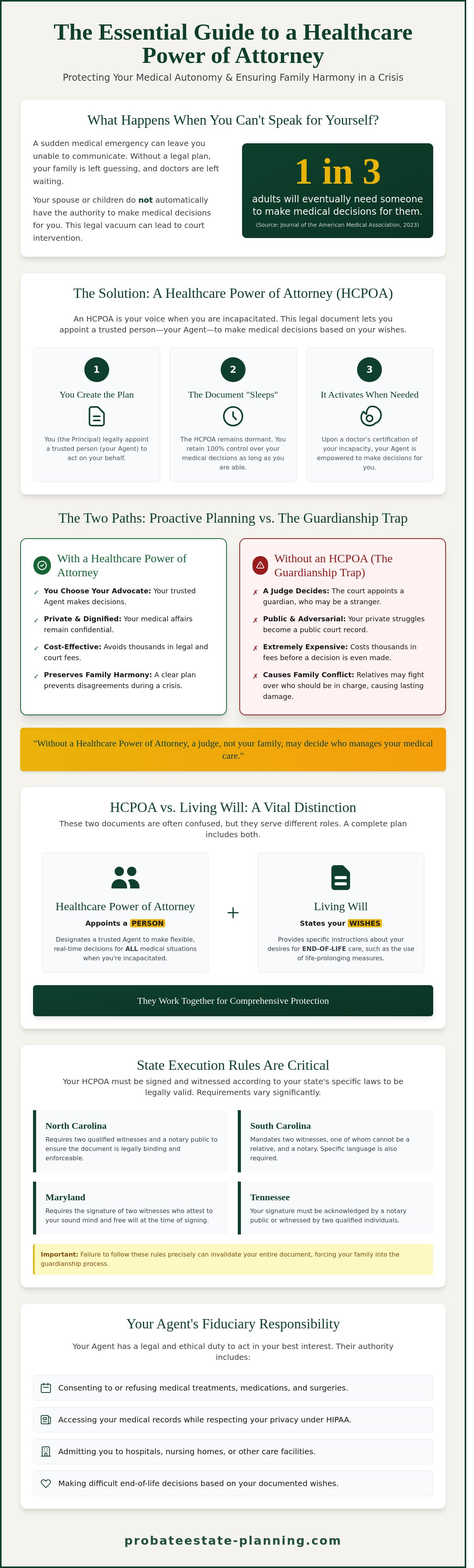
Imagine a Tuesday evening in Charlotte or Nashville where a sudden medical emergency leaves a loved one unable to speak. Without a healthcare power of attorney, your family is left guessing what you would want while the hospital staff waits for a legal decision maker. You likely believe that your spouse or children will automatically have the authority to guide your care. However, without the proper legal framework in states like North Carolina or Tennessee, even the most tight-knit families can find themselves paralyzed by disagreement or facing a costly court-ordered guardianship. In fact, research published by the Journal of the American Medical Association in 2023 indicates that roughly 33% of adults will eventually require a surrogate to make medical decisions on their behalf.
You deserve to know that your medical treatment remains in your control, even when you cannot speak for yourself. We've designed this guide to help you protect your medical autonomy and prevent your family from experiencing unnecessary chaos during a health crisis. You'll learn the specific legal requirements for a healthcare power of attorney in NC, SC, MD, and TN, giving you a clear path toward a plan that actually works when it's needed most. This is about more than just paperwork; it's about providing your family with a legacy of harmony and peace of mind during life's most difficult moments.
Key Takeaways
- Understand the vital role of your healthcare agent and how their fiduciary duty safeguards your medical wishes when you cannot speak for yourself.
- Learn why a healthcare power of attorney is distinct from a living will and how both documents work together to provide comprehensive protection.
- Identify the specific legal execution rules for NC, SC, MD, and TN to ensure your documents are valid and enforceable across state lines.
- Discover how to create a functional plan that prevents family chaos and provides a clear, compassionate roadmap during a health crisis.
What is a Healthcare Power of Attorney in the Southeast and Mid-Atlantic?
A Power of Attorney is a foundational tool in any comprehensive estate plan. In the Southeast and Mid-Atlantic, a healthcare power of attorney serves as your voice when you are unable to speak for yourself. This legal document establishes a formal relationship between two specific parties: the Principal and the Agent. As the Principal, you're the one granting authority. Your Agent, sometimes called a medical proxy, is the person you trust to make life-altering medical decisions on your behalf.
To better understand how this document functions in real-world scenarios, watch this helpful video:
It's a common misconception that a Last Will and Testament covers these needs. In reality, a Will only takes effect after death to manage your assets. This medical directive is designed for your lifetime. It remains dormant until a "trigger event" occurs. This event is almost always a medical professional's certification of your incapacity. Until that specific moment, the document "sleeps," and you retain 100% control over your own medical choices.
The Legal Authority of a Medical Proxy
Your agent's authority is broad but strictly bounded by the wishes you've documented. They can choose your doctors, authorize or refuse surgeries, and make difficult end-of-life decisions. Physicians in states like North Carolina and Maryland typically follow strict protocols to certify incapacity. This often requires one or two doctors to sign a formal statement confirming you can't understand the consequences of your medical decisions. This safeguard ensures your autonomy isn't stripped away prematurely. Your agent is legally bound to act in your best interest, providing a sense of stewardship over your physical well-being when you are at your most vulnerable.
The Consequences of Inaction: Avoiding the Guardianship Trap
If you don't have this directive in place in NC, SC, MD, or TN, your family faces a "Guardianship Trap." Without a designated agent, the court must intervene to appoint a legal guardian or conservator. This is a public, adversarial, and expensive process. In Tennessee, for instance, a conservatorship petition can cost thousands in legal fees and court costs before a single medical decision is even made.
"Without a Healthcare Power of Attorney, a judge, not your family, may decide who manages your medical care."
In South Carolina and Maryland, the court process is not just expensive; it's also a matter of public record. Your family's private struggles become part of a public docket. This often leads to internal family friction as relatives may disagree on who should lead your care. A proactive healthcare power of attorney preserves family harmony by removing the guesswork and keeping the government out of your private medical affairs.
The Duties of a Healthcare Agent: Authority and Fiduciary Responsibility
When you sign a healthcare power of attorney, you're designating a fiduciary. This legal term means your agent has a strict duty to act in your best interest, putting your preferences above their own. This role carries significant weight in states like North Carolina and Maryland, where medical professionals rely on your agent to make life-altering choices when you can't speak for yourself. It is a partnership in stewardship that requires your agent to protect your dignity and your medical legacy.
Your agent's authority typically includes:
- Consenting to or refusing specific medical treatments, medications, and surgeries.
- Reviewing and releasing medical records under federal privacy laws.
- Admitting you to hospitals, nursing homes, or memory care facilities in South Carolina or Tennessee.
- Making difficult decisions regarding life-prolonging measures, such as nutrition and hydration.
Most agents operate under the Substituted Judgment standard. This means they must decide based on what they know you'd want, rather than what they think is best. They essentially step into your shoes. If your wishes aren't clear, they shift to the Best Interests standard, choosing the path that provides the most objective benefit. Because this is a heavy emotional burden, your agent needs to be someone who remains calm under pressure. If you're ready to begin this process, you can find state-specific advance directive forms to help outline these preferences for your loved ones.
Accessing Information: HIPAA and Medical Privacy
The HIPAA Privacy Rule of 1996 created strict barriers to protect patient data. Without specific language in your healthcare power of attorney, doctors may refuse to speak with your agent. This can cause dangerous delays during a crisis. We ensure your document includes a clear HIPAA release so your agent has immediate access to your charts. Keeping a digital copy on a smartphone or a physical copy in a glove box ensures the document is available the moment it's needed.
The Intersection of Medical Care and Medicaid Planning
Healthcare decisions often lead to long-term care needs. A skilled agent understands how a choice between a private facility and home health care affects your financial health. If a transition to professional care becomes necessary, your healthcare agent must coordinate closely with your financial advocates. This coordination is vital for effective Medicaid Crisis Planning, ensuring you receive quality care without unnecessarily depleting your assets. Taking these steps now is about securing your family's future and preventing the chaos of a medical emergency. Choosing the right person today provides the steady guidance your family will need tomorrow.
Healthcare Power of Attorney vs. Living Wills: Clearing the Confusion
Many families use these terms interchangeably, but they serve different roles in a protective estate plan. A Living Will acts as a static set of instructions. It outlines your specific desires regarding life-prolonging treatments, such as ventilators or feeding tubes, if you're unable to communicate. In contrast, a healthcare power of attorney is a dynamic tool. It appoints a trusted individual to make medical decisions for you in situations you couldn't have predicted, such as a sudden surgical complication or a temporary loss of consciousness.
In South Carolina and Tennessee, legal practitioners typically advise clients to execute both documents. Relying on just one can create a gap in your stewardship. For example, a Living Will might be silent on a new experimental treatment, but your appointed agent can evaluate that option in real time. The American Bar Association provides resources highlighting how these tools work together to ensure your medical care remains consistent with your values. This dual-layered approach preserves family harmony by removing the burden of guesswork from your loved ones.
When the Living Will Takes Precedence
The Living Will usually becomes the primary authority in specific, end-of-life scenarios. These include terminal illnesses where death is imminent or persistent vegetative states confirmed by two physicians. In these moments, the document speaks for you when you can't. Your healthcare power of attorney agent doesn't have the authority to override these specific written instructions; instead, they ensure the medical team honors them. Think of the Living Will as the script and the Agent as the director. The script sets the boundaries of the story, while the director ensures the performance stays true to your original vision as medical circumstances shift.
The Advance Directive: Combining the Two
Maryland and several other states have moved toward a more streamlined approach by using "Advance Directive" as an umbrella term. This consolidated format combines your treatment preferences and your agent designation into a single, cohesive document. This structure is highly beneficial during hospital intake processes because it reduces the volume of paperwork your family must manage during a crisis. It provides a clear, unified roadmap for healthcare providers, which minimizes the risk of administrative delays.
A common pitfall occurs when documents are inconsistent or outdated. If you signed a Living Will in 2014 but appointed a different agent in a 2023 document, the resulting conflict can lead to legal stalemates. We often see families face unnecessary stress when separate documents provide clashing instructions on palliative care or resuscitation. Maintaining a unified Advance Directive ensures your plan works exactly as intended when it's needed most, safeguarding your legacy and your physical well-being simultaneously.
Executing Your HCPOA: State-Specific Rules for NC, SC, MD, and TN
A healthcare power of attorney is more than just a signature on a page. It's a formal legal instrument that must adhere to specific statutory mandates to be recognized by hospitals and physicians. You can't rely on a "one size fits all" template found on a generic website. If your document fails to meet the exact criteria of your state's laws, your chosen agent may find themselves locked out of the decision-making process during a medical crisis. Legal requirements aren't mere suggestions; they're the safeguards that ensure your voice is heard when you can't speak for yourself.
Witness and Notary Requirements
States maintain different standards for what constitutes a valid execution. Failing to follow these leads to delays that your family cannot afford during an emergency.
- North Carolina: You must have two qualified witnesses and a notary public. Under NCGS § 32A-16, certain individuals, such as your healthcare provider or their employees, are prohibited from serving as witnesses.
- South Carolina: Per SC Code § 62-5-504, you need two witnesses and a notary. At least one witness must not be a beneficiary of your estate or your attending physician to prevent claims of a conflict of interest.
- Maryland: Two witnesses must sign the document. While Maryland law doesn't strictly require a notary for the healthcare directive itself, having one significantly improves portability if you seek treatment in a neighboring state.
- Tennessee: You have a choice. You can either have two witnesses sign or have the document acknowledged before a notary public under TN Code § 34-6-203.
Generally, your designated agent shouldn't serve as a witness. This practice maintains the integrity of the document and ensures your plan remains robust if it's ever challenged in court. Choosing neutral witnesses provides an extra layer of protection for your legacy.
Revoking and Updating Your Directive
Your life isn't static, and your legal documents shouldn't be either. You have the right to revoke or change your healthcare power of attorney at any time, provided you have the mental capacity to do so. A 2023 study by the Journal of the American Medical Association indicates that nearly 25% of patients require a different level of care than they initially planned for ten years prior. This makes regular reviews essential for your peace of mind.
If you move from Maryland to North Carolina, don't assume your old form is sufficient. While many states have "reciprocity" laws, local doctors are more comfortable with forms they recognize. To update your plan, you should physically destroy old copies. This "Rule of Destruction" prevents confusion among family members about which version is current. Major life events, like a 2024 divorce or a new medical diagnosis, are immediate signals that you need to refresh your strategy with a professional.
Protect your family from the chaos of an invalid document by working with a guide who understands these local nuances. Secure your future by establishing a valid estate plan today.
Securing Your Future with The Probate & Estate Planning Co.
Choosing the right representative for your medical decisions is a profound act of stewardship. At The Probate & Estate Planning Co., we act as a Steady Guide for families navigating the friction of complex dynamics. We understand that family relationships aren't always linear. Our role is to ensure your wishes remain the priority, even when opinions among your loved ones differ. We focus on creating a "Plan that Works," which means we prioritize functional outcomes over simply handing you a stack of paper. A document is only as good as its ability to be honored in a hospital room during a midnight crisis.
We integrate your healthcare power of attorney into a comprehensive asset protection strategy. Without these directives, families often face the "guardianship trap." In states like North Carolina or Maryland, a lack of clear medical and financial directives can force your family into public incompetency proceedings. These court-managed processes often cost upwards of $3,500 in initial filing and legal fees, and they strip your family of privacy. By planning now, you retain control and keep your private medical choices out of the public record.
Beyond the Document: Our Partnership in Stewardship
Our commitment to your family goes beyond drafting. We focus on preparing your chosen agent for the weight of their future responsibilities. We provide the legal clarity required to withstand challenges from estranged family members who might attempt to interfere with your care. With specific expertise across NC, SC, MD, and TN, we ensure your documents comply with the unique statutes of your home state. This professional precision prevents the technical errors that often lead to a healthcare power of attorney being rejected by hospital legal departments.
Take the First Step Toward Peace of Mind
The most difficult time to plan for a crisis is during one. Research from the American Journal of Managed Care indicates that nearly 30% of surrogate decision-makers experience significant emotional distress or family conflict when directives are unclear. You can eliminate this burden for your family by acting while you have the clarity to do so. We invite you to move away from the anxiety of the unknown and toward a methodical, protective plan that secures your dignity. Our team is ready to provide a personalized review of your situation to ensure your legacy remains in your hands.
Don't leave your most personal decisions to chance or court intervention. Schedule your estate planning consultation today to begin building a strategy that protects your wishes and your family's harmony.
Take Control of Your Medical Legacy Today
Securing your future involves more than just signing a form; it's about ensuring your voice is heard when you can't speak for yourself. You've learned how a healthcare power of attorneyempowers a trusted agent to handle your medical decisions according to your specific values. By addressing the unique statutes in North Carolina, South Carolina, Maryland, and Tennessee, you prevent the chaos of probate court guardianship. This legal protection keeps your private matters out of public courtrooms and maintains harmony among your loved ones during difficult times.
At The Probate & Estate Planning Co., we provide multi-state expertise across these 4 key regions to ensure your plan is legally sound and personally meaningful. Our human-centric approach focuses on your emotional well-being, moving beyond cold legalism to offer true peace of mind. We've guided countless families through these complexities, and we're ready to act as your steady guide. Don't leave your medical care to chance or the rigid rules of a state-appointed official.
Secure your medical future with a professional Healthcare Power of Attorney
You deserve the confidence that comes with a plan designed to protect your dignity and your family's future. We're here to help you navigate every step with care and precision.
Frequently Asked Questions
Is a Healthcare Power of Attorney the same as a Durable Power of Attorney?
A Healthcare Power of Attorney is distinct from a Durable Power of Attorney, which typically manages financial affairs. While both are essential components of a protective estate plan, the HCPOA focuses exclusively on medical decisions. In North Carolina, these roles are governed by separate statutes, specifically Chapter 32A and Chapter 32C of the General Statutes. Keeping them separate ensures your medical agent isn't burdened with property management during a health crisis.
Can my Healthcare Agent make financial decisions for me?
Your Healthcare Agent does not have the authority to access your bank accounts or pay your bills. Their power is strictly limited to medical consent and treatment choices. To grant someone financial authority, you must execute a separate Financial Power of Attorney. According to a 2023 report from the National Council on Aging, clearly defining these roles prevents the confusion that affects 20 percent of families during medical emergencies.
What happens if I move from North Carolina to South Carolina? Is my HCPOA still valid?
Your document remains valid if it met the legal requirements of North Carolina at the time you signed it. South Carolina Code Section 62-5-504 recognizes out of state healthcare directives that comply with the law of the state of execution. However, it's wise to update your healthcare power of attorney after moving. Local hospitals in the 46 counties of South Carolina are more familiar with their state's specific statutory forms, which speeds up care.
Who should I choose as my Healthcare Agent if I don't have close family?
You can appoint a trusted friend, a professional fiduciary, or a long-time colleague as your agent. The American Bar Association suggests selecting someone who lives within 50 miles of your primary residence to ensure they can arrive at the hospital quickly. This person must be someone who understands your values and can remain calm under pressure. Choosing a reliable non-family member prevents your care from falling into the hands of a court-appointed guardian.
Can I have more than one Healthcare Agent serving at the same time?
You can technically appoint co-agents, but we strongly advise naming one primary agent followed by a sequence of alternates. Requiring two people to agree on a single medical procedure can lead to delays or family disputes. A 2022 study on clinical ethics found that 30 percent of medical delays occur when co-decision-makers disagree. Naming a single "Steady Guide" as your primary agent ensures your medical team receives clear, decisive instructions without hesitation.
Does a Healthcare Power of Attorney expire?
A healthcare power of attorney does not have an expiration date and remains effective until you revoke it or pass away. It's designed to provide lifelong protection and peace of mind. We recommend reviewing your documents every 3 to 5 years or after major life events like a divorce or a new diagnosis. This regular stewardship ensures your plan reflects your current health status and personal relationships as they evolve over time.
Can my doctor or healthcare provider serve as my agent?
Most state laws, including those in Maryland and Tennessee, prohibit your treating physician or their employees from serving as your agent. This rule exists to prevent conflicts of interest between the person providing the care and the person consenting to it. Tennessee Code Section 68-11-1803 specifically outlines these restrictions. Selecting an independent advocate ensures your personal wishes remain the sole priority during your treatment and avoids legal complications for the hospital.
What is the difference between an Advance Directive and a Healthcare Power of Attorney?
An Advance Directive is a broad category that includes both a Living Will and a Healthcare Power of Attorney. While the Living Will outlines your specific preferences for end-of-life care, the HCPOA names the person who will speak for you. Having both documents ensures a comprehensive shield of protection. This combination allows your agent to use their judgment while following the specific instructions you recorded in your Living Will, preventing chaos for your loved ones.
Comments
There are no comments for this post. Be the first and Add your Comment below.
Leave a Comment