

What if the most expensive part of your estate plan isn't the fee you pay an attorney, but the "probate tax" your family pays if you choose the wrong path? When you start researching the average cost of estate planning in Tennessee, it's natural to feel a sense of hesitation. You don't want to overpay for standard documents, yet you likely worry that a cheap DIY plan might fail when your family needs it most in a Tennessee probate court. It's a delicate balance between managing your current budget and ensuring your legacy remains intact.
We understand that you're looking for more than just a price tag; you're looking for peace of mind. This guide will clarify the real investment required for a 2026 Tennessee estate plan and demonstrate how proactive preparation can save your heirs from the high costs of probate. We'll explore the differences between a simple will and a trust-based strategy, helping you understand what a complete plan actually includes. By the end, you'll have the confidence to choose the right path for your family, knowing exactly how to protect your future while keeping costs manageable and predictable.
Key Takeaways
- Learn how the average cost of estate planning in Tennessee serves as a strategic investment to help your family avoid the 3 to 8 percent probate fee typically charged on an estate's total value.
- Understand the transition toward flat-fee pricing models in 2026, which offers you financial predictability and eliminates the anxiety of unexpected hourly billing.
- Compare the initial costs of a Last Will and Testament against the long-term, probate-avoidance benefits provided by a Revocable Living Trust.
- Identify how specific family dynamics, such as blended families or special needs beneficiaries, can influence the complexity and final quote of your legal plan.
- Discover why professional legal guidance is essential to prevent the functional failures and court battles often associated with DIY documents in Tennessee.
Understanding the Investment: Average Estate Planning Costs in Tennessee
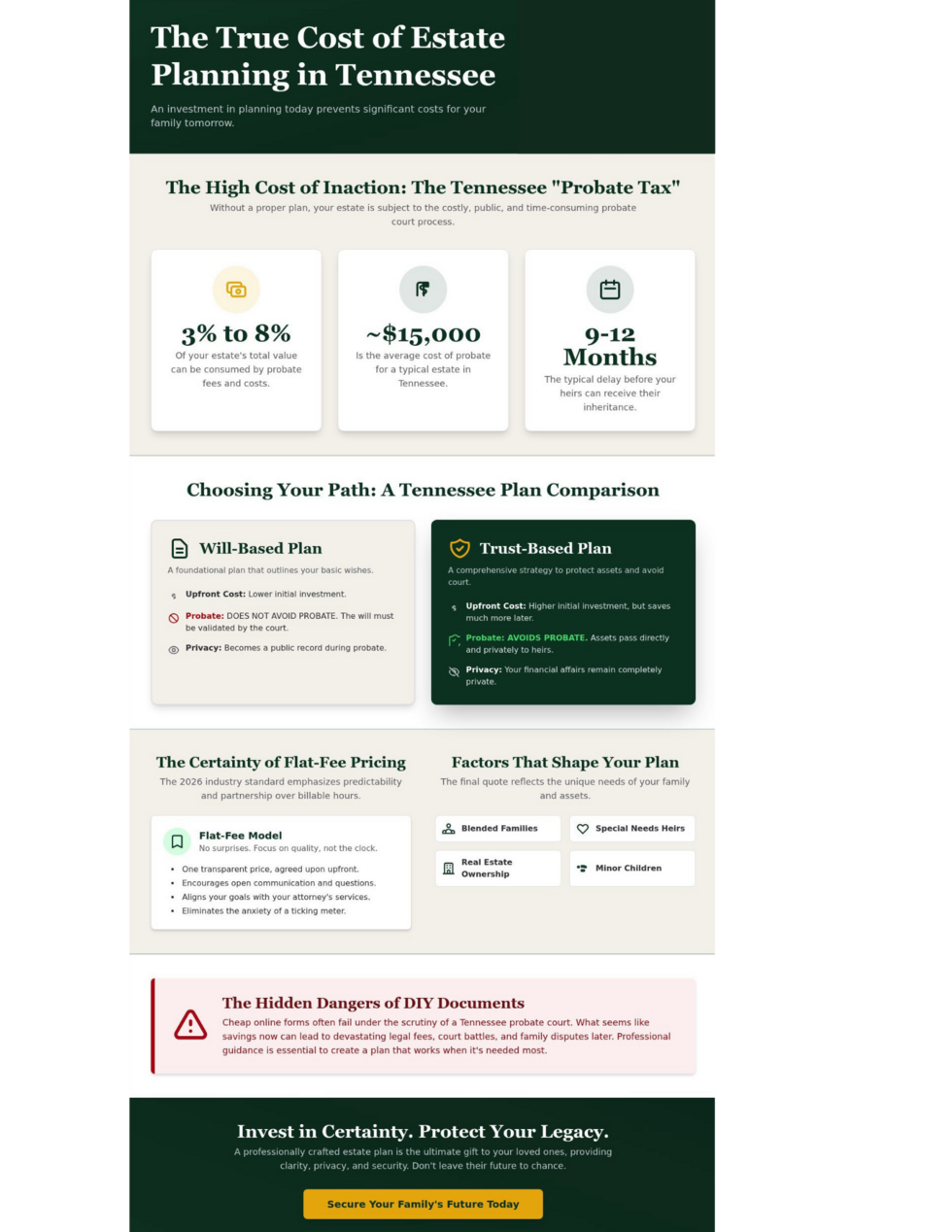
When you begin looking into the average cost of estate planning in Tennessee, it's helpful to view the expense not as a simple purchase, but as a strategic investment in your family's future security. The total cost typically reflects the complexity of your assets and the specific legacy goals you wish to achieve. Many people focus on the immediate price of drafting documents, yet the "cost of doing nothing" is often much higher. Without a plan, Tennessee probate can consume 3 to 8 percent of an estate's total value, creating a significant financial burden for grieving loved ones during an already difficult time.
To understand the broader context of these preparations, one might ask, What is Estate Planning? At its core, it is the methodical process of arranging the management and disposal of an estate during a person's life while minimizing legal complications for those left behind. In 2026, pricing for these professional services often accounts for modern needs, such as digital asset management and sophisticated tax strategies designed to protect wealth across generations. This thorough approach ensures that your plan doesn't just exist on paper but functions reliably when it matters most.
To better understand this concept, watch this helpful video:
The Basic Will-Based Plan vs. Comprehensive Protection
A basic plan generally includes a Last Will and Testament, a Durable Power of Attorney, and a Healthcare Power of Attorney. While these documents provide a foundational level of security, they may be more expensive in the long run because a will does not avoid the probate process in Tennessee. A transition to a trust-based plan usually becomes necessary when a resident owns real estate, has minor children, or wants to ensure their assets are distributed privately without the 9 to 12 month delay of court proceedings. Choosing a more comprehensive strategy upfront often results in lower total costs for the estate over time.
Tennessee Probate Court Fees: The Hidden Variable
Beyond attorney fees, the hidden variable in any estate strategy is the cost of the probate court itself. Filing fees and administrative costs vary across Tennessee counties, but the overall impact is consistent. An upfront investment in professional planning often prevents thousands of dollars in court-mandated expenses later. In Tennessee, estates valued at $50,000 or less, excluding real property, may qualify for a simplified small estate process that avoids full probate. For estates above this threshold, industry data suggests the average cost of probate can reach approximately $15,000, making proactive planning a financially sound decision for most families.
Flat Fees vs. Hourly Rates: How Tennessee Attorneys Bill
Choosing how to pay for legal services is as important as the documents themselves. In 2026, we see a significant shift in how professionals handle the average cost of estate planning in Tennessee. Most families now prefer a flat-fee structure over traditional hourly billing. This preference stems from a deep desire for financial predictability. You shouldn't have to worry about a ticking clock when you're discussing sensitive family transitions or long-term security goals. A flat-fee model ensures that the focus remains entirely on the quality of the protection rather than the minutes spent on a phone call.
This steady, methodical approach to billing allows you to feel like a partner in the process. When fees are transparent from the start, it removes the inherent anxiety associated with professional legal advice. It transforms the experience from a clinical transaction into a collaborative effort to safeguard your legacy. By removing the pressure of a running timer, you can take the time needed to ensure every detail of your plan is accurate and reflects your true intentions for your loved ones.
The Value of a Flat-Fee Package
A flat-fee arrangement typically bundles several essential steps into one predictable investment. This package often includes your in-depth consultation, the meticulous drafting of your primary documents, necessary revisions, and the formal signing ceremony. By choosing a comprehensive package, you often find a more cost-effective path than if you were to request document preparation on an individual basis. More importantly, it provides the "Peace of Mind" that comes with knowing the total cost upfront. This clarity allows for more thorough, patient conversations as you work with your mentor to secure your family's future.
Hourly Rates in Tennessee Metro Areas
While flat fees are becoming the standard for proactive planning, hourly billing remains common in specific, high-complexity scenarios. You might encounter hourly rates when dealing with contested estates or complex Probate Administration Services where the total scope of work is difficult to predict at the outset. These rates often fluctuate based on geography. Legal professionals in metro hubs like Nashville or Memphis typically have higher overhead than those in rural counties, which is reflected in their billing structures. Additionally, the experience level of the attorney, such as a Senior Partner versus a Junior Associate, will naturally influence the hourly rate applied to your file.
The Tennessee Bar Association provides resources that highlight the importance of understanding these billing structures before you sign a formal agreement. When reviewing a retainer contract, look for clear definitions of what services are included and what specific actions might trigger additional charges. This meticulous attention to detail at the start of your partnership ensures a predictable outcome and a steady path toward your long-term goals. It's about creating a relationship built on trust and functional reliability from the very first meeting.
Will-Based vs. Trust-Based Plans: A Tennessee Cost-Benefit Analysis
Choosing between a Last Will and Testament and a Revocable Living Trust is the most significant decision affecting your total investment. While a will is often the entry point for many families, you should understand why the average cost of estate planning in Tennessee shifts upward when you choose a trust-based strategy. You aren't just paying for more pages of legal text. You're investing in a functional mechanism that bypasses the court system entirely. This proactive step saves your family from the public, time-consuming nature of probate.
A will is essentially a letter to a judge. Once it enters the probate process, it becomes a public document that anyone can access. This means your family's financial business is no longer private. Conversely, a trust remains a private family matter. By avoiding the 9 to 12 month probate timeline, your heirs receive their inheritance much faster and without the mandatory court fees that frequently consume a large portion of the estate's value. This "unseen" value of privacy and speed is often the primary reason families choose to invest more at the start.
If you have minor children, a trust offers a level of protection that a simple will cannot match. A will typically results in an outright distribution of assets once a child turns 18. A trust allows you to appoint a Successor Trustee to manage those funds for specific needs like education and health. You can even stagger the inheritance over several years. This ensures your children have a steady guide for their financial future even if you aren't there to provide it yourself.
The Tennessee Revocable Living Trust
The Revocable Living Trust is the "gold standard" for anyone owning real estate in the Volunteer State. Cost factors for these plans often depend on the number of assets you need to fund into the trust and the complexity of your holdings. Professional guidance is vital during this setup phase. A trust that isn't properly funded with your property is like a vault without anything inside. It requires a meticulous, step-by-step approach to ensure your home and accounts transfer correctly and stay out of the courtroom.
Medicaid Planning and Asset Protection
For those concerned about the high costs of long-term care, an Irrevocable Trust or specialized Asset Protection Planning may be necessary. These are specialized legal instruments with a higher upfront cost because they involve relinquishing certain controls to protect assets from nursing home expenses. When you consider that a single month in a Tennessee nursing home can cost upwards of $7,000, the fee for an attorney is a fraction of the potential loss. Medicaid Crisis Planning is a reactive strategy used when a loved one is already entering care, which is almost always more stressful and costly than proactive work. Tennessee's 60-month "look-back" period means that planning at least five years before you need care is the most cost-effective way to safeguard your home and life savings
Factors That Influence Your Final Estate Planning Quote
Every family has a unique story. This means the average cost of estate planning in Tennessee is rarely a one-size-fits-all figure. Your final quote is shaped by the specific variables of your life. For instance, a blended family with children from previous marriages requires more intricate drafting than a traditional structure. This complexity ensures that your intentions are clear and that no one is inadvertently disinherited or left without a designated guardian. It's about building a framework that respects your past while protecting your future.
Asset diversity also plays a major role in the planning process. If you own a high-value collection or significant investments, your plan must account for the 2026 federal estate tax exemption changes. With the individual exemption set at $15 million and $30 million for married couples, many families find they need more sophisticated tax planning to preserve their wealth for future generations. While Tennessee has no state-level estate tax, aligning your local plan with federal requirements is a critical step in long-term management. This thoroughness prevents unexpected tax burdens from depleting your legacy.
Special Needs and Supplemental Needs Trusts
Providing for a loved one with a disability requires a Supplemental Needs Trust. These specialized documents must be drafted with extreme precision to ensure the beneficiary remains eligible for government assistance like SSI or Medicaid. In Tennessee, failing to include specific language can result in a loss of benefits, which creates a significant financial and emotional burden. Investing in an expert prevents these functional failures. It provides a steady guide for those who cannot manage assets themselves, ensuring their care is never interrupted.
Business Succession and Multi-State Property
If you own a business in Tennessee, your estate plan must include a succession strategy to ensure continuity for your employees and partners. Additionally, owning real estate in another state adds a layer of complexity known as "ancillary probate." Without a trust, your family might have to go through the court process in multiple states simultaneously. We often take a team-based approach, coordinating with your CPA to ensure your business and property interests are protected from every angle. This coordination creates a seamless transition that preserves the value of your hard work.
Finally, the timeline of your request influences the investment. Proactive planning is always more cost-effective than "Crisis Planning." When an individual is facing an immediate end-of-life situation or a sudden move to long-term care, the need for rapid document preparation often carries a premium. Taking action now allows for a more measured, deliberate process that prioritizes your emotional well-being. If you are ready to explore a plan tailored to your specific family needs, contact us today for a consultation on Estate Planning.
Why Professional Planning Saves Tennessee Families Money
It's easy to focus solely on the immediate price of legal documents, but true financial wisdom lies in looking at the long-term outcome. When you consider the average cost of estate planning in Tennessee, you're actually looking at a form of financial insurance. A professional plan acts as a shield against the high costs of legal errors and the administrative drain of a long probate process. By choosing a methodical, attorney-led approach, you ensure that your assets transfer to your loved ones without being diminished by avoidable court fees or unnecessary taxes. It's about spending a predictable amount now to prevent an unpredictable loss later.
Our approach at The Probate & Estate Planning Co. is built on transparent, value-driven guidance. We don't just provide a stack of papers; we offer a partnership in long-term management. We've seen many families struggle with the emotional and financial fallout of an incomplete plan. Our goal is to provide the quiet confidence that comes from knowing your affairs are in order. This professional oversight ensures that your most important interpersonal connections are preserved and your legacy remains exactly as you intended.
The Risks of Online Templates in Tennessee
Choosing the cheapest option often feels like a win in the short term, but DIY templates frequently lead to functional failures in Tennessee courts. Tennessee judges are remarkably strict about document formalities and execution requirements. A single missing signature or a vague clause can trigger a contested estate battle that costs your heirs far more than a professional plan ever would. Furthermore, online forms don't account for changing state laws. A lawyer doesn't just draft a document; they "future-proof" your legacy by ensuring it complies with specific Tennessee statutes and remains valid as regulations evolve.
Start Your Planning with Confidence
Your journey toward security begins with a deliberate, step-by-step process. We guide you from the initial consultation through the final signing ceremony, ensuring every detail is captured with meticulous attention. This goes far beyond just a simple will. We focus on comprehensive Asset Protection Planning to guard your life's work from creditors and long-term care expenses. This thoroughness is what creates real value for Tennessee families. If you're ready to move toward a secure and predictable outcome, we're here to help you navigate these complexities with ease.
Secure your family's future—contact The Probate & Estate Planning Co. for a consultation today.
Take the Next Step Toward Lasting Security
Gaining a clear perspective on the average cost of estate planning in Tennessee allows you to make an informed decision for your family's long-term security. As we've discussed, the true value of a professional plan isn't found in the documents themselves, but in the peace of mind that comes from avoiding the high costs and delays of the probate court. By choosing a methodical, attorney-led approach, you're investing in a functional shield that protects your assets and preserves your most important interpersonal connections.
With specialized expertise in Tennessee probate and Medicaid planning, our multi-state practice serves the Southeast with a commitment to functional reliability. We understand the gravity of these transitions and offer a partnership built on wisdom and meticulous attention to detail. You deserve a plan that reflects your unique circumstances and provides predictable outcomes for those you love. Please schedule your estate planning consultation with our Tennessee team today to begin crafting your personalized strategy. Taking this action today ensures your legacy remains a source of comfort rather than a procedural burden for your heirs.
Frequently Asked Questions
How much does a simple will cost in Tennessee in 2026?
Attorney-prepared simple wills in Tennessee generally range from $903 to $1,806 for the 2026 calendar year. While online templates offer a lower upfront price point, they often lack the functional reliability required by Tennessee courts. Investing in a professionally drafted document ensures your intentions are legally sound and provides your family with a clear, steady guide during a difficult transition.
Is a trust really worth the extra cost compared to a will?
A trust is often considered a superior investment because it bypasses the public probate process entirely. While a will-based plan is less expensive initially, it requires your heirs to navigate a 9 to 12 month court process that can consume up to 8 percent of your estate's value. Choosing a trust-based strategy provides immediate asset protection and maintains your family's privacy, which many residents find invaluable.
Does estate planning cost more for married couples in Tennessee?
Estate planning for couples typically involves a higher investment because it requires the preparation of two sets of reciprocal documents. However, most firms offer a bundled package for couples that is more cost-effective than preparing documents individually. This coordinated approach ensures that both partners are protected and that asset transitions between spouses and to future generations are seamless and predictable.
Can I lower my estate planning costs by doing some of the work myself?
You can reduce the professional time required by organizing your financial records and clearly defining your goals before your first meeting. However, attempting to draft legal documents yourself often leads to functional failures that are far more expensive to fix in probate court later. The average cost of estate planning in Tennessee includes the professional oversight needed to future-proof your plan against complex state statutes.
What happens if I die in Tennessee without a will or estate plan?
If you pass away without a plan, Tennessee's intestacy laws dictate how your assets are distributed, which may not align with your true wishes. Your estate will be forced into a full probate process that typically takes 9 to 12 months to close. This lack of preparation often creates procedural obstacles and unnecessary emotional stress for your loved ones as they navigate the court system without your guidance.
How often should I update my estate plan and does it cost more?
It's wise to review your plan every three to five years or after significant life events like a birth, death, or major asset acquisition. Updates are generally less expensive than the initial setup because the foundational framework is already in place. Maintaining a current plan ensures that your protective strategies remain aligned with your interpersonal connections and any recent changes in Tennessee tax or probate laws.
Are there additional fees for funding a trust in Tennessee?
Funding a trust involves transferring your assets, such as real estate or bank accounts, into the trust's name, which may incur small administrative or recording fees. While some families handle these transfers themselves to save on legal fees, many prefer professional assistance to ensure the process is completed correctly. A trust that isn't fully funded cannot provide the probate avoidance benefits you originally invested in.
What is the average cost of probate administration in Tennessee if I don't have a plan?
Probate administration in Tennessee typically costs between 3 and 8 percent of the total estate value, with an average case often reaching approximately $15,000. These expenses include court filing fees, executor commissions, and attorney fees required to settle the estate over a 9 to 12 month period. Proactive planning is the most effective way to prevent these significant financial losses and ensure more of your legacy stays with your family.
Comments
There are no comments for this post. Be the first and Add your Comment below.
Leave a Comment