

Could the simple act of accepting a paycheck for your work be the one thing that unravels your family's legacy? You likely stepped into this role out of a sense of duty, but after logging 150 hours or more of administrative tasks, you've realized that family trustee compensation is about much more than a bank transfer. It is about honoring the time you have sacrificed while maintaining your role as a protective steward of your loved one's wishes.
You probably feel that you deserve to be paid fairly for your labor, yet you worry that taking a fee might spark resentment among beneficiaries or lead to accusations of self-dealing. It's a heavy burden to carry alone. We've created this 2026 guide to help you establish a clear, legally compliant fee structure in North Carolina, South Carolina, Maryland, and Tennessee. You'll learn how to meet specific state requirements and present your numbers with confidence. We will walk through the exact steps to secure your compensation while ensuring your family relationships remain intact and your legal protection is absolute.
Key Takeaways
- Understand your legal right to receive payment for fiduciary services, ensuring your time and effort are respected despite your personal relationship with beneficiaries.
- Navigate the specific "reasonable fee" standards across NC, SC, MD, and TN to ensure your family trustee compensation aligns with local probate court expectations.
- Evaluate the pros and cons of percentage-based fees versus hourly rates to find a calculation method that is both fair to you and transparent to the estate.
- Master communication techniques that prevent family feuds by presenting your fee structure with the clarity and documentation required to maintain harmony.
- Recognize the warning signs that necessitate professional legal guidance to protect your personal liability and the long-term security of the trust.
Understanding the Legal Right to Family Trustee Compensation
Serving as a trustee is often viewed as a gesture of love, but it's legally recognized as a professional service. Family trustee compensation is the payment a trustee receives for the fiduciary services they provide to the estate. While family members often feel hesitant to accept payment from a loved one's legacy, the law recognizes that managing a trust is a demanding job. This payment is distinct from an inheritance. An inheritance is a gift from the grantor, while trustee fees are earned income for labor performed. Understanding the Role of a Trustee is the first step in recognizing why this distinction matters for your family's harmony.
In 2026, the definition of "reasonable" effort has shifted. Economic shifts and increased reporting requirements mean that even a "simple" trust requires more hours than it did in 2020. A trustee might manage complex digital assets, navigate updated tax codes, or handle volatile real estate markets. These tasks require a level of attention that goes beyond a casual family favor. Without clear compensation, the person you've entrusted with your legacy may feel overwhelmed or undervalued, which can lead to administrative errors.
The Fiduciary Burden: Why Compensation is Justified
Fiduciary duty is the highest standard of care in law. This isn't just a moral guideline; it's a legal mandate. If a trustee makes a mistake, they face personal legal liability. Beneficiaries can sue for perceived mismanagement of funds or delays in distribution. Beyond the risk, there's a clear opportunity cost. A family member might spend 10 to 15 hours a week on trust administration, taking time away from their own career or personal life. Compensation acknowledges this sacrifice and ensures the trustee can focus on protecting the family legacy without financial strain. It transforms the role from a burden into a professional commitment.
When the Trust Document is Silent
Grantors sometimes forget to specify a fee structure in their documents. When this happens, the law doesn't leave the trustee empty-handed. Most jurisdictions, including those following the Uniform Trust Code (UTC), default to state law to determine payment. In 2026, courts interpret "reasonable compensation" by looking at several factors:
- The total value and nature of the trust assets.
- The complexity of the tax filings and accounting required.
- The amount of time spent resolving disputes among beneficiaries.
- The specialized skills the trustee brings to the administration.
State statutes in North Carolina, South Carolina, Maryland, and Tennessee provide frameworks to prevent chaos. These laws ensure that the trustee is protected even if the original trust document was vague. This legal safety net maintains the stability of the trust and prevents the resentment that can arise when one family member works for free while others benefit. It's a structured approach to stewardship that prioritizes clarity over conflict.
State-Specific Rules: NC, SC, MD, and TN Trustee Laws
Determining family trustee compensation isn't a one-size-fits-all calculation. Each state operates under the "Reasonable Fee" standard, but what's reasonable in Baltimore might seem excessive in a rural Tennessee county. This regional variation stems from local cost-of-living indices and the specific "customary rates" established by local probate courts. For instance, a trustee managing complex real estate in Charlotte often commands a higher hourly rate than one overseeing a simple brokerage account in a smaller town. As we move into 2026, these regional economic shifts continue to influence how judges view fiduciary pay, making it essential to understand the statutes that govern your specific area.
North Carolina and South Carolina: The Carolinas Approach
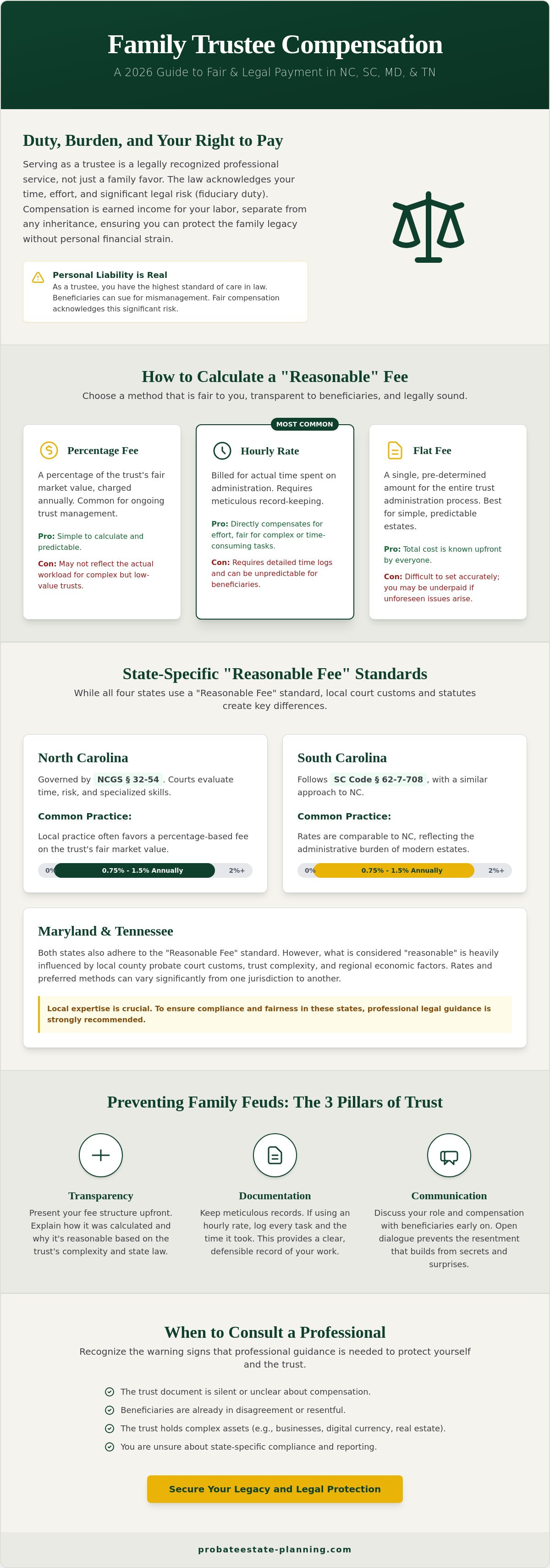
In North Carolina, NCGS § 32-54 provides the framework for pay. The law looks at the time spent, the risk involved, and the trustee's specialized skills. South Carolina follows a similar path under SC Code § 62-7-708. In Greenville and Charlotte, local practices often lean toward a percentage of the trust's fair market value, typically ranging from 0.75% to 1.5% annually for family members. These rates reflect the increasing administrative burden of modern estate management. If you're unsure how these rules apply to your specific situation, it's helpful to consult with a professional advisor to ensure your family's legacy remains intact. This guidance helps prevent the resentment that often arises when compensation isn't clearly defined from the start.
Maryland and Tennessee: Statutes and Standards
Maryland and Tennessee offer distinct perspectives on fiduciary pay. Maryland Code, Est. & Trusts § 14.5-708 establishes the "Reasonable" test, but the state is known for its detailed Maryland Trustee Compensation Schedules. These schedules provide a structured roadmap for both income and principal commissions, offering a level of predictability that many families find comforting. In Tennessee, TN Code § 35-15-708 governs remuneration. Nashville courts often grant trustees significant latitude, but they prioritize transparency and thorough record-keeping.
A trustee in Baltimore might face stricter reporting requirements than one in Nashville, where judicial discretion plays a larger role in approving hourly rates. In metropolitan areas, you might see hourly rates vary by 15% to 25% compared to rural districts, reflecting the higher overhead of professional services in those cities. By understanding these state-specific nuances, you protect the harmony of your family while ensuring the steward of your estate is fairly rewarded. Proper family trustee compensation isn't just about the money; it's about acknowledging the weight of the responsibility they've accepted.
- NCGS § 32-54: Focuses on the "nature and extent" of the trustee's duties.
- SC Code § 62-7-708: Allows the court to adjust pay if the duties are substantially different than originally planned.
- MD Code § 14.5-708: Relies heavily on statutory commission schedules.
- TN Code § 35-15-708: Grants broad judicial discretion based on the "reasonableness" of the effort.
Calculating the Fee: Percentage vs. Hourly vs. Flat Rate
Determining family trustee compensation requires balancing the value of the trustee's time with the essential goal of preserving the family legacy. While the "1% Rule" remains a common benchmark in 2026, courts and beneficiaries often demand a more granular breakdown of how that figure was reached. A trustee's pay must be "reasonable," a term that shifts based on the complexity of the assets and the level of risk the individual assumes.
Certain factors naturally increase the threshold for reasonable pay. If the trust holds a family business, requires intricate tax filings, or is currently involved in litigation, the trustee's liability increases. In these scenarios, a higher fee is often defensible to account for the specialized skill and increased personal exposure required to protect the estate from chaos.
The Percentage Model: Pros and Cons
Standard ranges for the percentage model typically fall between 0.5% and 1.5% of the total trust assets annually. For estates exceeding $5 million, most professional and family trustees utilize a sliding scale. This descending percentage ensures the fee remains proportionate; for instance, a trust might charge 1% on the first $2 million and 0.5% on any amount above that threshold. When calculating the base, trustees must distinguish between the principal value and the annual income. Most modern trust documents specify whether the percentage applies to the fair market value of the entire portfolio or solely to the income generated by those assets.
Hourly Rates for the Non-Professional Trustee
If you choose an hourly model, your rate must align with local market standards for administrative labor rather than your personal professional salary. Charging a "physician's rate" or "attorney's rate" for tasks like checking mail or organizing receipts will likely lead to beneficiary disputes. To maintain transparency, you should maintain a detailed log of every minute spent on trust business. When evaluating the fairness of these charges, look to Tennessee's Reasonable Compensation Factors as a guide; this statute highlights how the nature of the task, the time involved, and the skill required all dictate the final number. Hourly rates must reflect the nature of the task performed. You might charge $150 per hour for complex investment oversight but only $40 per hour for basic clerical work.
The IRS Factor: Tax Implications of Your Fee
The IRS views family trustee compensation as ordinary income, which you must report on Form 1040. This is a critical distinction for family members to understand before accepting a fee. While an inheritance or a bequest is generally tax-free to the recipient, a trustee fee is fully taxable. You should also consider self-employment tax if you are managing multiple trusts or acting in a semi-professional capacity. For many families, it is often more tax-efficient for a trustee to waive their fee in favor of receiving a larger, tax-free share of the inheritance. This strategy preserves more of the family's wealth while fulfilling your role as a steward of the estate.
Avoiding Family Feuds: Transparency and Documentation
The primary cause of trust litigation in North Carolina, South Carolina, Maryland, and Tennessee isn't usually the complexity of the law. It's a lack of communication about money. When beneficiaries are left in the dark, silence often breeds suspicion. If you're serving as a trustee, you're a steward of your family's legacy. Proposing your family trustee compensationshouldn't feel like an adversarial negotiation; it's a professional necessity that protects the trust's long-term health. By being transparent from the start, you replace anxiety with clarity and ensure that your role as a protector doesn't lead to a fractured family dynamic.
Best Practices for Time Tracking
If a beneficiary challenges your fees in 2026, a judge won't be satisfied with vague entries. Terms like "Admin work" or "Trustee duties" are insufficient and often lead to fee reductions during a court audit. You must provide granular detail to justify your time. For example, instead of writing "Phone calls," your log should state: "35-minute call with Maryland tax assessor regarding property valuation for the Smith Family Trust."
- Software and Tools: In 2026, manual spreadsheets are becoming obsolete. Use fiduciary-specific apps or secure cloud-based portals that allow you to timestamp entries and upload receipts directly from your mobile device.
- Specificity: Record the exact date, the duration of the task in tenths of an hour, and a description of the benefit provided to the trust.
- The Gold Standard: A contemporaneous record is the gold standard for evidence, as it serves as a real-time log that captures your actions the moment they occur to prevent any doubt about your integrity.
Communicating with Beneficiaries
Setting expectations early is your best defense against conflict. We recommend an "Initial Meeting" strategy where you walk beneficiaries through the trust's terms and your proposed compensation structure before you take your first payment. This isn't just about the numbers; it's about explaining the weight of your fiduciary duty and the hours required to protect their inheritance. Providing quarterly accountings that include full fee disclosures ensures there are no surprises at the end of the year.
When you encounter a disgruntled sibling or a family member who objects to your pay, don't retreat into silence. Acknowledge their concerns with empathy. Often, an objection stems from a misunderstanding of the workload involved in probate or trust administration. If a disagreement persists, obtaining a written waiver or consent form from all beneficiaries can provide a layer of legal protection that prevents future claims of self-dealing. You're not just managing a bank account; you're preserving a family's harmony.
When to Consult a Probate & Estate Planning Attorney
Serving as a trustee is a profound act of service, but it's also a heavy legal responsibility that carries personal risk. While the guidelines for family trustee compensation in states like North Carolina and Maryland provide a framework, the path isn't always clear. You should seek legal counsel the moment you encounter "red flags" such as beneficiaries questioning your accounting, ambiguous language in the trust document, or assets that are difficult to value. If a family member threatens litigation or expresses hostility regarding your decisions, immediate intervention is necessary to prevent a total breakdown of the estate's administration.
The cost-benefit analysis of hiring an attorney often surprises many trustees. You don't have to guess if your fee is reasonable or risk a court-ordered surcharge for overpayment. Professional guidance ensures your calculations align with the specific statutes of South Carolina or Tennessee. Most importantly, legal fees for trustee advice are typically classified as administrative expenses. This means the trust pays the bill, not you personally. You gain the protection of a legal expert without depleting your own inheritance or your earned compensation.
How We Help Trustees in NC, SC, MD, and TN
Our team provides the structural support you need to fulfill your fiduciary duties without the constant fear of making a mistake. We focus on three critical areas to keep the process moving forward:
- Formal Fee Agreements: We draft clear, binding agreements that define your family trustee compensation, preventing disputes before they start.
- Document Review: We analyze the specific language of your trust to ensure every distribution and fee complies with the grantor's original intent and current 2026 state laws.
- Emotional Buffering: We act as the objective voice in the room, absorbing the friction of difficult family dynamics so you can remain a family member first and a trustee second.
Securing Your Peace of Mind
Managing millions in family assets requires more than just good intentions. It requires a "Legal Shield" that protects your personal liability. Whether you're navigating the 5% commission rules in Maryland or the "reasonableness" standards in North Carolina, our goal is to ensure your plan works when it's needed most. We help you move from a place of anxiety to one of quiet confidence. You've been trusted with a legacy; we provide the stewardship to preserve it. If you're ready to secure your position and protect your family's future, Schedule a consultation with our multi-state probate team today.
Protecting Your Family Legacy Through Clear Stewardship
Managing a trust is a significant responsibility that demands a clear understanding of state statutes. Whether you're navigating North Carolina General Statute Chapter 36C or Maryland Code Section 14.5-708, the rules for family trustee compensation require strict adherence to prevent legal friction. You've seen how North Carolina, South Carolina, Maryland, and Tennessee each apply unique standards for fee calculations. By documenting every action and maintaining transparency, you're not just following the law; you're preserving the bonds that matter most.
Our team specializes in Medicaid crisis and asset protection across these four states. We focus on creating structured plans that eliminate the risk of family chaos. We're licensed in NC, SC, MD, and TN to provide the steady guidance you need during difficult transitions. It's vital to have a strategy that functions exactly as intended when it's needed most. Protect your family harmony and get the compensation you deserve, contact us today.
You have the power to turn a complex legal obligation into a lasting gift of security for your heirs.
Frequently Asked Questions
Is trustee compensation taxable as income for a family member?
Yes, any family trustee compensation you receive is considered ordinary taxable income by the IRS. You must report these earnings on your Form 1040, just as you'd report wages from a traditional job. If the trust pays you more than $600 in a calendar year, the trust must issue you a Form 1099-NEC. This ensures your personal tax filings remain accurate while you fulfill your role as a financial steward.
What is considered a "reasonable" hourly rate for a trustee in North Carolina?
North Carolina law under N.C.G.S. § 32-53 doesn't set a fixed dollar amount, but family trustees typically charge between $30 and $60 per hour. The court determines reasonableness by looking at the complexity of the assets and the time required to manage them. While professional fiduciaries often charge more, staying within this range for non-professionals helps maintain family harmony. It's a balanced approach that respects both your time and the beneficiaries' interests.
Can a beneficiary sue a family trustee for taking a fee?
Yes, a beneficiary can file a lawsuit if they believe your fee is excessive or unauthorized by the trust terms. Under the Uniform Trust Code followed in NC, SC, MD, and TN, you have a fiduciary duty to act in the beneficiaries' best interests. If a court finds the compensation unreasonable, you might have to repay the trust from your personal funds. Providing a detailed accounting to all 100% of beneficiaries can prevent these legal challenges.
What happens if the trust document says the trustee should serve without pay?
The specific instructions in the trust document generally override state law, meaning you're legally bound to serve without pay if you accept the role. You can, however, petition a court for an exception if the workload becomes 25% more burdensome than the grantor originally anticipated. Even if you don't receive a fee, you're still entitled to 100% reimbursement for out-of-pocket expenses like travel, storage fees, or professional tax preparation.
How do I track my time as a successor trustee?
You should maintain a contemporaneous log that records every task you perform in 15-minute increments. Use a digital spreadsheet to note the date, the duration of the task, and a specific description of the work, such as "communicating with real estate agent regarding property sale." This detailed record-keeping is the best way to justify your family trustee compensationif it's ever questioned. Clear documentation provides the peace of mind that your actions are transparent and beyond reproach.
Can I pay myself from the trust bank account directly?
You have the legal authority to write checks from the trust account, but paying yourself without notice can lead to significant family conflict. It's a better practice to send a written notice to all beneficiaries 30 days before you plan to take a payment. This gives everyone a chance to review the request and ask questions. Always keep a copy of the invoice and the cancelled check to ensure your records are complete for the final accounting.
Do I need a lawyer to approve my trustee compensation?
You aren't legally required to hire a lawyer to approve your fees, but doing so provides a critical layer of protection. An attorney can review the 2026 statutes in your specific state to confirm your rate is defensible and aligns with current legal standards. This professional oversight can reduce the risk of litigation by 50% by showing you acted with due diligence. It's an investment in your own security and the trust's stability.
How does Tennessee law differ from Maryland law regarding trustee fees?
Tennessee law under T.C.A. § 35-15-708 is flexible, allowing for "reasonable" pay without a set formula. Maryland is much more structured and uses a statutory commission schedule under MD Code, Estates and Trusts, § 14-103. For example, Maryland trustees often follow a sliding scale that starts at 0.6% for the first $250,000 of the trust's principal. Knowing these state-specific rules is vital if you're managing a legacy that spans multiple jurisdictions.
Comments
There are no comments for this post. Be the first and Add your Comment below.
Leave a Comment