

What if the cabin that holds your family's most cherished memories becomes the very thing that tears your heirs apart? You've worked hard to build a sanctuary in the Tennessee hills or along the water, and it's natural to assume your children will share it with the same harmony you've fostered. Yet, without a formal structure, the transition of ownership often triggers painful disputes over maintenance costs, usage schedules, or the pressure to sell. Effective family cabin succession planning tennessee is about more than just passing down a deed. It is about creating a governance framework that preserves your legacy for 2026 and beyond.
We understand that your goal is to keep the property in the family for generations. This article explains how to protect your vacation home from the complexities of probate court, shield it from Medicaid estate recovery, and prevent the threat of a partition lawsuit. You'll learn how specific legal tools, such as an irrevocable trust or a structured LLC, can provide a clear roadmap for shared ownership. By the end, you'll have a methodical plan to safeguard your property from creditors and long-term care costs while ensuring your family's peace of mind remains intact.
Key Takeaways
- Discover why a standard Will is insufficient for mountain or lakefront properties and how family cabin succession planning tennessee creates a specialized governance structure for multiple heirs.
- Compare the benefits of a Revocable Living Trust for avoiding probate with the liability protection and formal management rules offered by a "Cabin LLC."
- Learn how to establish a functional maintenance budget and "User Manual" to prevent common sibling disputes over usage, taxes, and repairs.
- Understand the critical risks of Medicaid estate recovery and why your vacation home requires specific asset protection planning to remain in the family.
- Gain a clear roadmap for transitioning ownership that prioritizes your family's emotional well-being and ensures the cabin remains a place of peace rather than conflict.
What is Family Cabin Succession Planning in Tennessee?
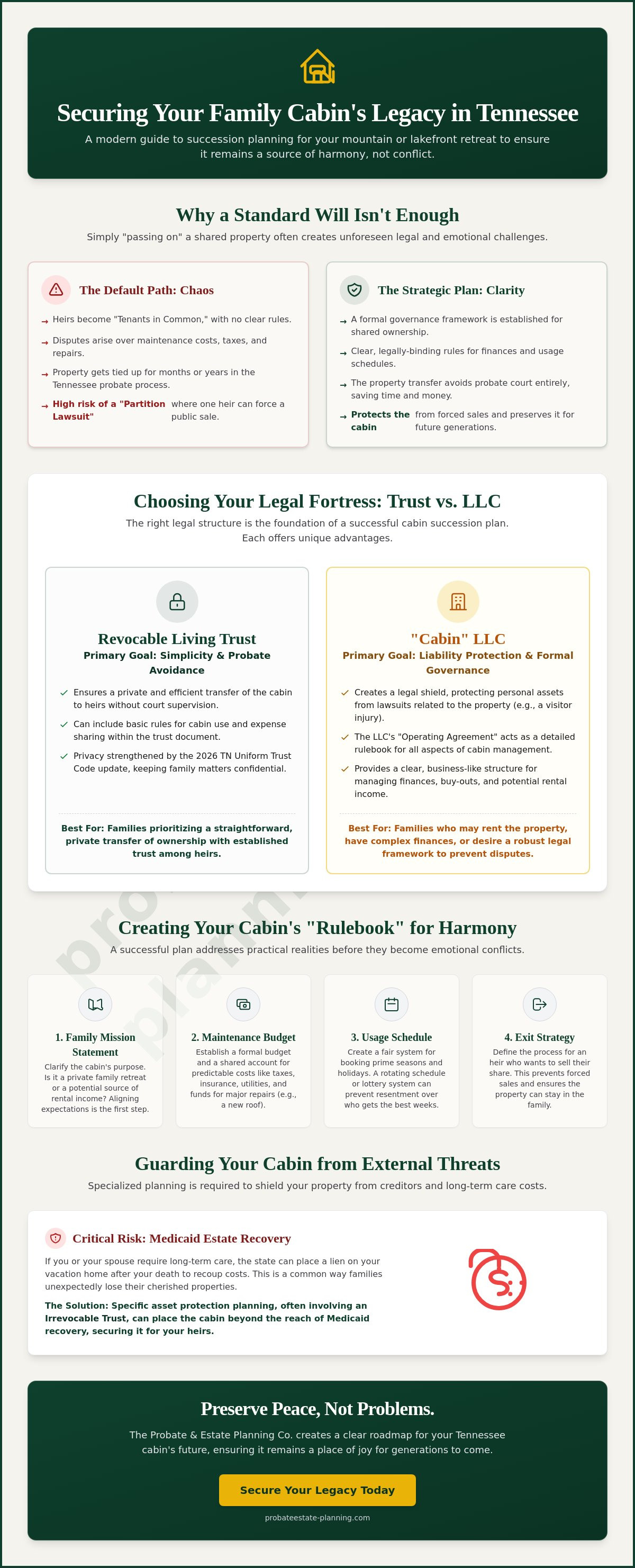
Family cabin succession planning tennessee is a specialized legal strategy designed to transition a seasonal property to multiple heirs while minimizing the risk of internal conflict. Most people assume that a standard Last Will and Testament is enough to handle a mountain retreat or lakefront home. However, simply "passing it on" often leads to a legal stalemate. Preserving a property for generations requires a governance framework that addresses who pays the bills, who gets the holiday weeks, and what happens if someone wants out. Without this level of detail, the property falls under standard intestacy laws or generic probate rules that weren't built for the nuances of family vacation homes.
The Tennessee probate process can create significant temporal delays. If your cabin is tied up in court for months, basic maintenance like winterizing or lawn care can fall through the cracks. This administrative friction often highlights the difference between a simple real estate transfer and a true succession plan. You need a methodical approach that prioritizes functional reliability over mere administrative preparation.
To better understand the core concepts of cabin preservation, watch this helpful video:
The Unique Challenges of Shared Tennessee Real Estate
In Tennessee, if you leave a cabin to three children without a specific structure, they become "Tenants in Common" by default. This arrangement is often a recipe for family disputes. Each owner has an undivided interest, meaning they all have the right to use the entire property, but no one has the legal authority to force the others to pay for a new HVAC system. Proactive family cabin succession planning tennessee helps you avoid these pitfalls by defining exit strategies for heirs before a crisis occurs. This is vital because one disgruntled heir can file a partition lawsuit to force a public sale of the property. While the Tennessee Uniform Partition of Heirs Property Act offers some protections, 2026 updates clarify that probate law still governs if the property must be brought into an estate to pay debts.
Emotional vs. Legal Ownership
A successful plan starts with an honest conversation about whether your children actually want the responsibility of the cabin. Some may live too far away; others might lack the financial stability to contribute to its upkeep. Sentimental value does not pay for a new roof. You must weigh the emotional attachment against the practical reality of property taxes and local county regulations. Creating a "Family Mission Statement" helps clarify the property's purpose. It ensures everyone agrees on whether the cabin is a private retreat or a potential rental income source before you engage in formal probate administration services or trust creation.
Choosing the Right Legal Structure: Trusts vs. LLCs
Selecting the appropriate legal vehicle is the most critical decision in family cabin succession planning tennessee. While many families default to simple joint ownership, this rarely provides the protection needed for a multi-generational legacy. A revocable living trust serves as the baseline for avoiding the Tennessee probate process. It ensures that the transition of the property happens privately and efficiently, without the delays of a court supervised estate administration. The 2026 update to the Tennessee Uniform Trust Code (SB1910) further strengthens this privacy. As of April 2026, families can redact or seal confidential trust information in court filings without a prior court order, keeping your family's private financial arrangements out of the public record.
While a trust offers administrative ease, a "Cabin LLC" introduces the robust framework of business law to govern what is essentially a personal asset. An LLC is particularly effective when heirs have varying levels of financial stability or interest in the property. It treats the cabin as a business entity, which allows for a more formal management structure. Choosing between these two depends on whether your primary goal is simple probate avoidance or detailed operational governance. Creating a comprehensive estate planning strategy ensures your cabin remains a place of joy rather than a source of legal friction.
The Tennessee Limited Liability Company (LLC) Advantage
An LLC provides a shield against personal liability that a standard trust cannot match. If a guest is injured on the property, the LLC helps protect the personal assets of the individual owners from a potential lawsuit. To establish this, you must file Articles of Organization with the state, which carries a minimum initial fee of $300 as of 2026. Maintaining the entity requires an annual report fee, also starting at a minimum of $300. The heart of this structure is the Operating Agreement. This document acts as a rulebook, detailing how property taxes are split, how repair costs are handled, and the process for transferring a member's interest if they wish to exit the arrangement.
Specialized Trusts for Asset Preservation
For high-value Tennessee retreats, a standard revocable trust may not offer enough protection. Irrevocable trusts are often utilized to shield the cabin from future creditors or to prepare for long-term care needs. Tennessee is a leading jurisdiction for these tools, specifically through the Tennessee Investment Services Trust (TIST). This is a type of Domestic Asset Protection Trust that allows you to be a beneficiary of your own trust while protecting the asset from most creditors. These specialized trusts are also ideal for managing the property for minor grandchildren, ensuring the cabin is preserved until they reach an age of financial responsibility.
Creating a Cabin Governance and Maintenance Plan
Establishing a legal entity like a trust or an LLC is a vital first step, but a legal shell is useless without a functional "User Manual." You need a clear set of operational guidelines to prevent the friction that often arises when multiple families share one roof. Family cabin succession planning tennessee requires a shift from informal handshake agreements to a methodical governance plan. This document acts as the glue that holds your legal structure together, ensuring that the transition of the property is as smooth as the lake water on a summer morning.
Your governance plan should follow a logical, step-by-step process to eliminate ambiguity. First, establish a detailed budget that covers Tennessee property taxes, specialized insurance for seasonal homes, and routine maintenance like septic pumping or dock repairs. Second, create a fair scheduling system. Many families find success with a rotating priority list for peak weeks, such as the Fourth of July or Thanksgiving, while allowing more flexible access during off-peak months. Third, define specific "House Rules." Clear expectations regarding guests, pets, and unauthorized renovations prevent long-term resentment. Finally, appoint a property manager. This could be a sibling with a knack for logistics or a third-party service. Having one designated point of contact for contractors ensures that vital maintenance tasks don't fall through the cracks.
The "Buy-Out" Clause: Planning for the Exit
Even the most dedicated heirs may eventually find that they can no longer afford their share or simply no longer use the property. A solid plan anticipates this by including a pre-set valuation method. Relying on a professional appraisal or a pre-determined formula prevents arguments over the cabin's value during an emotional transition. It is also wise to include a Right of First Refusal. This legal mechanism ensures the property stays within the bloodline by giving the remaining family members the first opportunity to purchase a departing heir's interest before it can be offered to an outside party.
Funding the Future: The Cabin Endowment
An endowment fund is the financial heartbeat of a legacy property. Without a dedicated source of liquidity, the financial burden of a large mountain retreat can quickly overwhelm your children. You can use life insurance or a portion of your estate to create a maintenance fund for your heirs. This "seed money" stays in the cabin LLC bank account, providing a buffer for unexpected repairs like a new roof or HVAC system. By funding the future today, you ensure the cabin remains a gift to your family rather than a financial liability.
Medicaid Planning and Protecting the Cabin from Long-Term Care Costs
The financial burden of long-term care represents the single greatest threat to your family's legacy. In Tennessee, the average private-pay nursing home rate for 2026 is approximately $7,200 per month. If you or your spouse requires professional care, these costs can rapidly deplete your liquid assets, eventually leaving the family cabin vulnerable to medical liens or forced sales. While many people believe their home is safe, Tennessee Medicaid (TennCare) rules are strict. Your vacation property is not considered an "exempt asset" because it's not your primary residence. This makes integrated family cabin succession planning tennesseeessential for anyone who wants to ensure their mountain retreat isn't lost to the state to cover care costs.
The 60-month look-back period is a critical factor in this process. Any transfer of ownership made within five years of a Medicaid application can trigger a penalty period, during which you'd be ineligible for benefits. Proactive asset protection planning allows you to move the property into a protective structure, such as an irrevocable trust, well before the need for care arises. This methodical approach secures the property's future while ensuring you remain eligible for the support you may eventually need. If you're concerned about how current health transitions might impact your property, it's vital to explore your estate planning options before the five-year clock becomes an obstacle.
Medicaid Crisis Planning for Vacation Homes
If a parent needs immediate nursing home care and the cabin is still in their name, you may feel like it's too late. However, specialized Medicaid crisis planning can still provide solutions to safeguard a portion of the family legacy. You should avoid gifting the cabin to children outright in a panic. Doing so can trigger immediate tax penalties and expose the property to the children's personal creditors or legal issues. Instead, legal strategies can often be used to restructure assets even after a health crisis has begun, providing a path toward eligibility while protecting what matters most.
Life Estates and Lady Bird Deeds in Tennessee
Retaining a life estate in the family cabin is a common strategy, but it requires careful execution under Tennessee law. A life estate allows you to use the property for the rest of your life while the "remainder interest" passes to your heirs automatically upon your death. This avoids probate and ensures your children receive a "step-up in basis." This tax benefit means they'll inherit the property at its current market value rather than what you originally paid, potentially saving them thousands in capital gains taxes. While some states use "Lady Bird Deeds" for this purpose, Tennessee's specific statutes regarding deed transfers and Medicaid recovery mean you need a plan tailored to local regulations to avoid unintended complications.
How The Probate & Estate Planning Co. Secures Your Tennessee Legacy
Protecting a multi-generational vacation home requires more than just filling out standard forms. It requires a partner who understands the emotional weight of your legacy and the technicalities of state-specific statutes. Our firm brings multi-state experience in Tennessee, North Carolina, and South Carolina law to every consultation. This regional perspective is vital for families whose members may live across state lines but share a single retreat in the Smokies or on the banks of the Tennessee River. We specialize in family cabin succession planning tennessee by looking at the entire picture, ensuring your legal documents reflect your unique family dynamics.
We take a holistic approach that balances current needs with future protection. By combining our expertise in probate administration services with proactive estate planning, we help you anticipate hurdles before they manifest. Our role is to act as a steady guide, facilitating the "hard conversations" between heirs that many families tend to avoid. We help you address potential conflicts over usage, expenses, and ownership today, so your children don't have to resolve them in a courtroom later. This methodical process provides the functional reliability you need to rest easy.
Customized Document Preparation
Every cabin is different, and your legal documents should be too. We focus on drafting LLC Operating Agreements that prioritize family harmony by including clear rules for dispute resolution and property maintenance. If your goals include long-term care protection, we design irrevocable trusts specifically structured to survive the five-year Medicaid look-back period. We also ensure your Last Will and Testament is fully updated to align with your cabin succession goals. This level of detail ensures that your property transition is predictable and secure.
A Steady Guide Through Complex Transitions
Our commitment goes beyond managing administrative tasks. We strive to protect your interpersonal connections as much as your physical assets. The peace of mind that comes from professional authority allows you to focus on enjoying the property with your loved ones now, rather than worrying about the "what-ifs" of 2026. We offer a partnership in long-term management, providing the wisdom and competence required to navigate sensitive transitions. Contact us today to begin your journey and schedule a legacy consultation to secure your family's future in the Tennessee hills.
Protecting Your Sanctuary for the Next Generation
Your Tennessee cabin is more than just a piece of real estate; it's the foundation of your family's history. Securing its future requires a plan that addresses both legal technicalities and interpersonal dynamics. By choosing the right legal structure and establishing a clear governance manual, you prevent the administrative delays of probate and the emotional toll of sibling disputes. Proactive asset protection also ensures that the rising costs of long-term care don't force a sale of your cherished retreat. Comprehensive family cabin succession planning tennessee is the most reliable way to transform a potential burden into a lasting gift for your heirs.
Our practice offers a steady hand through these complex transitions. We bring multi-state legal expertise across Tennessee, North Carolina, South Carolina, and Maryland, ensuring your plan is robust regardless of where your family members reside. With a specialized focus on Medicaid Crisis Planning and Asset Protection, we prioritize your emotional well-being alongside your formal security. We don't just draft documents; we partner with you to preserve your most important interpersonal connections. Secure your family legacy—schedule a consultation with our Tennessee estate planning team today. You've spent a lifetime building these memories, and we're here to help you protect them for the generations to come.
Frequently Asked Questions
Can I just put my kids' names on the cabin deed in Tennessee?
You can, but doing so is rarely a sound strategy for long-term security. Adding children to a deed is considered an immediate gift by the IRS, which can complicate your tax situation and forfeit the "step-up in basis" that would otherwise save your heirs from heavy capital gains taxes. More importantly, it exposes your cherished property to your children's personal risks, such as lawsuits, creditors, or divorce settlements. If one child faces financial trouble, a lien could be placed on the entire family cabin.
Does a family cabin have to go through probate in Tennessee?
If the property is held in your individual name or as a tenant in common, it must pass through the Tennessee probate court before it can be transferred to your heirs. This process often involves significant delays and public filings that many families prefer to avoid. Holding the property in a Revocable Living Trust or a properly structured LLC allows the transition to happen privately and immediately, ensuring the cabin remains available for family use without court intervention.
What is the best legal entity for a shared family vacation home?
The "best" entity depends on your specific goals, but an LLC is often the superior choice for governance and liability protection. While a trust is excellent for avoiding probate, an LLC allows you to create a detailed Operating Agreement. This document acts as a rulebook for usage schedules, expense sharing, and maintenance responsibilities. It also provides a shield between the property and your heirs' personal assets, which is a vital component of family cabin succession planning tennessee.
How do we handle a sibling who won't pay their share of cabin expenses?
This common conflict is best managed through a pre-written enforcement mechanism in your LLC Operating Agreement or Trust. You can include provisions that suspend a sibling's usage rights if they fail to contribute to taxes or insurance. In more serious cases, the agreement can allow the other owners to pay the delinquent share and receive a larger equity stake in return. Having these rules in place before a dispute arises prevents resentment and keeps the property financially stable.
Will Medicaid take my family cabin if I go into a nursing home?
Tennessee Medicaid, known as TennCare, considers a vacation cabin a countable asset because it is not your primary residence. If you require long-term care, you may be forced to sell the property to meet the $2,000 asset limit for eligibility. However, proactive family cabin succession planning tennessee using an irrevocable trust can protect the home. If the transfer occurs at least five years before you apply for benefits, the cabin is generally shielded from estate recovery and medical liens.
What happens to the cabin if one of my children gets a divorce?
Without a protective legal structure, a child's interest in the cabin could be considered a marital asset or its value could be used to offset other assets in a divorce settlement. You can prevent this by using a trust or LLC with a "spendthrift" clause or a "bloodline" provision. These legal tools ensure that the interest in the property stays within your family and cannot be transferred to a former spouse, preserving the legacy for your grandchildren.
Is an LLC or a Trust better for avoiding Tennessee inheritance issues?
Since Tennessee repealed its inheritance tax in 2016, the primary "inheritance issues" families face are probate costs and interpersonal conflict. A Revocable Living Trust is often the most cost-effective way to bypass probate and ensure a smooth transition. However, if you anticipate that your children will struggle to agree on property management, an LLC provides a more robust framework for resolving disputes. Many families find that a combination of both tools offers the most comprehensive protection.
Comments
There are no comments for this post. Be the first and Add your Comment below.
Leave a Comment