

You find yourself standing before a mountain of paperwork, feeling the heavy responsibility of a loved one's final wishes while worrying that a single missed court deadline could lead to personal liability. It's a weight no one should carry alone. You likely feel a deep desire to protect your family's harmony, yet the confusion between Maryland's 10% inheritance tax and the $5 million estate tax exemption creates a sense of constant unease.
This executor of estate checklist maryland provides the professional roadmap you need to move forward with quiet confidence. We've designed this 2026 guide to simplify the next 12 months, ensuring you meet every requirement from the Register of Wills without the typical stress. You'll learn how to identify small estate shortcuts, manage creditor claims within the strict six-month window, and efficiently distribute assets so you can focus on what matters most: protecting a legacy.
Key Takeaways
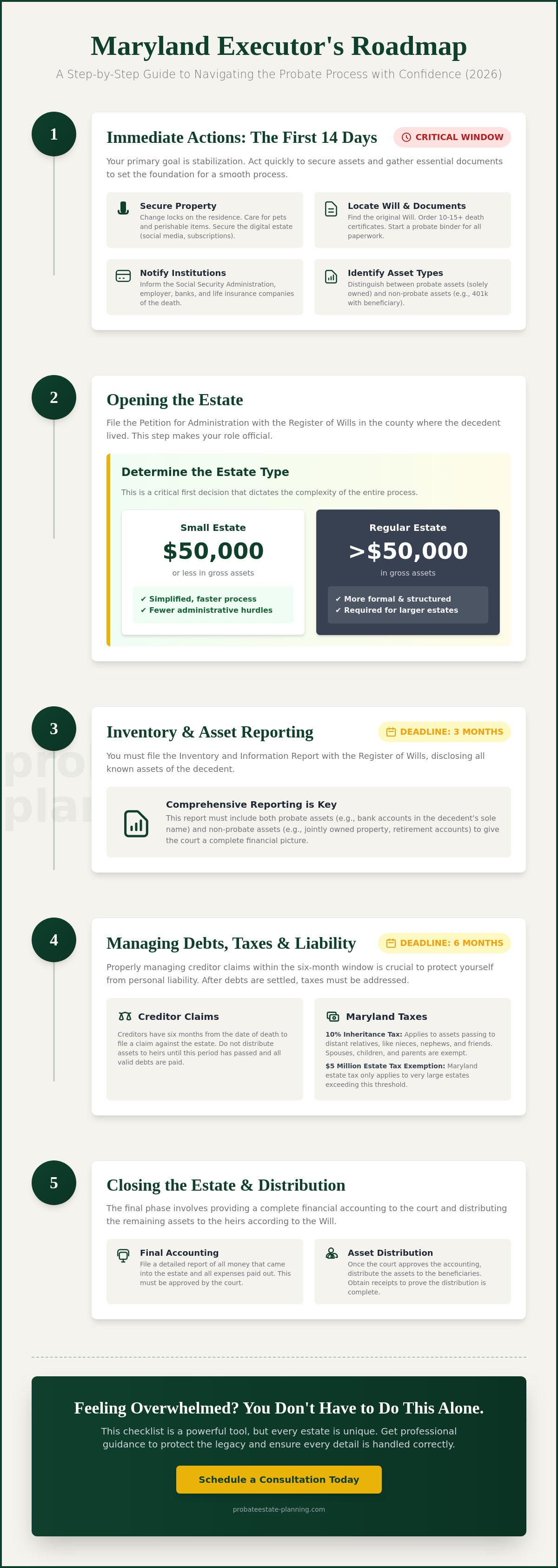
- Master the critical first 14 days by securing the residence and locating the original Will before filing in the correct Maryland county.
- Navigate the Register of Wills with a comprehensive executor of estate checklist maryland that guides you through filing the Petition for Administration.
- Understand the mandatory three-month deadline for filing the Inventory and Information Report to disclose both probate and non-probate assets.
- Protect yourself from personal liability by managing the six-month creditor claim period and identifying which heirs are subject to the 10% inheritance tax.
- Streamline the final accounting process to ensure a harmonious distribution of assets that honors your loved one's legacy.
Immediate Actions for a Maryland Executor: The First 14 Days
The weight of your new role as an Executor often feels heaviest in the quiet moments following a loss. You aren't just managing files; you're safeguarding a life's work. During these first 14 days, your primary goal is stabilization. You don't need to have every answer yet, but you must act quickly to prevent loss or confusion. This initial window is the most critical part of your executor of estate checklist maryland, as it sets the tone for the entire probate process.
To better understand how this process fits into the broader legal landscape, watch this helpful video on the Maryland probate process:
Your first task is locating the original Last Will and Testament along with any codicils. Maryland law requires the custodian of a Will to deliver it to the Register of Wills promptly after a death. You should also order at least 10 to 15 certified copies of the death certificate. You'll find that every financial institution, from banks to life insurance companies, will demand their own original copy before they'll even speak with you. Don't forget to notify the Social Security Administration and the decedent's employer to stop payments and inquire about survivor benefits.
Securing the Physical and Digital Estate
Security is about more than just locking the front door. If non-heirs or distant relatives have keys to the residence, you should change the locks immediately to protect the assets. You must inventory and provide care for perishable items and pets first to ensure no living thing or valuable resource is neglected. In our modern age, you also need to secure the digital estate. This means identifying social media accounts, email access, and cancelling recurring subscriptions like streaming services or cloud storage that can drain estate funds if left active.
Locating and Protecting Vital Documents
Organization is your best defense against anxiety. Start a probate binder to track every receipt, letter, and court filing. You'll need this for reimbursement later. Search for life insurance policies, safe deposit box keys, and military discharge papers, which may provide burial benefits. It's also vital to identify non-probate assets early. Items like 401(k) accounts with named beneficiaries or Payable on Death bank accounts bypass the court entirely. Distinguishing these from probate assets now will save you months of confusion when you finally file your inventory with the court.
Opening the Estate: Navigating the Maryland Register of Wills
Walking into the Register of Wills for the first time often feels like a daunting milestone. It's the moment your role as a personal representative becomes official. In Maryland, you must open the estate in the county where the decedent lived at the time of their death. This office acts as your primary administrative contact throughout the process, providing the necessary forms and oversight to ensure the legacy is protected. If you live outside of Maryland, you'll need to appoint a Resident Agent. This is simply a person living in the state who can accept legal documents on your behalf, ensuring the court always has a reliable point of contact.
One of the most important steps on your executor of estate checklist maryland is determining the size of the estate, as this dictates your entire workload. The "Regular Estate" process is more formal, while a "Small Estate" offers a streamlined path with fewer administrative hurdles.
Small Estate vs. Regular Estate in Maryland
Maryland law distinguishes between estates based on their gross value. This distinction is vital because it determines how many filings you'll manage over the coming year.
| Estate Type | Gross Value Threshold | Process Complexity |
|---|---|---|
|
Small Estate |
$50,000 or less |
Simplified; faster closure |
|
Regular Estate |
Over $50,000 |
Full administration required |
There is a significant exception to these rules. If the surviving spouse is the sole heir or legatee, the threshold for a small estate increases to $100,000. This higher limit acknowledges the unique bond of marriage and allows for a more efficient transfer of assets to a grieving spouse.
Filing the Petition and Obtaining Letters of Administration
Once you've identified the estate type, you'll prepare the Petition for Administration along with "Schedule A," which provides a preliminary look at the estate's value. You must also file a List of Interested Persons, which includes all heirs and people named in the Will. The court often requires a "Bond," a form of insurance that protects the heirs from any potential mismanagement. For a more detailed look at the procedural timeline, the Maryland People's Law Library offers a step-by-step breakdown of these statutory requirements.
Upon approval, the court issues "Letters of Administration." These documents are your legal "key." They prove to banks, the MVA, and utility companies that you have the authority to act. If the paperwork feels overwhelming, seeking professional probate administration services can help you navigate these filings with precision and peace of mind.
The Inventory and Information Report: Tracking Estate Assets
Once you've received your Letters of Administration, your focus shifts from court filings to the meticulous work of accounting for what was left behind. This stage of the executor of estate checklist maryland requires you to act as a diligent steward of the decedent's legacy. You're now tasked with identifying everything the decedent owned, from the family home to forgotten bank accounts. Maryland law requires you to file two distinct documents within three months of your appointment as personal representative: the Inventory and the Information Report.
The Inventory (Form 1122) focuses on probate assets, which are items held solely in the decedent's name. In contrast, the Information Report (Form 1124) covers non-probate assets that pass directly to beneficiaries outside of the Will. You must take this three-month deadline seriously. Failing to file these documents on time can result in the court issuing a "Show Cause" order, which essentially requires you to appear before a judge to explain the delay. This added stress is easily avoided with a methodical approach to asset tracking.
Valuing Real Estate and Personal Property
Determining the worth of the estate isn't just about total numbers; it's about establishing a legal baseline for future tax obligations. For initial estimates of Maryland property, you can use the values provided by the Maryland Department of Assessments and Taxation (SDAT). However, these figures often lag behind current market trends. The Date of Death Value serves as the critical baseline for determining the tax basis of an asset when it is eventually sold by an heir. For regular estates, you'll likely need a formal, professional appraisal for real estate, jewelry, or unique collectibles to ensure accuracy and protect yourself from future disputes among beneficiaries. For a deeper look at these requirements, the Maryland Estate Administration Guide provides a helpful framework for managing these valuations.
Identifying Non-Probate and Jointly Held Assets
It's a common misconception that an executor only worries about what is mentioned in the Will. You must also document non-probate assets on the Information Report to ensure all state tax requirements are met. This includes property held as "Tenants by the Entirety," a specific form of joint ownership between spouses that automatically transfers to the survivor. You also need to track accounts with "Transfer on Death" (TOD) or "Payable on Death" (POD) designations. While these assets bypass the probate court's control, they still represent a portion of the decedent's financial footprint that must be reported. By clearly identifying these items early, you maintain the transparency necessary to preserve family harmony and fulfill your fiduciary duty.
Debts, Taxes, and Fiduciary Liability in Maryland
Managing the financial obligations of an estate is where your role as a personal representative carries the most personal risk. While you've already inventoried the assets, you cannot simply begin writing checks to heirs. Maryland law requires you to prioritize the estate's obligations first. If you distribute funds too early and the estate later lacks the money to pay a valid creditor or tax bill, you could be held personally liable for the shortfall. This reality is why the executor of estate checklist maryland emphasizes patience and precision over speed.
You must maintain a separate estate bank account and never comingle these funds with your own. Your fiduciary duty requires you to act with the highest standard of care, putting the interests of the beneficiaries and creditors above your own. This includes filing the decedent's final federal and state 1040 income tax returns for the year they passed away, as well as the Form 1041 fiduciary return if the estate generates more than $600 in gross income during the administration period.
Managing Creditor Claims and Priority of Payments
Creditors generally have six months from the decedent's date of death to file a claim against the estate. This timeline is strict. To start this clock, you must publish a "Notice to Creditors" in a local newspaper in the county where the estate was opened. If a claim is filed after the six-month window, you typically have the right to deny it. However, if a claim is valid and filed on time, Maryland law dictates a specific order of priority for payment:
- Funeral expenses (up to statutory limits).
- Court costs and Register of Wills fees.
- Family allowance for a surviving spouse or children.
- Federal and state taxes.
- Medical expenses from the decedent's final illness.
- All other valid, unsecured debts.
Maryland Inheritance Tax vs. Estate Tax
Maryland is currently the only state in the country that imposes both an estate tax and a separate inheritance tax. It's easy to confuse the two, but they impact the estate differently. The Maryland estate tax is paid by the estate itself if the total value exceeds $5 million in 2026. This is significantly lower than the 2026 federal exemption of $15 million, meaning many Maryland families will owe state taxes even if they are exempt from federal ones.
The Maryland inheritance tax is a 10% tax paid by certain beneficiaries on the value of the property they receive. While direct descendants like children, parents, and siblings are exempt, "collateral" heirs such as nieces, nephews, cousins, and friends must pay this 10% rate. Managing these calculations requires absolute accuracy to avoid delays in closing the estate. If you're concerned about navigating these complex tax filings, our professional probate administration services can ensure every dollar is accounted for correctly.
Closing the Estate: Final Accounting and Distribution
Reaching the final stage of your responsibilities brings a sense of relief, but this is the moment where meticulous record-keeping truly pays off. As you complete your executor of estate checklist maryland, the First Account serves as your final report card to the court. This document is due within 9 months of your appointment and must account for every penny that entered or left the estate account since the date of death. It isn't just a summary. It's a line-by-line justification of your stewardship.
Once the Register of Wills approves your accounting, you can finally begin the distribution of assets. Whether you're following the specific instructions in a Last Will and Testament or adhering to Maryland's intestacy laws, you must be methodical. Before any heir receives their inheritance, you should obtain a signed Receipt and Release. This document is your shield. It confirms the beneficiary has received their share and releases you from future claims regarding that specific distribution. Only after all debts are paid and assets are distributed can you file the final Petition for Termination and close the estate bank account.
The Final Account Filing Requirements
Your accounting must itemize every administrative expense, including court fees, bond premiums, and any professional fees. You're also entitled to a Personal Representative commission for your time and effort. Under Maryland law, this compensation is capped at a maximum of 9% on the first $20,000 of the estate's value and 3.6% on any amount above that threshold. To ensure transparency, you must file a Certificate of Service. This confirms you've provided a copy of the account to all interested parties, giving them the opportunity to review your work before the court grants final approval.
When to Seek Professional Maryland Probate Counsel
While many estates are straightforward, certain red flags suggest you need professional guidance. If you're facing family litigation, complex tax issues involving the Maryland estate tax, or an insolvent estate where debts exceed assets, the risk of personal error is too high. You don't have to carry this burden alone. In most cases, legal fees for probate assistance are paid directly from the estate assets rather than your own pocket. If the process feels overwhelming, Schedule a consultation with our Maryland probate team to ensure your loved one's legacy is handled with the precision and care it deserves.
Securing Your Loved One's Legacy with Confidence
You now have a clear roadmap for the months ahead. By following this executor of estate checklist maryland, you've learned how to secure assets within the first 14 days and navigate the specific tax thresholds that define the Maryland probate process. Remember that meeting the three-month inventory deadline and respecting the six-month creditor window are the best ways to protect yourself from personal liability while ensuring a smooth distribution to heirs.
Our firm brings decades of experience working within Maryland Register of Wills offices to provide the empathetic guidance your family needs during this difficult transition. We prioritize your peace of mind through transparent fee structures for probate administration, helping you move away from confusion toward a place of legal security. To further simplify your journey, Download our Full Maryland Executor Toolkit and gain access to the resources you need to fulfill your duties with precision.
You've already taken the most important step by seeking the knowledge required to lead your family through this process. With a steady hand and a clear plan, you'll successfully preserve your loved one's legacy and protect the future of those they cared for most.
Frequently Asked Questions
How long do I have to file a Will in Maryland after someone dies?
Maryland law requires the custodian of a Will to deliver the original document to the Register of Wills promptly after learning of the person's death. While the statutes don't provide a specific day-count penalty, failing to file the Will can lead to legal complications or court orders. It's best to handle this within the first few weeks to ensure the estate administration begins without unnecessary friction.
What is the difference between a Small Estate and a Regular Estate in Maryland?
The distinction depends entirely on the gross value of the assets solely owned by the decedent. An estate qualifies as a small estate if the value is $50,000 or less, though this limit increases to $100,000 if the surviving spouse is the only heir. Regular estates exceed these thresholds and require a more formal, structured process that typically involves more extensive court filings and a longer timeline for closure.
Does an executor get paid in Maryland?
Yes, personal representatives are entitled to a commission as compensation for their fiduciary duties. Maryland law caps this payment at 9% of the first $20,000 of the estate's value and 3.6% of any amount exceeding $20,000. This commission is a way to acknowledge the significant time and responsibility required to manage the executor of estate checklist maryland tasks while protecting the interests of all beneficiaries.
Can I be held personally liable for the estate's debts in Maryland?
You can be held personally liable if you distribute assets to beneficiaries before satisfying the estate's valid debts and taxes. As the personal representative, you are responsible for following the legal order of payments. If you deplete the estate's funds by paying heirs too early and a valid creditor or tax bill remains unpaid, the court may require you to use your own assets to cover the shortfall.
How long does the probate process usually take in Maryland?
A regular estate typically takes between 9 and 12 months to reach completion. This timeline is largely driven by the mandatory six-month window that creditors have to file claims against the estate. While a small estate can often be settled in a few months, more complex cases involving property sales, business interests, or disputes among family members can extend the process well beyond the one-year mark.
What happens if the decedent died without a Will in Maryland?
The estate will be distributed according to Maryland's intestacy laws, which provide a rigid formula for how assets pass to surviving relatives. The court will still appoint a personal representative to manage the executor of estate checklist maryland, but that person must follow state law rather than the decedent's private wishes. This often leads to outcomes that may not reflect the family's unique needs or the decedent's true intentions.
Do I need a lawyer to be an executor in Maryland?
Maryland law doesn't require you to hire an attorney, but many executors find the process too complex to navigate alone. Professional guidance is especially helpful when dealing with regular estates, potential family conflict, or the state's unique tax landscape. Since legal fees are generally paid from the estate's assets rather than your own pocket, hiring counsel is a practical way to ensure you fulfill your duties correctly.
What is the Maryland inheritance tax rate for 2026?
The Maryland inheritance tax rate is 10% for assets distributed to collateral heirs. This tax specifically impacts beneficiaries like nieces, nephews, cousins, and friends. It is important to remember that direct family members, including spouses, children, parents, and siblings, are exempt from this tax. This 10% rate is distinct from the Maryland estate tax, which only applies to estates valued over $5 million in 2026.
Comments
There are no comments for this post. Be the first and Add your Comment below.
Leave a Comment