

In Tennessee, silence is often a quiet choice to disinherit the people you love most. You likely believe that your spouse will naturally look after your children from a previous marriage, but without a formal strategy, state law often dictates a very different outcome. Effective estate planning for blended families in Tennessee requires more than just good intentions. It demands a proactive approach to override default statutes that don't account for modern family structures. It's a heavy responsibility to weigh the security of a current partner against the legacy of your biological children, and it's natural to feel anxious about the potential for family conflict after you're gone.
You deserve the peace of mind that comes from knowing every family member is treated fairly and protected from legal uncertainty. This guide will show you how to balance your spouse's immediate needs with your children's long-term inheritance while navigating the complexities of Tennessee's elective share laws. We'll explore how to use tools like revocable living trusts to bypass probate delays, minimize estate taxes, and ensure your legacy remains exactly as you intended. By the end of this article, you'll have a clear path toward a plan that honors every relationship in your life.
Key Takeaways
- Learn why traditional "I-Love-You" wills often lead to the accidental disinheritance of biological children in complex family structures.
- Understand how Tennessee's elective share and intestacy laws can override your intentions if you die without a proactive, legally sound strategy.
- Discover why a Revocable Living Trust is often the most effective tool for estate planning for blended families in Tennessee, offering more control than a standard will.
- Get a practical checklist for auditing your assets and updating beneficiary designations to ensure your life insurance and retirement accounts align with your goals.
- Gain peace of mind by exploring custom legal solutions that provide for your surviving spouse while guaranteeing a lasting legacy for your children.
The Unique Challenges of Blended Family Estate Planning in Tennessee
Creating a legacy is a deeply personal task, yet for many, it feels like a zero-sum game. You want to ensure your spouse lives comfortably, but you also want to guarantee that the assets you've spent a lifetime building eventually reach your children. In Tennessee, the default legal framework isn't designed for these nuances. It often forces a choice between two parties you love equally. This is why understanding estate planning is essential; it moves you away from generic solutions toward a protective, intentional strategy. Without this clarity, you risk leaving your family's future to chance.
Tennessee law is quite specific about who inherits when there is no plan in place. If you die without a valid will, the state's intestacy laws prioritize biological and legally adopted children alongside your spouse. However, stepchildren are not recognized as heirs under these default rules. This creates a precarious situation where your intentions for your stepchildren might never be realized, or conversely, your biological children might find their inheritance diminished by a surviving spouse's legal claims. Effective estate planning for blended families in Tennesseeis about taking the wheel so the state doesn't drive your legacy into a ditch.
The "Simple Will" Trap
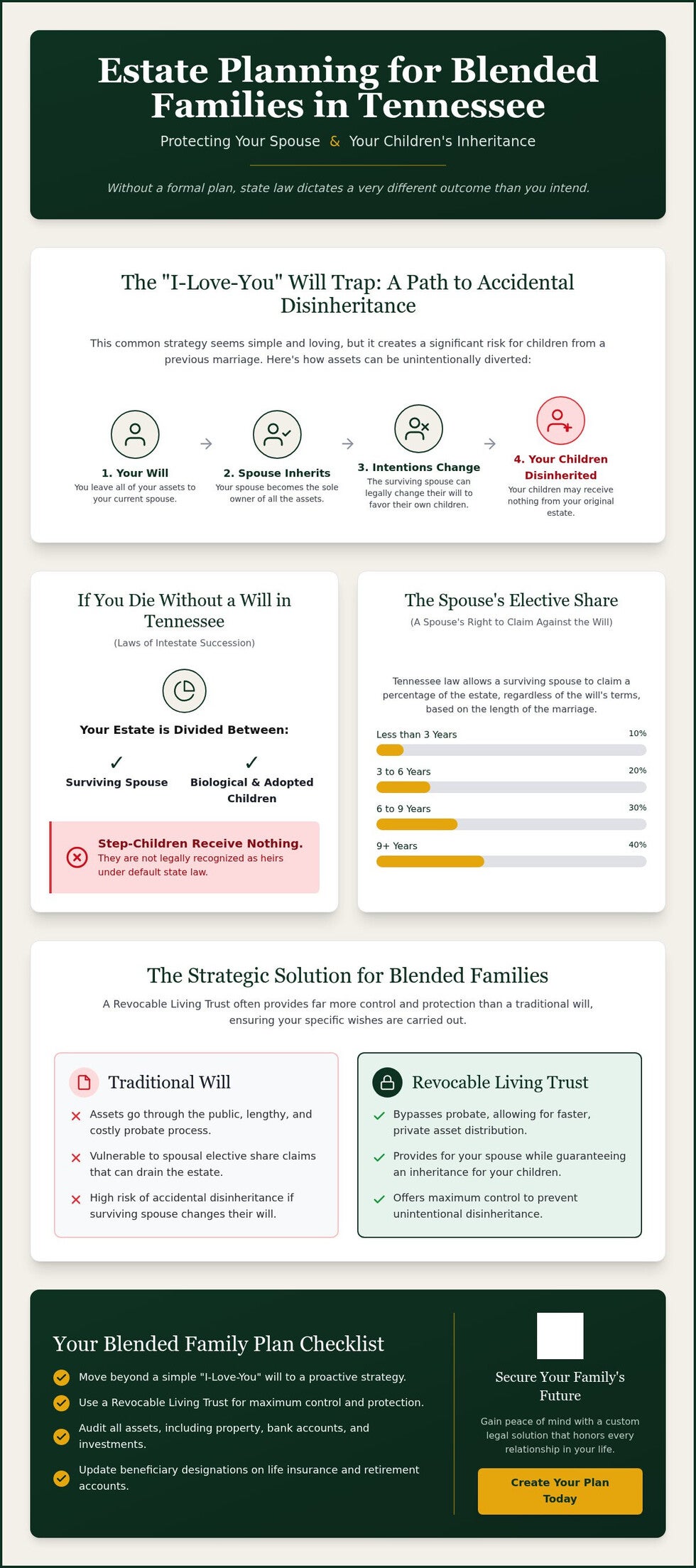
Many couples opt for what we call "I-Love-You" wills, where each spouse leaves everything to the other. While this feels romantic and straightforward, it's often the primary cause of accidental disinheritance. Once you pass away, your surviving spouse becomes the sole owner of those assets. They have the legal right to change their own will entirely. They might remarry, or they might simply decide to leave everything to their own biological children, effectively cutting yours out of the family legacy. In Tennessee probate court, a verbal promise to "take care of the kids" carries no legal weight. Without a written, legally binding plan, your children have no recourse if they're excluded later on.
Balancing Competing Interests
The core of estate planning for blended families in Tennessee is finding a middle ground where no one loses. You're trying to solve two puzzles at once: maintaining your spouse's standard of living and securing your children's future. It's common to feel a sense of guilt or anxiety when discussing these topics. An experienced attorney acts as a steady guide, helping you look at the facts without the cloud of emotional pressure. The Blended Family Conflict is a preventable legal hurdle that arises when a lack of structure forces loved ones into opposing positions during a time of grief. By being proactive, you can ensure that your spouse is supported while your biological children remain protected from being overlooked.
Understanding Tennessee Laws: Why Your Current Plan Might Fail
Relying on a standard estate plan or, worse, having no plan at all, leaves your family vulnerable to the default statutes of the state. If you pass away without a valid will in Tennessee, the laws of intestate succession take over. These rules are rigid; they don't care about the unique bonds you've formed with step-children or the verbal promises you've made. Under intestacy, your assets are divided between your surviving spouse and your biological or legally adopted children. Step-children receive nothing. This rigid distribution often creates immediate financial friction, especially if your spouse and children have different long-term needs. Effective estate planning for blended families in Tennessee requires you to step outside these defaults to ensure everyone you love is intentionally included.
The Tennessee Elective Share Explained
Even if you create a will that leaves everything to your children, Tennessee law provides a safety net for surviving spouses called the Elective Share. This statute allows a spouse to "elect" against the will and claim a percentage of the "net estate" regardless of what your documents say. The percentage they can claim depends entirely on the length of your marriage. For marriages of less than three years, the share is 10%; this increases to 20% for three to six years, 30% for six to nine years, and reaches 40% once you've been married for nine years or more. This law exists to prevent spouses from being left destitute, but it can inadvertently drain the funds you specifically earmarked for your children's inheritance or education.
Beyond the elective share, Tennessee also offers "Year's Support" and "Homestead" exemptions. These allow a surviving spouse to claim additional assets and the right to remain in the family home, potentially displacing children from a prior marriage. If these legal layers feel daunting, speaking with a professional about estate planning can provide the clarity you need to protect both your spouse and your legacy.
Probate and Non-Probate Assets
A common mistake is focusing solely on the will while ignoring how assets are actually titled. In Tennessee, many assets never pass through probate, meaning your will has no power over them. For example, if you own a home as "Joint Tenants with Right of Survivorship" (JTWROS) with your spouse, that property transfers to them automatically upon your death. The same applies to "Pay on Death" (POD) bank accounts or life insurance policies with a named beneficiary. When managing estate planning for a blended family, you must look at the total picture. If all your major assets are titled jointly with your spouse, your biological children may be left with nothing, even if your will says otherwise. You must align your beneficiary designations with your overall goals to prevent accidental disinheritance.
Strategic Tools: Trusts vs. Wills for Step-Children and Spouses
A Last Will and Testament is often the first document people consider, yet it offers limited control over the long-term journey of your assets. A will is essentially a one-time set of instructions. Once your estate passes through probate and assets are distributed to your surviving spouse, your influence ends. If you want to ensure your biological children receive their intended inheritance after your spouse passes, a will alone may not be enough. This is a central challenge in estate planning for blended families in Tennessee. To protect everyone involved, you need tools that offer ongoing oversight and specific conditions for distribution.
Trusts provide a level of flexibility that a standard will cannot match. They allow you to dictate not just who receives your property, but when and how they receive it. For many remarried couples, the goal is to provide financial security for a current partner while "locking in" a legacy for children from a previous marriage. This proactive approach prevents the common scenario where assets are diverted away from your children due to a spouse's future remarriage or change of heart. By using a Estate Planning for the Blended Family strategy, you can create a framework that honors all your interpersonal connections without leaving anyone's future to chance.
The Power of the QTIP Trust
A Qualified Terminable Interest Property (QTIP) trust is a sophisticated tool designed specifically for these circumstances. It allows you to provide for your surviving spouse by giving them access to the income generated by the trust's assets for the rest of their life. However, the spouse does not own the principal. When they pass away, the remaining assets go directly to your children as you originally specified. This ensures your spouse maintains their standard of living while preventing them from changing the ultimate beneficiaries. In 2026, with federal estate tax exemptions at $15 million per individual, these marital trusts also offer significant tax advantages by deferring taxes until the death of the second spouse.
Revocable Living Trusts: Privacy and Control
Unlike a will, which becomes a public record during the Tennessee probate process, a trust remains private. This keeps your family's financial details and distribution choices out of the public eye. A trust also provides vital protection if you or your spouse become incapacitated. Instead of a court-supervised guardianship, your handpicked successor trustee can step in to manage assets according to your exact instructions. This continuity is essential for maintaining family harmony during difficult transitions. You can learn more about our Revocable Living Trust services to see how this tool fits into your specific family dynamic.
Finally, consider using life insurance as a "legacy equalizer." If you plan to leave the family home or a business to your spouse, a life insurance policy can provide a separate, immediate inheritance for your children. This ensures that no one feels slighted or left behind, providing the functional reliability your family needs for long-term security.
A Practical Checklist for Your Tennessee Blended Family Plan
Turning your intentions into a functional reality requires a methodical approach. While understanding the legal landscape is the first step, the second is taking concrete action to align your paperwork with your goals. Estate planning for blended families in Tennessee isn't a one-time event; it's a process of continuous refinement. Start by gathering every document related to your financial life, including divorce decrees or settlement agreements from previous marriages. These documents often contain obligations that must be satisfied before your current estate can be distributed. Use the following checklist to ensure no detail is overlooked:
- Inventory all assets: List everything from real estate to digital accounts, noting how each is currently titled.
- Review marital agreements: Consider a pre-nuptial or post-nuptial agreement to formally waive elective share rights, ensuring your specific distribution plan remains intact.
- Schedule a family meeting: Open communication, often facilitated by a professional, can manage expectations and prevent future resentment.
- Audit beneficiary forms: Check every retirement account and life insurance policy for outdated information.
Updating Beneficiary Designations
Many people don't realize that certain assets exist outside the jurisdiction of a will. If you name an ex-spouse on a life insurance policy and forget to update it, that company is legally bound to pay them, regardless of what your current will says. This hierarchy of legal documents means that a simple beneficiary form can override years of careful planning. "Set it and forget it" is the leading cause of estate litigation. You must ensure that your 401(k)s, IRAs, and insurance policies reflect your current family structure. If you haven't reviewed these designations since your last major life change, it's time to schedule an estate planning review to secure your legacy.
Choosing the Right Fiduciary
The person you choose to manage your estate, known as a fiduciary, holds a position of immense responsibility. In a blended family, naming a current spouse or a biological child as the sole executor or trustee can create a perceived conflict of interest. This often leads to tension or legal challenges from other family members who feel their interests aren't being prioritized. Appointing a neutral successor trustee or a professional fiduciary provides a layer of protection for everyone. A neutral party isn't swayed by family history or personal bias; they're simply there to carry out your wishes exactly as written. This decision alone can be the difference between a peaceful transition and a fractured family.
Securing Your Family's Future with The Probate & Estate Planning Co.
Managing the dynamics of a blended family is a delicate act of love and responsibility. At The Probate & Estate Planning Co., we understand that you aren't just distributing assets; you're preserving relationships. Estate planning for blended families in Tennessee requires a firm that looks beyond the legal documents to the human beings they protect. We approach every case with a blend of professional authority and empathetic reassurance, ensuring your voice is heard and your family's unique needs are met. Our goal is to move you from a state of anxiety to a position of structured, predictable security.
A Partnership in Long-Term Management
We don't just draft documents; we safeguard your interpersonal connections through every transition. Our team specializes in crafting custom trusts that provide for a surviving spouse while guaranteeing that children from a prior marriage remain the ultimate beneficiaries of your legacy. For families with complex lives, our multi-state expertise is a vital asset. Whether your property and heirs are located in Tennessee, North Carolina, South Carolina, or Maryland, we provide the seamless continuity required to manage assets across state lines.
Beyond standard preparations, we bring deep experience in Medicaid crisis planning and asset protection planning for Tennessee seniors. These services are essential for protecting your resources from being entirely depleted by long-term care costs, which could otherwise leave your heirs with nothing. We see ourselves as your steady guides, offering wisdom that feels both protective and highly competent. You can contact us for a consultation with a Nashville probate attorney to begin the process of securing your future with a partner who understands the gravity of your situation.
Schedule Your Peace of Mind Today
The year 2026 stands as a critical threshold for many families. With potential federal tax law changes on the horizon, including shifts in the $15 million individual exemption, the plans you made years ago may no longer offer the functional reliability your family deserves. Proactive preparation is the only way to prevent future complications for those you love. Our communication rhythm is measured and patient; we don't rush you through high-pressure tactics. Instead, we flow logically from identifying your specific concerns to offering a methodical, step-by-step solution that restores your peace of mind.
Working with our professional guides means your legacy is handled with meticulous attention to detail. We take pride in delivering practical outcomes that prioritize your emotional well-being alongside your formal security. You've worked hard to build a life that includes everyone you care about. Now is the time to ensure that life is protected by a plan that is as unique as your family. Protect your legacy and your loved ones today by taking the first step toward a secure and predictable outcome.
Take the Next Step Toward Lasting Family Harmony
A legacy isn't built on good intentions alone; it's built on the functional reliability of a well-crafted plan. You now understand how Tennessee's elective share and intestacy laws can inadvertently compromise your wishes if left to chance. By utilizing strategic tools like revocable living trusts and QTIP trusts, you can ensure your spouse is supported while your children's inheritance remains secure. Effective estate planning for blended families in Tennessee requires more than just filling out forms. It demands a partner who understands the intricate emotional and legal layers involved in protecting diverse family structures.
Our practice provides the multi-state legal expertise you need if your life spans across TN, NC, SC, or MD. We focus on complex family dynamics and asset protection with a mentor-led approach that prioritizes your peace of mind. You don't have to navigate these sensitive transitions alone. Secure your family's legacy with a custom Tennessee estate plan and gain the confidence that comes from professional oversight. Your family's future is too important to leave to the default rules of the state. We are here to help you steer toward a predictable, fair, and protective outcome for everyone you love.
Frequently Asked Questions
What happens to my estate in Tennessee if I die without a will and have a blended family?
If you die without a will in Tennessee, the state's intestacy laws dictate how your assets are distributed. Your surviving spouse and biological or legally adopted children will share the estate according to a set formula, but step-children have no legal right to inherit anything. This rigid distribution often fails to reflect the personal bonds and promises you've made within your family.
Can my spouse disinherit my children from a previous marriage in Tennessee?
Yes, a surviving spouse can legally disinherit your children if they become the sole owners of your assets after you pass away. Once property is transferred to them through a simple will or joint ownership, they have the right to create their own will that excludes your biological children entirely. This risk makes proactive estate planning for blended families in Tennessee a vital step in protecting your children's future.
What is a QTIP trust and why is it recommended for blended families?
A Qualified Terminable Interest Property (QTIP) trust is a legal tool that provides life-long income for your surviving spouse while preserving the principal for your children. It's a popular choice for blended families because it ensures your spouse is financially cared for without giving them the power to change the ultimate beneficiaries. This structure provides a reliable balance between the needs of your current partner and your biological children.
How does the Tennessee elective share affect my estate plan?
The Tennessee elective share allows a surviving spouse to claim a statutory percentage of your estate, ranging from 10% to 40% based on the length of your marriage. This claim can override your will and potentially drain funds you specifically intended for your children's inheritance. You must account for this legal right when structuring your plan to avoid unexpected disruptions to your legacy.
Do I need a pre-nuptial agreement to protect my children's inheritance in Tennessee?
A pre-nuptial or post-nuptial agreement is often the most effective way to protect your children's inheritance by having a spouse formally waive their elective share rights. Without such an agreement, your spouse retains a legal claim to a portion of your estate regardless of your written instructions. These agreements provide a clear and enforceable foundation for your broader family goals.
How can life insurance help balance an estate for step-children?
Life insurance serves as a legacy equalizer by providing a dedicated and immediate source of funds for your children while other assets, like the family home, are left to your spouse. This prevents the need to liquidate property to provide for your children and ensures that everyone receives a fair share. It's a practical way to minimize family resentment and provide long-term security for all members.
Is a revocable living trust better than a will for a blended family in Tennessee?
A revocable living trust is often a superior option because it offers greater control and privacy than a standard Last Will and Testament. Unlike a will, a trust bypasses the public probate process and allows you to set specific conditions for how and when your assets are distributed. This is a central component of effective estate planning for blended families in Tennessee, as it prevents accidental disinheritance and protects family harmony.
What is the role of a successor trustee in a blended family trust?
A successor trustee is responsible for managing and distributing the assets within your trust if you become incapacitated or pass away. In a blended family, appointing a neutral third party or a professional fiduciary can prevent perceptions of favoritism and reduce conflict between a spouse and children. Their primary role is to ensure your instructions are followed exactly as written, providing stability during a sensitive transition.
Comments
There are no comments for this post. Be the first and Add your Comment below.
Leave a Comment