

What if the legal document you signed to protect your children actually leaves them stuck in a courtroom for twelve to eighteen months? Many families in North Carolina, South Carolina, Maryland, and Tennessee believe that simply signing a document is enough to bypass the court system. You likely want to ensure your home and savings pass to your heirs without the stress of public filings or frozen accounts. It's a common concern, especially when you own property across state lines and fear the complexity of multi-state laws. You deserve a clear answer to the question: does a trust avoid probate?
The answer is a definitive yes, but there's a catch that often leads to family chaos. A trust only works if it's properly funded and maintained. You'll discover how a trust can protect your family from the delays of probate court and exactly what steps you must take in your state to ensure it works. We'll walk you through the specific requirements for your region and show you how to move from a folder of papers to a plan that offers genuine stewardship. This guide provides the clarity you need to safeguard your legacy and provide lasting harmony for those you love.
Key Takeaways
- Recognize the specific delays, court fees, and public record risks inherent to the probate processes in North Carolina, South Carolina, Maryland, and Tennessee.
- Learn the answer to the vital question, "does a trust avoid probate?" by understanding how changing legal title to a fiduciary entity protects your family's privacy.
- Avoid the "funding" trap that leaves many trusts empty and ineffective, ensuring your assets are properly retitled to work when they are needed most.
- Navigate state-specific "small estate" thresholds and discover how to prevent the nightmare of ancillary probate if you own property across state lines.
- Distinguish between a simple document and a comprehensive estate plan that prioritizes family harmony and provides a clear, guided path for your loved ones.
Understanding Probate: Why Families in the Southeast Seek Alternatives
Probate is the court-supervised legal procedure used to authenticate a person's will and oversee the distribution of their assets. While the system exists to ensure debts are paid and property reaches the right hands, it often creates a heavy emotional and financial weight for families in North Carolina, South Carolina, Maryland, and Tennessee. If you're asking, "does a trust avoid probate?" you're likely looking for a way to shield your loved ones from unnecessary stress during a period of grief.
To better understand this concept, watch this helpful video:
The Real Cost of Probate in Your State
In states like North Carolina and Maryland, probate isn't just a legal formality; it's a matter of public record. Once a will is filed at the courthouse, your family's private financial details and distribution plans become accessible to anyone who cares to look. This loss of privacy is often the first "pain point" families encounter. Beyond privacy, the timeline is a significant burden. In busy jurisdictions like Charlotte, NC or Nashville, TN, the probate process typically spans 9 to 18 months. During this window, assets may be frozen, leaving heirs waiting for their inheritance while court filing fees and executor commissions slowly chip away at the estate's value. In some jurisdictions, these commissions can reach up to 5% of the estate assets, creating a financial leak that proper planning could have prevented.
Will vs. Trust: The Authority Gap
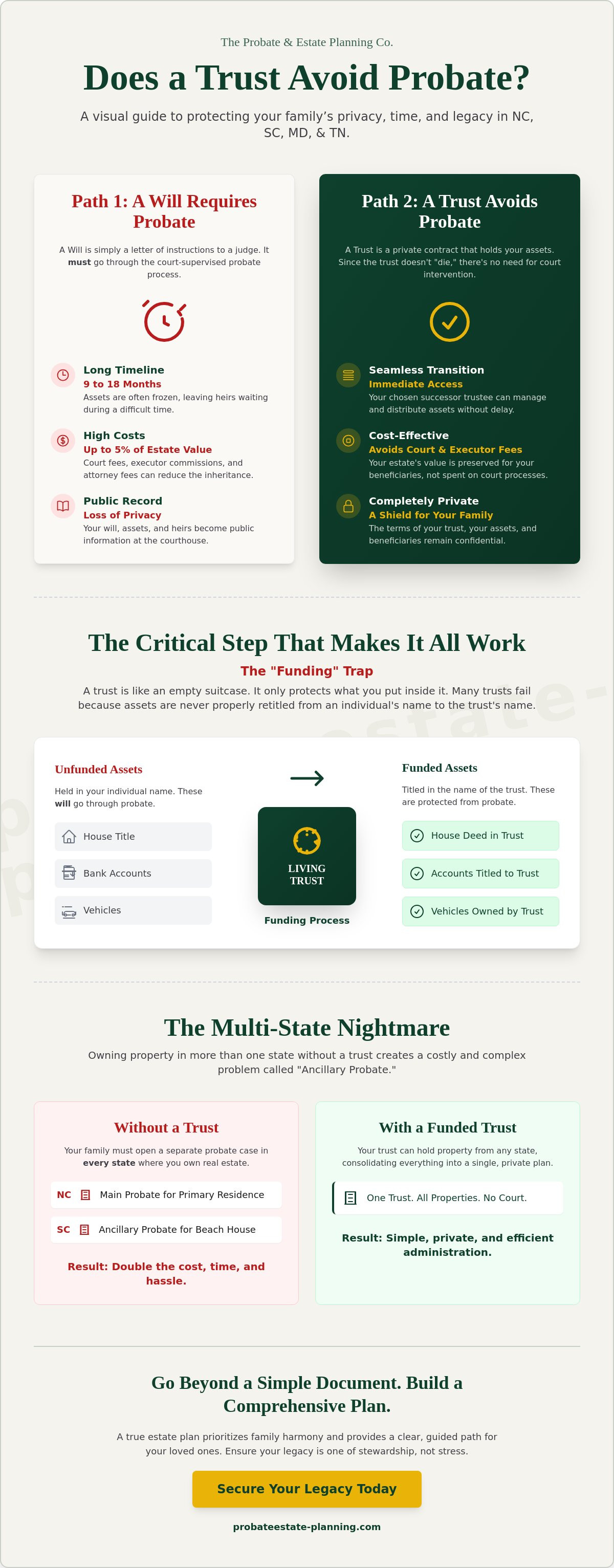
A common misconception is that having a will means you avoid court. In reality, a will is simply a letter of instructions addressed to a judge. It requires the probate process to be effective. A Living trust functions differently. It's a private contract that holds the authority to transfer assets immediately upon your passing without court intervention. This is the fundamental reason why families wonder, "does a trust avoid probate?" as they seek a more seamless transition for their heirs.
The difference lies in how assets are titled. We categorize assets into two groups:
- Probate Assets: Property held in your individual name that requires a court order to transfer.
- Non-Probate Assets: Property titled in a trust or with designated beneficiaries that passes directly to heirs.
By moving your property into a trust, you effectively move it out of the court's jurisdiction. This shift provides a sense of harmony and protection, ensuring your legacy is handled with the quiet dignity your family deserves rather than through a public, slow-moving legal machine.
How a Revocable Living Trust Bypasses the Court System
To understand how a trust functions, you must first understand the concept of legal title. When you own a car or a home in your own name, the law recognizes you as the sole owner. If you pass away, that title is effectively stuck in your name. The probate court must intervene to legally transfer that title to your heirs. This is the primary reason why families ask, does a trust avoid probate? The answer lies in the transition from individual ownership to fiduciary stewardship.
When you create a trust, you change how your property is held. You move the title from yourself to the trust entity. Because the trust is a legal arrangement that exists independently of your physical person, it doesn't die when you do. The court has no jurisdiction over these assets because they aren't part of your "probate estate." They belong to the trust, which remains active and intact.
The Legal Shift of Ownership
Think of a trust as a sturdy suitcase. While you're alive, you own the suitcase and everything inside it. You are the Grantor, the person who created the plan, and usually the initial Trustee, the person who manages it. You have total control. When you fund the trust, you're placing your assets into this suitcase. Many families wonder, does a trust avoid probate for all types of property? It does, provided the assets are correctly titled in the name of the trust.
The person you name to take over is the Successor Trustee. They're like a relief driver waiting to take the wheel. When you pass away or become unable to manage your affairs, the Successor Trustee steps in immediately. They don't need a judge's permission or a court order to act. In states like Maryland or Tennessee, probate can take 9 to 12 months to conclude. A Successor Trustee, however, can often begin managing or distributing assets within days of a death.
Privacy and Continuity of Management
Probate is a public process. In North Carolina and South Carolina, your neighbors or even strangers can often view your inventory of assets and the names of your heirs at the local courthouse. Trust administration happens privately in a lawyer's office. This keeps your family's financial business behind closed doors, which helps maintain harmony and reduces the potential for public scrutiny.
A trust also protects you while you're still here. If you become incapacitated, the trust allows your Successor Trustee to manage your affairs without a court-supervised guardianship. This avoids "living probate," a process that often involves high legal costs and emotional strain. By prioritizing proactive estate planning, you ensure a seamless transition that preserves your legacy and your family's peace of mind.
The "Funding" Trap: Why Some Trusts Fail to Avoid Probate
Many families believe that signing their estate planning documents is the final step in securing their legacy. This is a dangerous misconception. If you're asking, does a trust avoid probate, the answer depends entirely on whether you've actually moved your property into that trust. Funding is the physical transfer of legal title to the trustee. Without this step, your trust remains "empty," and an empty trust has no power to protect your assets from the court's oversight. It's a stack of paper that lacks the legal authority to control what it doesn't own.
A trust only governs assets that are titled in its name. People often overlook specific items during this transition, leaving their loved ones to deal with the very complications they tried to prevent. Common assets that families forget to fund include:
- Primary residences and vacation homes.
- Non-retirement brokerage accounts.
- Business interests, such as LLC memberships or closely held stock.
- Personal property with high value, like fine art or collectibles.
When these items are left in your individual name, they're stuck in your probate estate. This forces your family into a public court process that can last months or even years. Proper stewardship requires a methodical approach to ensure every significant asset is correctly aligned with your plan.
How to Properly Fund Your Trust
Retitling a home deed in North or South Carolina requires preparing and recording a new deed with the local County Register of Deeds. This document changes the owner from your individual name to the name of your trust. For financial instruments like life insurance or retirement accounts, you must update beneficiary designations through your provider's specific forms. This ensures these payouts align with your overall legacy plan. Each institution has its own requirements, so you'll need to coordinate with banks and insurance companies to confirm they've updated their records to reflect your trust as the owner or beneficiary.
The Pour-Over Will: The Essential Backup
A Pour-Over Will acts as a legal safety net for your family. If you forget to fund a specific asset or acquire new property and neglect to title it in the trust's name, this document "pours" that asset into your trust after you pass away. It ensures that your trust's distribution instructions still apply to all your property, maintaining the harmony of your original plan.
Crucial Warning: Assets caught by a Pour-Over Will must still go through probate first. The court must validate the will and authorize the transfer before the assets can reach the trust. This adds the very delays and costs you sought to avoid. Your goal is to never actually use the Pour-Over Will. It exists for emergencies, but the true answer to does a trust avoid probate rests on your diligence in funding every account today. This proactive step is what truly provides your family with the protection they'll need during a difficult time.
State-Specific Nuances: NC, SC, MD, and TN
While the fundamental question of does a trust avoid probate remains the same across state lines, the practical execution depends heavily on local statutes. Legal requirements in the Mid-Atlantic and Southeast are not identical. A document that works perfectly in Maryland might face hurdles in Tennessee if it doesn't account for specific state codes. Your family's peace of mind depends on a plan that respects these geographical boundaries.
Ancillary Probate: The Multi-State Property Headache
If you live in Bethesda, Maryland, but own a getaway in North Myrtle Beach, South Carolina, your estate faces a double burden. Without a trust, your family must navigate "ancillary probate." This means opening a primary probate case in Maryland and a secondary legal proceeding in South Carolina just to handle the beach house. Your executor will likely need to hire two different attorneys and pay two sets of court filing fees. This process often doubles the time it takes to settle your affairs.
A trust consolidates these properties under one "roof." By transferring the deeds of both your Maryland residence and your South Carolina vacation home into the trust, you bypass the need for court intervention in either state. You must ensure the deeds are recorded correctly. In North Carolina and Tennessee, specific formatting and "prepared by" statements are mandatory for a deed to be validly recorded. Getting these details wrong can leave a property "outside" the trust, forcing your family back into the courtroom you tried to avoid.
Local Probate Thresholds and Short-Cuts
Every state offers a "small estate" shortcut, but the limits vary significantly. In Maryland, a small estate is generally defined as one valued at $50,000 or less, though this increases to $100,000 if a surviving spouse is the sole heir. Tennessee also sets its small estate limit at $50,000 under T.C.A. § 30-4-101. If your assets fall below these numbers, you might wonder if a trust is necessary.
- Paperwork still exists: Even "simple" probate in Maryland requires filings with the Register of Wills.
- Public records: Small estate affidavits are still public documents, exposing your family's privacy.
- Shifting limits: State legislatures change these dollar limits frequently. A trust provides a consistent solution that doesn't depend on current government thresholds.
In South Carolina, the probate court often requires a highly structured inventory process, even for modest estates. Using a trust ensures that does a trust avoid probate is a reality for your family, regardless of whether your estate is worth $60,000 or $6,000,000. It removes the stress of meeting rigid court deadlines during a time of grief.
Your family deserves a strategy that accounts for every acre and every local rule. To ensure your plan is legally sound across state lines, schedule a consultation with our estate planning team today.
Building a Plan That Works When It Matters Most
A stack of legal documents doesn't equal a secure future. Many families mistakenly turn to "document mills" or online templates that provide a generic set of papers without any guidance on implementation. At The Probate & Estate Planning Co., we recognize that while the fundamental question for many families is does a trust avoid probate, the answer depends entirely on the quality of the execution. An empty trust is just an expensive folder on a shelf. It has no power to protect your family if it isn't properly connected to your assets.
Our firm takes a proactive approach to funding. We don't just hand you a trust and wish you luck; we partner with you to ensure your real estate, bank accounts, and investments are correctly retitled. This meticulous attention to detail prevents your family from ending up in a courtroom despite your best intentions. By moving assets into the trust now, you ensure they are managed by your chosen successor without the delay, cost, or public exposure of the court system.
- Personalized Strategy: We move beyond cookie-cutter forms to create plans that reflect your specific family dynamics.
- Funding Support: We provide clear instructions and direct assistance to ensure your trust is fully operational.
- Regional Expertise: Our team understands the specific local rules in North Carolina, South Carolina, Maryland, and Tennessee.
Beyond Probate: Protecting Assets from Long-Term Care Costs
Protecting your legacy requires looking past the immediate transition. We integrate Asset Protection Planning to address the rising costs of long-term care. In 2023, the median cost for a private room in a nursing home exceeded $100,000 annually in many regions. An irrevocable trust can help you meet Medicaid eligibility requirements while keeping your home safe from estate recovery. We also structure these plans to protect an inheritance from a child's potential divorce or creditors. This ensures your hard-earned assets stay within your bloodline and provide for your heirs as you intended.
Your Next Steps Toward Peace of Mind
True stewardship begins with a professional review of your current assets. Whether you're in Charlotte, Charleston, Baltimore, or Nashville, our multi-state team understands the nuances of local court systems. We help you lead a conversation with your heirs that focuses on harmony rather than just inheritance. A trust avoids probate only when it's part of a living, breathing financial strategy. Don't leave your family's peace of mind to chance. Schedule a consultation with our multi-state legal team today to build a plan that stands the test of time.
Protecting Your Family Legacy Across the Southeast
Navigating the legal landscape of the Southeast requires more than just standard templates. While a revocable living trust is a powerful tool, the answer to the question does a trust avoid probate depends entirely on how well that trust is funded and maintained. In North Carolina, South Carolina, Maryland, and Tennessee, state specific statutes dictate how assets transition. A plan that isn't fully funded often leaves families facing the exact court delays they hoped to escape. Our firm focuses on creating functional plans that work when your family needs them most. We're licensed to practice across NC, SC, MD, and TN; our team also specializes in Medicaid Crisis Planning to protect your assets from more than just the probate court. You deserve a strategy that preserves harmony and provides a clear path forward for those you love. Don't leave your legacy to chance or allow administrative chaos to burden your grieving heirs. We've helped families across these four states build resilient plans that stand the test of time and law. Your peace of mind is our priority.
Secure your family's legacy and avoid the chaos of probate; contact us for a consultation today.
You've worked hard to build what you have, and it's our privilege to help you keep it safe for the next generation.
Frequently Asked Questions
Does a revocable living trust avoid all taxes?
No, a revocable living trust doesn't eliminate all tax obligations, though it simplifies the transfer of assets. While the trust helps ensure your family doesn't have to ask "does a trust avoid probate," it remains tax-neutral during your lifetime. You'll still pay income tax on earnings. For 2024, the federal estate tax exemption is $13.61 million per individual, so most families won't owe federal estate taxes regardless of their trust status.
Can I still sell my house if it's in a trust?
You retain full control to sell your home even after transferring the deed to a revocable living trust. As the trustee, you sign the closing documents just as you would if the house were in your personal name. This flexibility ensures your stewardship over your property remains intact. Data from the National Association of Realtors shows that millions of homes are sold annually through various title structures, including trusts, without complicating the closing process.
How much does it cost to set up a trust in North Carolina?
The cost to establish a trust in North Carolina varies based on the complexity of your family's needs and the level of protection required. While specific legal fees depend on your chosen firm, the North Carolina Administrative Office of the Courts notes that probate court costs alone can reach $6,000 for a $1.5 million estate. Investing in a trust now prevents these court-mandated fees later, providing your family with immediate financial harmony and security.
Do I still need a Will if I have a trust?
You still need a "Pour-Over Will" to act as a safety net for your trust. This document acts as a legal funnel for assets like a $500 rebate check or a forgotten bank account found after your passing. According to the American Bar Association, a Will is also necessary to name guardians for children under age 18. Without this backup, those forgotten items face court delays you intended to avoid. It's a vital component of a plan that works.
What happens if I forget to put an asset in my trust?
Any asset left outside your trust at the time of your death must typically go through the court system. This is why many families ask, "does a trust avoid probate," only to find that an unassigned bank account or vehicle triggers a court filing. To fix this, your executor uses your Pour-Over Will to move the asset into the trust. This process usually requires formal probate oversight for that specific item, which can take 6 to 12 months to resolve.
Is a trust private in South Carolina and Maryland?
Yes, trusts generally remain private documents in both South Carolina and Maryland, unlike a Will which becomes a public record once filed. In South Carolina, the Trust Code protects the confidentiality of your beneficiaries and asset values from public view. Maryland law similarly allows for the private administration of trust assets. This privacy prevents strangers or creditors from viewing your family's legacy, maintaining the quiet dignity of your estate and protecting your loved ones from solicitation.
Can a trust be contested like a Will can?
A trust can be contested in court, but it's often much harder to successfully challenge than a Will. Because a trust is managed during your lifetime, you demonstrate your intent through your ongoing actions as trustee. The 2023 Uniform Trust Code standards used in many states make the burden of proof for "undue influence" very high. This protection helps preserve family harmony and reduces the risk of long-term legal battles that can drain an estate's value by 10 percent or more.
How long does it take to distribute trust assets after death?
Trust assets can often be distributed to your loved ones within weeks, whereas probate in states like Tennessee or Maryland can take 9 to 18 months. Since the trustee already has legal authority over the assets, they don't have to wait for a court to grant permission. This speed provides your family with the immediate resources they need to handle final expenses and maintain their standard of living without unnecessary delay or public scrutiny.
Comments
There are no comments for this post. Be the first and Add your Comment below.
Leave a Comment