

What if the true price of your legacy isn't what you pay today, but what your family loses to the Register of Wills tomorrow? You're likely feeling a mix of responsibility and hesitation as you research the cost of setting up a trust in Maryland. It's natural to feel a sense of caution regarding attorney fee structures or the potential for hidden expenses during the asset funding phase. You want to ensure your life's work is protected, yet the known complexities of the Maryland probate court can make the path forward feel uncertain.
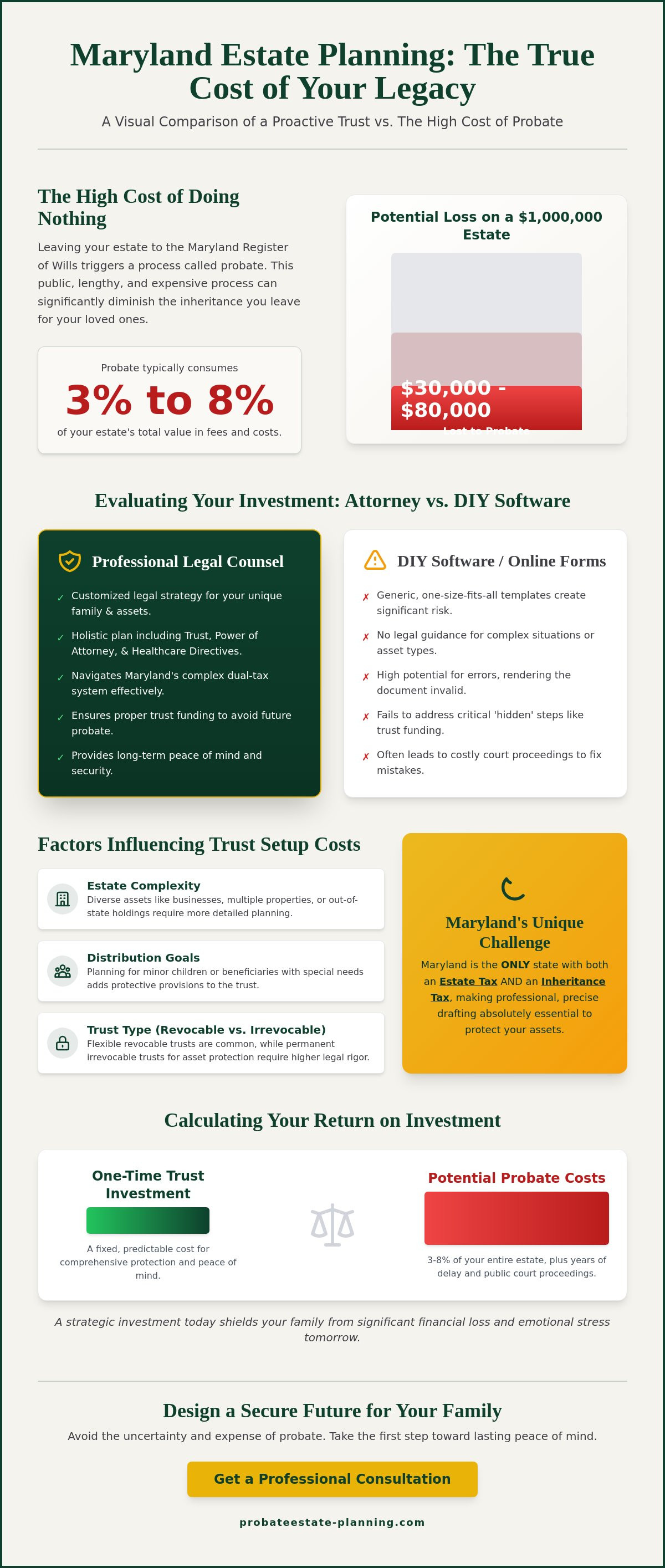
We believe that clarity is the first step toward security. This guide will show you how to balance your initial investment with the long-term goal of shielding your heirs from a probate process that often consumes 3% to 8% of an estate's total value. You'll gain a clear understanding of Maryland-specific expenses and the strategic differences between revocable and irrevocable trusts. We will examine the factors that influence these costs and explain how meticulous preparation helps your family manage the state's unique dual-tax system with confidence and lasting peace of mind.
Key Takeaways
- Learn how Maryland's specific legal landscape and dual-tax system dictate the drafting complexity required for a secure estate plan.
- Evaluate the long-term value of professional guidance versus DIY software to ensure the cost of setting up a trust in maryland doesn't lead to costly probate mistakes.
- Identify the critical hidden steps of trust funding, such as retitling assets and paying Maryland deed recording fees, to make your plan functional.
- Calculate your potential return on investment by comparing trust creation expenses with the high fees and temporal delays of the Maryland Register of Wills.
- Establish a protective strategy that prioritizes your family's emotional well-being and financial continuity through precise asset protection planning.
Factors Influencing the Cost of a Trust in Maryland (2026)
Understanding the cost of setting up a trust in maryland requires looking beyond a simple price tag. You're investing in a customized legal framework designed to protect your family's future. Before diving into specific numbers, it helps to establish a clear baseline of what a trust is. In essence, it's a legal arrangement where a grantor transfers assets to a trustee, who then manages those assets for the benefit of chosen beneficiaries. Because Maryland is the only state in the country to maintain both an estate tax and an inheritance tax, the drafting process requires a high level of precision to ensure your plan remains tax-efficient.
To better understand the value of this investment, watch this helpful video analysis of estate planning costs:
The structure of your trust depends heavily on the relationship between the grantor and the trustee. If you choose a professional or corporate trustee, the legal language must be more robust to define their specific powers and limitations. Additionally, the size and diversity of your assets play a major role. Managing a single primary residence is straightforward. However, if your estate includes a family business, multiple brokerage accounts, or diverse real estate holdings, the time required to draft a comprehensive plan naturally increases. This complexity is why the cost of setting up a trust in maryland varies so significantly from one family to another.
Complexity of the Estate and Distribution Goals
Your specific goals for your heirs will dictate the depth of the legal work. A simple revocable trust might suffice for a couple with adult children and straightforward assets. However, if you're planning for minor children or family members with special needs, the trust must include specific protective provisions. These instructions ensure that your loved ones are cared for without accidentally disqualifying them from essential government benefits. Furthermore, if you own property outside of Maryland, your attorney must coordinate with the laws of those other jurisdictions to avoid multiple probate proceedings. This layered approach prevents future complications but does require more initial preparation time.
Revocable vs. Irrevocable Trust Structures
Most families begin with a revocable living trust because it offers maximum flexibility during the grantor's lifetime. You can change your mind, move assets in or out, or even dissolve the trust entirely. Irrevocable trusts are different. These are often used for advanced asset protection planning or Medicaid crisis planning. Because these documents are generally permanent and have significant tax implications, they require a much higher level of legal rigor. The choice between these structures will directly impact your initial setup costs and the long-term maintenance required to keep the trust compliant with Maryland's shifting tax exemptions, which currently sit at $5 million for 2026.
Attorney Fees vs. DIY Software: Evaluating the Investment
Choosing between an attorney and a DIY online platform is often the first hurdle for families. The total cost of setting up a trust in maryland depends largely on whether you choose a personalized legal strategy or a generic digital template. While the entry price for software-generated documents is lower, this initial savings often masks significant long-term risks. Professional legal fees provide a level of security that automated forms simply cannot replicate. Most comprehensive estate planning packages include the trust document, a durable power of attorney, and a healthcare power of attorney. This holistic approach ensures that your plan works as a cohesive unit rather than a collection of disjointed papers.
Fee structures also vary by practice. Some firms prefer hourly billing, while others offer flat-fee packages that provide cost certainty. When researching the cost to set up a trust, it's vital to remember that the investment you make today serves as a safeguard against the much higher expenses of probate. Paying for professional expertise means you aren't just buying documents; you're securing a partnership to guide you through complex state regulations. When evaluating the cost of setting up a trust in maryland, it's helpful to view the expense as a form of insurance for your family's future emotional and financial well-being.
The Risks of DIY Maryland Trusts
Generic software often fails to account for Maryland's strict witness and notarization requirements. A single procedural error can render your entire trust invalid, forcing your family into the very probate court you sought to avoid. Additionally, many DIY users forget the critical step of funding the trust. If you don't retitle your assets, the trust remains an empty shell. Online platforms also rarely address Maryland's specific Medicaid recovery rules, which could put your family home at risk. For many, a professional review of your estate planning documents is the only way to ensure they'll actually work when needed.
Specialized Trusts: Medicaid and Asset Protection
For families facing immediate health transitions, Medicaid crisis planning requires specialized instruments like an irrevocable trust. These structures are more complex to draft and carry a higher initial cost than standard revocable trusts. However, the cost is justified by the protection they offer. They can shield your primary residence from being counted as an asset for Medicaid eligibility. This level of asset protection planning requires expert legal oversight to remain compliant with both federal and Maryland law, ensuring your family's legacy remains intact despite rising long-term care costs.
The 'Hidden' Costs of a Maryland Trust: Funding and Recording
Signing your trust documents is a significant milestone, but it isn't the final step. Many families are surprised to learn that the initial cost of setting up a trust in maryland doesn't always include the administrative work of "funding" the structure. Funding is the process of retitling your assets—such as your home, bank accounts, and investment portfolios—from your individual name into the name of your trust. If you leave the trust "unfunded," it remains an empty legal shell. This oversight can force your estate back into the Maryland probate court, effectively wasting the time and resources you invested in the planning stage.
Funding involves a mix of administrative time and specific filing fees. While retitling a bank account might only require a visit to your local branch with a Certificate of Trust, transferring real estate is more complex. You'll need to coordinate with the Maryland Land Records office in the county where the property is located. This process carries its own expenses, including deed preparation and recording fees. While the cost of setting up a trust in maryland should be viewed as a long-term savings strategy, you must budget for these procedural requirements to ensure the plan actually functions when your family needs it most.
Transferring Maryland Real Estate into a Trust
To move your Maryland home into a trust, a new deed must be drafted and recorded. Typically, this is done via a Quitclaim Deed or a Confirmatory Deed. The good news for Maryland residents is that transfers into a revocable living trust are generally exempt from state transfer and recordation taxes. However, you'll still be responsible for the nominal recording fees charged by the circuit court. Local nuances matter; for instance, the intake requirements in Baltimore City may differ from those in Montgomery County or Prince George's County. Ensuring these deeds are filed correctly is essential to avoid "chain of title" issues that could complicate a future sale of the home.
Administrative Fees and Professional Services
The execution of your trust requires strict adherence to Maryland's witness and notary requirements. While these fees are small, they are mandatory for the document to be legally binding. You should also consider the potential costs of your chosen trustee. If you appoint a professional or corporate trustee, they will charge ongoing management fees, whereas a family member might serve for free. Additionally, your trust isn't a static document. Life changes like a new marriage or a significant inheritance might require an amendment or a full restatement. In Maryland, simple amendments typically range from $425 to $850, while major updates due to life transitions can range from $1,700 to $3,400.
Trust vs. Probate: Calculating the Return on Your Investment
The decision to establish a trust often comes down to a simple comparison: pay now for a structured plan or let your family pay later in the probate court. While the initial cost of setting up a trust in maryland might seem like a significant commitment, it's small compared to the mandatory fees of the Maryland Register of Wills. For a $500,000 estate, the state filing fee alone is $1,000. However, when you add in personal representative commissions and legal fees, the total probate expense can climb to approximately $20,080. This "hidden tax" effectively reduces the inheritance you worked a lifetime to build.
Beyond the financial drain, probate is a matter of public record. Anyone can access the details of your assets and your beneficiaries' identities. Choosing a trust preserves your family's privacy and ensures that sensitive financial transitions remain a private matter. Time is another critical factor. While a trust allows for nearly immediate asset distribution, the Maryland probate process typically lasts between 9 and 18 months. During this time, your heirs may face procedural obstacles that delay their access to necessary funds. Viewing the cost of setting up a trust in maryland as a strategic investment helps you prioritize your family's long-term stability.
Maryland Probate Fees Explained
Maryland calculates probate fees based on the gross value of your estate, not the net value. This means if you own a home valued at $400,000 with a mortgage, the court still bases its fees on the full $400,000. This calculation method frequently catches families off guard. Even a modest Maryland home can trigger significant expenses and administrative burdens. Protecting your family from the stress of these court proceedings is as much about emotional well-being as it is about financial preservation. By bypassing the Register of Wills, you're opting for a methodical, private solution that respects your family's time and resources.
The Long-Term Savings of a Well-Drafted Trust
When you compare a $500,000 estate's probate cost of roughly $20,080 to the typical expense of a trust, the return on investment becomes clear. A trust functions as a strategic insurance policy. It doesn't just save money; it ensures functional reliability. If you become incapacitated, your successor trustee can step in immediately to manage your portfolio without waiting for a court order. For those concerned about nursing home expenses, specialized asset protection planning can also prevent an estate from being entirely consumed by long-term care costs. This continuity is priceless for families who rely on a steady management plan during sensitive transitions.
If you're ready to secure your family's future and avoid the delays of the court system, exploring comprehensive estate planning is the most effective way to ensure your legacy remains intact and accessible.
Designing a Secure Future with The Probate & Estate Planning Co.
We understand that discussing the cost of setting up a trust in maryland is about more than just a financial transaction. It's a deeply personal decision rooted in the desire to protect the people you love and the legacy you've built. Our practice approaches estate planning with a blend of professional authority and empathetic reassurance. We don't just provide documents; we offer a partnership in long-term management. By acting as a reliable mentor, we help you move away from the anxiety of legal technicalities toward a human-centric plan that prioritizes your family's emotional well-being alongside their formal security.
Local expertise is the foundation of a successful plan. Because Maryland is the only state in the country with both an estate tax and an inheritance tax, generic solutions often fail to provide the protection you need. Our team possesses the quiet confidence that comes from navigating these complexities many times before. We guide you through the specific nuances of Maryland law, ensuring your trust is structured to handle the state's $5 million exemption and unique tax traps. This methodical approach ensures functional reliability, giving you the peace of mind that your family will avoid the procedural obstacles of the probate court.
Our Maryland Estate Planning Process
Our process begins with a deep understanding of your unique circumstances. We look beyond the administrative tasks to identify the interpersonal connections and long-term goals that define your life. This clarity allows us to build a step-by-step strategy for asset protection planning and wealth transfer. We don't stop at the drafting phase. We provide comprehensive support to ensure your trust is properly funded, coordinating the retitling of assets and the recording of deeds to make your plan fully operational. Because laws and family dynamics change, we remain a steady guide, helping your plan evolve to meet future challenges.
Take the First Step Toward Peace of Mind
Securing your legacy shouldn't feel overwhelming. When you're ready to discuss your specific needs, scheduling a consultation is the most effective way to gain clarity on the cost of setting up a trust in maryland for your unique estate. To make our first meeting as efficient and cost-effective as possible, we recommend gathering a general list of your assets, including real estate deeds, bank statements, and retirement account information. We'll use this information to walk you through a private consultation designed specifically for your long-term goals. Contact us today to safeguard your family's future.
Securing Your Legacy Through Methodical Planning
Managing the financial complexities of estate planning requires a focus on functional reliability rather than just administrative preparation. You've seen how the initial cost of setting up a trust in maryland acts as a protective shield, allowing your heirs to bypass the delays and public nature of the Register of Wills. By prioritizing proper asset funding and addressing Maryland's unique dual-tax environment today, you prevent the emotional and financial strain that often accompanies unplanned transitions. A well-structured plan ensures your assets are managed exactly as you intended, providing a steady foundation for those you love.
Our practice brings a wealth of experience in Medicaid Crisis Planning and probate avoidance across Maryland, North Carolina, South Carolina, and Tennessee. We're committed to guiding you through these sensitive legal processes with the quiet confidence of a steady mentor. You don't have to face these complexities alone. Taking this proactive step is the most effective way to ensure your family's future remains secure and predictable. Schedule a Maryland Trust Consultation with Our Steady Guides to begin drafting your path toward lasting peace of mind.
Frequently Asked Questions
Is a trust more expensive than a will in Maryland?
A trust typically requires a higher upfront investment than a simple will. However, this initial expense is often offset by the long-term savings of avoiding Maryland's probate system, which can consume 3% to 8% of your estate's value. While a will only costs $5.00 to file for safekeeping with the Register of Wills, it guarantees your family will face the court process later.
Do I have to pay taxes to transfer my Maryland home into a living trust?
Most homeowners don't pay transfer or recordation taxes when moving their primary residence into a revocable living trust. Maryland law generally provides an exemption for these specific transfers to ensure your planning isn't hindered by immediate tax burdens. You'll still be responsible for the nominal recording fees charged by the circuit court in your county, but the heavy taxes associated with property sales don't apply.
How much are the filing fees for the Maryland Register of Wills?
Filing fees are calculated based on the gross value of the estate at the time of death. For an estate valued at $500,000, the Maryland Register of Wills charges a $1,000 filing fee. It's important to remember that this fee is only a small portion of the total probate cost, which often exceeds $20,000 when including attorney fees and personal representative commissions.
Can I change my trust after it's set up, and what does that cost?
You can amend a revocable trust at any time to reflect life changes like marriage, divorce, or the birth of a child. The cost of setting up a trust in maryland often includes the initial drafting, but future amendments carry separate fees. Simple updates typically range from $425 to $850, while major restatements following significant life transitions may cost between $1,700 and $3,400.
Does a revocable trust protect my assets from Maryland Medicaid recovery?
A revocable trust doesn't shield your assets from Maryland Medicaid recovery because you still maintain control over the property. To protect your home and savings from long-term care costs, you generally need an irrevocable trust as part of a comprehensive Medicaid crisis planning strategy. These specialized structures require a higher level of legal rigor but offer the asset protection that standard revocable trusts cannot provide.
How long does it take to set up a trust in Maryland from start to finish?
Establishing a trust usually takes between three and eight weeks from the initial consultation to the final signing. This timeline depends on the complexity of your assets and how quickly you can gather necessary financial information. After the documents are signed, the funding phase begins, which involves retitling your accounts and property to ensure the trust is fully operational and ready to protect your legacy.
Do I need a lawyer to set up a trust in Maryland, or can I do it myself?
While you can use online software to create documents for as little as $30 to $600, Maryland's unique tax laws make professional guidance a safer investment. Errors in witness requirements or notarization can lead to your trust being declared invalid in court. The cost of setting up a trust in maryland with an attorney ensures your plan accounts for the state's $5 million estate tax exemption and dual-tax system.
What happens if I create a trust but never transfer my assets into it?
If you fail to transfer your assets, your trust is considered "unfunded" and won't function as intended. Any property left in your individual name at the time of your death must go through the Maryland probate process, even if you have a trust document. This oversight is one of the most common reasons estate plans fail, making the funding phase just as critical as the initial drafting of the document.
Comments
There are no comments for this post. Be the first and Add your Comment below.
Leave a Comment