

Imagine sitting in a quiet office in Raleigh or Baltimore, expecting to finalize your father's estate, only to discover a new signature on a document dated just three days before his passing. This sudden change doesn't reflect the conversations you had for decades, and the confusion you feel is often the first sign that something is wrong. When a legacy that was meant to provide security instead sparks conflict, you need a contested will attorney who understands that this isn't just about assets; it's about honoring a life. You deserve to know that the documents guiding your family's future are authentic and fair.
You probably feel that a person's true intentions should be the final word in probate, and you're right to protect that principle. In this guide, you'll learn how to identify signs of undue influence or lack of capacity and the specific legal steps required to challenge a suspicious document. We'll walk through the litigation process across North Carolina, South Carolina, Maryland, and Tennessee. This roadmap helps you move from uncertainty to a position of strength, providing the clarity you need to safeguard your inheritance and restore your peace of mind.
Key Takeaways
- Learn how a contested will attorney differs from a standard probate lawyer and why specialized litigation expertise is essential for resolving inheritance disputes.
- Identify the four primary legal pillars—including undue influence and lack of capacity—required to successfully challenge a will across NC, SC, MD, and TN.
- Discover a strategic framework for evaluating the "Real Value" of your claim to ensure your pursuit of justice aligns with your financial interests.
- Navigate the "will caveat" process and the lifecycle of probate litigation with a clear, step-by-step timeline of what to expect during the legal journey.
- Protect your family's legacy and restore harmony by partnering with a steady guide who understands the emotional and legal complexities of multi-state estate disputes.
What is a Contested Will Attorney and When Do You Need One?
A contested will attorney is a legal professional who focuses specifically on probate litigation. While many lawyers can draft a basic testament, a litigator steps in when a family's peace is disrupted by disputes over an estate's validity. They serve as a steady guide during a period of high emotional stress, ensuring that the true intentions of the deceased are honored and that your inheritance remains secure.
You need this specialized representation when the probate process moves from a routine administrative task to a legal conflict. Statistics from the National Center for State Courts indicate that while less than 3% of wills are formally contested, these cases often involve significant assets and complex family dynamics. A litigator provides the technical knowledge to challenge or defend a document in a courtroom setting, which is a different environment than a standard law office.
To file a challenge, you must have what the law calls "standing." This means you're a party in interest who's directly affected by the outcome. Generally, this includes beneficiaries named in a previous version of the will or legal heirs who would inherit under state law if no will existed. Without standing, the court won't permit a legal challenge to proceed.
The Difference Between Probate Administration and Litigation
Probate administration is largely a clerical and procedural process. It involves filing death certificates, notifying creditors, and distributing assets according to the document's instructions. It's a cooperative effort led by an executor. Litigation, however, is adversarial. It begins when someone alleges the document is a product of fraud, undue influence, or a lack of mental capacity.
Your regular family lawyer might refer you to a specialist for these disputes because trial work requires specific evidentiary rules. At the heart of these cases is the fiduciary duty. This is the strict legal obligation of an executor to act with total honesty and loyalty to the beneficiaries. When an executor fails this duty, a contested will attorney steps in to hold them accountable and restore harmony to the estate.
Common Scenarios Requiring Legal Intervention
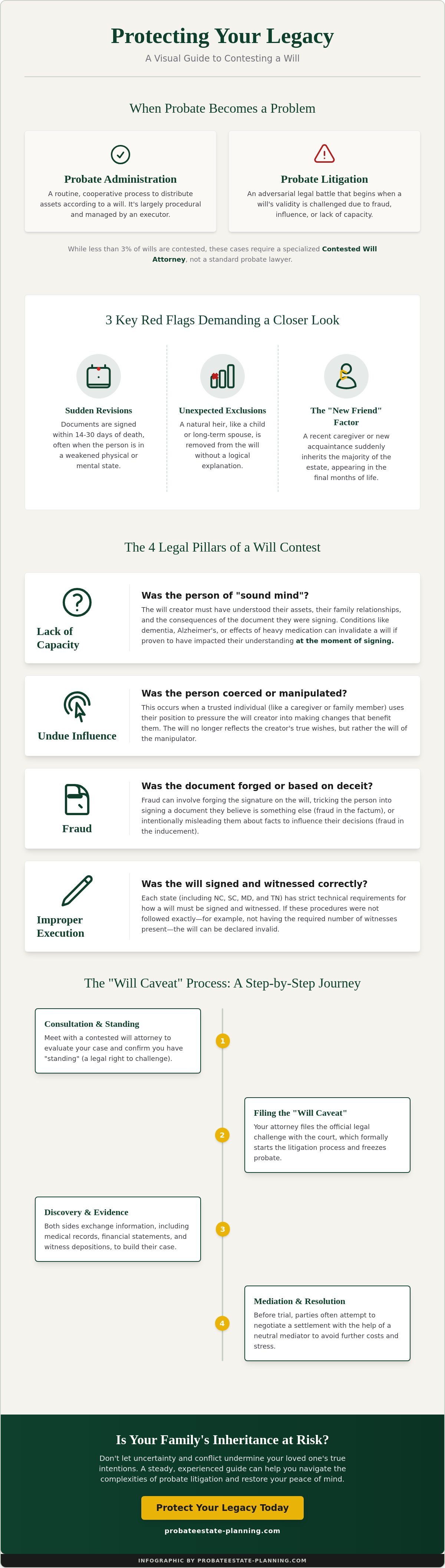
Identifying red flags early can prevent the total loss of a legacy. Certain patterns frequently appear in probate courts across NC, SC, MD, and TN that suggest a will doesn't reflect the decedent's actual wishes. You should seek a consultation if you notice these specific triggers:
- Sudden Revisions: Documents signed within 14 to 30 days of death, especially if the person was on heavy medication or in a weakened physical state.
- Unexpected Exclusions: The total removal of a natural heir, such as a child or spouse of 20 years, without a clear and logical explanation in the text.
- The "New Friend" Factor: A new version of a will that leaves the majority of an estate to a recent caregiver or acquaintance who only entered the decedent's life in their final 12 months.
These scenarios don't always mean a crime occurred, but they provide the legal grounds to investigate whether the document is authentic. Protecting your family's future requires a plan that actually works when it's needed most, and litigation is sometimes the only path to achieving that predictable outcome.
Legal Grounds for Challenging a Will in 2026
Challenging a final will is a heavy undertaking that requires more than just a feeling of unfairness. To protect a family legacy, you must anchor your claim in specific legal grounds recognized by state courts. As of January 2026, courts in North Carolina, South Carolina, Maryland, and Tennessee continue to rely on four primary pillars for will contests: capacity, influence, fraud, and execution. A contested will attorney works to shift the burden of proof by compiling a rigorous evidentiary record, often including 2025 medical evaluations and digital communication logs.
Lack of Testamentary Capacity
The "sound mind" standard in North and South Carolina requires that the person making the will understood their assets and identified their natural heirs. Dementia, late-stage Alzheimer's, or the side effects of intensive medical treatments can cloud this clarity. In 2026, legal standards define testamentary capacity as "the functional ability to maintain a consistent understanding of one's estate and family obligations at the precise moment of document execution." Evidence often hinges on medical records and testimony from healthcare providers who observed the decedent's cognitive state during the weeks surrounding the signing.
Undue Influence and Duress
Proving undue influence involves showing that a beneficiary exerted pressure so severe it overpowered the decedent's free will. In Tennessee and Maryland, courts look closely at "confidential relationships" where a caregiver or advisor held a position of trust. If a 30% shift in asset distribution occurred shortly after a new person entered the decedent's life, it may signal psychological manipulation. We distinguish between simple persuasion, which is legal, and duress, which replaces the decedent's intent with that of the influencer. If you suspect a loved one was coerced, consulting a contested will attorney can help you identify the subtle signs of emotional exploitation.
Improper Execution and Forgery
Each state maintains strict procedural requirements for a will to be valid. In the Southeast, most states require the presence of two disinterested witnesses and a notary. Tennessee law recognizes holographic (handwritten) wills if the signature and material provisions are in the decedent's handwriting, while Maryland generally restricts these to active-duty military members. When forgery is suspected, we employ handwriting experts who use high-resolution digital forensics to compare the signature against verified documents from 2024 and 2025. Failure to follow these technical steps can render an entire document void, regardless of the decedent's actual wishes.
- Medical Records: Used to establish cognitive decline or the impact of heavy medication.
- Witness Testimony: Statements from neighbors or friends regarding the decedent's daily behavior.
- Financial Logs: Tracking sudden, unexplained changes in banking habits or beneficiary designations.
- Expert Analysis: Forensic reports from neurologists or document examiners.
Strategic Evaluation: Is Contesting a Will Worth the Cost?
Deciding to challenge a loved one's final wishes isn't just a legal choice; it's a significant financial and emotional investment. The most common concern families share is whether legal fees will consume the very inheritance they're trying to protect. A skilled contested will attorney helps you look past the immediate frustration to calculate the real value of a claim. This process involves weighing the potential recovery against the hard costs of litigation and the likelihood of a successful outcome.
Cost-Benefit Analysis of Estate Litigation
Litigation costs escalate quickly because of the technical nature of probate disputes. You'll likely face expenses for several critical components:
- Expert witnesses, such as forensic handwriting analysts or medical doctors who testify about testamentary capacity.
- Depositions, where witnesses provide sworn testimony before a court reporter to lock in their stories.
- Extensive discovery processes to uncover years of financial records or hidden communications.
Most cases don't end in a dramatic trial. A significant portion of estate disputes reach a favorable settlement during mediation or early negotiations. Our firm evaluates each case for legal merit before moving forward. This ensures you aren't spending resources on a battle that lacks a solid evidentiary foundation. We prioritize your financial security by identifying the most efficient path to a resolution.
Preserving Family Harmony vs. Seeking Justice
The court of law is different from the court of public opinion within a family. Sometimes, the emotional cost of a multi-year legal battle outweighs the financial gain. A contested will attorney acts as your steady guide, helping you remain objective when emotions threaten to derail your best interests. We focus on finding a path that achieves justice without causing unnecessary collateral damage to your relationships.
You must also consider "no-contest" clauses, also known as In Terrorem clauses. In states like Maryland and South Carolina, these clauses are generally enforceable but often include "good faith" or "probable cause" exceptions. If you challenge a will and lose, you could forfeit your entire share. North Carolina and Tennessee courts also look closely at the specific language used in these provisions. We help you evaluate these risks so you can choose a path that protects both your legacy and your peace of mind. Alternative Dispute Resolution (ADR), such as mediation, often offers a way to find a middle ground without the public bitterness of a courtroom fight.
The Will Caveat Process: A Step-by-Step Timeline
Understanding the timeline of a legal challenge helps replace anxiety with a clear sense of direction. In North Carolina, this process is formally known as a "will caveat." This term signifies a legal notice that warns the court not to treat a document as a valid will until a judge or jury resolves the dispute. It's a vital safeguard for your family's legacy, ensuring that only a document reflecting a loved one's true, uncoerced intent is honored.
Filing the Initial Challenge
The clock starts ticking the moment a will enters probate. North Carolina offers a three-year window from the date a will is offered for probate to file a caveat under NCGS § 31-32. However, waiting this long isn't advisable. Other states in our region require much swifter action. In Maryland, you typically have only six months from the appointment of a personal representative to file your challenge in the Orphans' Court. Tennessee allows two years, while South Carolina often limits this window to just one year from the date of informal probate or eight months from the first publication of notice to creditors.
Once you file, the Clerk of Superior Court or the relevant probate judge typically issues an order to halt distributions. This protective measure ensures the estate's assets remain intact while your contested will attorney works to uncover the truth. During this pending period, the executor's powers are usually restricted to preserving property rather than selling or giving it away.
Discovery and Evidentiary Hearings
The discovery phase is where the foundation of your case is built. It's a methodical search for facts that often takes six to 18 months. This period isn't just about paperwork; it's about reconstructing the circumstances surrounding the will's creation to ensure justice is served. During this time, your legal team will perform several critical tasks:
- Subpoena medical records: These documents help assess the testator's mental capacity at the specific time the will was signed.
- Review financial statements: Unusual transfers or sudden changes in beneficiaries can provide evidence of financial exploitation.
- Take depositions: These are recorded interviews under oath. Your lawyer will question the executor, the witnesses who signed the document, and any individuals suspected of exerting undue influence.
A contested will attorney uses this evidence to present a compelling case to the probate judge. If the judge finds sufficient evidence of a genuine dispute, the case moves toward a trial. Most cases reach a settlement before this point, as the discovery process often reveals a clear path toward a fair resolution that preserves family harmony and honors the deceased's true wishes.
If you're concerned about a loved one's final wishes being ignored or altered, schedule a consultation with our team to discuss your legal options and protect your inheritance.
Partnering with The Probate & Estate Planning Co.
Choosing a contested will attorney is a decision that impacts your family's stability and your financial future. At The Probate & Estate Planning Co., we serve as your steady guide through the emotional and legal complexities of estate disputes. Our firm operates across North Carolina, South Carolina, Maryland, and Tennessee, providing a cohesive legal strategy for families who often find their assets spread across state lines. We don't just process paperwork; we act as your trusted advisor, focusing on preserving your legacy and protecting your interpersonal relationships during a period of high stress.
Our approach balances rigorous litigation preparation with a commitment to peaceful resolution. While we are always ready to defend your rights in a courtroom, we recognize that a negotiated settlement often provides the quickest path to closure and healing. We analyze every detail of your case to identify the most effective strategy, whether that involves challenging a breach of fiduciary duty or defending the true intentions of a loved one. You deserve a partner who prioritizes your emotional well-being alongside your legal security.
Why a Multi-State Firm Matters
Estate matters rarely stop at state borders. It's common for a decedent to reside in Maryland while owning property in Tennessee, or to have lived in North Carolina with significant investments in South Carolina. Managing these "ancillary probates" requires a deep understanding of varying state statutes and regional court rules. Our team possesses the specific local knowledge required to navigate different county clerk offices, from the specific filing requirements in Mecklenburg County to the unique probate procedures in Charleston.
Our dual focus on probate and personal injury law provides a unique advantage. If a will contest involves claims of elder abuse or wrongful death, we have the internal resources to address those complexities without referring you to another firm. This integrated perspective ensures that every facet of your claim is handled with meticulous attention to detail and professional authority.
Your Next Steps: Preparing for Your Consultation
The first meeting with your contested will attorney is a critical step in assessing the validity of your claim. To make this time as productive as possible, you should gather all relevant documentation. This includes the most recent version of the will, any previous versions that might show a sudden change in intent, and the official death certificate. If you have suspicious emails, text messages, or letters from the time the will was signed, these can serve as vital evidence of undue influence or lack of capacity.
We recommend creating a written timeline of events. Note specific dates when you observed changes in the decedent's behavior or when a third party began restricting access to your loved one. This clarity empowers us to build a stronger case from the start. When you're ready to protect your inheritance and find peace of mind, we're here to help you move forward with confidence.
Schedule your case evaluation with our contested will attorneys today to begin the process of securing your family's future.
Securing Your Family Legacy and Peace of Mind
Challenging a legal document is a heavy decision that requires both emotional strength and a clear strategy. You've now seen how the legal grounds for 2026 and the step-by-step caveat process dictate the path forward in probate court. You don't have to navigate these rigid timelines or the risk of asset loss alone. Protecting a loved one's true intent is about more than paperwork; it's about preserving the harmony of your family's future through careful stewardship.
The Probate & Estate Planning Co. provides the professional authority you need in high-stakes probate litigation. We're licensed to practice in North Carolina, South Carolina, Maryland, and Tennessee, offering a specialized focus on Medicaid crisis and asset protection. By partnering with a dedicated contested will attorney, you ensure your case is handled with the meticulous attention to detail required to safeguard your interests. We've guided many families through these complexities and know how to steer you toward a predictable, secure outcome.
Request a Consultation with a Contested Will Attorney
Your family's stability and the protection of your rightful inheritance are within reach.
Frequently Asked Questions
How long do I have to contest a will in North Carolina?
In North Carolina, you generally have 3 years from the date the will is probated to file a caveat. This timeline is strictly enforced under North Carolina General Statutes Section 31-32. Waiting too long can permanently bar your claim and leave your family's legacy unprotected. It's vital to act quickly to ensure the court hears your concerns before the estate assets are distributed to other heirs.
Can an executor be sued for changing a will?
You can sue an executor if they attempt to alter the terms of a will or fail to follow its specific instructions. An executor's role is to act as a fiduciary, meaning they must protect the estate's value rather than rewrite the deceased's wishes. If an executor mismanages funds or ignores the document, they may be held personally liable for damages in a breach of fiduciary duty lawsuit.
What happens to the inheritance if a will is found invalid?
If a court finds a will invalid, the estate is typically distributed according to a prior valid will or through state intestacy laws. In North Carolina and South Carolina, intestacy laws provide a specific hierarchy of heirs, starting with spouses and children. Working with a contested will attorney helps ensure that the court applies the correct legal framework to restore order and preserve your rightful inheritance.
Is it expensive to hire an attorney to contest a will?
Costs for legal representation vary based on the complexity of the estate and whether the case reaches a full trial. Most firms offer different fee structures, such as hourly rates or contingency fee arrangements where the lawyer receives a percentage of the recovered assets. You should discuss these options during your initial consultation to find a path that protects your financial security while seeking justice for your family.
Can I contest a will if I was not mentioned in it at all?
You can contest a will even if you were excluded, provided you are an interested person with legal standing. This includes spouses, children, or heirs who would've inherited under a previous version of the document or under state law. Being left out entirely can be a sign of a procedural error or external pressure, making it necessary to seek professional guidance to reclaim your place in the family's legacy.
What is the most common reason a will contest succeeds?
Lack of testamentary capacity is the most frequent reason a challenge succeeds in probate court. This occurs when the person making the will didn't understand the nature of their assets or the identity of their heirs at the time of signing. A contested will attorney often uses medical records and witness testimony to prove that a loved one was not in a sound state of mind during the document's execution.
Does a "no-contest" clause mean I lose everything if I challenge the will?
A no-contest clause doesn't automatically strip you of your inheritance if you have probable cause for your challenge. States like Maryland and Tennessee often allow these contests to proceed without penalty if the court determines the person acted in good faith. These clauses are designed to prevent frivolous lawsuits, not to punish family members who have legitimate evidence of fraud or coercion.
How do I prove my parent was under "undue influence"?
Proving undue influence requires showing that a third party exerted enough pressure to overcome your parent's free will. You'll need to provide evidence of a confidential relationship, such as a caregiver who isolated your parent from 100 percent of other family members. Courts look for sudden changes in estate plans that benefit a specific person while departing from decades of previous documented intentions.
Comments
There are no comments for this post. Be the first and Add your Comment below.
Leave a Comment