
What if the person raising your children wasn't your first choice, but a relative selected by a court official who has never met your family? This unsettling possibility is a reality for many who delay the essential task of choosing a guardian for minor children in will nc. It is natural to feel overwhelmed by such a monumental decision, especially when you are trying to balance emotional bonds with practical financial stability. You deserve the peace of mind that comes from knowing your children's future is anchored by your own values, not a stranger's interpretation of North Carolina law.
We will help you secure that future by explaining how to select the right guardian and understanding the specific North Carolina statutes, including the 2024 updates, that protect your family's interests. You will learn the vital difference between a guardian of the person and a guardian of the estate, ensuring that both your child's daily care and their financial legacy are managed with precision. This guide provides a clear, methodical path through the legal process, covering everything from filing requirements to court hearings, so you can move forward with quiet confidence and protective clarity.
Key Takeaways
- Understand the critical role of the North Carolina Clerk of Superior Court in validating your nomination to ensure your wishes are legally recognized.
- Distinguish between a Guardian of the Person for daily care and a Guardian of the Estate for financial management to provide comprehensive protection.
- When choosing a guardian for minor children in will nc, perform a values audit to align parenting styles and consider how relocation might affect your child's stability.
- Explore legal tools like Standby Guardians under NCGS § 35A-1370 to provide immediate security in the event of parental incapacity.
- Learn why professional estate planning is vital to ensure your guardianship documents meet strict North Carolina validation standards and integrate with your total legacy plan.
The Legal Reality of Guardianship for Minor Children in North Carolina
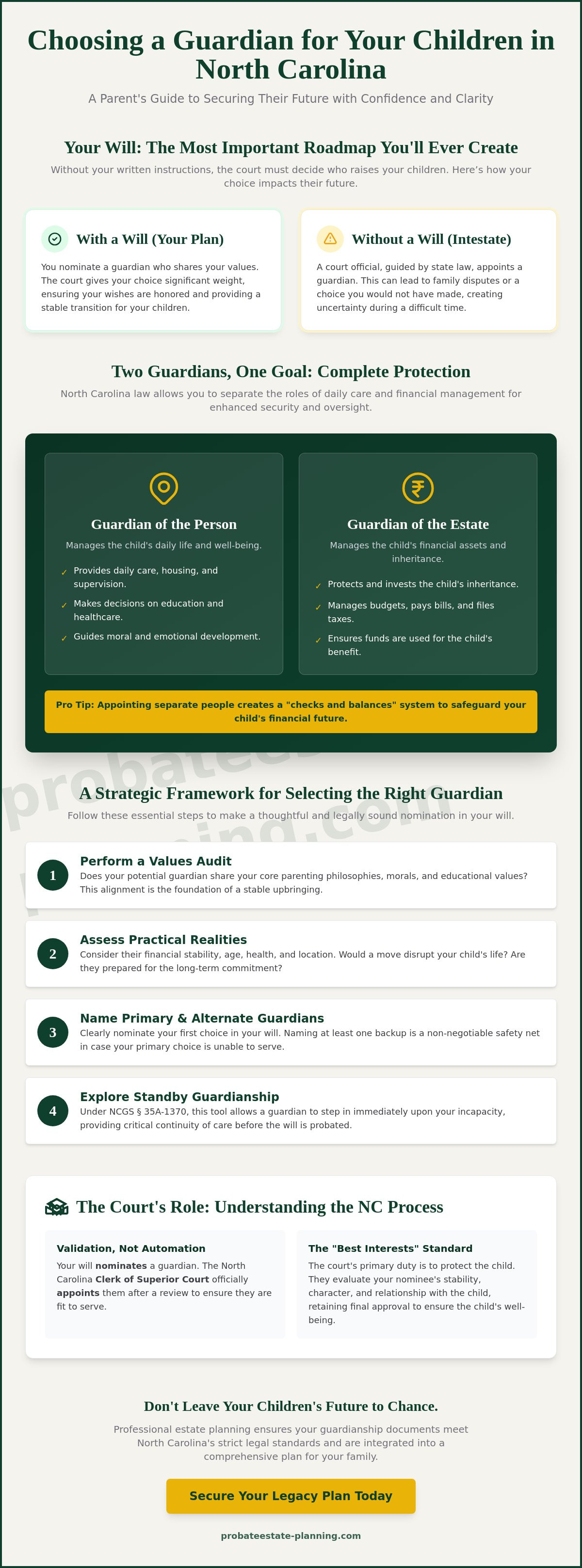
In North Carolina, a guardian is more than just a family contact; they are a court-appointed adult legally responsible for the physical care and general welfare of a minor. While you might feel that naming someone in your will is the final word, the North Carolina Clerk of Superior Court is the official who must validate your choice. This process ensures that the person you've selected is fit to serve and capable of handling the responsibilities of a Legal guardian. If you pass away without a will, you are considered "intestate." In these cases, the court must choose a guardian without your written guidance, which often leads to family disputes or the appointment of a relative you might not have trusted with your children's upbringing.
To better understand the weight of this decision and how to approach it correctly, watch this helpful video:
It is vital to remember that a surviving biological parent usually retains custody by law, even if your will names someone else. Unless that parent has had their rights terminated or is proven unfit, the court will prioritize their natural right to raise the child. This is why choosing a guardian for minor children in will nc is primarily a protection for scenarios where both parents are unavailable or deceased. It provides a roadmap for the court to follow during a time of immense transition.
The 'Best Interests of the Child' Standard in NC
North Carolina judges follow a specific legal standard known as the "best interests of the child." They evaluate potential guardians based on several factors, including the child's existing relationship with the person, the candidate's emotional stability, and their moral character. While North Carolina courts give significant weight to a parent's written nomination, the judge retains the ultimate veto power to ensure the child's safety and well-being.
When Does Guardianship Actually Take Effect?
The person you name in your will is technically a "testamentary guardian" until the court officially appoints them as a "general guardian." This transition happens during the probate process. Because the legal system can move slowly, the initial appointment may be temporary until the Clerk of Superior Court conducts a full review. Naming an alternate guardian is a non-negotiable safety net. If your first choice is unable to serve due to illness or a change in circumstances, your backup ensures your children don't end up in the care of the state while the court searches for a solution.
Guardian of the Person vs. Guardian of the Estate
When you begin choosing a guardian for minor children in will nc, you'll find that North Carolina law bifurcates the role into two distinct legal capacities. This distinction exists because the skills required to provide a loving home are often different from those needed to manage a complex financial inheritance. If your will doesn't specify different individuals for these tasks, the Clerk of Superior Court will typically appoint a "General Guardian" who handles both. While this is simpler, it places a significant burden on one person and removes a vital layer of oversight from your child's future.
Adopting a "Checks and Balances" strategy is a protective measure we often recommend. By naming one person to manage daily life and another to oversee the money, you create a system where two adults must cooperate for the child's benefit. This prevents financial abuse and ensures that decisions about the child's lifestyle are always supported by a separate, objective financial perspective. The North Carolina State Bar guidance on guardianship emphasizes that clearly defining these roles helps the court honor your parental intent while safeguarding the minor's assets. Integrating these distinct roles into a comprehensive Estate Planning strategy provides a layered defense for your family's most vulnerable members.
The Responsibilities of the Guardian of the Person
The Guardian of the Person is the individual who steps into your shoes as a parent. They have the legal authority to decide where your child lives, which schools they attend, and what religious upbringing they receive. Most importantly, this person provides the emotional stability and mentorship your child needs during a difficult transition. They are responsible for consenting to medical treatments and mental health services, acting as the primary advocate for the child's physical and emotional well-being. The process of choosing a guardian for minor children in will nc should prioritize a candidate whose values and parenting style mirror your own.
Managing the Money: The Guardian of the Estate
The Guardian of the Estate focuses strictly on the ledger. They must manage all assets the child inherits, from bank accounts to real estate. North Carolina law imposes strict requirements on this role to protect the minor. For example, if the estate value is $100,000 or less, the guardian must secure a bond of at least 125% of the value of the child's personal property. For estates exceeding $100,000, the bond is set at 110%. This guardian must also provide regular accountings and reports to the NC Clerk of Court, a process that can be both time-consuming and expensive. You can often bypass this heavy court supervision by using a Revocable Living Trust, which allows a trustee to manage funds privately and more efficiently.
A Strategic Framework for Selecting the Right Guardian
Selecting the right person to raise your child is a decision that carries immense emotional weight. To navigate this choice, we suggest performing a "Values Audit." This involves looking past surface-level affection to see if a potential nominee shares your parenting philosophy, religious beliefs, and moral foundations. The process of choosing a guardian for minor children in will nc requires looking beyond the present to imagine how that person will handle the future challenges of your child's development. You aren't just looking for someone who loves your child; you're looking for someone who will raise them in a way that honors your legacy.
Geography plays a significant role in this transition. If your chosen guardian lives outside of North Carolina, your child may have to leave their school, friends, and familiar community. While the court prioritizes your wishes, it also considers the disruption a major move might cause. Similarly, you must assess the nominee's current family dynamic. Does their home have the physical space for your children? Do they have other children whose personalities might conflict or harmonize with yours? These practicalities often dictate the success of the guardianship as much as emotional bonds do.
Many parents face the "Grandparent Dilemma" when weighing wisdom against physical energy. While grandparents often possess the deepest love and shared history, you must realistically consider if they can manage the demands of a toddler or a teenager for the next decade. If you choose an older relative, it's essential to name a younger alternate guardian as a secondary safety net to ensure long-term stability and continuity of care.
Financial Stability vs. Financial Management
It's a common misconception that a guardian must be wealthy. In reality, a guardian simply needs to be financially responsible and organized. You don't want to burden a loved one with the "cost of a child" without a clear plan. You can use life insurance or a trust to offset housing, education, and daily care costs. We recommend having an honest conversation with your nominee about these financial expectations to ensure they feel supported rather than overwhelmed by the potential responsibility of managing your child's inheritance.
The Sibling Factor: To Separate or Keep Together?
North Carolina courts have a strong preference for keeping siblings together in the same household. This stability is often considered vital to the "best interests" standard discussed earlier. Under North Carolina General Statutes § 35A-1225, your written recommendation in a will provides the primary evidence of your intent for their care. If you have unique circumstances that might require different guardians for different children, your will must contain specific, clear language explaining that choice. North Carolina law strongly favors keeping siblings in the same home to preserve their shared bond and emotional health.
Legal Formalities: Standby Guardians and Letters of Guidance
While the selection of a guardian in your will provides a long-term solution, North Carolina law offers additional layers of protection for immediate or temporary crises. Many parents focus solely on what happens after they pass away, yet they often overlook the possibility of being alive but unable to provide care due to a sudden medical emergency or cognitive decline. This is where the process of choosing a guardian for minor children in will nc expands into proactive incapacity planning. By utilizing specific legal formalities like a Declaration of Guardian or the Standby Guardian provision, you ensure your children remain in the care of people you trust without the intervention of state agencies.
A properly executed plan acts as a bridge between your current care and the future stability of your household. It removes the guesswork for the North Carolina Clerk of Superior Court and provides a clear, legal directive that prioritizes your family's continuity. If you are ready to formalize these protections, our team can help you draft a comprehensive Last Will and Testament that includes these vital guardianship provisions.
The Standby Guardian Provision
North Carolina General Statutes § 35A-1370 provides a powerful tool known as the Standby Guardian. Unlike a testamentary guardian who only takes over after death, a standby guardian is designated to step in during parental incapacity. This could be triggered by a chronic illness, a scheduled surgery with a long recovery, or progressive cognitive decline. By naming a standby guardian, you prevent the risk of your children being placed in temporary foster care while the court searches for a suitable relative during a family crisis. It allows for a seamless transition of authority that protects your children's emotional well-being when they are most vulnerable.
Writing the 'Letter of Guidance'
A Letter of Guidance is a non-binding but highly persuasive document that accompanies your will. While your will provides the legal "who," this letter explains the "why" to the Clerk of Court and the chosen guardian. It is your opportunity to detail your specific wishes for your child's education, extracurricular activities, and religious upbringing. You can also use it to outline your preferences for maintaining contact with certain family members, which helps prevent future disputes between relatives. This document serves as a practical roadmap, giving your chosen guardian the confidence to make decisions that mirror your own parenting style and values.
Life is rarely static, and your guardianship choices shouldn't be either. As your children grow and your chosen guardians age or move away, your documents must reflect those changes. Reviewing your plan every few years ensures that your nominations remain functional and that your "Letter of Guidance" stays relevant to your child's current needs and personality.
Securing Your Children's Future with Professional Guidance
The legal framework for choosing a guardian for minor children in will nc is precise. While online templates and do-it-yourself kits are widely available, they often lack the nuance required to survive the strict validation process of the North Carolina Clerk of Superior Court. A minor technical error or an ambiguous phrase can lead to the very outcome you are trying to avoid. This often results in a lengthy court battle over who is best suited to care for your children. We believe that true security comes from a comprehensive plan that leaves nothing to chance.
Our practice approaches guardianship as a central pillar of your broader Estate Planningstrategy. It's not enough to simply name a person in a document. Your Last Will and Testamentmust be carefully coordinated with other tools, such as a Revocable Living Trust and Durable Power of Attorney. This coordination ensures that the assets your children will inherit are managed properly. Without this professional structure, the court may require a Guardian of the Estate to post an expensive bond and file annual reports. This is a burden that can be avoided with proactive preparation.
Our Human-Centric Approach to Estate Planning
We understand that selecting a guardian is as much an emotional journey as it is a legal one. Our role is to act as a steady guide while you navigate these difficult family conversations. We don't just provide forms; we offer a partnership in long-term management. Whether your family is navigating the specific laws of North Carolina, South Carolina, Maryland, or Tennessee, we customize every plan to ensure your most important interpersonal connections are preserved. This protective stance prioritizes your emotional well-being alongside your formal legal security.
Next Steps: Protecting Your Most Precious Assets
The transition from anxiety to peace of mind begins with a structured consultation. When you meet with us, we'll review your family dynamics, financial goals, and specific concerns regarding your children's upbringing. You should bring any existing legal documents and a list of your potential nominees. We don't just draft a document and end the relationship. We grow with your family, offering ongoing support to update your plan as your children age or your circumstances change. The path to a predictable and secure outcome is through meticulous attention to detail. Secure your children's future with a professional consultation today to begin building your legacy of protection.
Secure Your Children's Legacy of Care
Planning for the unthinkable is one of the most profound acts of love a parent can perform. By distinguishing between the daily care of your child and the management of their financial inheritance, you create a protective system that ensures their long-term stability. The process of choosing a guardian for minor children in will nc is about more than just legal compliance; it's about preserving your family's values and ensuring your children are raised by the people you trust most. We bring specialized expertise in North Carolina guardianship statutes to every case, providing a human-centric approach that prioritizes your family's emotional well-being.
Our team offers multi-state coverage for families navigating complex dynamics across state lines, acting as a reliable mentor through every step of the process. You don't have to face these monumental decisions alone. We invite you to schedule your peace-of-mind consultation today to begin drafting a plan that honors your intent and secures your children's future. Taking action now provides the quiet confidence that your family will be protected, no matter what the future holds.
Frequently Asked Questions
Can I name two people as co-guardians in North Carolina?
You can name co-guardians in North Carolina, but this often creates procedural complications if the individuals disagree on major decisions. While the court allows it, we typically recommend naming one primary individual and an alternate. This structure provides a clearer path for the Clerk of Superior Court to follow. It avoids potential gridlock regarding your child's medical care or schooling that could arise if co-guardians cannot reach a consensus.
What happens if my chosen guardian lives outside of North Carolina?
North Carolina law does not prohibit you from naming an out-of-state guardian, but the court will carefully evaluate the child's best interests before approving the move. If relocating would significantly disrupt the child's education or existing support network, the judge might look for a local alternative. It's vital to include your reasoning for this choice in a Letter of Guidance. This helps the court understand why the out-of-state placement is best for your child's emotional well-being.
Does the guardian of my children automatically get my money?
No, the guardian of your children does not automatically gain control over your assets or inheritance. As discussed earlier, North Carolina distinguishes between the Guardian of the Person and the Guardian of the Estate. Unless you specifically name the same person for both roles, the financial assets will be managed by a separate individual. Using a Revocable Living Trust can also ensure your legacy is preserved and managed by a trustee for the child's future needs.
Can a family member contest my choice of guardian in NC?
Yes, a family member can challenge your nomination, but North Carolina courts give your written wishes significant weight. The court's primary duty is the "best interests of the child" standard. If a relative believes your choice is unfit, they must provide compelling evidence to the Clerk of Court. Ensuring your choice is clearly documented in a professionally drafted will reduces the risk of successful challenges and helps prevent painful family disputes during a time of transition.
How often should I review my guardianship choice in my will?
We recommend reviewing your guardianship choice every three to five years or whenever a major life event occurs. Life changes such as a guardian moving away, getting divorced, or experiencing health issues can impact their ability to serve. Regularly updating your plan for choosing a guardian for minor children in will nc ensures that your documents always reflect your current family dynamics. This proactive approach keeps your children's security anchored to your most current intentions.
What is the difference between a guardian and a godparent?
A guardian is a legally binding appointment made by a court, whereas a godparent is a religious or social role with no legal standing in North Carolina. While a godparent may have a close bond with your child, they have no authority to make medical or educational decisions. They cannot take physical custody unless they are also named as the guardian in your will. Formalizing this relationship through proper estate planning is the only way to provide legal protection.
Is a handwritten note enough to name a guardian in NC?
A simple handwritten note is rarely sufficient for choosing a guardian for minor children in will nc because it may not meet strict North Carolina probate requirements. While holographic wills are recognized in specific, narrow circumstances, they are frequently challenged and often fail to provide comprehensive protection. A formally executed Last Will and Testament, signed and witnessed according to state law, is the most reliable way to ensure the court honors your choice and secures your child's future.
Comments
There are no comments for this post. Be the first and Add your Comment below.
Leave a Comment