

The largest law firm in Charlotte or Raleigh might seem like the safest choice for your family's future, but the most expensive office space doesn't always guarantee the most meticulous protection. You might worry that a smaller practice lacks the resources to handle complex Medicaid crisis planning, yet you fear that a massive firm will treat your sensitive estate as just another administrative task. When conducting a ® Firm size and quality comparison, it's essential to look beyond the headcount and focus on the continuity of care provided to your loved ones.
We understand the anxiety that comes with navigating probate court or securing long-term care for a spouse. You deserve a legal partner that offers high-level expertise without sacrificing the personal touch that keeps your family's goals at the center of the process. This article will show you how to evaluate a firm's true quality so you can find a balance between professional resourcefulness and genuine, human-centric advocacy. We will examine the specific factors that ensure your legal documents, from revocable living trusts to durable powers of attorney, provide the peace of mind you need for a predictable and secure outcome.
Key Takeaways
- Learn why a higher attorney headcount doesn't guarantee better results and how to identify true professional accountability in your legal partner.
- Understand the specific accuracy standards required for complex Medicaid eligibility and probate court filings to ensure your plan stands up to scrutiny.
- Use our ® Firm size and quality comparison metrics, such as specialization and partner-to-associate ratios, to evaluate who is actually managing your file.
- Discover the benefits of choosing a regional practice that combines multi-state resources with the local roots necessary for personalized asset protection.
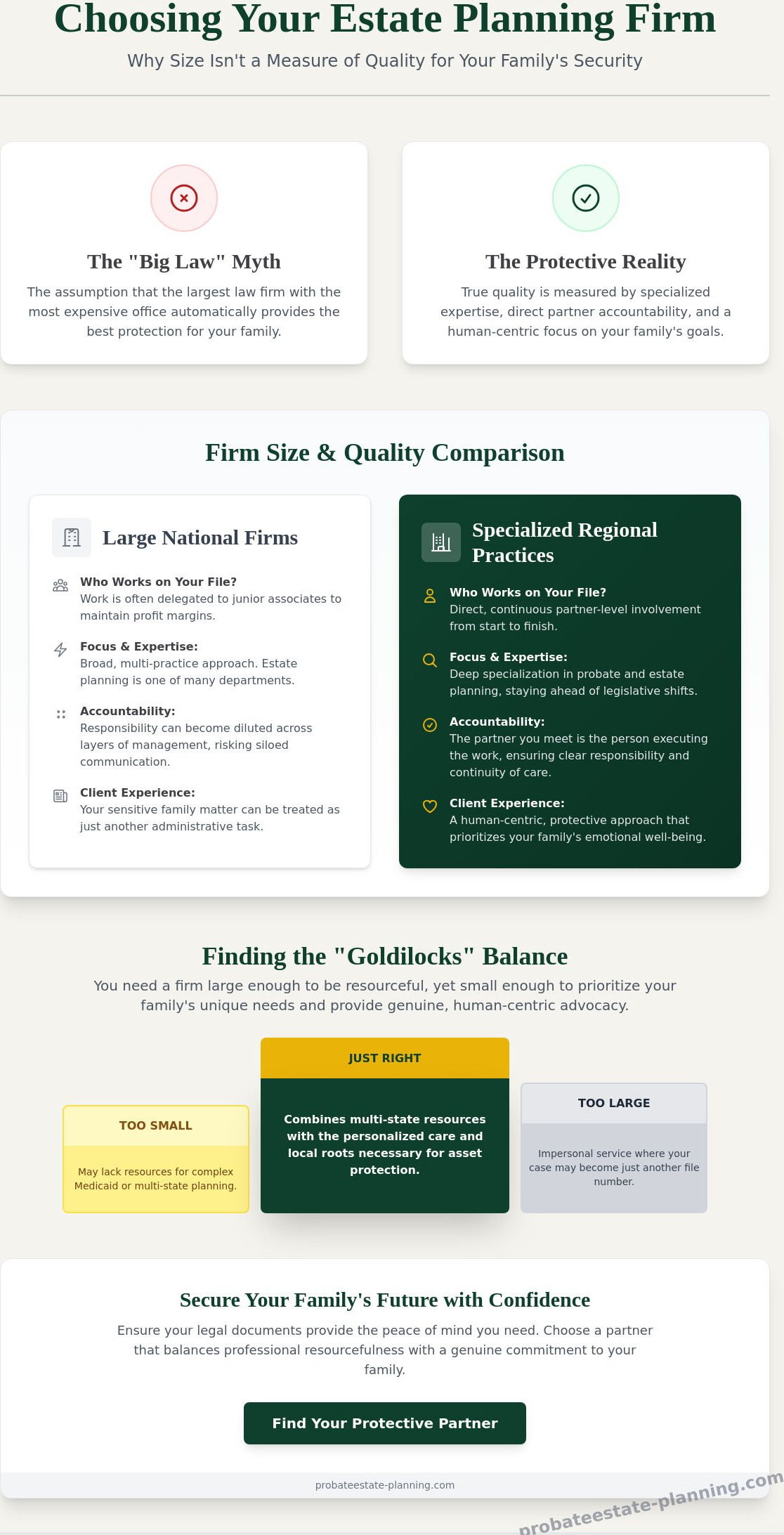
- Identify the "Goldilocks" balance between a firm large enough to be resourceful yet small enough to prioritize your family's emotional well-being.
Understanding the Firm Size and Quality Comparison in Legal Services
Choosing a legal partner in Charlotte or Raleigh often starts with a search for the most recognizable name. Many families assume that a firm with hundreds of attorneys and multiple floors in a downtown high-rise offers a higher level of security. This is the "Big Law" myth. While law firm structures and sizes vary significantly, a larger headcount doesn't always translate to a better outcome for your specific estate planning or probate administration needs. In fact, the metrics for success in personal legal matters are quite different from those in the corporate world.
In corporate law, size often correlates with the ability to handle massive, multi-billion dollar document reviews. However, when you're dealing with sensitive personal transitions, your ® Firm size and quality comparison should focus on professional accountability. You need to know exactly who is drafting your Last Will and Testament or reviewing your Medicaid Crisis Planning strategy. In a massive organization, that responsibility can become diluted across layers of management, which can lead to errors in complex filings. Quality in this field is measured by the depth of a lawyer's focus on your family's unique interpersonal connections and long-term security.
To better understand this concept, watch this helpful video:
The Resource vs. Attention Trade-off
Large firms frequently distribute workloads among junior associates to maintain high profit margins. While these individuals are capable, they often lack the years of experience required to anticipate the nuances of probate court. This creates a risk of siloed communication; the partner you met initially isn't the person actually managing your file. Boutique firms prioritize partner-level involvement in every case. This ensures the person providing your advice is the same person executing the work, providing a more human-centric and protective experience that prevents future complications.
Quality Control in Estate Law
High-quality legal work in estate planning isn't just about filling in templates. It requires staying ahead of legislative shifts, such as the new North Carolina laws regarding electronic wills effective January 1, 2026. Specialized firms maintain higher standards by focusing exclusively on these areas. Instead of a generic national presence, a firm with deep roots in North Carolina, South Carolina, Maryland, and Tennessee offers functional reliability. They understand the local clerk of court's requirements and the specific nuances of asset protection planning that a broad, national model might overlook.
Defining 'Quality' in Probate and Estate Planning
Quality is often viewed as a baseline requirement, yet in the world of estate law, it's a variable spectrum. While every practicing attorney holds a bar license, the true measure of quality lies in the functional reliability of the documents they produce. In a ® Firm size and quality comparison, quality should be viewed through the lens of accuracy in complex filings. A single error in Medicaid Crisis Planning can lead to a denial of benefits, forcing families to deplete assets that were meant to be protected for a surviving spouse. Similarly, probate court standards in Charlotte and Raleigh require meticulous attention to detail to avoid procedural obstacles and temporal delays that can last months.
High-quality legal work is a protective stance. It moves away from cold, clinical technicalities toward a human-centric approach that prioritizes your emotional well-being. This means your legal partner must act as a reliable mentor, steering you toward a secure and predictable outcome. When a firm prioritizes quality, they don't just draft a Last Will and Testament; they safeguard your most important interpersonal connections by preventing future complications before they arise. This level of care is essential when navigating the gravity of sensitive personal transitions.
Technical Precision in Document Drafting
Large firms often rely on "cookie-cutter" templates to manage high volumes of clients. However, these generic forms often fail when they meet the specific requirements of local probate courts. Quality planning requires deep, state-specific knowledge for North Carolina, South Carolina, Maryland, and Tennessee. For example, a quality-focused firm will have already integrated the January 1, 2026, legislative updates regarding electronic wills and the increased spousal allowance of $60,000 into their practice. By utilizing robust Asset Protection Planning, you ensure that your documents are not just administrative preparation, but functional tools that stand up to legal scrutiny.
The 'Human-Centric' Quality Standard
Quality is also an emotional metric. It's the peace of mind you feel during the executor's first 30 days, a period often marked by confusion and high anxiety. A quality firm provides a methodical, step-by-step solution that makes the daunting legal landscape feel manageable. Accessibility and responsiveness are core indicators of this standard. You shouldn't feel like a number in a massive database. Instead, you deserve a partnership where your unique circumstances and long-term goals are the primary focus of the planning process. This steady, patient communication rhythm is what truly defines a high-quality legal experience.
Large National Firms vs. Specialized Regional Practices
When you weigh the benefits of a national law firm against a specialized regional practice, you're essentially choosing between perceived reach and practical impact. National firms often market themselves on the strength of their geographic footprint, suggesting that a presence in every major city translates to superior protection. However, a thorough ® Firm size and quality comparison often shows a disconnect between a firm's national marketing and its local execution. Probate is an inherently local court process. It's governed by specific state statutes and the procedural preferences of individual county clerks. A regional practice that maintains deep roots in North Carolina, South Carolina, Maryland, and Tennessee offers a distinct advantage; they combine the resources of a large firm with the specialized focus of a local mentor.
Your legal fees should fund expertise, not corporate overhead. In a massive national model, a portion of your investment supports expensive leases in cities you'll never visit. Conversely, a regional powerhouse directs those resources toward specialized software and focused legal research that directly benefits your file. This ensures that your Probate Administration Services or Medicaid filings are handled with the precision required to stand up in court, rather than being processed through a generic, one-size-fits-all system.
Local Knowledge in Probate Court
Knowing the specific clerks in Tennessee or North Carolina matters. In North Carolina, the probate fee is calculated as 0.4% of the estate's value, with a maximum fee of $6,000. An out-of-state attorney managing a local probate file may not be familiar with the nuances of these calculations or the recent procedural updates to the elective share statute that took effect on January 1, 2026. Regional firms bridge this gap. They understand how to navigate local courtrooms to avoid temporal delays, ensuring your family's assets are distributed according to your wishes without unnecessary hurdles.
Continuity of Care and Long-Term Security
Large, high-pressure firms often struggle with high attorney turnover. This creates a significant risk for your long-term security. If your attorney leaves the firm every few years, the continuity of your legacy planning is broken. You need a steady guide who will be there when your family needs them most. By choosing a firm that handles both the initial Estate Planning and the eventual administration, you ensure a partnership in long-term management. This consistency provides a sense of quiet confidence, knowing that the organization has navigated these complexities many times before and knows exactly how to protect your interpersonal connections.
5 Metrics to Evaluate Legal Quality Beyond Firm Headcount
Evaluating a law firm's reputation based solely on its size is a common pitfall. While some academic models suggest headcount is a proxy for quality, this logic often fails in the sensitive fields of probate and Medicaid planning. A true ® Firm size and quality comparison requires looking at specific performance metrics that impact your family's long-term security. You need to look for functional reliability rather than just a large administrative footprint. By focusing on these five metrics, you can ensure your legal partner offers the wisdom and protection your circumstances require.
- Specialization Ratio: Look at what percentage of the firm's work is dedicated to estate law. A firm that balances personal injury legal representation with corporate litigation may lack the depth needed for complex irrevocable trusts.
- Partner-to-Associate Ratio: Ask who is actually doing the work on your file. High-quality firms ensure a seasoned mentor steers your case, rather than delegating sensitive document drafting to a junior associate.
- Geographic Alignment: Verify the firm has a physical presence and deep roots in North Carolina, South Carolina, Maryland, or Tennessee. This ensures they possess the local court familiarity necessary to navigate procedural obstacles.
- Technological Integration: Modern quality standards require specialized software for asset protection and Medicaid planning. These tools help model various scenarios to ensure your plan stands up to scrutiny.
- Client Continuity: Seek a firm that prioritizes long-term management. You need a partner who will be there to administer the plan they helped you create, preserving your legacy for the next generation.
Vetting the Attorney's Expertise
When you meet with a potential guide, ask specific questions about their experience with Medicaid crisis planning. It's not enough to have a general understanding; they must know how to navigate the current 2026 regulations to protect a surviving spouse's assets. Verify their track record in probate administration within your specific county. General practice firms often lack the granular knowledge required to manage complex filings, which can lead to temporal delays and increased costs for your family.
Assessing the Firm's Process
Quality firms provide a clear, step-by-step roadmap for your probate case from the very beginning. This methodical approach instills trust and makes the daunting legal landscape feel manageable. If you own property in both South Carolina and North Carolina, ask how they handle multi-state assets to prevent future complications. Transparent fee structures are also a key indicator of professional authority. A firm that is open about costs reflects a commitment to your emotional well-being and formal security. To ensure your family's future is handled with this level of meticulous care, explore our Medicaid Crisis Planning services today.
Finding the Right Fit for Your Family's Security
Selecting a legal partner is one of the most consequential decisions you'll make for your family's future. As we have explored throughout this ® Firm size and quality comparison, the objective is to find a practice that offers the sophisticated resources of a large organization without losing the empathetic touch of a local guide. The Probate & Estate Planning Co. serves as a "Goldilocks" solution. We provide the technical proficiency required for complex Asset Protection Planning while ensuring you never feel like a mere file number in a database.
We understand the gravity of sensitive legal transitions. Whether you are mourning a loss or planning for future long-term care, the legal process should alleviate your anxiety rather than adding to it. A firm that balances multi-state reach with personalized service creates a protective environment where your emotional well-being is prioritized alongside your formal security. This partnership in long-term management ensures that your legacy is preserved exactly as you intended, providing a sense of quiet confidence that only comes from meticulous preparation.
Our Approach to Protective Planning
Our practice is built on the foundation of functional reliability. We safeguard legacies across North Carolina, South Carolina, Maryland, and Tennessee by maintaining a deep understanding of local court standards and legislative updates. We intentionally avoid cold, clinical technicalities. Instead, we use clear, instructional guidance to make daunting professional landscapes feel navigable and manageable. By focusing exclusively on probate and estate law, we offer a level of precision that general practice firms often struggle to match. This specialized focus is what allows us to prevent future complications for your loved ones before they ever arise.
Take Action Toward Peace of Mind
Proactive preparation is the most effective way to protect your family from the risks of inaction. Waiting for a crisis to occur often limits your options and increases the likelihood of procedural obstacles or family disputes. Our team is here to guide executors through the meticulous details of Probate Administration Services, providing a steady, patient pace that mirrors the thoroughness required for a secure outcome. You don't have to navigate these complexities alone. We invite you to schedule a consultation with our experienced legal team today to assess our quality for yourself and begin the process of securing your family's future.
Your Path to Predictable Security
Choosing the right legal partner is about more than just office locations or attorney headcount. True quality is found in a specialized focus and the ability to navigate the unique nuances of local probate courts. A thorough ® Firm size and quality comparison reveals that functional reliability comes from a team that understands the gravity of your situation. You need a partner that treats your family's future with the seriousness it deserves while maintaining an approachable, calming presence.
Our practice provides the multi-state expertise across North Carolina, South Carolina, Maryland, and Tennessee that your complex assets require. We pair this technical precision with an empathetic, human-centric approach to Medicaid crisis planning and probate administration. We focus on preventing future complications so you can focus on your family's well-being. It's time to move toward a secure outcome with a steady guide by your side.
We are ready to help you navigate these transitions with the quiet confidence that comes from expert, protective planning. Your peace of mind is our highest priority.
Frequently Asked Questions
Does a larger law firm have more influence in probate court?
No, influence in probate court is based on a firm's mastery of local rules and procedural accuracy rather than its headcount. Judges and clerks prioritize filings that meet exact statutory requirements to ensure a predictable outcome for the estate. A larger firm doesn't receive preferential treatment. In fact, a smaller firm with deep local roots often navigates the clerk's office more efficiently because they specialize in these specific regional requirements.
How do I know if a boutique law firm has enough resources for my complex estate?
You can assess a firm's resources by looking at their technological integration and their specialization ratio. A boutique firm that focuses exclusively on estate law often invests in specialized software and research tools that general practice firms overlook. This focused investment ensures they have the specific resources needed for complex Medicaid Crisis Planning or intricate asset protection strategies, providing you with high-level expertise and personal protection.
Is it more expensive to hire a specialized estate planning firm than a general practice?
Specialized firms may have different fee structures, but they often provide better value by preventing costly errors. A general practice firm might seem accessible, yet a lack of specialization can lead to procedural obstacles that increase temporal delays and legal costs. A specialized firm offers functional reliability, ensuring your Last Will and Testament or trusts are drafted correctly the first time to avoid future family litigation.
Can one firm handle probate in multiple states like North Carolina and Tennessee?
Yes, a firm with multi-state expertise can manage probate across several jurisdictions, such as North Carolina, South Carolina, Maryland, and Tennessee. This is a vital factor in any ® Firm size and quality comparison. Families with property across state lines need a partner that understands the distinct filing deadlines and elective share laws in each jurisdiction. This regional focus ensures that your planning remains cohesive and legally sound.
What is the most important factor in determining the quality of an estate lawyer?
The most important factor is the lawyer's ability to translate complex legal transitions into a human-centric, protective strategy. Quality is measured by functional outcomes and the prevention of future complications for your loved ones. You should look for a reliable mentor who prioritizes your emotional well-being and offers a methodical, step-by-step solution to your long-term security needs rather than just administrative preparation.
Why does attorney turnover in large firms matter for my long-term estate plan?
Attorney turnover breaks the continuity of care that is essential for long-term legacy protection. If the lawyer who drafted your Revocable Living Trust leaves the firm, your family loses the institutional memory and personal connection associated with your goals. A stable firm with low turnover acts as a steady guide, ensuring the same team that planned your estate is there to handle the probate administration when the time comes.
How can I verify a firm's quality before signing a retainer?
You can verify quality by asking about the firm's partner-to-associate ratio and their specific experience with complex filings like Medicaid Crisis Planning. A high-quality firm will be transparent about their process and provide a clear roadmap for your case. During your initial consultation, observe whether they use accessible, comfort-oriented language or hide behind dense technical jargon; a true expert should make the process feel navigable and manageable.
Does firm size affect the speed of the probate administration process?
Firm size does not inherently dictate speed, but internal bureaucracy in massive firms can often lead to delays. In larger organizations, communication can become siloed as files move between different departments and junior associates. A specialized, mid-sized firm often provides a more responsive experience. Because a senior mentor is directly involved in the process, they can resolve procedural obstacles quickly, moving your family toward a predictable and secure resolution.
Comments
There are no comments for this post. Be the first and Add your Comment below.
Leave a Comment