

What if your family's most valuable asset could bypass the courthouse entirely, arriving in your children's hands without a single public hearing or a year-long wait? For many homeowners, avoiding probate on real estate in tennessee isn't just about saving money; it's about protecting a legacy from being "stuck" in a public legal system that was never designed for speed. It's natural to feel anxious about your home being tied up in court for months or concerned that a lack of a clear, automated plan might lead to family friction during an already difficult time.
We understand that your primary goal is peace of mind. You want to know that your heirs are cared for and that your private family matters stay private. This guide provides a clear path forward by exploring the most effective legal strategies to ensure a faster, more cost-effective transfer of your property. We'll examine the significant changes brought by the Tennessee Uniform Real Property Transfer on Death Act, which takes effect on July 1, 2026. You'll also learn the critical differences between TOD deeds and Trusts, and how to develop a plan that protects your home from Medicaid recovery while securing your family's future.
Key Takeaways
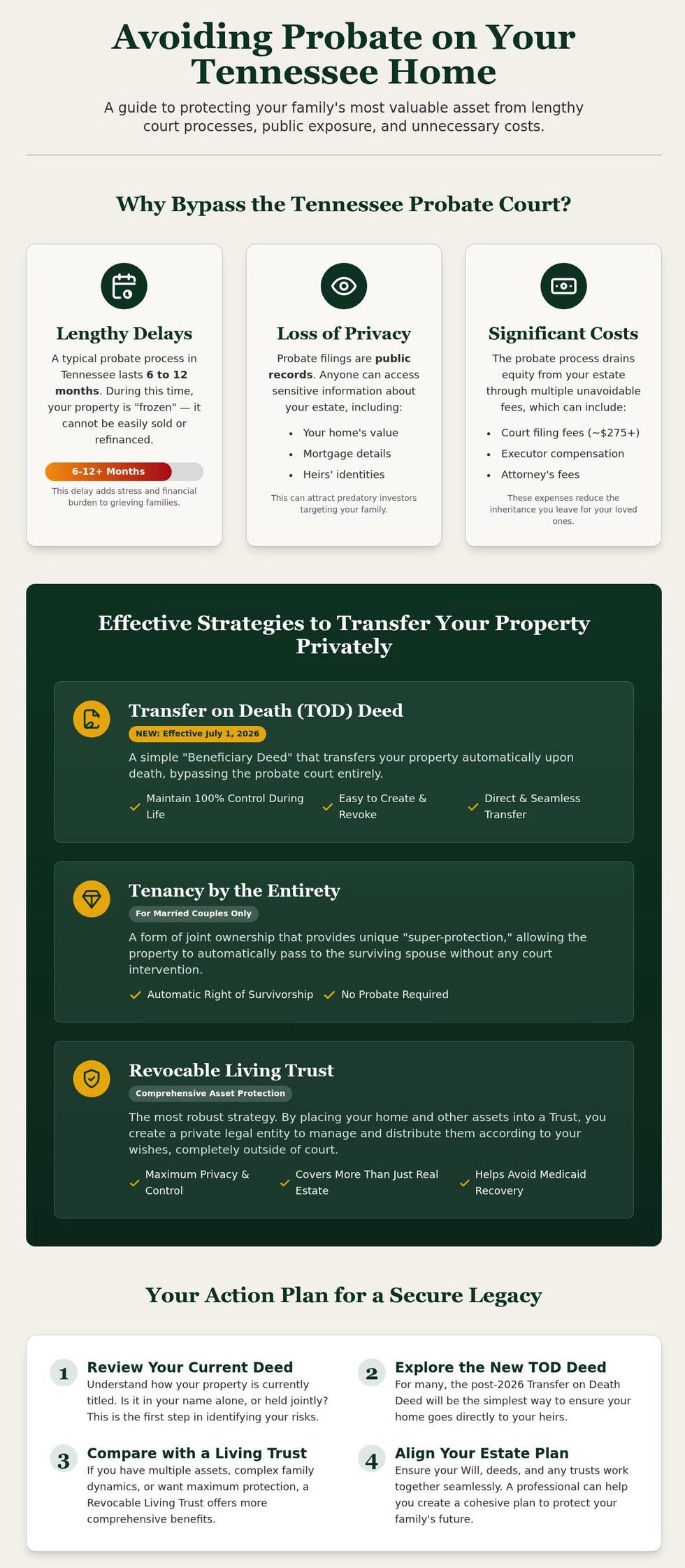
- Understand why Tennessee homeowners seek to bypass the probate process to protect family privacy and avoid the typical 6-to-12 month delay in asset distribution.
- Explore how the 2026 Tennessee Uniform Real Property Transfer on Death Act offers a simplified way to transfer property titles while you maintain full control during your lifetime.
- Learn the specific advantages of using a Revocable Living Trust or a TOD deed as part of your strategy for avoiding probate on real estate in tennessee.
- Discover how Tenancy by the Entirety provides unique "super-protection" for married couples, allowing for an automatic title shift without court intervention.
- Identify the immediate steps needed to review your current deed and align your estate plan with the latest statutes to ensure your family's legacy remains secure.
Why Tennessee Homeowners Prioritize Bypassing the Probate Court
Many homeowners assume that drafting a Last Will and Testament is the final step to protecting their family. However, a common misconception exists: a Will does not bypass the court; it actually serves as the legal roadmap for it. Probate is the judicial process of validating that Will and ensuring debts are paid before your home can legally belong to your heirs. Without proactive planning for avoiding probate on real estate in tennessee, your property enters a period of legal limbo where it cannot be sold or refinanced easily.
To better understand this concept, watch this helpful video:
The timeline is often the most stressful part for grieving families. In Tennessee, even a straightforward estate typically remains open for six to twelve months. During this window, the real estate is effectively frozen. If the house requires urgent repairs or if the market shifts, your family might find their hands tied by court schedules and procedural delays. This wait time often adds unnecessary weight to an already difficult emotional transition. By understanding the mechanics of the system, you can take steps to ensure your property transfers with the speed and dignity your family deserves.
The Public Nature of Tennessee Probate Records
Privacy is a significant concern because Tennessee probate filings are part of the public record. This means anyone, from nosy neighbors to predatory real estate investors, can search for your home's value, outstanding mortgage balances, and the names of your beneficiaries. For many, the idea of having family finances aired in a public forum is deeply unsettling. Predatory buyers often use these public lists to find distressed properties, potentially pressuring your heirs into making quick, undervalued sales while they are still mourning. Because real estate is a tangible, high-value asset, private administration options are rarely available to protect it from public scrutiny.
Understanding the Financial Drain on Estate Equity
The financial cost of the court process can be substantial, often draining the equity you worked a lifetime to build. As of January 1, 2026, the base filing fee to open a probate case in Tennessee is $275, but this is only the starting point. In major counties like Davidson, Shelby, and Knox, additional local fees and administrative costs quickly accumulate. Beyond court fees, statutory compensation for executors and professional fees for attorneys can take a significant percentage of the estate's value. Probate is the court-supervised process of validating a will and settling debts before title can pass. If you don't take steps toward avoiding probate on real estate in tennessee, your children may receive a much smaller inheritance than you intended due to these avoidable administrative expenses.
The Tennessee Transfer on Death (TOD) Deed: The Simplest Path?
Tennessee homeowners gained a powerful new tool on July 1, 2026. The Tennessee Uniform Real Property Transfer on Death Act (URPTODA) now allows for a direct, seamless transfer of title upon your passing. This "Beneficiary Deed" is often the most straightforward method for avoiding probate on real estate in tennessee because it bypasses the court system entirely. You name your chosen heir on the document, and the property moves to them automatically when you die, much like a beneficiary designation on a bank account.
One of the most significant advantages is that you retain absolute control during your lifetime. Unlike adding someone to your deed as a joint owner now, a TOD deed doesn't give the beneficiary any current legal interest in your home. You don't need their permission to sell the house, take out a mortgage, or even renovate the property. If your family circumstances shift, you can revoke the deed or name a different beneficiary at any time without their consent. This flexibility provides a layer of security that traditional transfers simply can't match.
It's also vital to understand the "120-day rule" survival requirement. Under the 2026 statutes, a beneficiary must survive the property owner by at least 120 days to inherit the home via the TOD deed. If they pass away within that window, the deed is treated as if the beneficiary died first. This rule prevents property from getting stuck in multiple probate cases simultaneously if a tragedy affects both the owner and the heir in a short period.
How to Properly Execute a TOD Deed in Tennessee
Precision is mandatory when drafting this document. You must include the correct legal description of the property and the specific Parcel ID found in county tax records. The most critical step is recording the deed in the county register's office before the owner's death. A TOD deed that is signed but sitting in a desk drawer is legally invalid. Common mistakes, such as failing to notarize the document according to specific Tennessee standards, can lead to the very court battles you are trying to prevent. Considering these technical requirements, many find that professional estate planning is the best way to ensure the deed is recorded correctly.
Limitations of the TOD Deed
While efficient, the TOD deed isn't a perfect shield. It does not protect the home from the owner's creditors; if you die with significant debt, those creditors may still be able to reach the property's value. There is also a "contingent beneficiary" problem. If your named heir passes away before you and you haven't named a backup, the deed fails, and the house will likely head to probate court anyway. This is why many compare it to a standard Quitclaim Deed. A Quitclaim Deed is immediate and irrevocable, often causing tax headaches and loss of control. The TOD deed is usually safer, but it requires a clear backup plan to be truly effective.
Joint Ownership and Tenancy by the Entirety in Tennessee
While the new TOD deed offers a future-focused solution, many homeowners rely on how their property is currently titled to manage the transfer of assets. In Tennessee, joint ownership with a Right of Survivorship is a long-standing method for avoiding probate on real estate in tennessee. This legal structure ensures that when one owner passes away, their interest in the home shifts automatically to the surviving owner. There is no need for court intervention or a judge's signature. The title simply continues with the survivor, providing an immediate sense of continuity and security for the remaining household.
Married Couples and Asset Protection
For married couples, Tennessee law offers a specific form of ownership known as Tenancy by the Entirety. This is often considered the gold standard for marital homes because it provides a layer of super-protection that standard joint tenancy does not. Under this rule, the couple is viewed as a single legal entity. If one spouse faces a personal lawsuit or individual debt, the creditor generally cannot attach a lien to the home to satisfy that debt. The moment one spouse passes away, the survivor becomes the sole owner instantly. This transition is private, fast, and protects the surviving spouse's right to remain in the home without the threat of outside claims.
The Dangers of Joint Tenancy with Non-Spouses
The risks increase significantly when homeowners attempt to simplify things by adding a child or a non-spouse to the deed. This often leads to accidental disinheritance. If you add one child as a joint tenant but your Will says your estate should be split among three children, the joint tenancy usually overrides the Will. The child on the deed becomes the sole owner, leaving the others with no legal claim to the house. Additionally, your home becomes vulnerable to that joint owner's life complications. If they face a bankruptcy, a messy divorce, or a tax lien, their creditors may attempt to force a sale of your home to collect. Adding a child as a joint tenant is considered a taxable gift by the IRS. This can create complicated federal filing requirements that many families aren't prepared to handle.
It is also important to consider how a divorce or legal separation changes these plans. In Tennessee, a divorce typically severs a Tenancy by the Entirety, converting it into a Tenancy in Common. Without the right of survivorship, each person's share would then be subject to probate upon their death. Proactive planning ensures that these shifts in life don't leave your legacy exposed to the very court processes you intended to avoid. Taking the time to review your deed now prevents these complications from surfacing later when it's too late to make adjustments.
The Revocable Living Trust: Comprehensive Protection for TN Real Estate
While TOD deeds and joint ownership offer specific solutions, a Revocable Living Trustprovides a more comprehensive framework for avoiding probate on real estate in tennessee. Think of a trust as a legal "bucket" that holds the title to your home. You remain the manager, or Trustee, during your life, but you designate a Successor Trustee to take over immediately upon your death or incapacity. This individual moves at the speed of a signature, not a court order. There is no waiting for a judge to open a file or authorize a sale. Because the trust is a private contract, the details of your estate never enter the public record, protecting your heirs from the predatory buyers often found in courthouse filings.
A trust is only as strong as its "funding." Many homeowners create a trust document but fail to deed their property into it. If the title remains in your individual name at the time of your death, the trust is effectively an empty bucket. The home will still be forced through the probate court to get into the trust, defeating the entire purpose of the plan. Ensuring your deed is properly transferred is a vital step in this methodical process. If you are ready to secure your property, you can establish a Revocable Living Trust to ensure your legacy is handled with care.
Trusts vs. TOD Deeds: Which is Right for You?
A trust is often necessary for those with multiple properties, minor children, or complex family dynamics. While a TOD deed is simpler and cheaper to set up, it doesn't offer incapacity planning. If you become unable to manage your affairs, a Successor Trustee can step in to manage the property for your benefit. A TOD deed only triggers at death. While the upfront setup costs for a trust are higher, they are often dwarfed by the massive savings and speed achieved at the end of life. This proactive preparation moves you away from clinical technicalities and toward a human-centric plan that prioritizes your family's emotional well-being.
Protecting the Home from Medicaid Estate Recovery
It's vital to coordinate your plan with Medicaid crisis planning. In Tennessee, TennCare has a five-year "look-back" period for asset transfers. A Revocable Living Trust does not protect your home from Medicaid estate recovery because you still maintain control over the assets. If long-term care costs become a concern, an Irrevocable Trust might be required to shield the home's equity. Balancing probate avoidance with long-term care protection requires a methodical, step-by-step approach to ensure your most important interpersonal connections and your home are preserved for the next generation.
Taking Action: Designing Your Tennessee Estate Plan
The first step in any reliable strategy for avoiding probate on real estate in tennessee is a thorough review of your current deed. Many homeowners are surprised to find that their property is titled in a way that virtually guarantees a trip to court, regardless of what their Will says. You should look for specific language, such as "Joint Tenants with Right of Survivorship" or "Tenancy by the Entirety." If these phrases are missing, your home may be held as a "Tenancy in Common," which means your share doesn't automatically pass to the other owner. This simple administrative detail is often the difference between a seamless transition and a year of legal obstacles.
With the new provisions of the Tennessee Uniform Real Property Transfer on Death Act taking effect on July 1, 2026, the landscape of estate planning has shifted. What worked for your parents or even a neighbor a few years ago might not be the most efficient path for you today. Consulting with a professional ensures your plan complies with these latest requirements, particularly the strict recording rules for TOD deeds. A "Peace of Mind Audit" isn't just about the house; it's about confirming that your beneficiaries are correctly named and that every necessary document is recorded in the proper county office.
Life is rarely static, and your estate plan shouldn't be either. A change in marital status, the birth of a grandchild, or moving to a new county in Tennessee requires a legal check-up. For instance, if you move from Nashville to Knoxville, you must ensure your new deed is structured correctly under local county register standards. Proactive preparation prevents future complications for your loved ones, moving you away from the risks of inaction toward a secure and predictable outcome.
Next Steps for Tennessee Homeowners
To begin this process, gather your current deed and your most recent property tax bill. These documents provide the legal description and parcel ID necessary for any new filings. Once you have your records, schedule a strategy session to weigh the benefits of a TOD deed against the more comprehensive protection of a Revocable Living Trust. During this time, it's also vital to ensure your Durable Power of Attorney and Healthcare Directives are in place. These documents protect you during your lifetime, while your real estate plan protects your family after you're gone.
How The Probate & Estate Planning Co. Can Help
Our practice offers a partnership in long-term management. We provide a blend of professional authority and empathetic reassurance, focusing on functional reliability over mere administrative preparation. We understand that you aren't just managing a house; you're safeguarding a family legacy. We simplify the complex by handling the deed drafting and recording for you, ensuring your strategy for avoiding probate on real estate in tennessee is executed perfectly. Contact us today for a consultation on securing your Tennessee legacy.
Securing Your Family Legacy Beyond the Courthouse
The legal landscape for avoiding probate on real estate in tennessee has changed significantly with the 2026 statutes. You now have powerful tools like the Transfer on Death deed to simplify asset transfers, yet the core of a successful plan remains the same: proactive preparation and attention to detail. Whether you choose the privacy of a Revocable Living Trust or the automatic protections of Tenancy by the Entirety, your goal is to ensure your heirs aren't left managing a frozen asset during a time of grief.
Our firm provides a partnership in long-term management through empathetic, mentor-led guidance. With specialized expertise in Medicaid crisis planning and a multi-state practice covering TN, NC, SC, and MD, we help you navigate these sensitive transitions with quiet confidence. We prioritize your emotional well-being alongside your formal security, ensuring your family legacy stays exactly where it belongs. Secure your home and your family's future. Schedule your Tennessee estate planning consultation now.
Taking action today replaces anxiety with a predictable outcome. You've worked hard to build your equity, and we're here to help you protect it for the people who matter most.
Frequently Asked Questions
Does a Will avoid probate on real estate in Tennessee?
No, a Will does not avoid probate; it serves as the legal instrument that directs the court on how to distribute your assets. In Tennessee, real estate titled in your name alone must pass through the probate court to legally transfer the title to your heirs. This process remains public and can take six to twelve months to complete. Proactive planning is necessary to keep the home out of the judicial system entirely.
What is a Transfer on Death (TOD) deed, and is it legal in TN?
A Transfer on Death (TOD) deed is a legal document that names a beneficiary to receive your property automatically upon your death. It became legal in Tennessee on July 1, 2026, under the Tennessee Uniform Real Property Transfer on Death Act. This deed must be recorded in the county register's office while you are still alive to be valid for avoiding probate on real estate in tennessee.
Can I avoid probate if I own my home jointly with my spouse in Tennessee?
Yes, if your deed specifically lists you and your spouse as "tenants by the entirety" or "joint tenants with right of survivorship," the property passes to the survivor without court intervention. This happens automatically the moment one spouse passes away. However, if the surviving spouse does not then create a new plan, the home will likely face probate when that second spouse eventually dies.
How much does it cost to avoid probate on a house in TN?
The cost depends on the strategy you choose, such as a TOD deed or a Revocable Living Trust. While there are upfront costs for drafting and recording these documents, they are generally much lower than the thousands of dollars typically spent on probate. For perspective, the base filing fee alone to open a probate case in Tennessee is $275, before factoring in executor commissions and attorney fees.
Will avoiding probate protect my home from TennCare (Medicaid) recovery?
Avoiding probate does not automatically protect your home from TennCare estate recovery. Methods like TOD deeds or Revocable Living Trusts still leave the property as an accessible asset for Medicaid purposes. Protecting a home from recovery usually requires more specialized strategies, such as an Irrevocable Trust, which must be implemented well before the five-year Medicaid look-back period begins.
What happens if I die in Tennessee without a probate avoidance plan for my house?
If you die without a plan, your home will be subject to Tennessee's intestacy laws and the full probate process. The court will determine who the legal heirs are based on state statutes, which might not align with your personal wishes. This often leads to a "frozen" title for several months, preventing your family from selling or managing the property until the court grants legal authority.
Can I sell my house if I have already recorded a TOD deed?
Yes, you retain absolute control over your property even after a TOD deed is recorded. You can sell the home, refinance it, or revoke the deed entirely without the beneficiary's permission. The beneficiary has no legal right to the property until your death, making this a flexible option for many homeowners who want to maintain their independence and privacy.
Is a Revocable Living Trust better than a TOD deed for a single home?
A Revocable Living Trust is often considered superior if you need to plan for incapacity or have multiple beneficiaries. While a TOD deed is simpler for avoiding probate on real estate in tennessee, it only functions at the moment of death. A trust allows a successor trustee to manage the home if you become ill, providing a more comprehensive safety net for your family's emotional and financial security.
Comments
There are no comments for this post. Be the first and Add your Comment below.
Leave a Comment