

What if the legacy you've spent forty years building could be dismantled by eighteen months of probate delays or a $14,000 monthly nursing home bill? For many families across the Southeast and Mid-Atlantic, this isn't just a worry; it's a reality that occurs when estate plans lack the necessary depth. Finding attorneys specializing in trusts is about more than just signing documents. It's about choosing a steady guide who understands that your primary goal is harmony and protection for those you love.
You likely want to avoid the chaos of legal jargon and ensure your assets don't vanish into the probate system. It's natural to feel anxious about how these complexities might impact your heirs. This article will teach you how to evaluate and select the right legal partner in North Carolina, South Carolina, Maryland, or Tennessee to safeguard your future. We'll explore the essential qualities of a trust specialist and provide a clear roadmap for avoiding probate while securing your family's long-term well-being and protecting your estate from Medicaid recovery.
Key Takeaways
- Understand why working with attorneys specializing in trusts is essential for navigating the complex laws of NC, SC, MD, and TN compared to using generic templates.
- Learn the five critical criteria for selecting a legal guide, including their experience with local probate courts and state-specific Medicaid asset protection.
- Identify whether a Revocable Living Trust or an Irrevocable "Shield" Trust is the right tool to preserve your family harmony and secure your legacy.
- Discover how proactive trust planning prevents the "Chaos Tax"—the high emotional and financial cost of probate litigation and family disputes.
- See how a multi-state, human-centric approach ensures your estate plan works exactly when your loved ones need it most.
Why You Need Attorneys Specializing in Trusts (Not Generalists)
Choosing the right legal partner for your estate plan is a decision that impacts your family for generations. While many general practitioners offer basic document preparation, true stewardship requires a dedicated strategist. Attorneys specializing in trusts focus their entire practice on the nuances of wealth preservation and family harmony. They don't just draft papers; they build a protective shield around your legacy. To establish a baseline for your planning, it's helpful to review the foundational question: What is a Trust? At its core, it's a fiduciary relationship that demands precise management to remain effective.
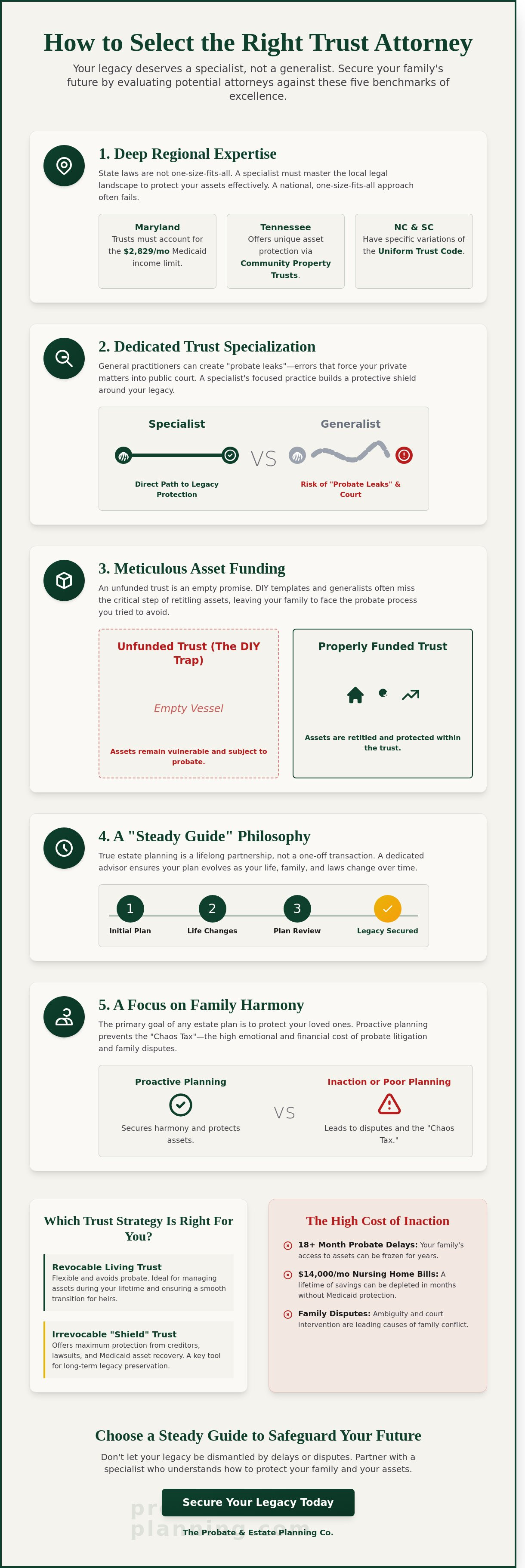
Generalists often treat estate planning as a one-off transaction. In contrast, a specialist views the process as a lifelong partnership in stewardship. This "Steady Guide" philosophy ensures that your plan evolves as your life changes. Without this specialized oversight, families often encounter "probate leaks." These occur when technical errors or overlooked assets cause a trust to fail, forcing your private matters into a public, time-consuming court process. In complex jurisdictions like Maryland or Tennessee, these leaks can drain a significant portion of an estate's value through avoidable legal fees and court costs.
To better understand how specific roles within these documents protect your interests, watch this helpful video:
The Complexity of Multi-State Estate Planning
Navigating the legal landscape of the Southeast requires local expertise. North Carolina adopted its version of the Uniform Trust Code (UTC) in 2005, while South Carolina followed with its own specific variations in 2006. These statutes aren't identical. A specialist understands how these subtle differences affect your tax exposure and creditor protection. Trust Specialization is the intersection of tax law, probate avoidance, and family dynamics. If you own property in both states, your attorney must harmonize these conflicting laws to prevent administrative chaos for your heirs.
Avoiding the DIY Trust Trap
The allure of "cheap" online trust forms often leads to expensive failures during administration. These templates don't account for the specific funding requirements of the Mid-Atlantic region. A trust is essentially an empty vessel until it's properly funded. Attorneys specializing in trustsensure that your assets, from real estate to brokerage accounts, are correctly retitled. If this step is missed, the trust remains a hollow document, and your family will still face the probate process you worked so hard to avoid. A specialist provides the meticulous attention to detail required to ensure your plan actually works when it matters most.
5 Criteria for Evaluating Trust Attorneys in NC, SC, MD, and TN
Selecting a partner for your estate plan is a weighty decision. You aren't just buying a set of documents; you're securing your family's future and ensuring your wishes are honored without conflict. When searching for attorneys specializing in trusts, look for these five benchmarks of excellence to ensure your assets remain protected.
Regional Expertise: Why Local Knowledge is Non-Negotiable
Laws change the moment you cross state lines. In Maryland, for example, the 2024 Medicaid income limit for a single applicant is $2,829 per month. An attorney must design a trust that accounts for these specific thresholds to ensure eligibility for long-term care. Tennessee offers unique asset protection through Community Property Trusts, a tool that isn't available in many other jurisdictions. Meanwhile, South Carolina's probate code has specific requirements for "informal" versus "formal" proceedings that a national, one-size-fits-all firm might overlook. If you're currently dealing with the complexities of a settled estate, you may need Probate Administration Services to navigate these local court nuances effectively.
Effective planning requires a process-driven approach to Medicaid Crisis Planning. This goes beyond the basic IRS definition of a trust, which focuses on the fiduciary relationship between a grantor and trustee. In our region, a strategic plan must protect your home and savings from the $10,000-per-month cost of skilled nursing care. Your attorney should explain the "why" behind choosing a revocable versus an irrevocable structure without hiding behind complex jargon.
The 'Peace of Mind' Test: Assessing Communication Style
Does the attorney ask about your family dynamics? A steady guide listens for potential friction between siblings or concerns about a beneficiary's financial maturity. They should be proactive. If they wait for you to ask the hard questions, they aren't leading you. For those already facing the loss of a loved one and the confusion that follows, finding Probate Administration Serviceshttps://meet.jandspllc.com/probate/that prioritize empathy can make a difficult season manageable.
Transparency in billing is another hallmark of a professional. Most attorneys specializing in trusts offer flat-fee packages for the initial creation of a plan, while hourly rates are more common for ongoing administration. Beyond the numbers, prioritize "Legacy Stewardship." This means the plan focuses on maintaining family harmony and protecting your values, not just tax avoidance. If you find yourself in the middle of a legal tangle without a clear plan in place, seeking Probate Administration Services is the first step toward restoring order for your survivors.
Comparing Trust Strategies: Which Specialist Do You Need?
Choosing a trust structure isn't just about moving assets; it's about securing a family's legacy and ensuring interpersonal harmony. Attorneys specializing in trusts help you determine which legal vehicle aligns with your specific goals. For most families, the Revocable Living Trustserves as the standard for probate avoidance. It keeps your private matters out of public courts and ensures your children aren't burdened by the administrative delays of the court system. However, if your concerns shift toward shielding assets from outside threats, you may need more robust tools.
Special Needs Trusts are vital for families caring for a vulnerable relative. These structures allow you to provide financial support for a loved one's quality of life without disqualifying them from essential government benefits like Supplemental Security Income (SSI). Conversely, Testamentary Trusts are created inside a Will and only take effect after you pass away. While they offer a level of control over how a beneficiary receives their inheritance, they don't avoid probate. This often makes them less efficient than living trusts for families seeking to minimize court involvement.
Revocable vs. Irrevocable: A Strategic Framework
For residents in North Carolina and South Carolina, the choice between these two often comes down to a trade-off between control and maximum protection. A revocable trust lets you change terms at any time. It's flexible and adapts as your life changes. An irrevocable trust requires you to give up direct control, but it creates a powerful shield against creditors and lawsuits. Timing is everything because of the 60-month Medicaid look-back period. If you transfer assets too late, you may face penalties that delay your eligibility for care. An irrevocable trust is the primary tool for safeguarding a home from Medicaid estate recovery. If you aren't sure which path fits your current wealth level, learning how to choose an estate planning attorney can help you find a specialist who understands these regional nuances.
Trusts for Medicaid and Long-Term Care
In Maryland, attorneys specializing in trusts often engage in "Crisis Planning" for families facing immediate nursing home placement. This process involves protecting the "Community Spouse," the partner who remains at home, to ensure they aren't left impoverished by the other's medical costs. Navigating state-specific agencies like the Department of Health and Human Resources (DHHR) requires a steady guide who understands the complex application process. A well-structured asset protection trust preserves your home and savings while meeting the strict asset limits required for state assistance. This methodical approach transforms a chaotic medical emergency into a manageable legal plan that prioritizes your family's emotional and financial well-being.
The True Cost of Trust Planning vs. The Risk of Inaction
Many families view the initial fee for a trust as an optional expense. However, the true cost of inaction often far exceeds the professional fees of attorneys specializing in trusts. When you choose to forego a structured plan, you're essentially opting into a "Chaos Tax" paid later. This tax is settled in court fees, lost time, and the erosion of family harmony. In the Southeast, the probate process can consume between 3% and 7% of your estate's total value. On a $500,000 estate, that represents up to $35,000 lost to administrative burdens that a trust could have avoided entirely.
A trust specialist pays for themselves by closing the gaps where money leaks out of an estate. They ensure your assets bypass the public court system, protecting your heirs from the predatory solicitors who often browse probate filings. Beyond the math, the value of a trust lies in the peace of mind it provides. It transforms a potentially volatile transition into a quiet, private transfer of stewardship.
Probate Avoidance: Saving Time and Treasury
In North Carolina, the probate process typically remains open for a minimum of one year. This delay occurs because state law requires a mandatory four-month notice period for creditors. During this time, your heirs might struggle to access the funds needed for property taxes or urgent maintenance on the family home. By contrast, a trust allows for the nearly immediate transfer of assets. You also preserve your family's privacy. Because probate is a public process, your assets and your beneficiaries' identities become part of the public record. A trust keeps your private business behind closed doors. If you're just starting to explore these concepts, you can review our Estate Planning Fundamentals for more legacy guidance.
Asset Protection: The Shield Against Long-Term Care Costs
The most significant threat to a middle-class legacy isn't the IRS; it's the cost of long-term care. In 2023, the median cost for a private nursing home room in states like South Carolina and Tennessee surpassed $8,500 per month. Without a trust, a three-year stay can entirely deplete a $300,000 life savings, leaving nothing for the next generation. Attorneys specializing in trusts use specific instruments to "stop the clock" on asset depletion, often protecting the family home from Medicaid estate recovery liens.
Many people believe they don't have enough money to need a trust. The reality is that if your estate is modest, you have less room for error. You can't afford to lose 7% to probate or 100% to a nursing home lien. A well-drafted trust isn't a luxury for the wealthy; it's a protective tool for anyone who wants to ensure their hard-earned assets reach their children rather than being consumed by state recovery programs.
Secure your family's future today by contacting our team for a comprehensive legacy review.
Choosing The Probate & Estate Planning Co. as Your Trusted Advisor
Selecting attorneys specializing in trusts is a decision that impacts your family for generations. Our firm provides regional mastery across North Carolina, South Carolina, Maryland, and Tennessee. This multi-state presence allows us to navigate specific state statutes while maintaining a unified, protective strategy for your estate. We don't just draft documents. We provide a human-centric approach that prioritizes your family's emotional well-being alongside legal precision.
We divide our practice into two essential categories to meet you wherever you are. Our "Peaceful Planning" services focus on proactive strategies that eliminate future uncertainty. For families already facing a transition, our "Crisis Management" team handles urgent Medicaid qualification and probate matters. Our "Works When Needed" Guarantee is our commitment to functional outcomes. It's a promise that your plan will perform exactly as intended during life's most difficult moments.
A Partnership in Stewardship
Our relationship begins with a discovery session, but it doesn't end when the ink dries. We guide you through the vital process of asset funding. Without this step, even the most sophisticated trust remains an empty vessel. We ensure your accounts and property are correctly titled to avoid the very probate process you're seeking to bypass. This attention to detail is what separates a document from a true legacy plan.
- Successor Support: We provide dedicated guidance to your chosen trustees so they aren't left guessing during a time of grief.
- Conflict Prevention: Our methods focus on maintaining family harmony and preventing the interpersonal friction that often leads to litigation.
- Long-term Clarity: We help you avoid family chaos by ensuring every beneficiary understands the roadmap you've created.
Next Steps: Your Consultation
Your first meeting with our trust specialists is designed to be restorative, not stressful. You don't need to have every answer ready. Simply bring a general summary of your assets and any existing legal documents you've signed in the past. We'll use this time to listen to your concerns and identify the specific protections your family requires. Whether your goals involve tax mitigation or protecting a vulnerable heir, we'll build a strategy that fits.
Within the first 30 days of our partnership, we'll implement your "Peace of Mind" roadmap. This is a structured, step-by-step process that moves you from a state of concern to a position of total control. You'll understand exactly how your legacy is protected and who will step in if you're ever unable to speak for yourself. It's about more than just money; it's about the people you love. Our attorneys specializing in trusts are ready to help you secure that future today.
Secure Your Family's Future with a Functional Plan
Your family's future shouldn't be left to chance or a generic template. Choosing attorneys specializing in trusts ensures your plan actually works when your loved ones need it most. We've seen how generalist documents fail, often leading to the 12 to 18 month probate delays common in state courts. By focusing on multi-state expertise across North Carolina, South Carolina, Maryland, and Tennessee, our team builds functional safeguards that account for specific local statutes. We prioritize Medicaid Crisis Planning to protect your assets from being depleted by long term care costs, which can exceed $100,000 annually according to Genworth's 2023 Cost of Care Survey. You deserve a plan that prevents chaos and preserves harmony. Our role is to provide the steady guidance needed to navigate these legal hurdles with confidence. It's about moving from uncertainty to a place of total security for the people you love. Taking this step now means your heirs won't face avoidable legal battles later.
Secure your family's legacy with a specialist; schedule your consultation now.
You've worked hard to build what you have; we're here to help you keep it safe.
Frequently Asked Questions
What is the difference between an estate lawyer and a trust attorney?
An estate lawyer manages broad planning like wills and powers of attorney, while a trust attorney focuses on the creation and management of complex trust structures. Think of an estate lawyer as a general architect and a trust specialist as a master of secure vaults. Attorneys specializing in trusts ensure your assets transition privately without the delays of court interference, providing a seamless bridge for your family's future.
Can a trust attorney help if my loved one is already in a nursing home?
Yes, a trust attorney can implement "crisis planning" even after a loved one enters a skilled nursing facility. In North Carolina, the 2024 Medicaid income limit for an individual is $1,242 per month, and specialized irrevocable trusts help protect assets from being entirely depleted by long-term care costs. This proactive step prevents the total loss of a family legacy to rising medical bills and state recovery efforts.
How much does it typically cost to have a trust drafted in North Carolina or Maryland?
Costs vary based on your family's needs, but 2023 industry reports show that a comprehensive living trust package in the Mid-Atlantic and Southeast regions often ranges from $2,000 to $5,000. This investment covers the trust document, pour-over wills, and healthcare directives. While a basic Will costs less upfront, a trust saves your family from the 3% to 5% probate fee typically charged on estate values in Maryland.
Do I need a trust if I already have a Last Will and Testament?
You need a trust if you want to avoid the public, time-consuming process of probate that a Will requires. A Will only takes effect after you pass away and must be verified by a court, which can take 9 to 18 months in states like Tennessee. A trust provides immediate management of your assets if you become incapacitated. It ensures your family isn't left in a legal limbo during a crisis.
What happens if my trust attorney is in one state but I own property in another?
Your attorney can draft a trust that holds property in any state, provided they follow the specific deed recording requirements of that jurisdiction. If you live in Maryland but own a vacation home in South Carolina, your trust must be funded by transferring the SC deed into the trust's name. Attorneys specializing in trusts coordinate these cross-border transfers to prevent "ancillary probate," which is a second, costly court process.
Can a trust protect my assets from a personal injury lawsuit settlement?
An irrevocable trust can protect assets from lawsuits, but a standard revocable living trust generally does not. In South Carolina, assets in a revocable trust are still considered your personal property because you maintain control over them. To shield a settlement from creditors, you must use specific "spendthrift" clauses or irrevocable structures. These legal tools relinquish your direct ownership to a trustee to ensure the funds remain for your care.
Is a revocable living trust private in South Carolina and Tennessee?
Yes, revocable living trusts remain private documents in both South Carolina and Tennessee, unlike a Will which becomes a public record after death. When a Will is probated, anyone can go to the county courthouse and see exactly what you owned and who inherited it. A trust allows your successor trustee to distribute assets behind closed doors. This maintains your family's dignity and keeps your financial affairs confidential.
How often should I have my trust reviewed by a specialist?
You should have your trust reviewed every 3 to 5 years or whenever a major life event occurs. Legislative changes, such as the SECURE Act of 2019 which altered IRA inheritance rules, can make older trust language obsolete. A regular check-up ensures your plan accounts for new tax laws and changes in your family structure. This might include the birth of a new grandchild or a move to a different state.
Comments
There are no comments for this post. Be the first and Add your Comment below.
Leave a Comment