

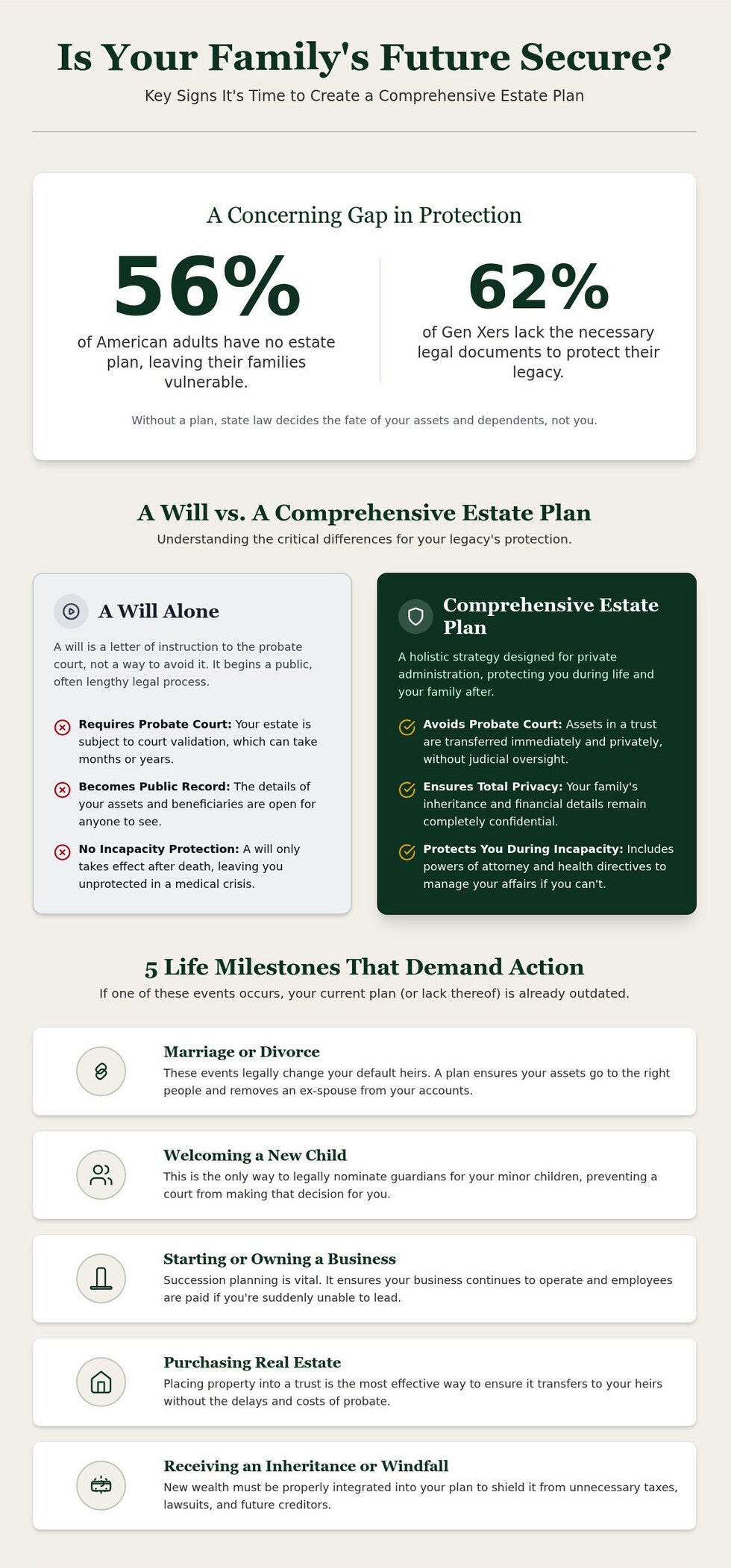
A 2026 survey found that 56% of American adults have no estate planning documents, and for Gen Xers, that figure rises to a concerning 62%. Many people delay this process because they believe it's only for the wealthy, yet the most urgent signs you need an estate plan often have more to do with protecting your family than the size of your bank account. Without a formal strategy, you risk leaving your loved ones with a complex legal mess and the frustration of probate court delays.
It's natural to feel anxious about nursing home costs or the thought of your inheritance being tied up in public filings. You want to ensure your legacy remains a source of support rather than a burden. In this article, you'll discover the life events and financial shifts that signal it's time to secure your family's future and preserve your interpersonal connections. We'll preview seven critical indicators that call for action and provide a clear roadmap to help you avoid probate in North Carolina, South Carolina, Maryland, or Tennessee.
Key Takeaways
- Understand the vital difference between a simple Will and a comprehensive estate plan to ensure your legacy avoids the delays and public nature of probate court.
- Recognize the five major life milestones—from new parenthood to real estate purchases—that are definitive signs you need an estate plan to protect those you love most.
- Learn how to navigate health-related triggers and the "Medicaid Window" to shield your hard-earned inheritance from the rising costs of long-term care.
- Identify the financial thresholds and complex assets, such as digital holdings or stocks, that necessitate precise legal instructions to prevent future family confusion.
- Follow a clear, state-specific roadmap for inventorying your assets and selecting trusted fiduciaries in North Carolina, South Carolina, Maryland, or Tennessee.
What is an Estate Plan vs. a Will? (And Why the Difference Matters)
Many people believe that drafting a Last Will and Testament is the final step in securing their future. While a will is a vital starting point, it's often just one piece of a much larger puzzle. Understanding What is an Estate Plan requires looking at your life through a wider lens. An estate plan is a proactive legal shield for both life and death. It doesn't just address what happens when you're gone; it protects you and your family while you're still here. Identifying the signs you need an estate plan often starts when you realize a simple will might leave your loved ones exposed to court interference.
To better understand the functional differences and why detailed preparation is essential for your family, watch this helpful video:
The Limitations of a Simple Will
In states like North Carolina or Maryland, a will alone doesn't bypass the probate process. Instead, it acts as a letter of instruction to the probate court. This means your estate must still go through a legal validation period that can take months or even years to resolve. Because probate is a public process, anyone can view the details of your assets and who is receiving them, which robs your family of their privacy. There's also a significant "gap" in a will. It only takes effect after you pass away. If you face a sudden medical crisis or incapacity, a will offers no protection or guidance for your care or your financial stability.
The Components of a Modern Estate Plan
A comprehensive plan moves away from court-managed processes toward private administration. It creates a seamless transition of authority and assets through several key documents. These include:
- Revocable Living Trusts: These are the gold standard for avoiding probate. They allow your assets to transfer to your beneficiaries immediately and privately, without a judge's oversight.
- Durable Power of Attorney: This grants a person you trust the legal authority to manage your bills and financial affairs if you're ever unable to do so yourself.
- Healthcare Directives: Documents like a Living Will ensure your medical wishes are honored. This takes the heavy burden of making life-altering decisions off your family's shoulders during an emotional crisis.
The primary goal of this holistic approach is to provide a roadmap for your life that stays out of the courthouse. By preparing now, you ensure that your legacy is handled with the same care and precision you applied to building it. Recognizing these signs you need an estate plan is the first step toward true peace of mind.
The 5 Life Milestones: Immediate Signs You Need an Estate Plan
Life transitions often happen in a blur of excitement or stress, but these moments are the most critical signs you need an estate plan. When your family structure or financial profile changes, the "default" rules set by state law might no longer align with your wishes. Relying on these defaults often leads to "intestacy," a legal state where the government, not you, decides how your assets are distributed and who cares for your dependents. Proactive planning ensures that your intentions override these rigid state mandates.
There are five specific milestones that should prompt an immediate review of your legal protections:
- Marriage or Divorce: These events fundamentally change your "default" heirs. An estate plan ensures your current spouse is protected or that an ex-spouse is removed from your accounts.
- Starting a Business: Succession planning is essential to ensure your employees are paid and your business legacy doesn't collapse if you're suddenly unable to lead.
- Receiving an Inheritance: With the 2026 federal estate tax exemption at $15 million per individual, new wealth must be integrated into a plan that shields it from unnecessary taxes and future creditors.
- Welcoming a New Child: This is the most urgent trigger for appointing legal guardians.
- Purchasing Real Estate: Property is often the largest asset in an estate and the most difficult to transfer through court processes.
Protecting Minor Children
If you haven't formally appointed a legal guardian, a judge who doesn't know your family will choose who raises your children. Beyond physical care, you must consider financial management. In most states, minors cannot legally inherit large sums of cash or property directly. Without a trust, the court may appoint a guardian ad litem to manage those funds until the child turns 18, at which point the child receives the full inheritance without any oversight. Establishing a trust allows you to control when and how they access these funds, ensuring their inheritance is used for education and long-term security. Exploring your options for Estate Planning now can prevent these complications for your children later.
Real Estate and Multi-State Ownership
Owning property in both Tennessee and South Carolina, for example, can lead to the "ancillary probate" trap. This requires your heirs to open separate legal proceedings in every state where you own land, which significantly increases costs and delays. A trust simplifies this by holding the title to all your properties, allowing for a private transfer across state lines without court involvement. This also helps avoid "partition sales," which occur when heirs disagree on whether to keep or sell a family home, often resulting in a forced sale that diminishes the property's value. A methodical approach to your real estate ensures your family home remains a blessing, not a legal burden.
Health Triggers: When Your Body Signals the Need for Planning
While many view legacy planning as a task for the distant future, sudden health shifts are immediate signs you need an estate plan. A new medical diagnosis or the natural process of aging into your 50s and 60s brings personal and financial risks that a simple will cannot address. It's vital to remember that incapacity planning is for the living, not just the deceased. It ensures you receive the care you want while protecting the assets you've spent a lifetime building. Without these protections, a medical crisis can quickly turn into a legal and financial one.
Aging into the "Medicaid Window" is a strategic time for asset protection. In states like Maryland and the Carolinas, the 5-year lookback rule means the government examines your financial transfers for the sixty months preceding a Medicaid application. If you wait until a crisis occurs to move assets, you may face penalties that leave your home and savings vulnerable to nursing home costs. Proactive preparation allows you to shield your home and preserve an inheritance for your children before the clock starts ticking on a medical emergency.
Medicaid Crisis Planning
When long-term care costs begin to exceed your monthly savings, the emotional and financial toll can be overwhelming. Many families believe they must "spend down" their entire life savings to qualify for assistance, but this often leaves a healthy spouse with little to live on. Through strategic Medicaid crisis planning, you can navigate these complex regulations to protect a spouse's standard of living. This approach prioritizes strategic asset protection over total depletion. It ensures your most important interpersonal connections remain the priority during a difficult transition rather than administrative hurdles.
Living Wills and Healthcare Directives
Defining your end-of-life wishes is an act of kindness for your family. It removes the agonizing burden of making life-sustaining decisions from your children or spouse during a period of intense grief. A Healthcare Power of Attorney and a Living Will allow you to name a healthcare proxy. This role is particularly significant in Maryland and the Carolinas for ensuring your medical preferences are legally binding and respected by hospital staff. These documents ensure your doctors and family are on the same page. This clarity provides a predictable and respectful outcome for your care, allowing your loved ones to focus on support rather than legal confusion.
Financial Signs: Asset Protection and Tax Mitigation
Financial growth often happens gradually, yet it eventually reaches a point where standard accounts and simple beneficiary designations are no longer sufficient. One of the clearest signs you need an estate plan is when your financial footprint expands beyond basic savings. While the 2026 federal estate tax exemption is high at $15 million per individual, state-level considerations and administrative costs remain significant hurdles. For instance, residents in Maryland must navigate a state estate tax with a much lower $5 million exemption. Failing to account for these state-specific rules can result in a significant portion of your legacy being redirected to taxes and court fees.
Complexity in your asset portfolio also demands a more sophisticated approach. If you own "complex assets" such as stocks, cryptocurrency, or intellectual property, a simple will often fails to provide the specific technical instructions required for a smooth transfer. Digital assets, in particular, can become permanently inaccessible without a structured plan. Additionally, if you have charitable goals, a formal plan allows you to leave a lasting legacy for a non-profit while potentially providing your heirs with tax advantages. Privacy is another major factor. Because probate is a public process, your financial affairs become part of the public record unless you use private administrative tools.
Avoiding the Probate "Tax"
Many families are surprised to learn that probate fees are often calculated based on the gross value of the estate, rather than the net value after debts are paid. This means the "tax" of probate can be thousands of dollars even if you still owe money on your home or business. Using an irrevocable trust or a revocable living trust allows your assets to bypass this expensive process entirely. The time savings are equally important. While the probate process in states like North Carolina and Tennessee typically takes 9 to 18 months to resolve, assets held in a trust can often be settled and distributed in just a few weeks.
Protecting Assets from Creditors and Lawsuits
Asset protection planning is a vital safeguard for professionals in high-risk industries or those who want to ensure an inheritance stays "in the family." If a child receives an inheritance directly and later goes through a divorce, those assets could be subject to division. A well-structured trust protects those funds from a beneficiary's creditors or legal disputes. Furthermore, if you've received a personal injury settlement, integrating those funds into your estate plan ensures long-term security and prevents the settlement from being depleted by mismanagement or medical liens. You can secure your financial future today by exploring Asset Protection Planning to ensure your hard-earned wealth remains exactly where you intended.
How to Start Your Estate Plan in NC, SC, MD, or TN
Once you recognize the signs you need an estate plan, the path forward requires a methodical and patient approach. Transitioning from awareness to action ensures that the protections we've discussed, such as avoiding probate or securing a child's future, are legally enforceable. This process isn't just about paperwork; it's about building a partnership in long-term management that adapts as your life changes.
Follow these five steps to establish a reliable foundation for your legacy:
- Step 1: Inventory your assets. Create a clear list of your real estate, financial accounts, and complex assets like digital holdings. Identify your primary protection goals, such as shielding a home from nursing home costs or providing for a minor child.
- Step 2: Choose your fiduciaries. Select the individuals you trust to serve as your executor, trustee, or healthcare agent. These people will make critical decisions on your behalf during sensitive transitions.
- Step 3: Consult a professional. Partner with a multi-state estate planning law firm to ensure your documents comply with the specific statutes of your home state.
- Step 4: Draft and execute core documents. This includes your Revocable Living Trust, Last Will and Testament, and Durable Powers of Attorney.
- Step 5: Commit to regular reviews. Your plan should be a living document. Review it every three to five years or immediately following major life events like a birth, death, or relocation.
Finding the Right Legal Partner
It's tempting to use "DIY" online forms to save time, but these templates often fail in probate court. Each state has unique signing requirements and witness rules. A document that's valid in Tennessee might face challenges in Maryland if it wasn't executed with precise attention to detail. Working with a firm that understands the nuances of North Carolina, South Carolina, Maryland, and Tennessee provides a level of functional reliability that software cannot match. During your initial consultation with a probate administration lawyer, you'll receive a private assessment designed specifically for your unique circumstances and long-term goals.
Maintaining Your Plan
The most critical step many people forget after signing their documents is "funding" their trust. A trust is like a protective safe; if you don't move your assets into it by changing titles or beneficiary designations, the safe remains empty. Without proper funding, your estate may still end up in probate despite your best intentions. Additionally, take the time to communicate your plan to your family. While you don't have to share every financial detail, ensuring your fiduciaries know where to find documents and understand your wishes prevents confusion and conflict. This steady, proactive approach provides the ultimate peace of mind, knowing that your most important interpersonal connections are preserved.
Securing Your Legacy and Your Peace of Mind
Protecting your family requires moving beyond the administrative basics of a simple will. By recognizing the signs you need an estate plan, you've already taken a vital step toward safeguarding your interpersonal connections and your hard-earned assets. Whether you're navigating the complexities of multi-state property ownership or preparing for the "Medicaid Window," a structured plan ensures that your wishes remain the priority, rather than the rigid mandates of a probate court.
Our practice offers a partnership in long-term management, providing the steady guidance you need to navigate these sensitive transitions. With specialized expertise in Medicaid crisis planning and a deep understanding of the laws in North Carolina, South Carolina, Maryland, and Tennessee, we help you steer toward a predictable and secure outcome. Schedule a consultation with our estate planning team today to receive compassionate, mentor-led legal guidance tailored to your unique circumstances.
Taking this step doesn't just manage tasks; it preserves your family's future. You've worked hard to build your life, and you deserve the confidence that comes with a professional, protective legal shield.
Frequently Asked Questions
Is an estate plan only for the wealthy?
No, an estate plan is a protective tool for anyone with assets, dependents, or specific health concerns. While high-net-worth individuals use these documents for tax mitigation, most families use them to appoint guardians for minor children and ensure assets bypass the public probate court. If you own a home or have life insurance, these are primary signs you need an estate plan to avoid leaving a legal burden for your loved ones.
What happens if I die without an estate plan or a will?
If you pass away without a plan, your assets are distributed according to the "intestacy" laws of your state. This means a judge, following a rigid legal formula, decides who inherits your property and who cares for your children. This process often ignores your personal relationships or specific wishes, potentially leaving your family in a prolonged and expensive legal conflict during an already emotional time.
How much does a typical estate plan cost in North Carolina or Maryland?
The cost of an estate plan varies based on the complexity of your assets and your specific protection goals. A plan involving multiple trusts and Medicaid crisis planning requires more detailed preparation than a basic set of documents. While we don't provide fixed pricing without a consultation, investing in a professional plan often saves families thousands of dollars in future probate fees and court costs.
Can I write my own estate plan using an online template?
You can use online templates, but they often fail to account for the state-specific signing requirements in places like North Carolina or Maryland. A small clerical error or a missing witness signature can make a document invalid, forcing your estate into probate despite your efforts. Professional guidance ensures your plan is functionally reliable and legally binding under the specific statutes of your home state.
How often should I update my estate plan?
You should review your estate plan every three to five years to ensure it still aligns with current laws and your personal goals. Major life milestones, such as a birth, marriage, divorce, or a significant change in your financial status, should trigger an immediate update. Keeping your documents current ensures your protections remain effective as your family and the legal landscape evolve.
Does an estate plan help me avoid inheritance taxes?
Certain estate planning tools can minimize or eliminate tax liabilities for your heirs depending on where you live. For example, in 2026, the federal exemption is $15 million, but Maryland has a much lower state-level exemption of $5 million. Strategic planning through trusts can help manage these thresholds and protect your legacy from being diminished by state-level estate or inheritance taxes.
What is the difference between a Healthcare POA and a Living Will?
A Healthcare Power of Attorney names a specific person to make medical decisions if you're incapacitated. A Living Will provides specific instructions regarding the types of medical treatments you do or do not want, such as life support. Using both documents together ensures that your trusted representative has a clear roadmap to follow during a medical crisis, removing the burden of guesswork from your family.
Will my estate plan still work if I move to a different state?
Most estate plans are legally recognized across state lines, but they should be reviewed by an attorney in your new state. Laws regarding probate and healthcare directives vary significantly between states like Tennessee and South Carolina. A local review ensures your documents meet specific state requirements and that your fiduciaries can act without procedural obstacles in your new jurisdiction.
Comments
There are no comments for this post. Be the first and Add your Comment below.
Leave a Comment